Montréal Contre-information

mtlcounter-info

Jul 012012
 

Download

A few reflections on the GAMMA squad

Word on the street is, there’s a new police squad in Montreal called GAMMA – short for “Guet des activités et des mouvements marginaux et anarchistes” – whose goal is to investigate and repress anarchist and marginal movements. The following is a series of reflections on this development from a few anarchists. Needless to say, it’s not meant to be representative, but is rather our own analysis of this situation, and can hopefully stimulate some discussion amongst our various circles.

We understand the GAMMA squad to be a sign of the state adapting its strategy not only to an increasing amount of attacks against it, but also to a broader context of increasing austerity, and therefore of potential rebellions to come. Its ultimate goal, of course, is the maintenance of social control, necessary for the preservation of this system.

Why GAMMA?

The new squad is part of the “Specialized Investigations” division of the SPVM, which is the umbrella group that has organized crime as one of its focuses. Taking a cue from how the police investigate street gangs, mafia, and the bikers, GAMMA has a mission to profile and accumulate information on the actions, interests, and lifestyles of people considered anarchist or marginal, and so specifically targets anyone who questions the dominant social order.

Why, then, a specialized squad to target anarchists? There are several reasons that we can think of. One the one hand, this is the state’s attempt at shaping the discourse around anarchist ideas and actions. By using the media to single out anarchists, the state tries to personify the anarchist as a dangerous terrorist and asks the population to become pre-emptive snitches in order to protect themselves from this supposed menace. An example of this sort of discourse put into practice is the citizen-snitches during and after the English riots this August, organizing vigilante squads, taking cell-phone photos, and calling in toll-free numbers to denounce the rioters. In casting the anarchist as “the dangerous other”, the specter of GAMMA hopes to draw a clear dividing line between those who are anarchists and will therefore be criminalized, and everyone else (who presumably doesn’t want to be criminalized) – a sort of classic divide and conquer, separate and box in. This is meant to discourage everyone else from getting any ideas about rebelling themselves, of identifying with the rebels, because they just may. Because in reality this line is a blurry one, and the desire to fight this social order is by no means unique to “the anarchists”, so in doing this the state is attempting to paint a line over already stormy, ever-shifting waters.

By creating a squad with this intention, the state is contributing to the maintenance of social control that capitalist society needs in order to function. In fact, it is physically impossible for the police to be everywhere at once – they can’t be everywhere all the time. They can try to get around this fact by installing all sorts of other technology of control – surveillance cameras on every corner, wiretapping phones, mapping out networks through facebook and twitter, store anti-theft detectors, ID cards, biometrics, collecting people’s DNA, x-ray machines at customs, flying drones over borders, the threat of prison – but the key element of social control is our own internalization of it, ie. the cop inside our head. It is the residue of the fear that they create. In the end, police squads like GAMMA accomplish as much through the ghost of their possible presence, as through their actual physical existence.

Of course, there is also a material logic to the creation of GAMMA. It appears to be a bureaucratic re-organization of police forces in order to more efficiently collect and process information about our struggles. They are focusing on anarchists and consolidating their databases to try to better understand patterns and draw links between distinct events.

Repression more broadly, and a rejection of the discourse of “rights”

GAMMA can only be understood by looking at the role repression plays more broadly. Repression has always been an integral part of the functioning of the state. Every state has at its foundation the monopoly on organized violence which it expresses through its laws, its police and its prisons. It therefore isn’t surprising to see the police trying to repress a struggle that has as its honest intention the total negation of the state.

Likewise, political profiling has always existed. Liberals like to boast about how we have freedom of speech, and that other one – freedom of thought. As long as ideas remain exclusively in the realm of just ideas, we have these “freedoms”. As soon as people start to put their ideas into practice, however, and when these challenge the dominant social order, repression suddenly makes itself felt and these freedoms fade into a quickly distant memory, echoed in the walls of the Toronto East detention centre, in Pinochet’s torture chambers, in the ruins of Warsaw, and in the sandy cemeteries of Afghanistan.

The rights that constitute this democratic state are compromises that are offered us in exchange for the maintenance of social peace (ie the absence of rebellion) and our obedience in the face of this system of misery. Within the discourse of rights is implicit the need for the police, the laws and the state to exist, to protect them. In reality, however, as soon as state power is threatened, rights rapidly disappear. To quell the uprisings in England, the government imposed a state of exception. Prime Minister Cameron ordered the police to use all the tools at their disposal in order to reestablish order – to do whatever it takes. The law was on their side. As soon as order was transgressed, democracy turned tyrannical. It started to look like scenes from a science fiction movie. The police symbolized the limits of the possible.

In our context, rights are often invoked in a moral way, a mythology to which people can refer to, the glorious constitution and such. We argue that rights are a concept that can, like all language, change its meaning, application, and intentions, and can be used or let go by the state depending on circumstances, as convenient. In building a serious struggle against the state, then, banking solely on our rights and throwing our lot in with that concept is a form of insanity. We need something else.

Democracy and fascism are two sides of the same coin, and it flips based on the social, political, geographic and economic context.

Repression in the austerity era

And the context is changing. We’re now full on in the era of austerity. Everywhere in the world, states are cutting their social and public sector policies, as well as their spending on public health, education, and social welfare. In order to deal with the current global financial crisis, the welfare state, established after the Second World War, is now being drawn back, with increasing privatization of whatever remains. By cutting social measures the State is also preparing to face the revolts of an increasing number of those exploited or excluded completely from the system, many of whose labor power has become redundant and who teeter around the service economy, trying to ink out a living. Austerity is the engine that is influencing the changing face and form that repression takes. Meanwhile, a real rage is simmering under this surface, and there are always those who chose to fight for freedom and for the destruction of this prison world that envelops us.

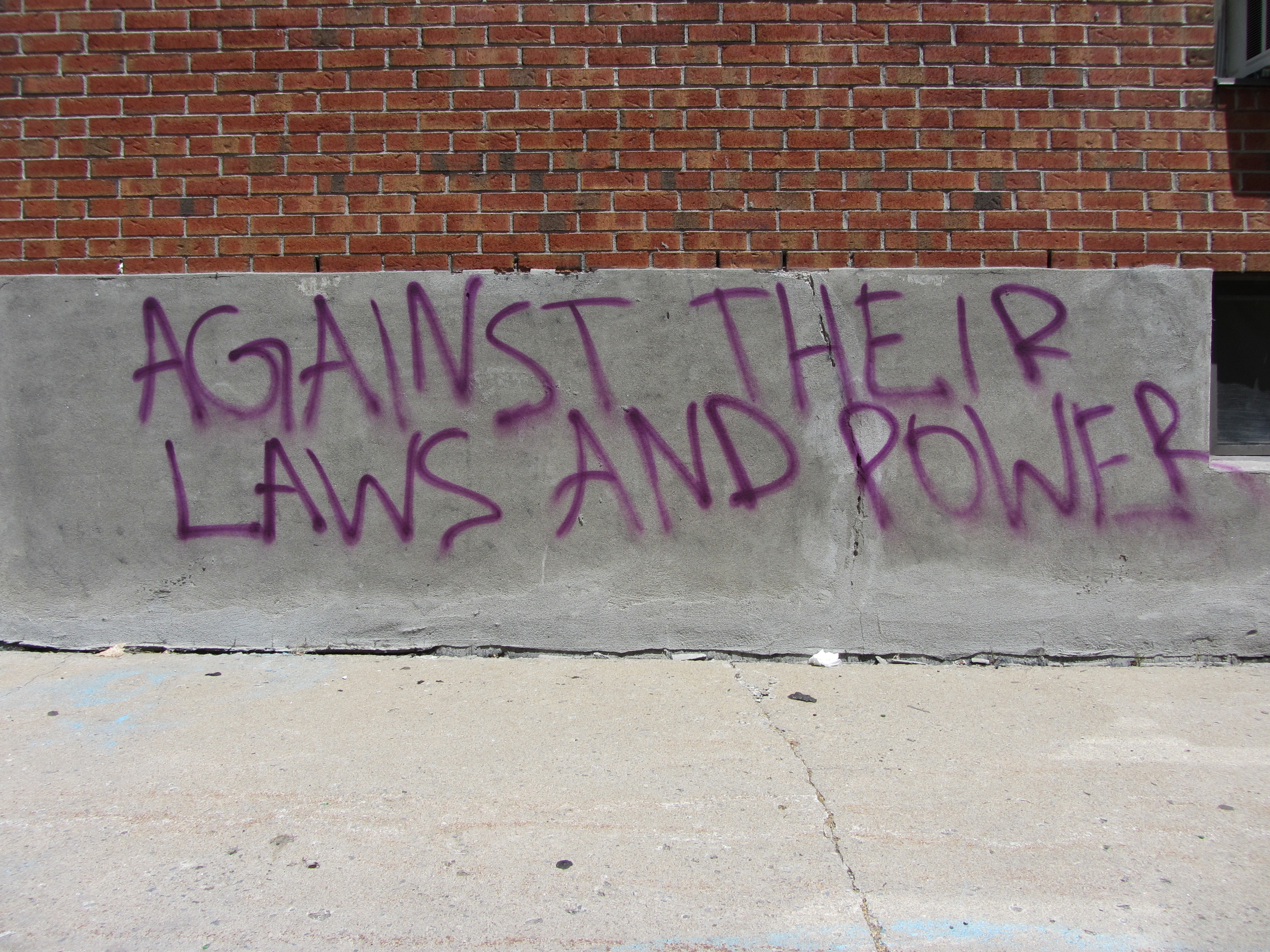
As anarchists, not only are we not surprised by these developments, but we refuse to hide behind the veil of justice to claim our innocence. What role does innocence play in a struggle anyway? For us, the courts are not the terrain of struggle on which we can win this war, even though we may have victories here and there. We refuse to use the discourse of the courts. In a world based on exploitation and misery, our desires for total freedom will always be criminal. The law’s main function is the maintenance of this system. Our struggle is against capital and the state in its entirety, and against all manifestations of this in our daily life, against the police and other forms and institutions that serve and reinforce the state’s power and control. As our struggles grow, develop, and intensify, it is not surprising that they will try to respond with greater repression.

How can we respond?

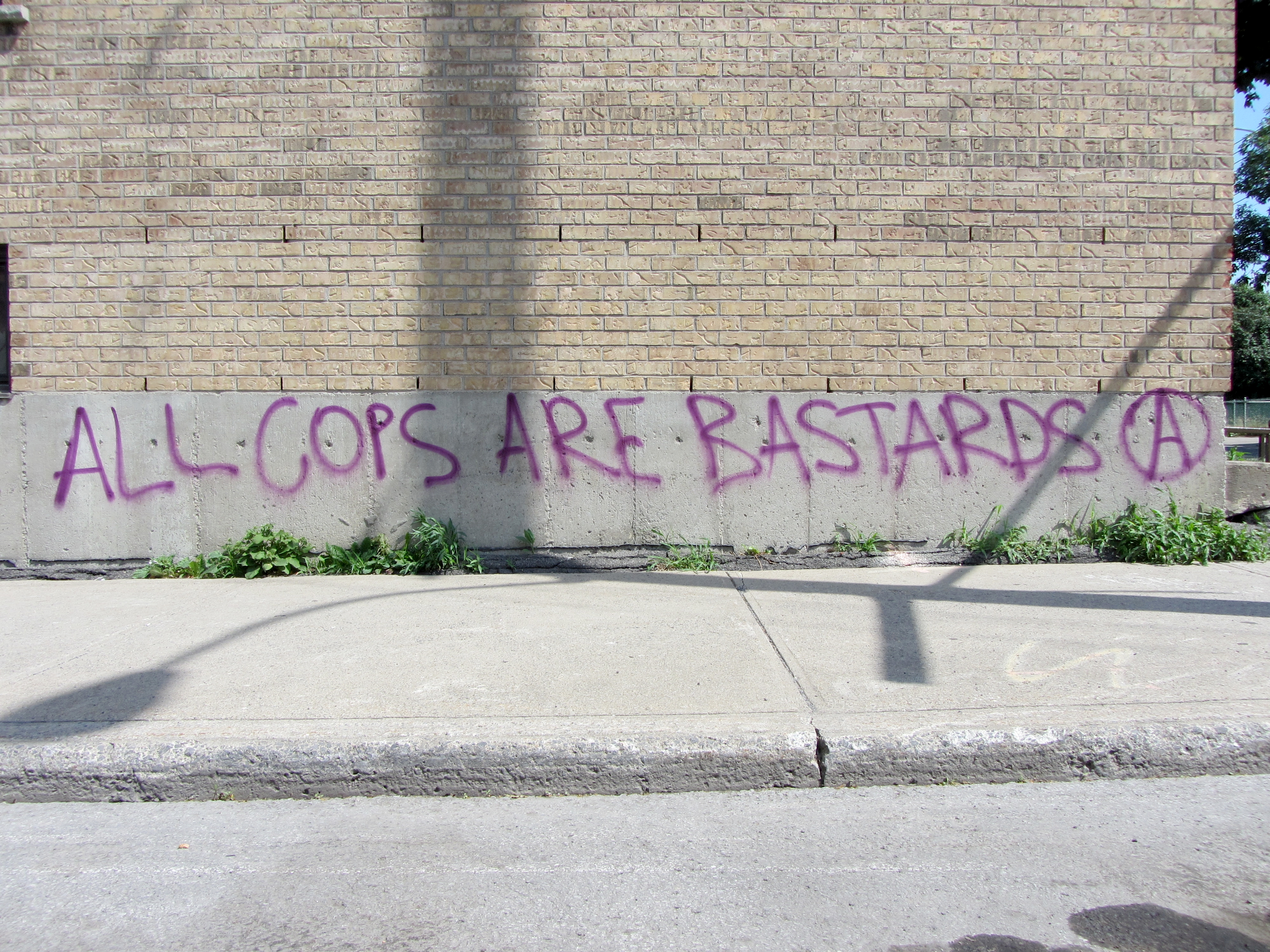
The question is, then, how do we respond? How many people hate this system? How many hide their rage, feeling isolated and alone? A world that needs prisons isn’t ours. Each pig is a symbol of rational domination over the body. Because we imagine a million other possible ways to live, and we have dreams, we refuse to bow our heads in front of the social order and its laws. Our power lies in the fact that we are not the only ones who are suffocating in this and who choose to fight it. The state’s control over our lives grows proportionally to the increase in people’s general sense of alienation. In the city, urban planning leads to a mapping of every inch of space, where there are less and less places to hide. Capital wages war on us by appropriating every centimeter of our space, every muscle of our bodies and the ideas in our heads. If we refuse to be colonized by this, we must find ways to fight it. We’ve made the choice to be in active conflict, together, in the face of this system rather than waiting in front of the television hoping that this system will collapse on its own. If the rioters of London, or those of the ghettos of Paris, or Egypt, or Greece, chose to take their lives into their own hands, we are surely capable of doing the same.

Now is the time to find each other as comrades in struggle, to self-organize. We need to create the things we want to see ourselves, because nobody will do it for us. We need to develop our practices in terms of communication, creativity, and conflictuality. The gap between ideas and action is really not that wide at all.

Now is also a time to work out our differences, and build a critical solidarity with each other, not letting the state tear us apart over petty conflicts. This doesn’t mean that we should erase our differences, or that we all have to work together, but we can still support each other.

Finally, we should be careful not to get cornered, or to get stuck in a war of attrition against the police. If we remain few, we will eventually lose. The repressive strategy of the Canadian state, similar to France, US, England and other dominant countries, is based on the theory of permanent counterinsurgency. This means that they must try to repress each social struggle in its infancy, before it has had a chance to grow or reach a certain critical mass.

Our greatest strength, then, is not our passion, nor our rage, nor even the sharpness of our revenge, but rather the possibility that our ideas and practices will spread to the powder keg that is this fragmented society.

Jun 282012
 

Download

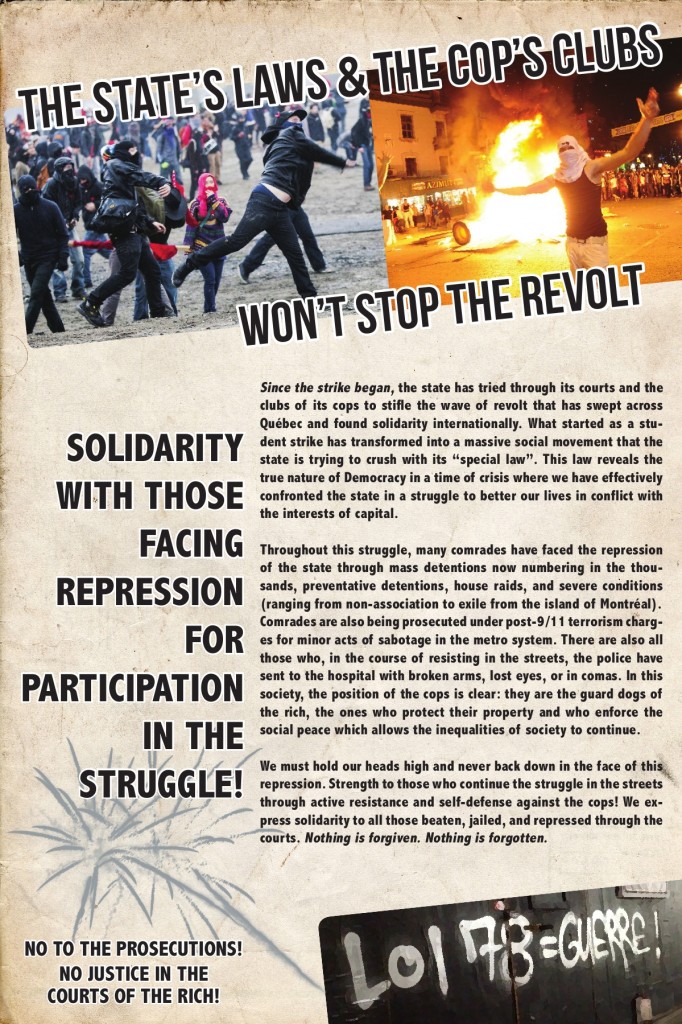
On Friday, May 18, 2012, two new laws came into effect in Montréal. Their purpose is to stifle the anti-capitalist revolt that has grown from the more-than 100-day-old provincial student strike. The first is the municipal by-law that forbids the wearing of masks during any demonstration with the penalty of a $1000 -$5000 fine (additionally, if the Federal government’s proposed law comes into effect, wearing a mask in a ‘riot’ could result in up to 10 years of prison). The second is the provincial government’s Special Law (Loi 78) that requires any public demonstration to submit itself to meticulous control by the police to avoid being declared ‘illegal’. Any leader, spokesperson, or rank-holding member of a student association that blocks access to classes or counsels others to do so will be subjected to a fine ranging between $7000 and $35,000.

While these laws may be shockingly harsh, their appearance is not a shock in itself. Throughout the course of this struggle the state and its police force have already taken eyes, broken arms, shattered jaws, and put people into life-threatening comas. Yet thousands of us still fill the streets day after day, hoping to maintain a struggle with teeth. These laws are the logical outcome of a situation that has surpassed the control of general assemblies, student federations and government authority. Loi 78 has been declared ‘anti-democratic’ by legal groups such as the Québec Human Rights Commission and the Bar of Québec. Yet we know the government will do what it wants. Democracy and the liberties often associated with it are fed to people in times of social ‘stability’. These laws show that as soon as we step out of line and create ‘unrest’, authoritarian repression strikes. The state of emergency is always around the corner, waiting to impose more control over our lives in the moments when we start to truly live them.

Laws, bureaucracy, and police came before democracy; they function the same way in a democracy as in a dictatorship. The only difference is that, because the right to vote exists, we’re supposed to regard them as ours even when they’re used against us. Democracy presumes that all power and legitimacy is vested in one decision-making structure, and it requires armed bodies (the police) to regulate, to control, to enforce these decisions. Knowing this, we fight for true liberation, not just a less-shitty politician in the same oppressive power structure.

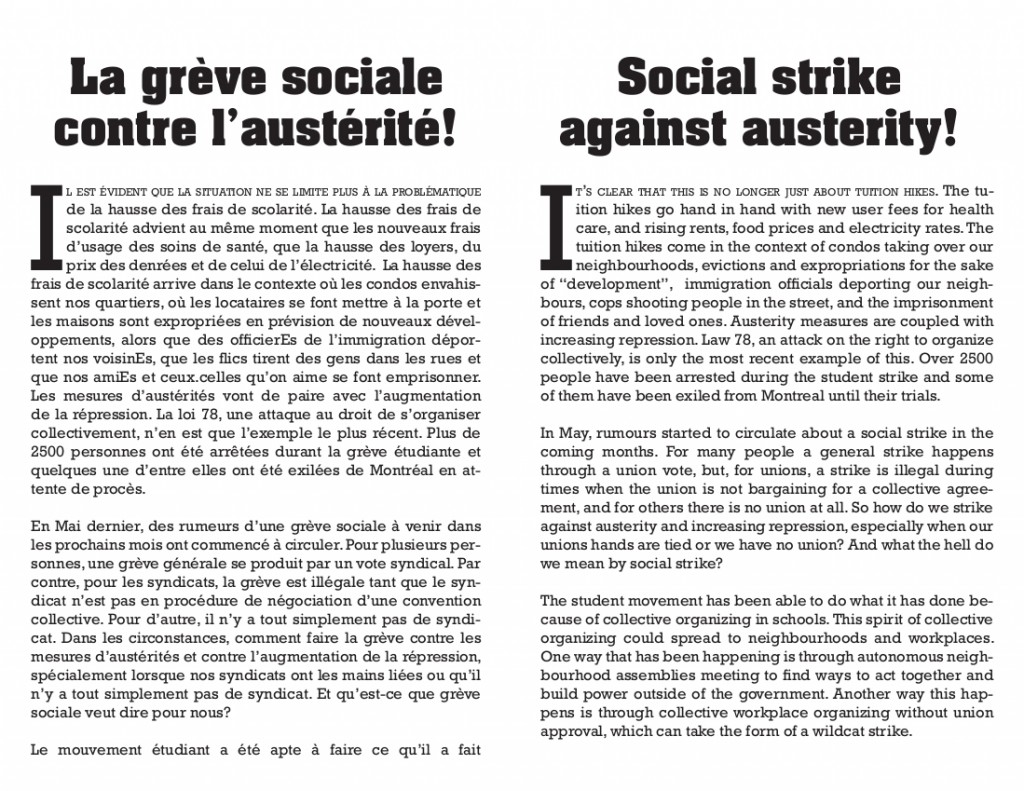
Resistance must spread, evolve and continue indefinitely. We have watched the situation transform from a limited strike with reformist goals to a generalized revolt with revolutionary aspirations. It is not just about tuition fees. This system that increases the cost of education is the same that cuts pensions and welfare in the name of austerity, turns forests to concrete and lakes to oil spills in the name of progress and industry, kills entire communities in the name of security and patriotism, and views lives as expendable in the name of profit. Capitalism and the state must be combatted in many ways.

Banging pots and pans in our neighbourhoods every night at 8pm is one way to do so, as well a way to build neighborhood cultures of resistance and start to form social relations outside the walls of isolation built by this society. But we must remember that power does not concede when simply asked. Even Finance minister Raymond Bachand approves of these casseroles demos, stating that they are festive and ‘send the right message’. In an effort to divide us into ‘good protestor’ and ‘bad protestor’, he wants to keep people’s participation pacified and business-as-usual continuing in the city. But we know that diverse and confrontational tactics will not only empower us to begin to act in this world on our own terms, but also to create a force to be reckoned with…

A force the state can no longer ignore!

Jun 212012
 

Download 8.5″x11″(bilangue) (francais)

“The law, in its majestic equality, forbids rich and poor alike to sleep under bridges, to beg in the streets and to steal bread.” Anatole France

“Violence was the law, and with the cannons in the hands of the whites, the law was white.” Sunera Thobani

The social struggle in Quebec, grown out of a student movement against tuition, has inspired many. But perhaps the central issue causing people to take the streets with pots and pans across the country is Bill 78, known as the ‘special law.’ It criminalizes demonstrations not approved by police and imposes heavy fines for political activity on school campuses. It has been accompanied by a crackdown that has seen more mass arrests than the FLQ Crisis of 1970, at last count over 2,500.

But the special law is not special. It is a predictable response to a special mobilization, a struggle that is unprecedented in its size, popular support and ferocity in recent Quebec history. In Ontario, we got a taste of ‘special law’ in 2010 at the G20 Summit, where government and police collaborated to create a ‘no-go zone’ around the security fence protecting G20 leaders. Rights were thrown out the window as downtown Toronto was transformed into a police state. Middle class white people were especially outraged, and will have their day in court now that the threat has temporarily subsided. But for people already criminalized under this system, this only represents an intensification of an everyday experience of targeted harassment. We see this same process happening in long-term ways on a federal level, with sweeping crime bills and specific laws aimed at pre-empting dissent, such as the anti-mask law with penalties of up to 10 years in prison.

This is about the interests of government and capital, not the evil conspiracies of Charest or Harper.

If we exceptionalize Bill 78, we ignore the fact that the law is a set of tools and weapons governments use to entrench the interests of the powerful, control and regulate the general population, and wage war against the ungovernables. The Canadian state is founded on the genocidal conquest of indigenous nations and land, and concessions such as the Charter are desperate attempts to create legitimacy where there is only a ruthless violence underpinning ‘Canada’. So we shouldn’t be shocked when we see these same rights instantly evaporate in a ‘crisis’. And in these times of social upheaval and economic austerity, we are approaching perpetual crisis.

Focusing on a particular law or appealing to rights risks going on the defensive and getting drawn into a conversation with our enemies. It paints the movement as powerless victims. We should be inspired to action not just by images of police brutality, but also by images of masked rebels chasing riot police. Now is the time to build our grassroots power, prepare for repression, support those targeted by the state, but most importantly to go on the offensive.

LA LOI SPÉCIALE – ON S’EN CALISSE!
NO PRISONS – NO BORDERS – FUCK LAW AND ORDER!

Jun 212012
 

Download 11″x17″

WORK IS WAGE SLAVERY

PROPERTY IS THEFT

The history of the economy is the history of theft.

Look at the piece of land you’re standing on. It was once tended by people who knew how to provide for themselves and their communities without destroying the environment. The possibility of dignified life and work was killed by the governments and land owners who organized colonizing armies and brought over labour gangs of indebted European immigrants and kidnapped African slaves.

In both cases, we see the pattern of forced dependence. People who were actually working in a dignified way – which is to say, for themselves, for their communities, at their own pace – were prevented from doing so through the organized violence of colonisation. Land that had belonged to everyone was divided up and usurped by the elite, the ancestors of many of those who are still wealthy today. Even after colonization, labour was little more than a tax. Give up a certain amount, more if you were black and less if you were white, and keep the rest to feed yourself. You could at least still see the product of your labour, and nourish yourself with it.

But then something happened. Slavery gradually ended – not in a sudden moment of liberation, as the history books tell it, but through a gradual shift towards the more profitable system of wage slavery. While no longer forced to work at gunpoint, the end

result is the same with all of the means of survival out of reach without money; people are forced to work, spending their time in the service of capital. Prisons and police await those who disobey. No one was liberated. Rather, black and white were transformed into machines.

Where’s the use in outright slavery when the bank can own your house, the boss can own your time, the collection agency contracted by the credit card company or the National Student Loans Centre can own your future, fashion companies can own your insecurities, Hollywood producers can own your heart, and the newspapers can own your mind? The daily life of a worker-consumer only consists of scrambling around to appease her owner’s needs.

The factory system makes workers a part of the process. The service sector jobs of today go even further, making demands of our very moods. No longer do we owe our bosses merely a certain amount of product, or even a certain amount of time, but a measured quantity of enthusiasm. Service with a smile. Who can imagine a more intimate form of violence? We’re not even allowed to be depressed by our total lack of power over our own lives. Already by the age of five, the sullen and the impatient ones are screened out for Prozac and Ritalin prescriptions. Kids diagnosed with disorders are often suddenly “cured” when they are allowed to organize their own lives, or determine their own rhythms. But once the needs of the economy send them back to work, back to school, suddenly they relapse and have to go back on pills.

The disorder is the society that sends bodies through a meat grinder, that demands we become interchangeable parts. The blackmail is the society that demands everything from us – not just our time, our obedience, and our energies, but also our friendliness and good faith – and gives us nothing in return but the means to participate in it more fully, on its terms, spending our meager wages on resources stolen from across the entire planet; the right wardrobe, the right diet, the right music collection. In fact, this careful assemblage of mass-produced goods is the only legal way we have to express our individuality.

At the base, those who extol the virtues of work are the same old blackmailers: work for us or starve in the gutters. But once we begin negotiating those who call themselves leaders, they only start to make more demands of us. Let’s not negotiate with the world of work and misery that we desire only the end of, but attack it in order to destroy it…

While misery exists, we choose rebellion.

Jun 212012
 

Download 11″x17″

Social War

A war is already being waged against us daily by the state and capital , by the miserable roles of submission imposed on us, by the police and their prisons. A rotten social peace is enforced to conceal that people fight back against exploitation and domination. Social war means making this war two-sided.

Social war means us against the state. The existence of this war is the best-kept secret of our civilization. Naming it is the first act of rebellion, the first step towards claiming control over our own lives.

We thought it was a one-sided war – waged by Authority, against us. We thought we had no hope but to ignore it, to make this misery a little more tolerable. We hoped it would pass us by. But it’s only encircling us, tighter and tighter, watching our every move while offering us a million more ways to buy into the system, to participate in our own domination. And most do participate, first of all by shying away from admitting that the war exists. They’ll talk about change, about politics, about reform, about corruption, but they will never talk about war unless they mean something happening far away. Because to admit the existence of the war waged against us is to admit that there is a line that divides acting for freedom or collaborating with the system and that the two cannot be reconciled. If we see that we are not fighting back, then we would have to admit that we have surrendered. That we have already been defeated. But just because we’re not free does not mean we are powerless. In fact, the rampant surveillance sends an obvious message: the state is afraid of our ability to realize it as an enemy, and to act on our desires to put an end to it. Because we will never be powerless. We have the power, the responsibility, to fight back.

The war waged against all of us can become a social war as we join together to fight against those who have stolen our lives, broken up our communities, poisoned our world. By declaring war, humankind can rise from its grave. Because for too long, we have been fleeing the catastrophe of our original defeat, through the wreckage of generations piling high enough to block out the sun – exiled into a future grown nightmarish with the lack of possibility. The state of affairs that pretends to be something complete – a perfected civilization which we can only sit back and accept – actually demands that we make a choice: fight against it, or surrender to it.

Many people are already fighting, all over the world. We are fighting in whatever ways are available to us. Destroying the system bit by bit, whether by burning a bank or sabotaging an oil pipeline. Overcoming the alienation that constitutes our invisible prison bars, by taking to the streets to riot together or talking with our fellow workers and organizing a collective force against the power of the bosses. Deserting and disobeying all the rules written against us, by squatting and stealing for our survival, refusing military service, rejecting the roles we’re assigned, as good worker, good student, good citizen. Rewriting the usual endings; by supporting prisoners rather than letting them disappear in isolation, by beating up rapists and homophobes rather than suffering their violence, by creating forms of love that only strengthen us rather than containing and limiting us. Taking control over our surroundings by painting graffiti on the walls or occupying space and planting gardens. By arming ourselves with the ability to create a new world and destroy the one that has been imposed on us.

We don’t expect you’ll pick up this fight, not right away, because to be honest about your place in the world and take action means to declare war against your life support system, to attack the chains that confine you but also keep you safe, dangling above the abyss that the system has dug out of our lives. To choose your own side in the social war is to jump into that abyss. But unless we want an existence based on subservience, it is our only choice; there is, after all, a difference between life and survival. And as soon as you take the plunge, you might find there are others who have your back, others who will fight alongside you. You might know what it means to break the alienation that defines this society, to finally have some control over your life.

Until then, keep your eyes open. Don’t believe the lies they tell about us. You may think that by fighting back, we are being irresponsible but we know very well the consequences of our actions. Each of us face down the possibility of repression from the state; of a prison cell or, in time, a concentration camp awaiting us. We continue to fight, because we are in love with all the possible worlds that are not allowed to bloom. You may think we are the ideological, cold-blooded monsters they say we are, but hear how loudly the blood rushes through our hearts. Calculating people would not enter this fight, because we have such a seemingly small chance of winning. The cold, calculating ones are those who become politicians. If there is a choice between cynicism and hopelessness or a determined and focused attack on the present systems of domination, as anarchists, we choose the latter…

We continue fighting, because we hate all authority, and love freedom, which cannot be given, but must be taken.

Jun 212012
 

Download 11″x17″

FIRE TO THE PRISONS AND THE WORLD THAT NEEDS THEM

Prison is nothing more than a reflection of the society in which we live. Our society resembles a great open-air prison; with the threat of starvation if you don’t spend your energy on meaningless work for capitalism, with cameras on every corner, with the police intimidating and murdering in the streets like the jailers do to those locked in cages, and with borders drawn by our rulers serving as walls. The inside and outside of prison only differ in their degree of intensity, but both are based on domination, alienation, and control.

The state is not interested in reducing crime, but in increasing social control. Decent imprisonment, like a humane capitalism, does not exist. Imprisonment – being held hostage by the state – is a reason in itself to rebel against jailers and their barbed wire. Just like on the street, there are people in the prisons, psychiatric institutions, and detention centres who do not come to peace with their conditions, who do not bury a certain taste for freedom just because a judge decides that they will live in a cage. Within these walls, there are those who refuse the daily humiliation of obeying the guards, for whom the walls and the barbed wire are not yet seared into their brains, and who rather observe them as obstacles that have yet to be overcome. The punishment that the judge imposes upon them is a consequence of a world that is based on exploitation and obedience, a world that would not function without the constant threat of prison for those who choose to not submit to the misery surrounding them.

Waves of revolts, riots, and rebellions are widespread within the prison system. By rising up, by burning the prison’s infrastructure, by attacking guards, and by escaping, some prisoners have rediscovered what the system has tried to take from them: courage, the desire for freedom, and the will to put an end to at least a part of this society of domination through rebellion against it.

Our desire to live free of exploitation is worthless if we are unwilling to act on it. The prison machine isn’t as well oiled as it seems, and those on the outside can find its gears on every street corner – from prison architects to banks that finance prisons. Our passion for freedom is stronger than their prisons!

“It’s the most terrible institution of our era, this justice, tired of outbidding the crime it pretends to punish; it no longer crucifies, tears apart, skins, impales, brands, and even beheads. There is no longer the iron, the wheel, the gallows, the stake, or anything. What replaces them is time. Life amputated by time! This is prison: time imposed in its nakedness. We no longer kill, we let die.” – Serge Coutel

“Even if prisons were transformed from human storerooms into luxury hotels, even if the prisoners of all prisons are satisfied with ‘reduced sentences’, even if the everyday beatings of prisoners are replaced by sly agreements and assimilated by correctional policies in accordance with the ‘human rights’ model, even if the ‘white cells’ turn ‘pink’ and heroin gives way to methadone we will remain forever enemies of any structure that denies us our freedom. We will be the rebels inside your luxury hotels and the arsonists of legal justice. We will be eternal fighters in love with freedom. Better prison conditions mean nothing more than improved conditions of captivity. For us the issue remains in its essence, the condition of captivity in itself.” – Yiannis Dimitrakis, anarchist bank robber imprisoned in Greece

“Prison is not simply a place, it is also a condition, the antithesis of which is freedom. By the same token, the absence of freedom is prison, and only when the latter is perceived as one’s own condition does it become possible to enter the destructive dimension without measure…Nothing less will do.” – Jean Weir