Montréal Contre-information

Sovereign Likhts’amisyu Action Camp October 1-11th

 Comments Off on Sovereign Likhts’amisyu Action Camp October 1-11th
Sep 302019
 

Anonymous submission to MTL Counter-info

(see video: https://www.youtube.com/watch?v=odLUEQsqJqI)

Do you want to do your part to defend Mother Earth from the ravages of the oil and gas industry? Do you want to support the indigenous people who have been on the front lines of the fight against pipelines for the past decade? Do you want to learn about decolonization, the sovereignty movement, and the campaign to prevent the Coastal GasLink (CG)L) pipeline from being built?

If so, you are invited to the first ever Sovereign Likhts’amisyu Action Camp. From October 1-11th, 2019, the Likhts’amisyu Clan of the Wet’suwet’en Nation will be hosting its first-ever action camp on traditional territory recently reclaimed from the Canadian state.

Following the RCMP invasion of Wet’suwet’en territory this past January, the Likhts’amisyu Clan of the Wet’suwet’en Nation re-occupied one of their traditional territories in so-called Northern B.C. Since May, we have been hard at work building a new village.  We are now requesting that volunteers come to make a major push to get everything done before the snow flies.

If this is the first you are hearing about the Sovereign Likhts’amisyu, please visit our website at www.likhtsamisyu.com.

Who are the Likhts’amisyu? What is this all about?

The Likhts’amisyu is one of the five clans of the Wet’suwet’en Nation. For the last ten years, the Wet’suwet’en have been resisting an  array of pipelines through which industry intends to ship diluted bitumen and fracked gas to the Northwest Coast for export. The focal point of these efforts have been the Unist’ot’en Camp, a long-standing territorial re-occupation which was built directly in the path of the proposed pipeline corridor. Years of resistance have caused multiple multi-billion-dollar projects to be delayed and/or cancelled. Things
came to a head this winter, when the Coastal GasLink pipeline corporation obtained a court injunction against the camp. In response, a
blockade was established on a neighbouring territory by members of another Wet’suwet’en clan, the Gidimt’en.

For three weeks, the Gidimt’en blocked pipeline workers and police from entering the territory. Then, on January 7th, 2019, militarized federal police raided the Gidimt’en camp, arresting 14 people and setting off a Canada-wide wave of protests. Two days later, the RCMP breached the gate of the Unist’ot’en Camp, and pipeline workers entered the territory, where they began destroying a vast swath of forest to make way for the pipeline right-of-way, as well as a large man camp to house pipeline workers.

It is important that people realize that this fight is far from over. Although preliminary work has begun on the pipeline, as well as on an LNG export terminal in the coastal city of Kitimat, no pipe has yet been laid. The events of December and January should be regarded as one phase in a struggle that has been going on for a decade.

Seen in this light, the Likhts’amisyu village represents a continuation and an expansion of the Wet’suwet’en people’s efforts to assert their
rights as a sovreign nation. Whereas at the beginning of December, there was one camp resisting ongoing colonialism on Wet’suwet’en territory, there are now three – the Unist’ot’en, the Gidimt’en, and the Likhts’amisyu. The three clans stand in solidarity with one another, as shown ceremonially in a recent Unification Rally (link). We encourage people who come to our action camp to also visit the other camps.

In the wake of the events of the winter, the Likhts’amisyu decided that the time was right to assert their sovereignty, and in May of this year, they began the process of building a new village on an ancient Wet’suwet’en village site. They received a donation of a significant
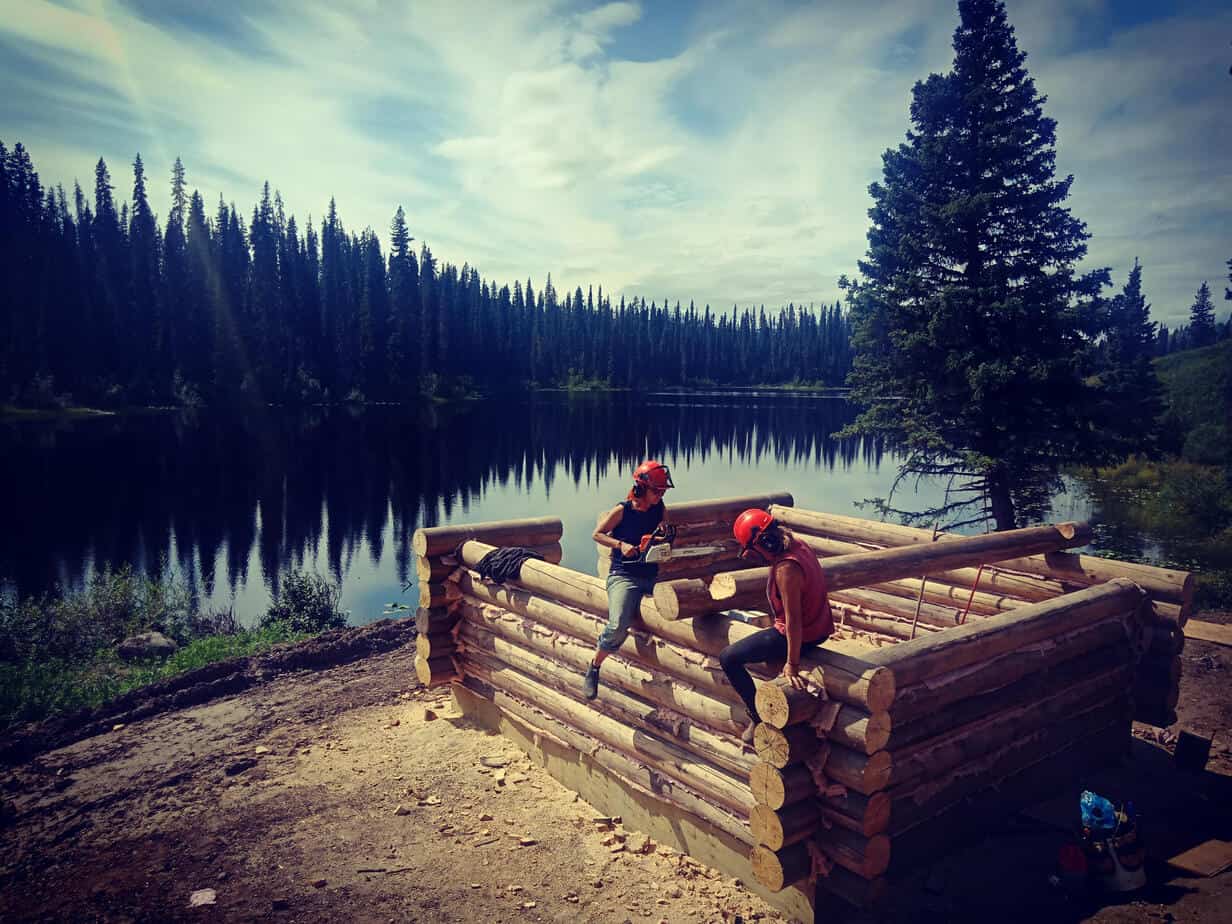
number of logs to use for building. As things currently stand, two log cabins have been built (both of which await the addition of a roof) and a third is well underway. The plan is to have all three cabins fully built, furnished, and move-in ready before the snow comes this Fall. In addition to this, a Summer kitchen has been built.

It will also be necessary to build several wood sheds and cut enough firewood to last the winter, so several days will be spent meeting this
need.

We encourage all people who are inspired by this project to come participate. Don’t be shy to come if you don’t have experience working construction. We will find a way for you to contribute. This is a great place to pick up some new skills.

Although we are requesting that volunteers come ready to work, this isn’t just a work camp. We are hoping that activists who are serious
about land defence and indigenous solidarity will see this as an opportunity to build and strengthen relationships, to share information, and to strategize about how best to wage a multi-faceted, multi-year campaign combining different approaches and sites of struggle. With
ecological struggle set to intensify in the near future, it is important that the people on the front lines are connected to the support of a
wider movement. Working together, as well as spending time around the fire, is a great way to build relationships rooted in mutual respect and trust. We believe that such strong-bond relationships are the stuff that resilient movements are made of.

There will also be other activities, such as tracking, hunting, fishing, foraging, berry-picking, paddle-boarding, kayaking, hiking, music,
workshops, story-telling, strategy discussions, and various kinds of skill-sharing. We will be inviting land defenders and knowledge-keepers from neighbouring nations to speak about the issues affecting their territories as well, as well share stories. If you would like to lead an activity, please email us with your idea.

We are also specifically reaching out to academics, researchers, scientists, and university faculty, inviting them to visit the camp during this time of heightened activity. We are doing this because we have plans to build a climate change research centre here. We want to connect with people working in the fields of biological, environmental science, anthropology, and archaeology.

Likhts’amisyu chief Dtsa’Hayl (a.k.a. Adam Gagnon), who is a professional contractor, has been leading the construction efforts at the village site. . We also welcome donations of goods such as building supplies, non-perishable food, and firewood. We are also currently fund-raising for building supplies, and encourage folks to check out the links below for ways to donate.

We understand that many people who might like to come do not own their own vehicles. If you are interested in coming, please email us telling us where you are located and we will do our best to find you a ride. Alternatively, you could post on the Facebook page and request a ride there. . Lastly, for people who do want to come, but who can’t come for the action camp, we encourage you to visit when you can. This is a multi-year project in an early phase. In the long run, we want to build up a strong network of people willing to support us on an ongoing basis.

So to all you beautiful freedom fighters (and future freedom fighters) out there in the world, come! The experience may well change your life…

Please share this invitation throughout your networks, and please do not hesitate to write us at likhtsamisyu@gmail.com (for the chiefs directly) or likhtsamisyu@riseup.net if you have any questions. If you leave a number, we will a call to answer any questions you have, as we realize that the dates of the camp are rapidly approaching and time is of the essence.

Thank you!

Likhts’amisyu Solidarity

******************************************************************************

Here are some useful links:

1. The Go Fund Me page is at: https://www.gofundme.com/manage/likhtsamisyu2019

2. The promotional video is at: https://www.youtube.com/watch?v=odLUEQsqJqI

3. The Likhtsamisyu website is at: www.likhtsamisyu.com

4. The Facebook page is at https://www.facebook.com/likhtsamisyu

Please write us at likhtsamisyu@gmail.com (for the chiefs directly) or likhtsamisyu@riseup.net (for the supporter collective) if you have any questions.

*******************************************************************************

***FIRST IMPORTANT ADDENDUM***

We encourage folks who are traveling long distances to come to Wet’suwet’en territory to also visit and support the other camps. The Unist’ot’en Camp has also recently put out a call for volunteers for an upcoming construction camp. Details can be found here:

https://itsgoingdown.org/strengthening-the-front-lines-on-wetsuweten-territory/

From their call for volunteers:

“During the last week of October and early November there will be a concerted push to complete the Healing Lodge. This beautiful and functional building has become the key embodiment of the Wet’suwt’en fight for sovereignty and against industrial destruction. The Healing Lodge is about 95% complete – it would be a great achievement to be able to declare this project finished this fall. Over the last several months good progress has also been made on other Village structures including a root cellar, tool shed and green house. These projects also require some additional work.”

***SECOND IMPORTANT ADDENDUM ***

We have just learned that the Gidimt’en Camp has also just announced dates for an Fall Work Camp. For details, see:

https://itsgoingdown.org/call-for-gidimten-work-camp-october-10th-21st/

“The cold is quickly approaching at the Gidimt’en Checkpoint and Costal Gaslink is preparing for construction activities in Gidimt’en territories this fall and winter – including the construction of another man camp and clearing the right of way on Gidimt’en yintah. We are preparing for the cold, hard battle ahead – and we invite you to join us.

In an era of attempted pipeline development across co-called “North America” the capitalist and colonial processes which displace Indigenous peoples from their land destroy the planet must be stopped! Working alongside the Gidimt’en checkpoint is concrete way to support resistance to the state along with colonial and capitalist projects which are destroying our territories and the planet more broadly.

Folks with carpentry, framing, logging, cooking and camping skills are encouraged to come to camp and work, ideally folks commit to ten days of work beginning October 10th, 2019. However supporters are needed before and after camp.”


 

How to find and take action against border infrastructure anywhere in Canada

 Comments Off on How to find and take action against border infrastructure anywhere in Canada
Sep 282019
 

Anonymous submission to MTL Counter-info

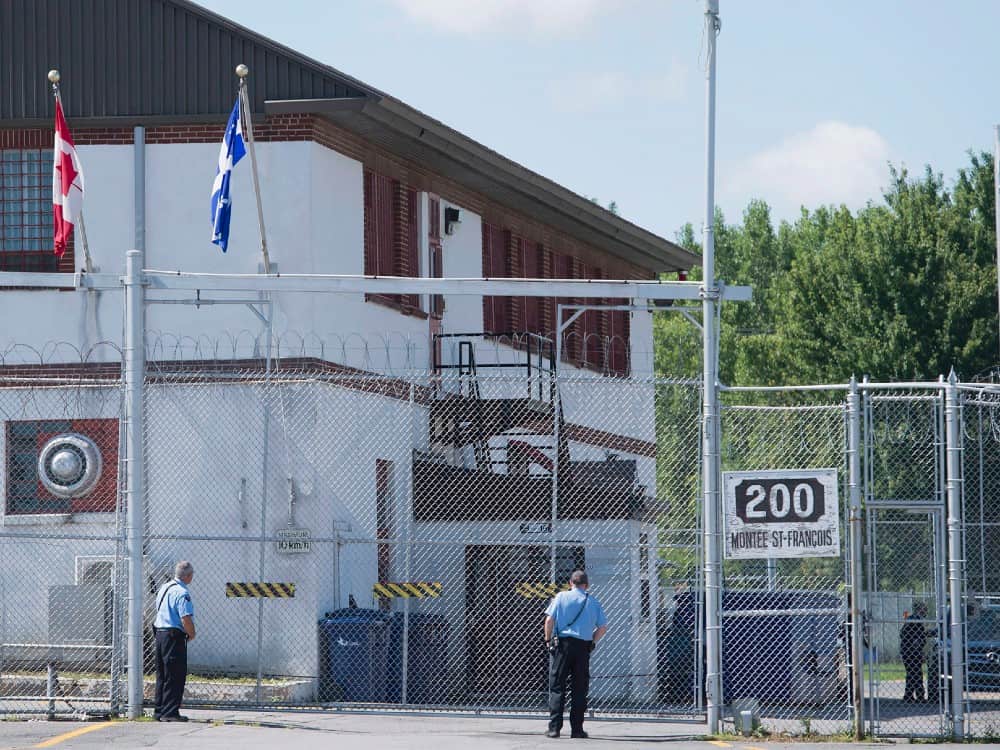
Construction has begun on a new prison for migrants and refugees in Laval, QC, a suburb just outside of Montreal. As the project has advanced, the struggle to stop it has ramped up as well, with a wide variety of actions being taken to stop its construction. The prison is part of a $138 million plan called the National Immigration Detention Framework (NIDF), announced in 2016 by the governnment of Canada following a period of resistance against the imprisonment of migrants. The NIDF expands and strengthens the government’s capacity to surveil, imprison, and deport migrants, creating two new migrant prisons as well as new forms of surveillance & control such as mandatory ankle bracelets, voice biometric scans, and halfway houses for migrants.

In the midst of this it can be hard to figure out how to intervene in what’s happening, either as an individual or group. In the spirit of spreading all forms of resistance to Canada’s border and prison regimes we’ve brainstormed a list of (just some of) the ways people might contribute to this fight.

Border and detention infrastructure can be found in most cities in Canada. Read on for some ways to identify it in your context (and a few ideas for what to do with that info).

IDENTIFYING BORDER INFRASTRUCTURE IN YOUR AREA

In the US, an extended and fierce struggle againt ICE has been ongoing, with most major cities in the country showing up to shut down ICE offices, hold noise demos outside of detention centers, and take other creative measures to counter the US detention and deportation regime. The government has been feeling the heat, and, while there’s still quite a ways to go, we think it’s both possible and necessary to bring resistance to the border in so-called Canada to this level!

Check if any of the following organizations have locations in your area:

Government:

  • Canada Border Services Agency (CBSA) – The main enforcement for the detention, surveillance and deportation of migrants in Canada. Offices, staff, and infrastructure located all over Canada.

Did you know that in 2017, an access to information request resulted in the release of the names and positions of hundreds of CBSA employees? You can read those documents at this link and figure out if there’s anyone in your area whose responsibility for the deportation and detention of migrants should be revealed. https://mtlcounterinfo.org/doxxing-the-canadian-border-services-agency/

  • CBSA migrant detention centres – there are currently three federal migrant prisons – one in Toronto, one in Laval, and one inside the Vancouver airport. Construction on a new one in Surrey, BC, was recently completed, and a new one is being built in Laval, QC.
  • Provincial jails – The CBSA pays millions of dollars to provincial governments each year, as part of deals that allow the agency to imprison migrants in provincial jails. In Ontario, most migrants detained by the CBSA are held in provincial jails.

NGOs profiting from and enforcing the “Alternatives to detention” portion of the NIDF: https://communemag.com/the-same-prison-with-a-nicer-facade/

  • John Howard Society – a non-profit which was awarded almost $5 million to implement the new “Community Case Management and Supervision” program, essentially a regime of programming and halfway houses for migrants that mirrors the existing parole system in Canada. Locations in all provinces across Canada, no location in Yukon or Nunavut. http://johnhoward.ca/services-across-canada/
  • Toronto Bail Program – A recipient of approximtely $7 million to implement the “Community Case Management and Supervision” program, located in Toronto.
  • The Salvation Army – A recipient of over $1 million to implement the “Community Case Management and Supervision” program, locations in most Canadian cities.

Profiteers from the construction of the new migrant prison in Laval

Miscellaneous:

  • GardaWorld – This private security company, contracted as prison guards at the current migrant prison in Laval, and as security at the construction site for the new one, has locations all over Canada. There is no shortage of heinous projects they’re connected to. Check their website to see if they have a location in your area.
  • G4S – Contracted as prison guards at the migrant prison in Toronto.

Once you know the organizations and companies in your area that are profiting from border enforcement, consider trying to find out the names and locations of individuals involved. Try finding out where the executives of the company live, and put up posters in their neighbourhood, or hold a surprise demo outside of their home. You can also send them emails, faxes, and letters from an anonymous computer.

With a trusted friend or friends, take action against the companies or implicated agencies directly!

You can find a collection of communiques from actions that have taken place against the construction of the new migrant prison at this link: https://www.stopponslaprison.info/en/news-and-analysis/

If you’re considering taking direct action against border infrastructure in your area, take a look at this “Recipe for nocturnal direct actions”, which covers a lot of useful information for planning and executing effective direct actions while keeping eachother as safe as possible in the process! https://mtlcounterinfo.org/a-recipe-for-nocturnal-direct-actions/

Still not sure whether there is border infrastructure in your area? Reach out to a nearby No-One Is Illegal chapter or other migrant justice organization and see if they can point you in the right direction. Or, get together with friends for a research night!

There are of course still things you can do even if you live in a small community without any border infrastructure:

1. Share materials and information

Check out the materials page of stopponslaprison.info. You can share and print zines, posters, flyers and stickers with those in your network.

Get a group of friends together, and put up some posters in your neighbourhood, or near a bus stop. You can find instructions on how to make wheatpaste, which makes posters hard to remove, at this link. https://mtlcounterinfo.org/how-to-wheatpaste/

Spend a couple hours putting up stickers in the transit system, in your school, workplace, or in your neighbourhood.

Do a banner drop in a visible location in your area that shares a message against borders and prisons! Here is some information on how to do a banner drop: http://destructables.org/node/56

Plan an information picket or flyering day. Print out some flyers, or make your own! Get a few friends together and hang out at the subway/metro/skytrain or bus station for a few hours, giving people information about the project.

2. Spam the companies

Send spam faxes or flood the phone lines, email accounts, and social media accounts of the companies and their employees.

It’s easy to make temporary email accounts with protonmail or guerrilamail.

You can send faxes for free online at https://www.gotfreefax.com/ or https://faxzero.com/. Sending faxes with a lot of black ink can waste all of the ink on their machine or jam up the machine, making it less possible for them to recieve real faxes.

If you’re thinking of spamming the companies online, keep in mind that you may not want to do so from your own social media account, or IP address. Take a look at the EFF guide to safer online communications, and check out tools such as Tor and TAILS to use to create your temporary anonymous email account and for sending faxes.
https://ssd.eff.org/
https://www.torproject.org/
https://tails.boum.org/

3. Share this call with friends and family, and meet with them to talk about how you might organize something in your area!

Why Stantec and the Guy-Favreau Complex got targeted at the climate march and why the climate movement should fight the border regime

 Comments Off on Why Stantec and the Guy-Favreau Complex got targeted at the climate march and why the climate movement should fight the border regime
Sep 282019
 

Anonymous submission to MTL Counter-info

Canada is a major contributor to the climate crisis, playing an active role in displacing people from their homes around the world. Canada hosts over 70% of the world’s mining companies, which sow environmental and economic devastation on a global scale. Canada creates more greenhouse gas emissions than any other G20 country, contributing to the creation of climate refugees. And within its borders, the federal government continues to push through pipeline project after pipeline project, despite sustained resistance by Indigenous communities.

As the climate crisis continues to escalate, pushed along by the extractive forces of capitalism and colonialism, this has led to an acceleration of the global migration crisis. In response, we see Canada further fortifying its borders in an attempt to prevent those it has displaced from seeking refuge.

This buildup of border infrastructure is not limited to the border itself. Over the past two decades, migrant detention has been one of the fastest growing forms of incarceration in Canada. The Canada Border Services Agency (CBSA) has three prisons just for migrants and rents space to detain migrants in jails across the country. In 2016, the government invested an additional $138 million to strengthen and expand this system, leading to the construction of two new migrant prisons (one in Laval, QC) as well as new systems of surveilance and control such as mandatory ankle bracelets and voice biometric scans for migrants.

As Canada responds to climate change by fortressing its borders, those championing the white supremacist politics behind this decision will continue to become more mainstream. In Quebec, we’ve already seen the mainstreaming of anti-islam groups like La Meute, the success of the CAQ’s anti-immigrant election campaign, as well as the violent consequences of its Law 21. As the charade that is the federal election begins, we have already seen a further mainstreaming of white nationalism, as politicians sow fear and hatred of migrants crossing into Quebec at Roxham Road.

Borders and prisons are colonial impositions on these territories, systems fundamentally about domination and control. As Canada continues to invest billions into extraction, those feeling the brunt of the crisis here continue to be Indigenous peoples. Whether its pipelines forcibly installed across Indigenous territories, mining or logging companies operating in Indigenous territories without consent, or the envrionmental devastation caused by refineries built right next to reserves, Indigenous communities are consitently on the frontlines, experiencing the harmful effects of extractivism, as well as leading the resistance to it.

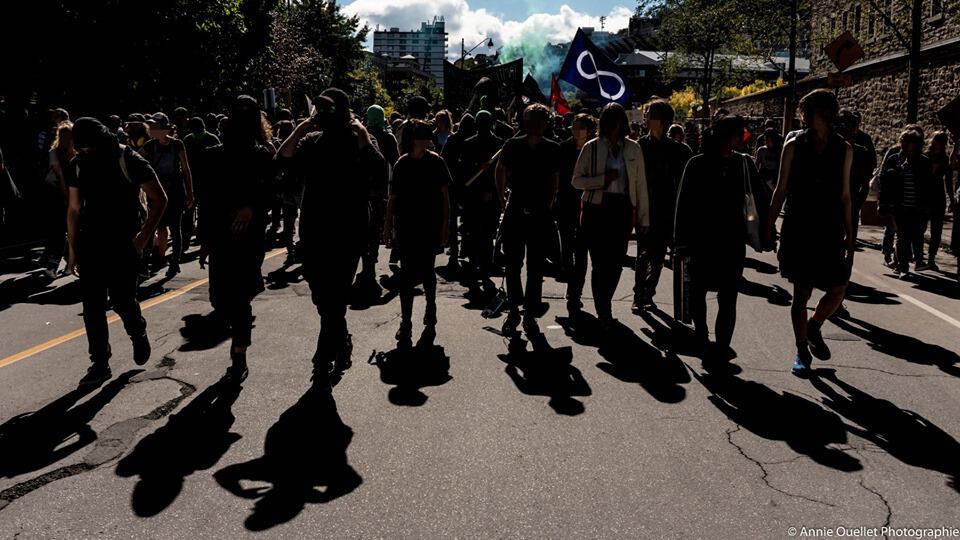
It is for these reasons and more that Stantec and the Guy-Favreau Complex were targeted by people participating in the climate march. The buildings were hit with green paintbombs and spraypainted with “Bienvenue aux migrants” (Welcome migrants). In the Guy-Favreau Complex, the Immigration and Refugee Board of Canada holds detention review hearings daily, often resulting in the prolongation of a migrant’s imprisonment. Stantec is an engineering consulting firm involved in the construction of the new migrant prison in Laval.

This new prison is part of Canada’s false solution to the threat posed by climate change, an attempt to further intensify its border infrastructure, to keep out those it continues to displace. The real threats to the earth and the people who live on it are capitalism, the destruction of the environment, and the politicians who, without fail, will continue to defend these systems while scapegoating those displaced by them.

We believe it is necessary to push far beyond making requests of politicians, and toward directly challenging the role Canada is playing in the global crisis. We hope that the climate struggle can broaden its tactics, deepen its analysis, and continue to build links with ongoing struggles against white supremacy, settler colonialism, and border imperialism.

Strengthening the Front Lines

 Comments Off on Strengthening the Front Lines
Sep 182019
 

Anonymous submission to MTL Counter-info

Respectful greetings.

Construction work is ongoing to strengthen the various Wet’suwet’en front lines. Meanwhile Coastal GasLink continues to push ahead with its fracked gas pipeline. The following are various opportunities for people with construction and other skills to stand with the Wet’suwet’en:

Unist’ot’en Healing Lodge and other Village structures

During the last week of October and early November there will be a concerted push to complete the Healing Lodge. This beautiful and functional building has become the key embodiment of the Wet’suwt’en fight for sovereignty and against industrial destruction. The Healing Lodge is about 95% complete – it would be a great achievement to be able to declare this project finished this fall. Over the last several months good progress has also been made on other Village structures including a root cellar, tool shed and green house. These projects also require some additional work.

All levels and varieties of skills (construction and other) are needed.If you can join us during this time, please:
1. Reply to this email, and
2. Go to https://unistoten.camp/come-to-camp/camp-registration/ to apply to attend the Unist’ot’en Village

Of course, volunteers are needed at all times at the Unist’ot’en Village, so please apply to come whatever your availability is.

Other Wet’suwet’en Clans also need construction help.

Likhts’amisyu

There will be a Sovereign Likhts’amisyu Action Camp from September 25th to October 4th. This is its first-ever action camp on traditional territory recently reclaimed from the Canadian state. The Likhts’amisyu is building a community on the site of an ancient village. The focus is on creating a Climate Change Research Centre – a complement to the healing focus of the Unist’ot’en Village.

The Action Camp will be multi-faceted with many activities besides construction going on. And, as with all the front lines, allies are needed at all times – not just during the Action Camp. For more information and to apply to attend, go to https://likhtsamisyu.com

Gidimt’en

The Gidimt’en Clan has established a substantial presence on its Territory. Work is ongoing to strengthen this place – which was the location of the largest recent confrontation in the Wet’suwet’en stand to protect its land. As you will recall, it was here in January of this year that the militarised RCMP arrested and brutalised 14 members and allies of the Gidimt’en Clan. Work is ongoing to strengthen this assertion of Gidimt’en sovereignty.

For more information and to apply to come to Gidimt’en Territory, go to
https://www.yintahaccess.com/

———————————————————————————————————————————————–

Coastal GasLink, and its allies in government and the RCMP, tramples on Indigenous sovereignty, ignores the environmental consequences of its actions and thinks only of dollars to be made. But, the Wet’suwet’en Nation has defended its lands for thousands of years. Never defeated in battle, never signed a treaty, never negotiated away its land, the Wet’suwet’en live by their longstanding principles.

With good will and determination, this fight can be won.

Stand with the Wet’suwet’en! Stand with those protecting our ability to live on this Earth!

“Heal the Land; Heal the People”

“You’re Not Tough Now”: Two Off-duty Cops Get Wrecked (Video)

 Comments Off on “You’re Not Tough Now”: Two Off-duty Cops Get Wrecked (Video)
Aug 302019
 

Anonymous submission to MTL Counter-info

The video being unfortunately already in the possession of the SPVM, we decided to create a little remix.
 
August 24th, 2019. Downtown Montreal. A crowd spots two off-duty cops from the Service de police de la Ville de Montréal outside a bar. From the nearby Station 21, they spend their shifts harassing and brutalizing poor and marginalized people in the area. Off-duty, they have no guns, no tasers, no radios to call for backup. Let’s see what happens when they have no badge to hide behind.

“It isn’t simply an attack against these police officers — it’s an attack on the entire justice system.”

— SPVM Spokesperson

ACAB.

Stay tuned for updates.

Tisseur Turns to Courts in Bid to Silence Critics of New Migrant Prison

 Comments Off on Tisseur Turns to Courts in Bid to Silence Critics of New Migrant Prison
Aug 282019
 

From Solidarity Across Borders

Info-picketMontreal, 27 August 2019 — The Superior Court of Quebec has granted Construction Tisseur Inc. a legal injunction against the migrant justice network Solidarity Across Borders. Tisseur was awarded the federal contract to build the new migrant prison in Laval in June. The temporary injunction was sought in response to a festive information-picket, featuring live Klezmer music, outside Tisseur’s headquarters in Val-David last Thursday.

“This sets a very disturbing precedent. It is a huge concern for everyone in Quebec when a company uses the courts to silence critics. We remember Barrick Gold’s legal harassment of Éco-societé for publishing Noir Canada. And we see a clear connection: Canadian mining companies like Barrick Gold contribute to displacing people who then end up in immigration detention centres. We won’t be silenced, there is far too much at stake,” said Jane Doe of Solidarity Across Borders.

Solidarity Across Borders received notice at 6:26 pm on Thursday, 22nd August of a court hearing the following morning. Solidarity Across Borders’ legal representative requested a postponement to allow time to prepare a defence, but the postponement was denied. The temporary injunction, prohibiting Solidarity Across Borders, Jane Doe, and John Doe access to Tisseur’s property at 1670 Route 117 in Val-David, remains in place until September 1st. The injunction could be renewed this week.

“We organized the picket last week to reach out to the workers involved in this project. We believe that detention centres for migrants and refugees, and the immigration system they are part of, undermine labour rights. We wanted to engage with Tisseur workers about this during their lunch hour,” said John Doe of Solidarity Across Borders.

“Tisseur complained that we put up posters on their walls. We taped up silhouettes of friends who had been detained and deported, such as Lucy Granados, a single mother and worker from Guatemala who came to Canada after the US-owned factory she was working at moved to Asia, where labour was cheaper, and “Daniel,” a 17-year old boy who was detained at a Montreal high school and deported alone to Mexico,” said Doe.

“We don’t think Yannick Tisseur was afraid of our temporary posters or non-stick tape, but he is clearly scared of these stories reaching his workers. One of the signs read, ‘Tisseur, would you imprison your kids?’ He doesn’t want his workers to know that this prison will be used to imprison children.”

Tisseur began construction of the new prison, located beside the current Laval Immigration Holding Centre, on 5 August 2019. Scheduled to open in 2021, it is part of a $138 million investment into Canada’s capacity to indefinitely detain and deport migrants, including children. Former detainees report serious mental health problems such as nightmares, depression, suicidal thoughts, difficulty sleeping, anxiety, and other symptoms related to post-traumatic stress syndrome.

Good Night Atalante

 Comments Off on Good Night Atalante
Aug 192019
 

Anonymous submission to MTL Counter-info

On the night of August 12th, 2019, three members of Atalante Quebec were attacked.

Atalante is a small group of fascists whose members have taken part in numerous attacks in recent years (starting with the knife attack at the Coop L’Agité in Quebec City). The group takes inspiration from CasaPound in Italy and Bastion social in France in an attempt to revive fascist ideology. Its members are antisemitic, homophobic, transphobic and colonialist. They shall not pass.

Roxanne Baron and Jonathan Payeur had their Jeep destroyed (windows smashed and skunk juice sprayed inside).

Jean Mecteau had his home and tattoo shop vandalized (NAZI SCUM and 161 (Antifascist Action) graffiti and black paint on his door and windows).

Why them?

Any of the members or sympathizers of Atalante could have been targeted. This time, it struck these three pieces of trash.

Roxanne Baron and Jonathan Payeur are members of the Quebec Stompers, the street gang associated with Atalante. Jo is also a former anti-racist skinhead who crossed to the wrong side. Today he considers himself Atalante’s sergeant-at-arms, he was the one who accompanied Baptiste Gilistro and Louis Fernandez, two young recruits, during the attack on the LvlOp bar in December 2018.

Jean Mecteau is the bassist of the band Légitime Violence, the leading group of the province’s fascists. He is also the owner of the tattoo shop Jhan Art, and he frequently does tattoos with Nazi or fascist references for his friends.

This action is in solidarity with all the victims of the far right, in Quebec City, Hamilton, Montreal, Lyon and everywhere else.

22 August – Protest the New Migrant Prison

 Comments Off on 22 August – Protest the New Migrant Prison
Aug 132019
 

From Solidarity Across Borders

Join us for the first of a series of public actions in opposition to the new Laval migrant prison! These actions will take place on Thursdays at noon at various locations, culminating in a multi-city day of action on October 3rd.

The new Laval migrant prison is part of a $138 million investment into Canada’s migrant detention system under the National Immigration Detention Framework (NIDF), a new policy announced in 2016. The NIDF provides for the construction of two new migrant prisons along with expanded carceral technologies to supervise and control migrants outside these facilities.

On Aug 22nd, we will be gathering in front of the Val-David headquarters of Tisseur Inc for a family-friendly, public, information-picket. Tisseur was recently awarded a $50 million contract to oversee construction of the new Laval prison, with initial work already begun.

Companies like Tisseur are eager to help build the infrastructure of an anti-migrant future but we have a vision of the future of our own. It does not include detention, borders, or prisons and we are calling for help to realise it.

To join us on August 22nd: we’ll be driving together from Montreal, so email solidaritesansfrontieres@gmail.com to reserve your place and find out the meet up place. We’ll be meeting at 10am to arrive at noon and return to Montreal no later than 4pm. If you have a car you can bring or lend, please let us know, as well as the number of seats you can offer.

No borders, no prisons, status for all!

Background

Statement to endorse

New Wet’suwet’en Village on Unceded Land! Support Requested

 Comments Off on New Wet’suwet’en Village on Unceded Land! Support Requested
Aug 122019
 

Anonymous submission to MTL Counter-info

Many of us in the environmental movement share a dream of a free society, in which people live together, caring for the land they inhabit. We imagine such a community as an autonomous zone, existing independently of the colonial, capitalist system we oppose.

I am pleased to report that I now write these words from exactly such a place. I now find myself by the shore of Parrott Lake, on a territory belonging to the Sun House of the Likhts’amisyu Clan of the Wet’suwet’en Nation. The exact place where we now camp was a Wet’suwet’en village site for many generations. In subsequent waves of colonial violence, the Wet’suwet’en were driven from this ancestral home. Now they have reclaimed it and are building a new village, which is be a place of cultural revitalization, of learning, of healing, and of stewardship of the land.

Some context is required here. The Likhts’amisyu is one of the five clans of the Wet’suwet’en Nation. For the last ten years, the Wet’suwet’en have been resisting an array of pipelines through which industry intends to ship diluted bitumen and fracked gas to the Northwest Coast for export. The focal point of these efforts has been the Unist’ot’en Camp, a long-standing territorial re-occupation which was built directly in the path of the proposed pipeline corridor. Years of resistance have caused multiple multi-billion-dollar projects to be delayed and/or cancelled. Things came to a head this winter, when the Coastal GasLink pipeline corporation obtained an injunction against the camp. In response, a blockade was established on a neighbouring territory by members of another Wet’suwet’en clan, the Gidimt’en. This was done as an act of solidarity with the Unistot’en, and was announced in the Wet’suwet’en feast hall, with the support of all five clans.

For three weeks, the Gidimt’en Access Checkpoint, as the new camp was called, blocked pipeline workers and police from entering the territory. Then, on January 7th, 2019, militarized federal police raided the Gidimt’en camp, arresting 14 people and setting off a Canada-wide wave of protests. Two days later, the RCMP breached the gate of the Unist’ot’en Camp, and pipeline workers entered the territory, where they began destroying a vast swath of forest to make way for the pipeline right-of-way, as well as a large man camp to house pipeline workers.

It is important that people realize that this fight is far from over. Although preliminary work has begun on the pipeline, and the LNG export terminal in the coastal city of Kitimat, no pipe has yet been laid. The events of December and January should be regarded as one phase in a struggle that has been going on for a decade.

A new phase of struggle has begun, and the Likhts’amisyu village represents a continuation and an expansion of Wet’suwet’en resistance. Part of the strategy is to stymie CGL by blocking them at multiple points. Whereas at the beginning of December, there was one camp resisting ongoing colonialism on Wet’suwet’en territory, there are now three – the Unist’ot’en, the Gidimt’en, and the Likhts’amisyu.

In the wake of the events of the winter, the Likhts’amisyu decided that the time was right to assert their sovereignty, and in May of this year, they began the process of building a new village. They received a donation of a significant number of logs, which they used to begin building log cabins. This was fortunate, as all of this construction has been done on a shoestring budget, with community members paying out of their pockets for many expenses. As things currently stand, one log cabin is built and awaits the addition of a roof, a second is being built, and the foundation for a third has been laid. The roofs will have to wait until some more funds come in. The plan is to have all three cabins constructed before the snow comes this Fall. In addition to this, a kitchen / mess hall has also been mostly built, and will be completed within the week.

The reclamation of this exact location is something that members of the Likhts’amisyu Clan had dreamed of for years. This is a traditional village site, likely inhabited by the Wet’suwet’en for centuries, if not millenia. It is located some 40 kilometres South of the logging town of Houston, by the shores of a beautiful mountain lake now called Parrott Lake. Close to the lake, there are alpine meadows rich in berry patches, likely evidence of Wet’suwet’en burning practices. A historic cremation site is located nearby. Many of the folks here speak of the strength of the connection they feel to this place, and of childhood memories of good times here. Everyone agrees: it feels right to be here. One woman spoke of incredibly vivid dreams in which her great-grandmother insisted that she understand how important it was that she bring her family out here.

This place was home to a traditional village up until the turn of the 20th century, when it was burned down as part of a government plan to force all indigenous people onto reserve. Although this marked the end of the village, in the following decades there was at least one Likhts’amisyu cabin here.

Back in 1995, Likhts’amisyu chief Dtsa’hayl built a cabin here, which was burned down five years later by a foresty worker. Apparently this was accidental, but the Wet’suwet’en received no compensation. In recent years, the site has been called the Parrott Lake Recreation Site, and has been managed by B.C. Parks and Recreation, which is the branch of the Ministry of Forests that maintains camp sites. As of now, B.C. Parks and Recreation has taken a very respectful approach to the Wet’suwet’en re-occupation, and there have been talks about managing the site in some kind of partnership. This may be due in part to the very friendly, non-confrontational tact taken by the camp leaders here. The vibe here is open and welcoming. When locals do come out to camp, to swim or to go boating, they are greeted in a friendly way, and will often be invited for tea, coffee, or to share food.

On a less positive note, there have been threatening comments made on Facebook against the Likhts’amisyu village. The Likhts’amisyu village is kept occupied 24/7, due to the fear of local people burning down the cabins and out-buildings. Sadly, there is a long history of Wet’suwet’en homes being destroyed maliciously by settlers. It will be important to have support throughout the Fall and Winter in order to maintain a constant presence here.

In terms of bringing Wet’suwet’en community members together, the Likhts’amisyu camp has already met with great success. Often, especially on weekends, the camp has the feeling of a family reunion – people sharing food, telling stories and reminiscing by the fire, while kids and dogs run and play. There are paddle-boards and kayaks here, and the water is perfect. Every evening, from where we sit by the fire, we see the sun paint the sky magnificent colours as it sets over the lake. Clan members have commented on how the village is bringing their families closer together.

All this to say, there is more to the Likhts’amisyu village than opposition to the pipeline. To clan members, it represents a deep yearning for a return to their ancestral way of life. There is a hope that perhaps the day has come when they can at last return home.

There are also plans for a climate change research centre here. The leaders of the Likhts’amisyu Camp are in talks with a respected NGO and the University of Northern British Columbia to collaborate on this project. They are also planning litigation against CGL, and the governments of Canada and B.C.

Both the climate change research centre and the lawsuit reflect the view that the Likhts’amisyu have in regards to the fight against the CGL pipeline – that the struggle to protect their territory is a long-term, intergenerational one, and that it is important in this day and age to fight intelligently, using all tools at their disposal. Chief Dtsa’hayl speaks about the need to seize the initiative in the fight against CGL. The hope is that the lawsuit, in combination with the hard data gained through on-the-ground research, will enable the clan to put the pipeline companies on the defensive.

Although the Likhts’amisyu village is an indigenous-led camp, its leaders envision the participation of non-natives as equal community members. They plan to invite people to homestead here, irrespective of race. If a settler wants to live out here, and help build this community, they may be welcomed to do so. If this sounds like a dream come true for you, you are encouraged to come visit the camp.

Help with the construction activities would very much be appreciated, but we also encourage people to come just to visit. We feel that people who do so will feel a personal connection to this place, and will want to support what is happening here.

In short, what is happening here is new and different, exciting and inspiring. Thus far, there has not been as much support from environmental activists as one would hope. The vast majority of work has been done by Wet’suwet’en community members. This is partly due to the fact that the activities of the Likhts’amisyu are not yet widely known-about. To address this, we are specifically requesting that folks with media production skills, such as photography, videography, video-editing, and podcasting, support us by using their skills to help boost the profile of the Likhts’amisyu Camp.

Lastly, funds are needed. As previously mentioned, we are limited in what we are able to do by monetary constraints. We are building a second log cabin before putting a roof on the first because we need funds for building supplies to complete said roof. Any support would be appreciated – we would greatly appreciate it if supporters would consider hosting fund-raising events or make funding requests on our behalf.

If you feel inspired to do such a thing, if you would like to volunteer to produce media in support of this project, or if you could simply just like to visit, please do no hesitate to get in touch.

We also encourage folks who can to donate to the Sovereign Likhts’amisyu GoFundMe page, a link to which can be found below.

Here are some useful links:

1. The Go Fund Me page is at: https://www.gofundme.com/manage/likhtsamisyu2019
2. The promotional video is at: https://vimeo.com/332477793
3. The Likhtsamisyu website is at: www.likhtsamisyu.com
4. The Facebook page is at https://www.facebook.com/likhtsamisyu/
5. The main email for people to reach the chiefs is: likhtsamisyu@gmail.com
6. The main email for people to reach the support team is: likhtsamisyu@riseup.net
7. To subscribe to the Likhts’amisyu listserv, please write likhtsamisyu@riseup.net introducing yourself and saying why and how you would like to support current organizing efforts.

We also ask that people share the above links through their social media accounts and amongst their friends and comrades. Thank you very much!