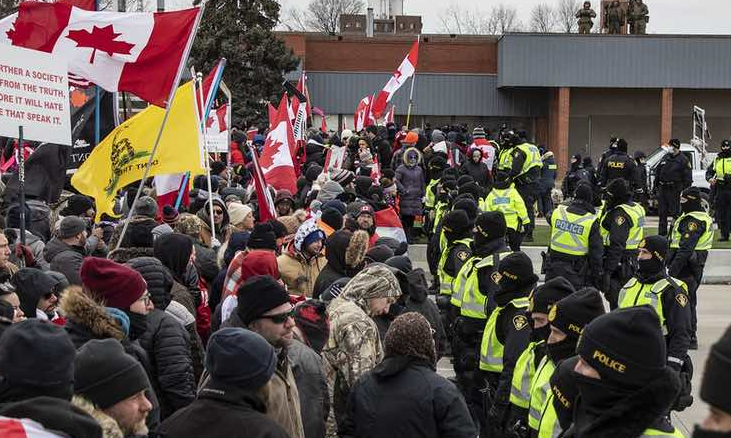
Interview with an anti-fascist observer about insights gained from the Public Order Emergency Commission hearings, a public inquiry into the federal government’s use of the Emergencies Act to repress the so-called Freedom Convoy in February 2022.
We discuss why governments invoke emergencies, OPP’s Project Hendon, how the Convoy was funded, the relationship between convoy organizers and police, comparisons with #ShutDownCanada, liberal conspiracy theories, the scale of economic disruption during the Convoy, and more.
We denounce the death of migrants detained at the Detention Center in Surrey, BC, and at Roxham Road.
We are, once again, infuriated and saddened to learn of the death of two migrants within a period of two weeks.
The death on Christmas Day of a person detained by the Canada Border Services Agency (CBSA) at the Surrey’s CBSA detention center in British Columbia was announced on December 27 by CBSA. On January 5, Sûreté du Québec confirmed they found the dead body of a man near Roxham Road, an irregular crossing of migrants between the USA and Canada.
We deplore the death of the migrant man near Roxham Road and hold the Canadian government responsible and accountable for it. While we do not know the cause of the death, we can say with certainty that no one should have to die alone trying to cross the border at great personal stress, danger, and grave expense. Every person has the right to migrate, the right to resist forced displacement, and the right to return to their country of origin if they so choose.
Let us recall that it is the Safe Third Country Agreement that forces people to choose riskier ways to cross the border. The STCA is an agreement between Canada and the United States that has been in place since 2004 and states that the United States and Canada designate the other country as a safe country for refugees and close the door to most refugee claimants at the US-Canada border. This agreement has been widely criticized by many organizations and by migrants and refugees themselves, particularly because it undermines the right of anyone fleeing persecution to seek asylum. Under this agreement, migrants and refugees who make asylum claims at official border crossings in Canada not meeting the criteria are automatically removed to the United States without due process. As a result, many migrants and refugees resign themselves to crossing the US-Canada border through so-called “irregular” ports of entry, including Roxham Road, sometimes at great risk to their lives – as seen in this case.
As for the death of the person detained by CBSA, their statement mentioned that the next of kin of the deceased migrant were contacted, but gave no information concerning the name, age, gender, country of origin, let alone the reason or duration of their detention. The information on the circumstances under which the person died in the detention center — as to why they could not get the person to a hospital in time to save their life — was also withheld. As usual, CBSA claims to do so “due to privacy consideration” (source: CBSA statement).
The death of this migrant in the Surrey BC prison echoes that of another person detained in Laval QC in January 2022. The CBSA similarly shared no details, particularly of the circumstances of the person’s death, and insisted that no information would be released as an “investigation is ongoing”. Almost a year later, there have been no updates. It is now becoming more and more clear that the CBSA means only to obscure the extraordinary violence of their detention regime and ensure that they are never accountable for the deaths in their custody, as they attempt to outwait the public scrutiny.
The person in Surrey, BC who was under CBSA custody died in the newly built immigration detention center. Ironically, in Montreal, groups have been protesting the newly built migrant prison – the so-called detention center, that is marketed as a more comfortable place for those detained. A prison is a prison whether there is a yard inside or not. These facilities are inhumane and the treatment of people detained therein remains harsh and as we saw, at times, lethal. Millions of dollars spent in new facilities does not replace freedom. No imprisonment provides justice or dignity.
We repeat: Borders Kill, CBSA Negligence Kills. No migrant, no human being, should have to suffer such inhumane treatment. We will fight until every person is free.
The way CBSA handles the detention and the medical care of people detained makes it clear how they dehumanize people while in detention and also in their death. This treatment of people detained is evident from the number of deaths of people while under CBSA custody; over the past twenty years, at least 17 people have died in detention:
Bolante Idowu Alo Abdurahman Ibrahim Hassan Fransisco Javier Roméro Astorga Melkioro Gahung Jan Szamko Lucia Vega Jimenez Joseph Fernandes Kevon O’BrienPhillip Unidentified man Shawn Dwight Cole Unidentified man Joseph Dunn Unidentified person Sheik Kudrath Maxamillion Akamai Unidentified person Unidentified person
“As long as the CBSA continues to detain migrants, deaths in detention will continue,” said a joint statement issued by migrant justice organizations based in BC.
We, the undersigned groups, stand in solidarity with the family of the person killed and with the groups in BC on the frontlines fighting this injustice.
Let us recall that detention is an inherent part of the repressive matrix of the Canadian immigration system. It’s a tool of the Canadian imperialist state that ignores any responsibility towards the people who are migrating for a better life, seeking to leave situations of poverty, exploitation and violence, where the Canadian state and companies are often complicit in creating these very conditions.
The aim of the detention apparatus of the State is to deter people from entering fortress Canada. This oppresses migrants and forces them to live in the margins, isolated and underground, constantly fearing arrest and imprisonment. The practice of putting migrants in prison promotes exploitation where the vulnerable people resort to working and living in abusive and unsafe conditions without recourse or protection.
We denounce the deaths of migrants at the Roxham Road and in the detention center in Surrey, BC and demand that this violence and impunity of CBSA ends. Not one more death.
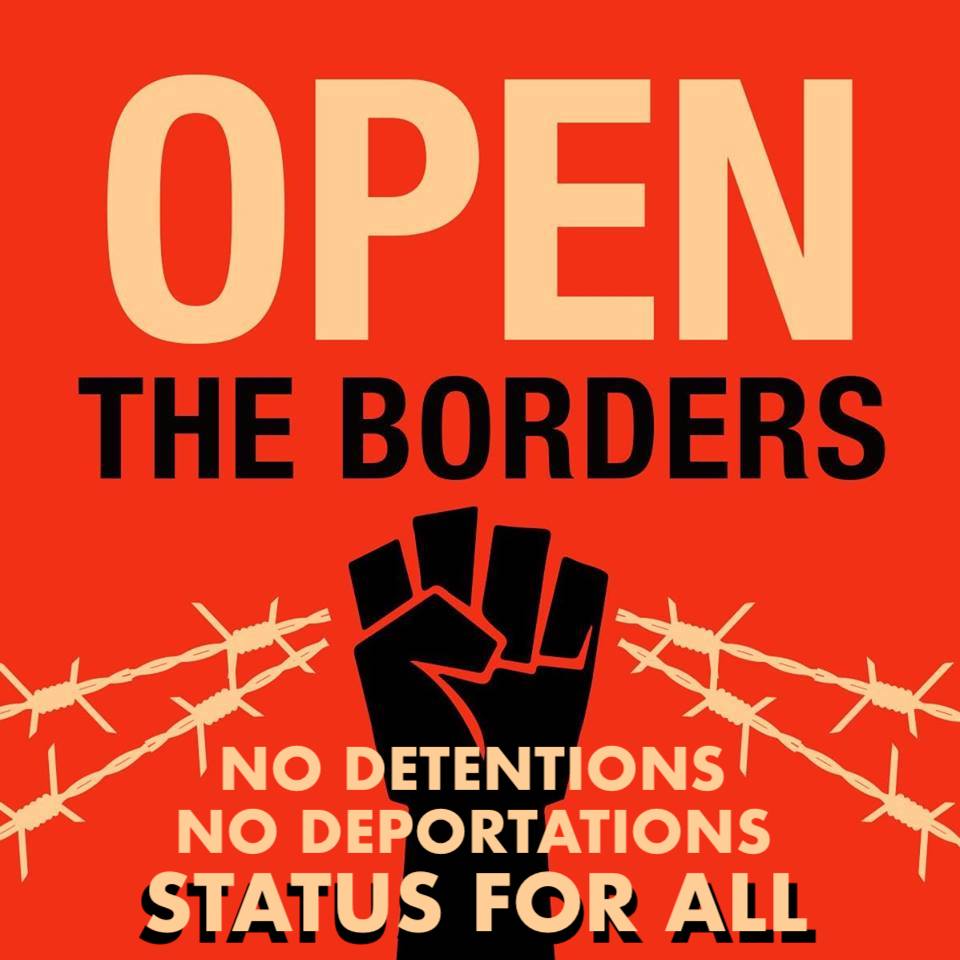
We demand open borders, no Safe Third Country Agreement, and the free movement of people seeking justice and dignity. That is, freedom to move, freedom to return, and freedom to stay.
Stop the detentions, stop the deportations! We demand a comprehensive, ongoing regularization program without any exceptions and discriminations!
Endorsed by:
Butterfly (Asian and Migrant Sex Workers Support Network) Carranza LLP Migrant Workers Alliance for Change Migrante Canada Migrante BC No One Is Illegal Toronto Parkdale Community Legal Services RAMA Okanagan RAMA Isla Sanctuary Health Sanctuary Students Solidarity & Support Collective Solidarity Across Borders Vancouver Committee for Domestic Workers and Caregivers Rights Workers’ Action Centre
Valérie, your cheap little speeches with their weak leftist flavor no longer convince even the staunchest citizens. Your determination to increase the SPVM’s budget over and over again motivated us to attack the equipment of the city of Montreal a bit. Last Thursday night, in Rosemont, the tires of 15 city vehicles, cars, vans and small trucks, were slashed with a knife and a nail. Watch out for your personal vehicles. Have a nice day!
Montréal Antifasciste monitors hate groups whether they are active in the real world or online.
In recent years, the radical fringes of the far right have tended to leave traditional platforms like Facebook and Instagram in favour of platforms that they judge to be less regulated (e.g., GAB) or more secure (e.g., Telegram). That has not prevented us from continuing our surveillance work, as has been the case this year with the Québec section of the nebulous White Lives Matter.
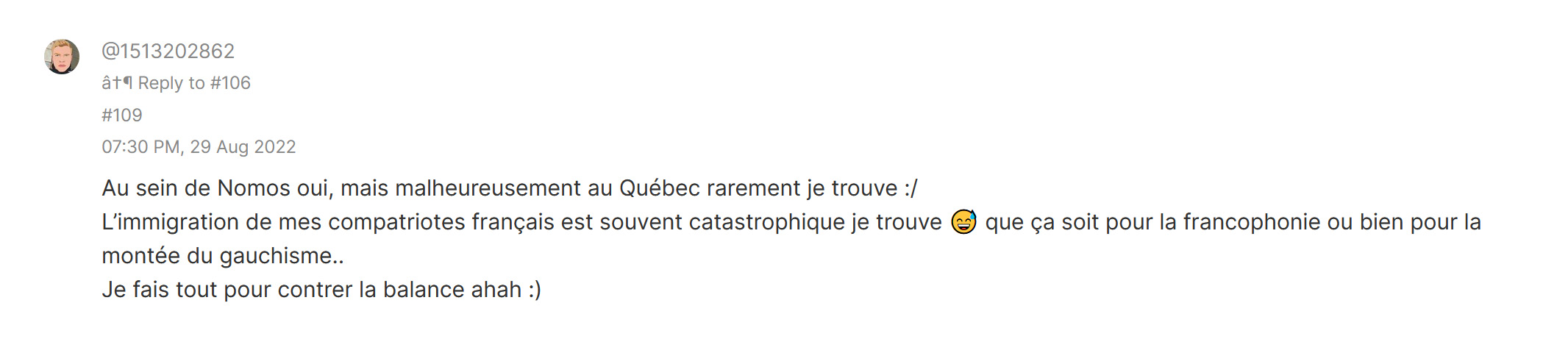
Despite their loss of some platforms, this year we’ve been interested in the community gathered around Alexandre Cormier-Denis and his media tool Nomos TV. Specifically, we were able to observe much of interest on the Telegram chat reserved for subscribers.
Recently, one user of this chat in particular caught our attention.
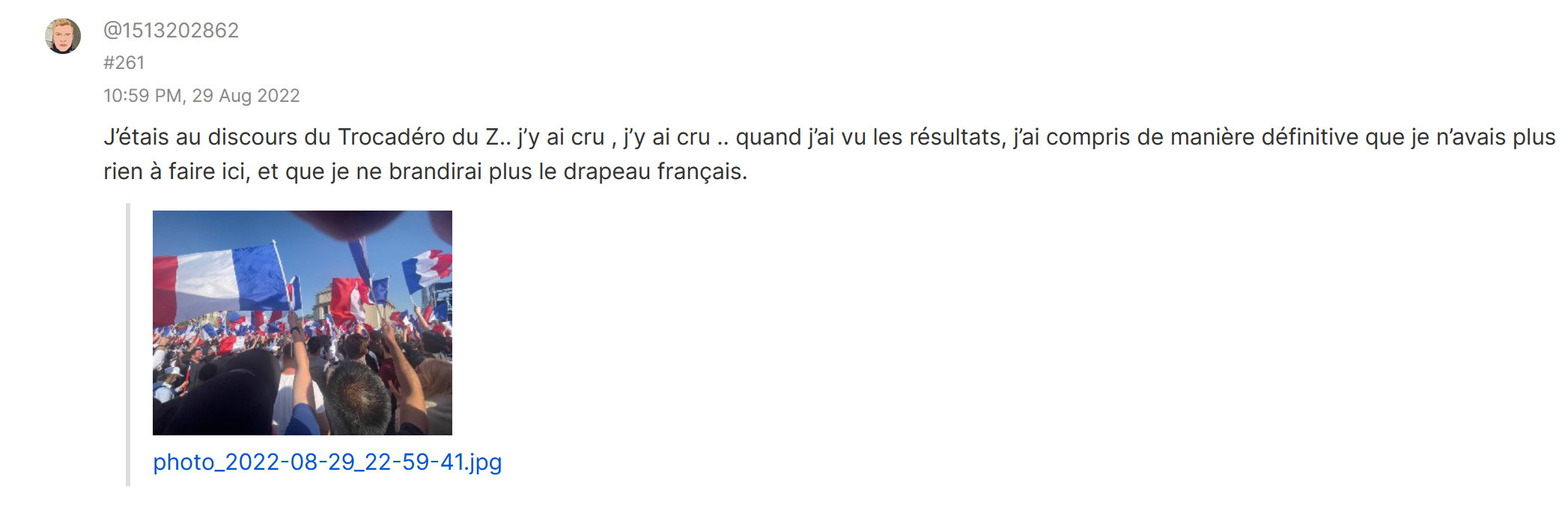
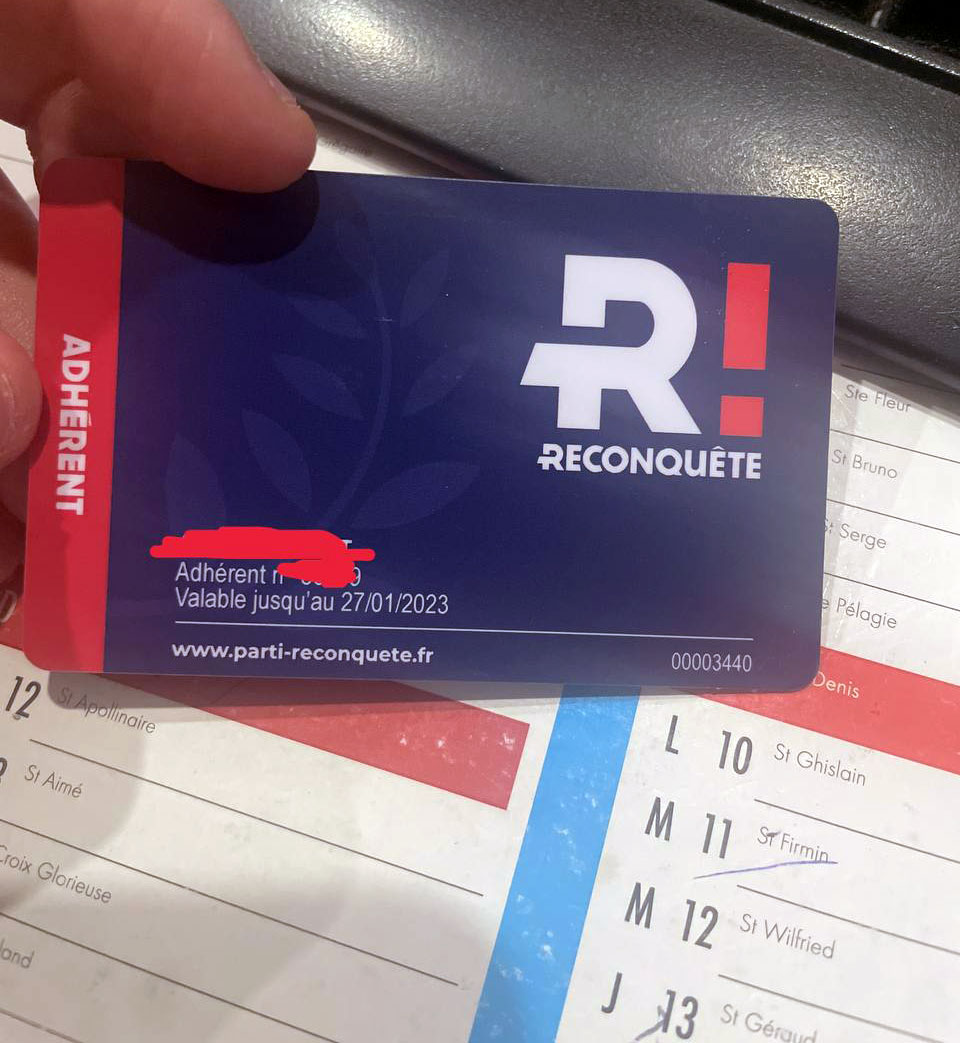
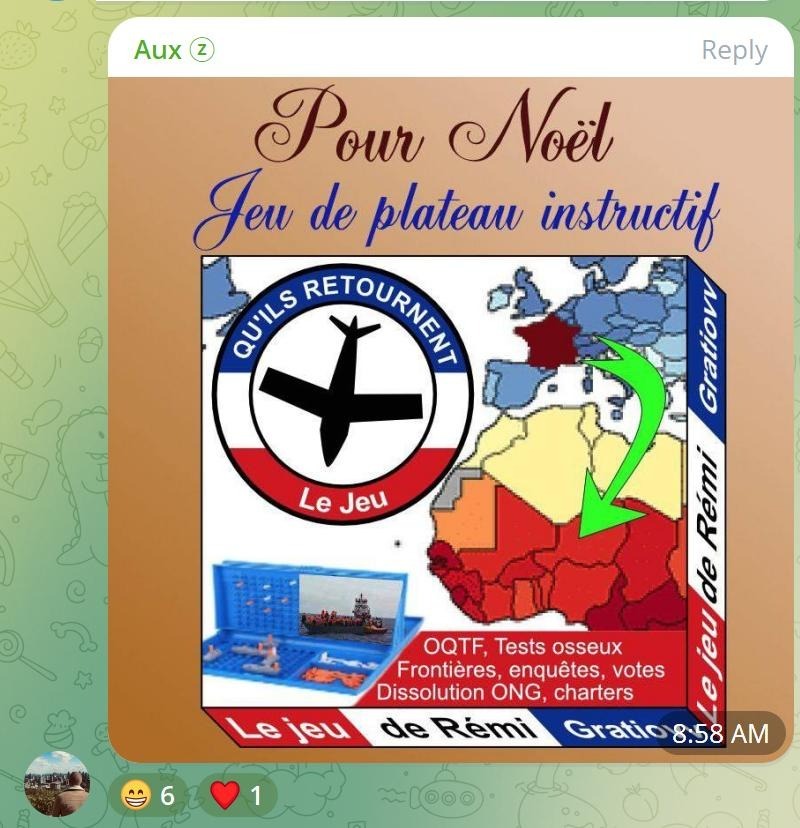
The user “Aux” is a young man from France who is preparing to move to Québec. He is a fervent supporter of Éric Zemmour (a former journalist who was a far-right candidate during the 2022 French presidential election, who makes Marine Le Pen seem like a cuddly kitten) and his organization Reconquête. Obviously, “AUX” ended up on the chat reserved for paying subscribers of Nomos TV because its host Alexandre Cormier-Denis was a strong supporter of Éric Zemmour. He’s been active on the chat since August 29, 2022.
From Mr Deez…
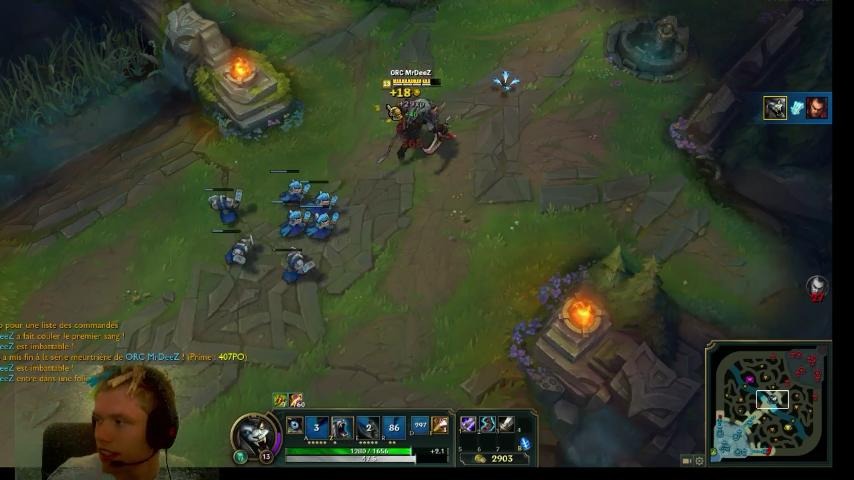
“Aux” is active in the video gamer community. He is most notably known as a player on the game Call of Duty, using the pseudonym “Mr Deez.” He also hosts a Twitch channel with 2,200 followers under that name and is behind the YouTube project “5 choses à savoir.” There is evidence galore that makes it virtually effortless to connect “Aux” to “Mr Deez”:
… to the Cop Jonot
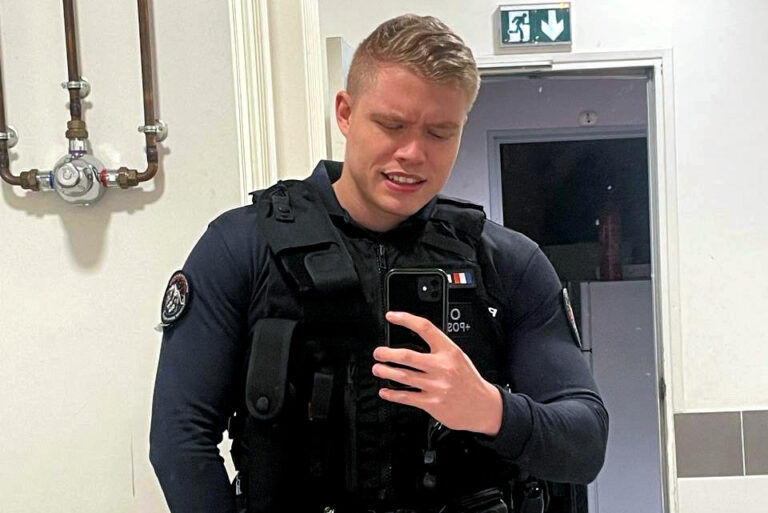
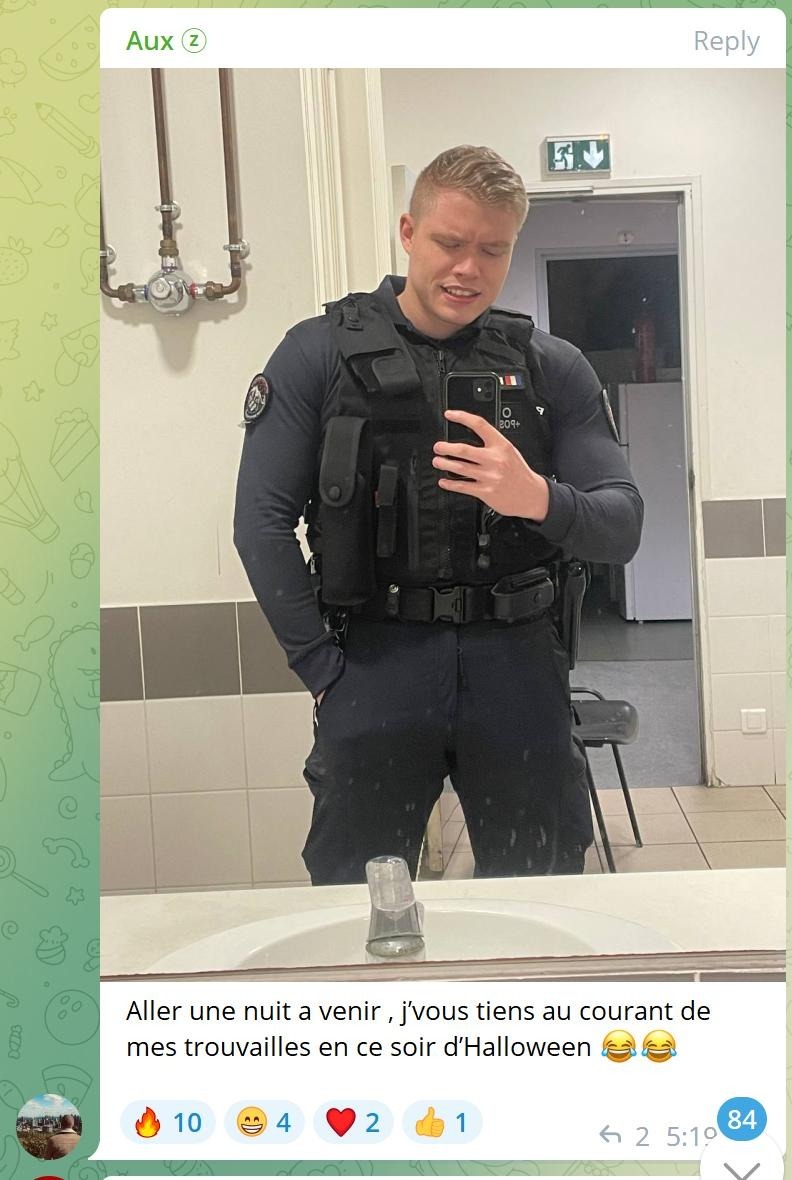
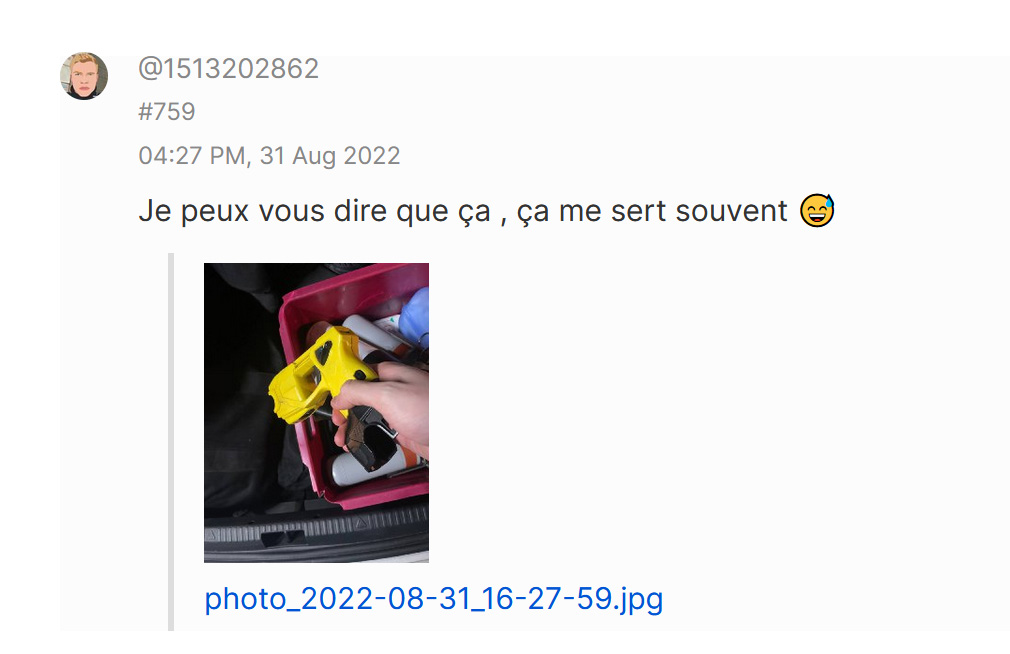
“Aux” finally divulged that he worked as a cop somewhere in the Parisian region. As well as posing in his uniform, he started sharing photos from his workday, e.g., photos of his Taser.
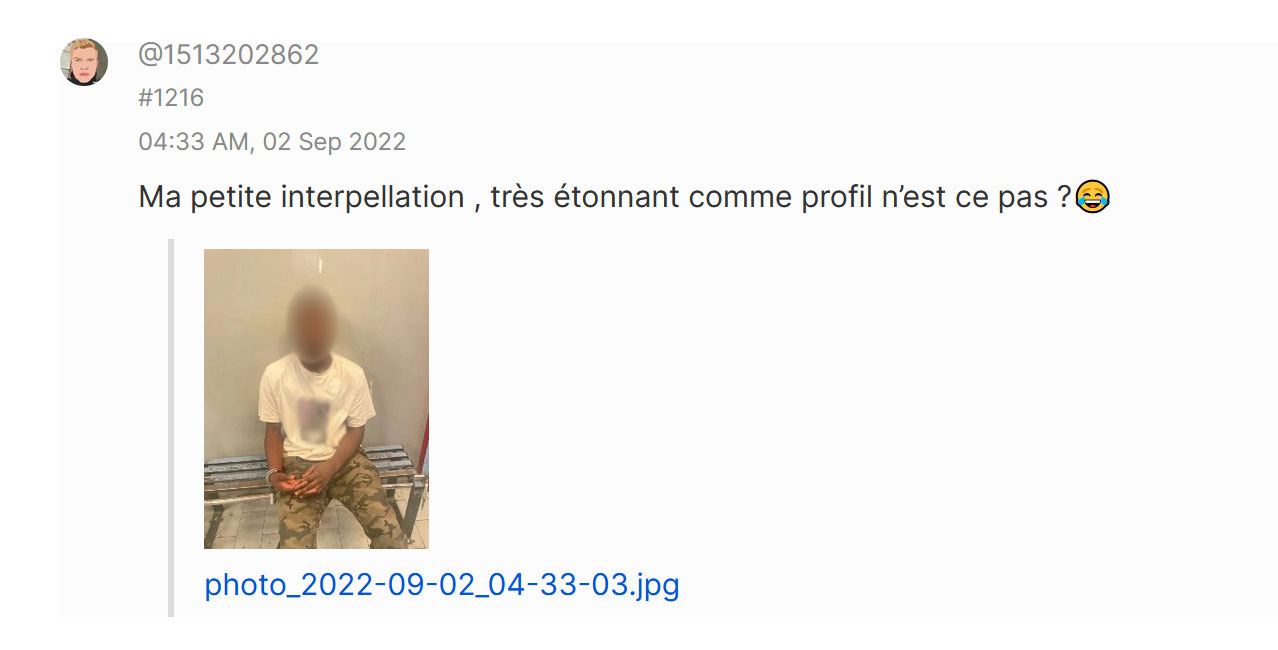
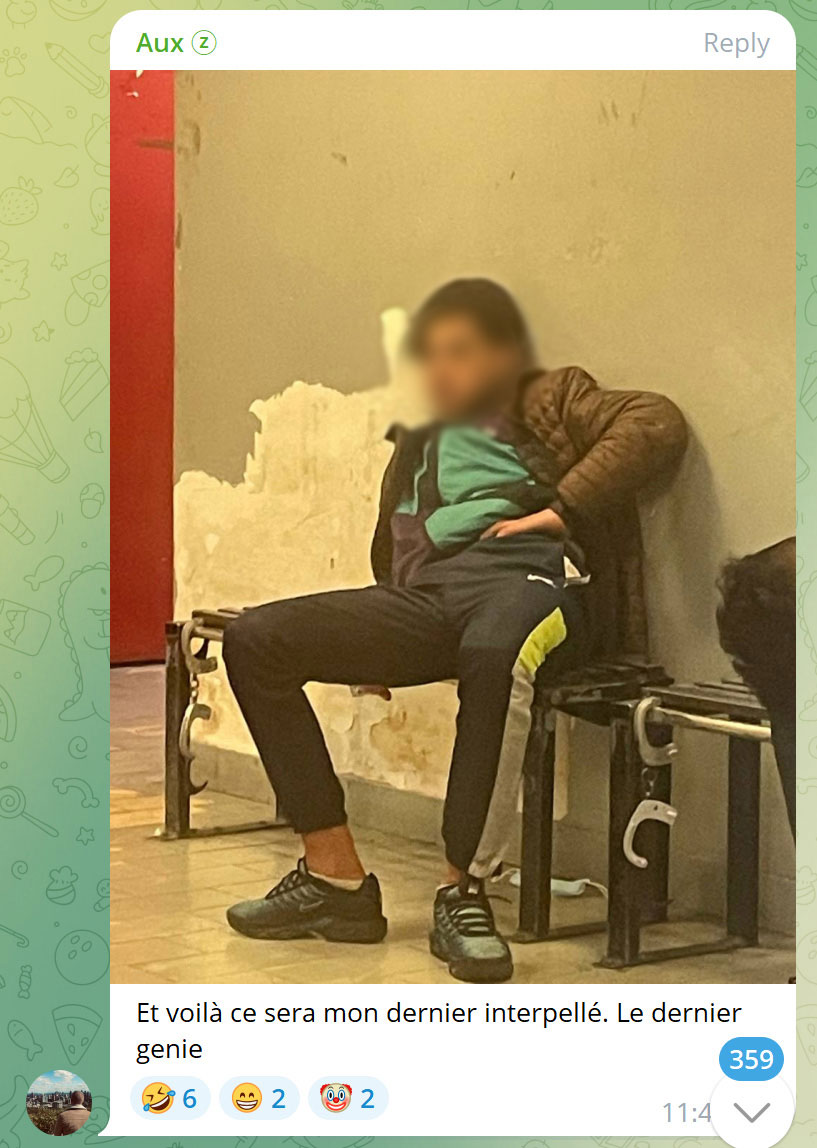
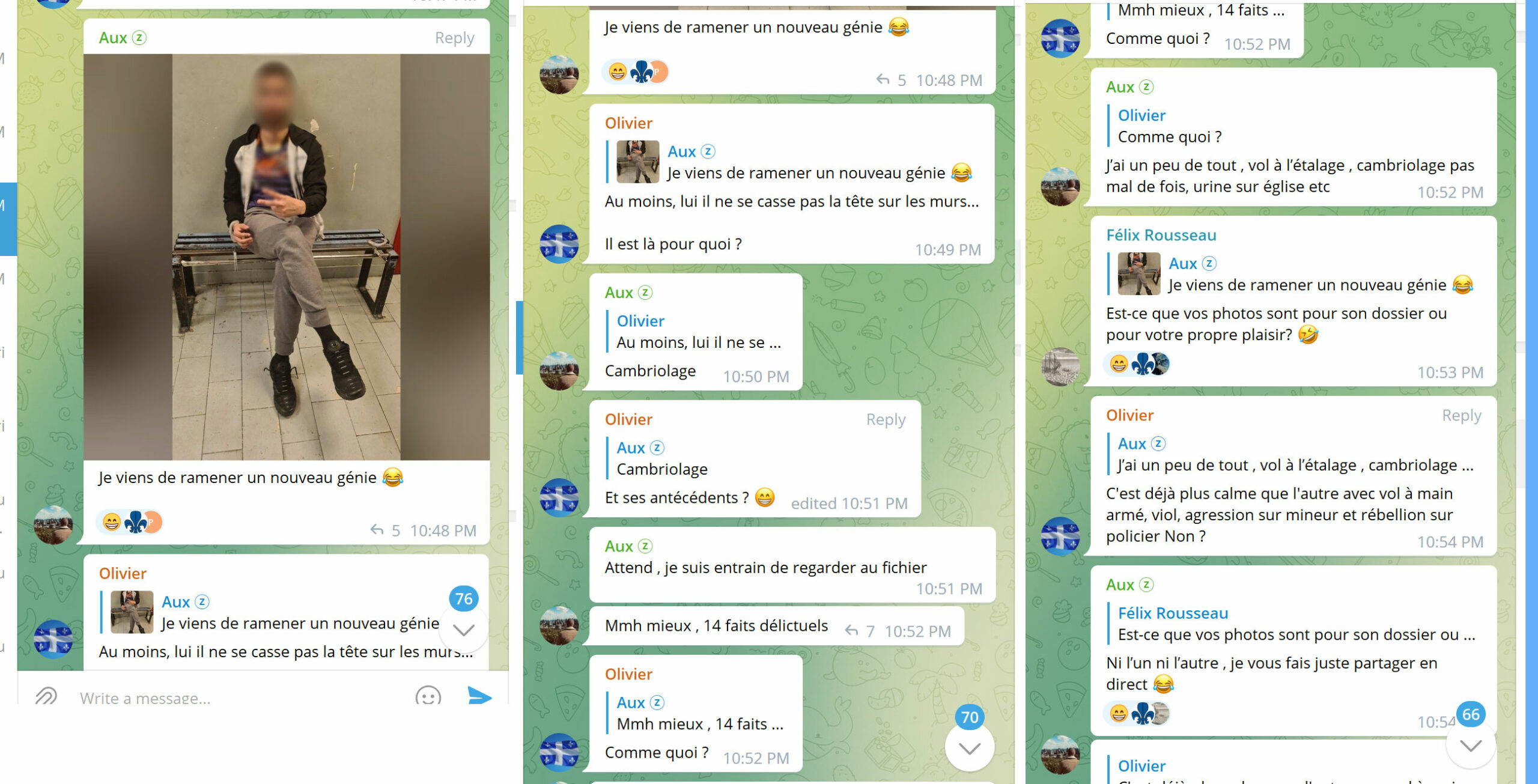
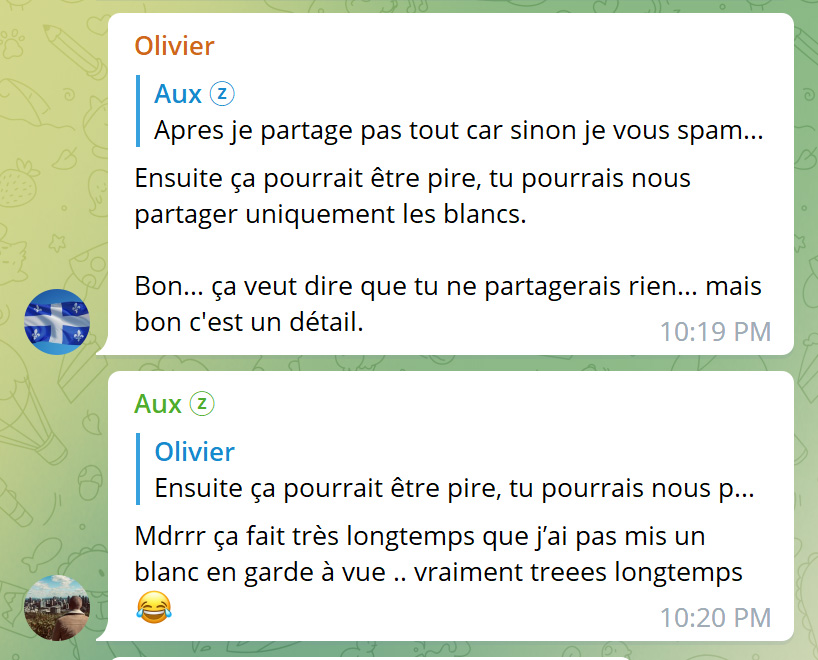
Even more shocking, he decided to share photos of arrestees in police custody—people handcuffed to a chair, obviously photographed without their consent. Growing increasingly uninhibited over the course of several weeks, he started to regularly publish the names and photos of people he questioned in a way meant to justify his racist ideology. He ended up publishing the photos and coordinates of at least fifteen detainees, revealing their arrest histories and the charges they faced, with tasteless racist commentary.
Here is a sample of the pictures of detained individuals that Auxane Jonot published on Nomos’ Telegram channel. We have blurred the faces and other elements that could be used to identify these persons.
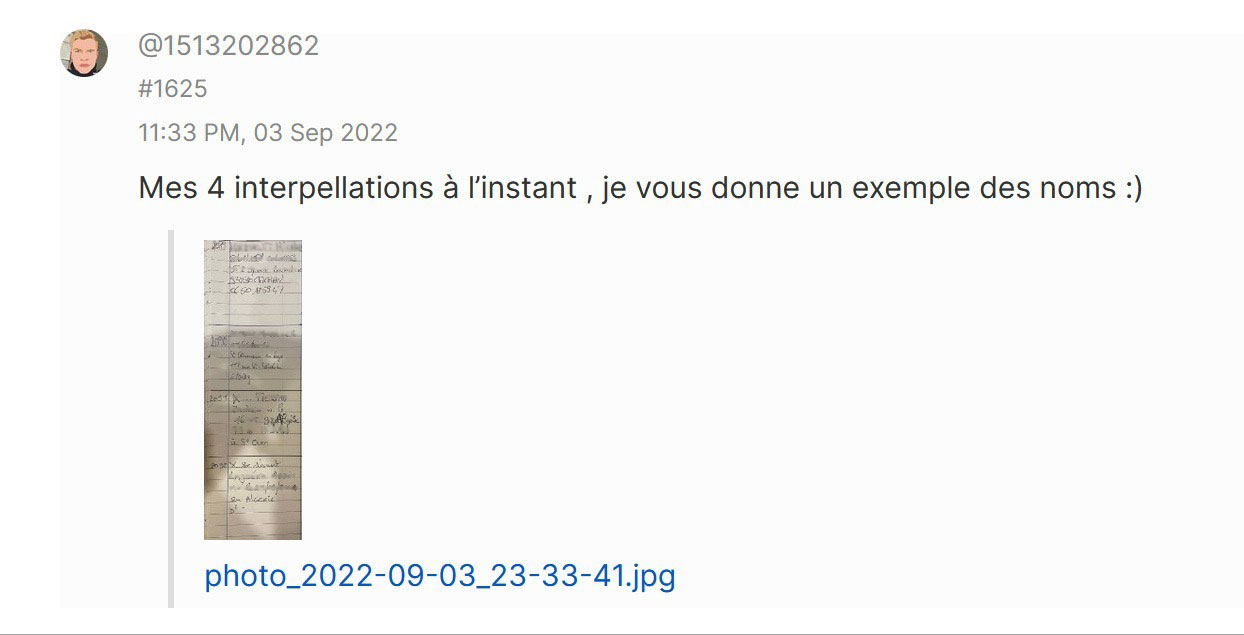
He even went as far as to publish extracts from his notes with names, birth dates, addresses, and telephone numbers—and a photo of the police internal computer system with details about a police intervention, with names, addresses, etc.—all of that as a pretext for a discussion of the “great replacement theory” and to denigrate people of colour.
“My four current interrogations will give you an example of the names 🙂 It’s us, we write very quickly 😭 they barely know how to write ahah In fact, I’m showing Québec that in France everything is going quite well and those who say otherwise are conspiracy theorists”
His behaviour and actions say a lot about the culture that reigns within the police services, which are submerged in systemic racism.
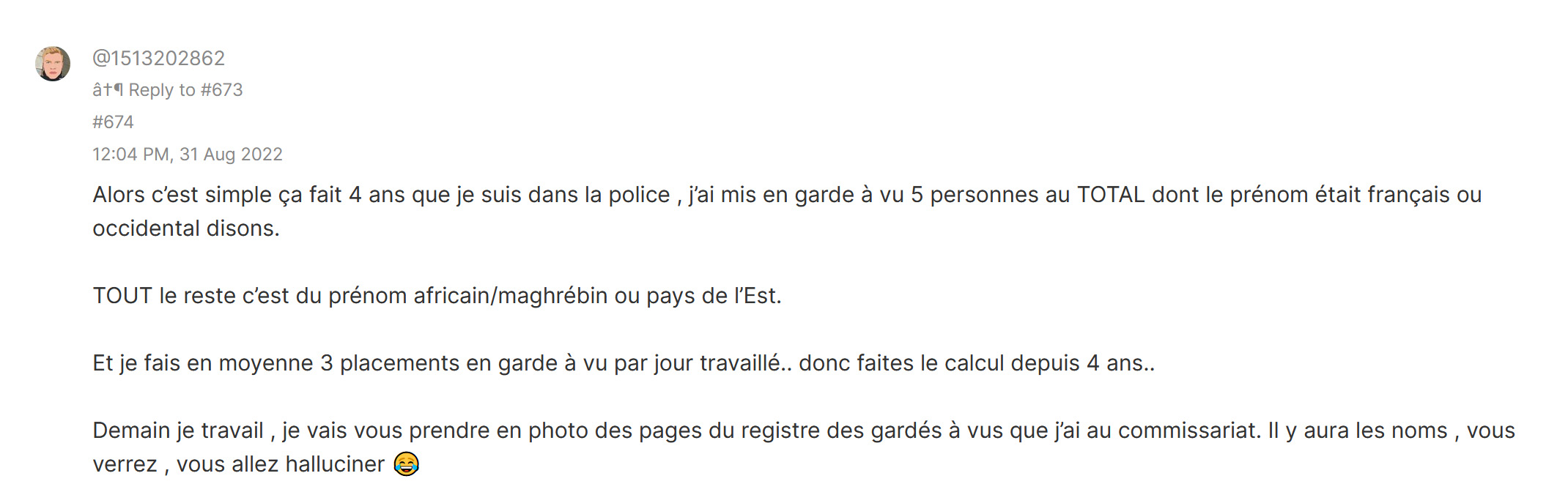
“Basically, it’s simple, I’ve been in the police force for four years and I’ve taken into custody five people with French or Western first names. All the rest had African/Maghrebin or East European first names.”
The Police and Systemic Racism
That the police is an institution that embodies systemic racism is not open to question—study after study proves it, with devastating consequences for BIPOC people (violence, death, imprisonment), as even police forces in large cities in Canadaarerecognizing. As we have seen, the Toronto police have lost the right to randomly stop people (the “stop and frisk” policy) because of flagrant racial profiling—and more recently Québec police lost the right to stop drivers without cause for the same reason.
There is also increasing documentation of substantial police sympathy with far-right movements, with some cops being members of far-right groups. In the case of the last January’s so-called Freedom Convoy, we saw examples of police being filmed offering their enthusiastic support, and even more shockingly have heard allegations of strategic leaks from “all police forces” to the convoy. In the US, we’ve seen the police offer support to militias intimidating Black Lives Matter activists, as well as not wanting to arrest Kyle Rittenhouse after he killed two demonstrators and seriously injured another at a mass demonstration. Rittenhouse was finally acquitted of all charges. In September, the Anti-Defamation League published a study addressing a leak about the American militia the Oath Keepers, which includes 373 police officers among its members, as well as relaying information about how they spread the militia’s anti-immigrant values within police forces. An ex–FBI agent also produced a report in 2020 that documented the extent of the connection between “law enforcement agencies” and militant racist activity in at least twelve states over the previous decade. In Europe, there are numerous studies addressing the far right in police forces—as the Guardian put it, there is a “culture of extremism,” including evidence that 81percent of police in France voted for the Rassemblement National, reminding us of the leak of a French police WhatsApp group riddled with racism.
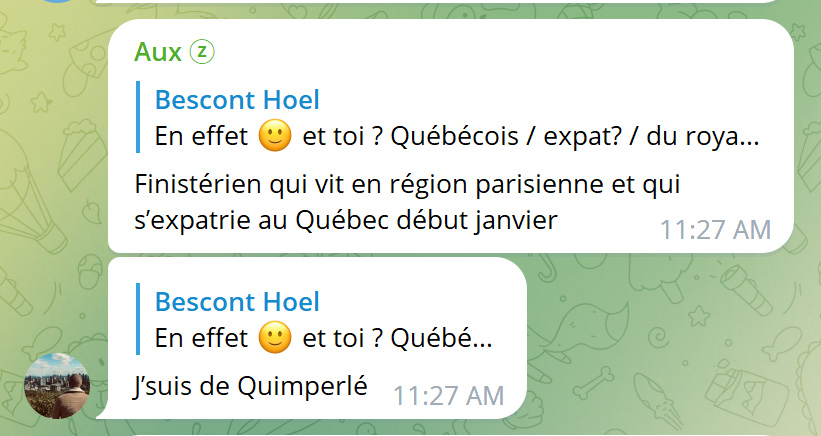
A number of clues scattered around the Nomos TV subscribers’ chat allowed us to quickly learn more about him. His first name is Auxane, he was born in the Bretagne region, and he lives in the Parisian region, where he worked as a police officer in Val-de-Marne (Department 94), specifically in the city of Arcueil.
His partner is a pharmacist who largely shares his racist ideas, which was confirmed by her Twitter account. It was from exchanges on their Twitter accounts that we were able to verify with certainty the identities of the couple Auxane Jonot and Emeline Maire.
An Imminent Arrival in Québec
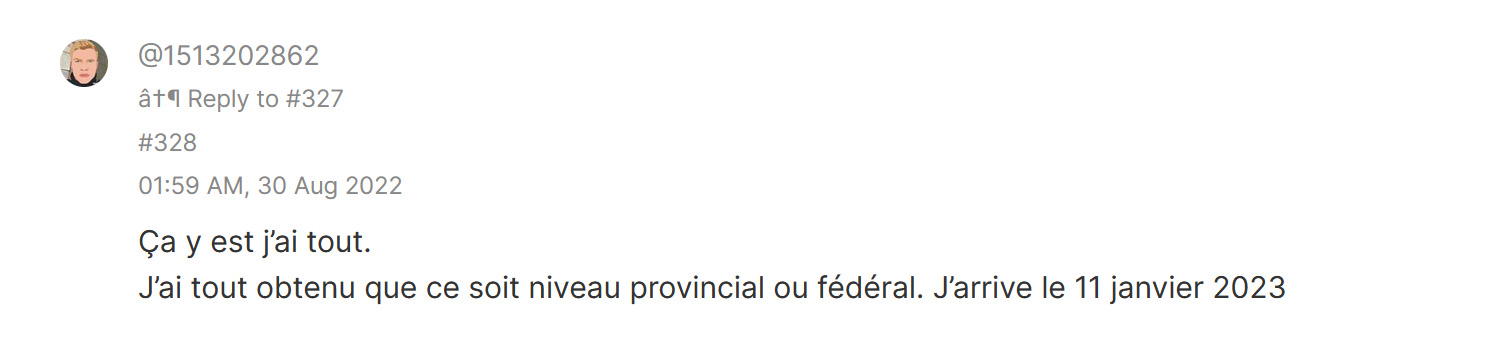
Fortunately for French youth, Auxane announced his resignation from his police position in November 2022. The French couple are now planning their move to Québec. They are scheduled to arrive on January 11, 2023.
They anticipated settling in Montréal, where Auxane would study computer science. On a chat, for example, Auxane asked:
“From your point of view, what are the best neighbourhoods in Montréal? The neighbourhoods most devoid of diversity”
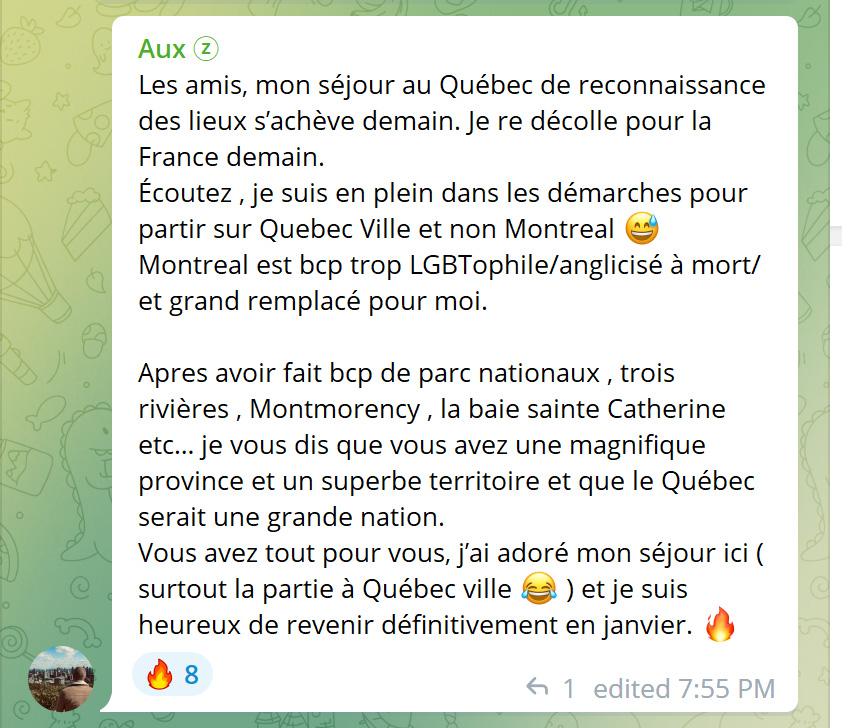
An exploratory visit last autumn changed everything. After that visit to Québec, Auxane said on the chat:
“Montréal is far too LGBTQophile/anglicized to death/and great replacement for me.”
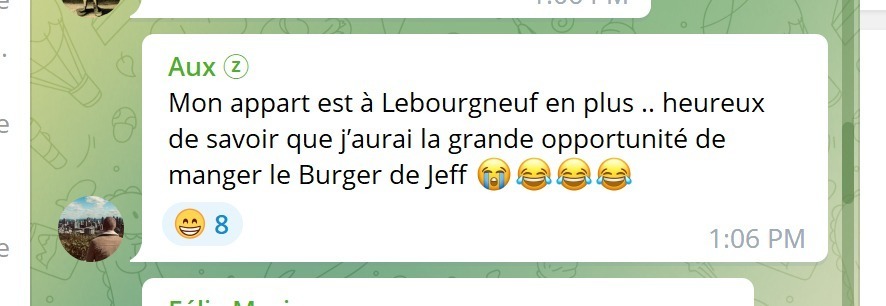
The couple have decided to settle in Québec City, which they judge to be more conservative. They have already found an apartment in the Lebourgneuf neighbourhood.
///
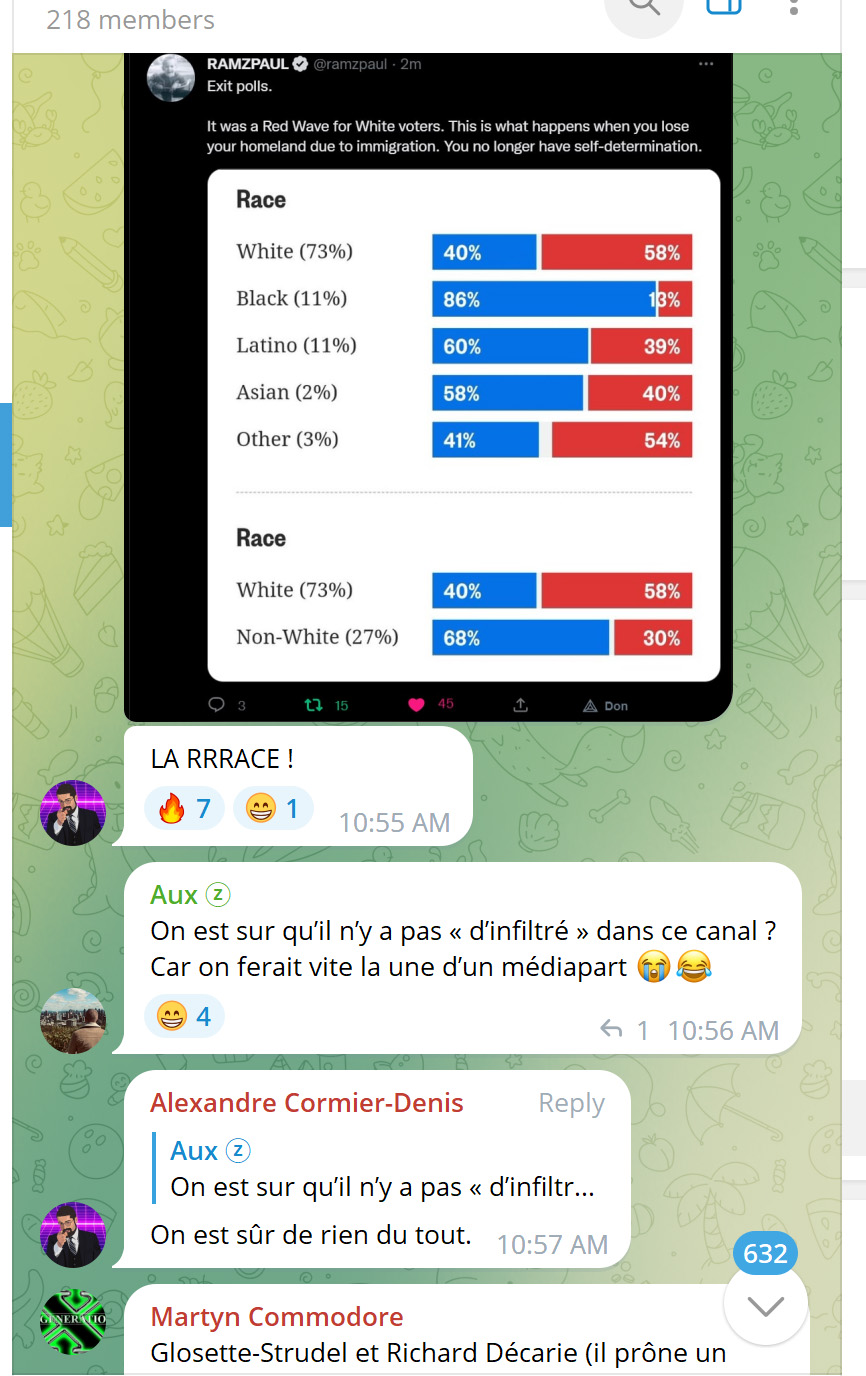
In a surprising moment of lucidity, Auxane Jonot posed this question on Nomos TV’s Telegram channel:
“Are we sure that there are no infiltrators on this channel? Because we’d quickly find ourselves the focus of attention on Mediapart”
This indicates that Auxane is entirely aware of the seriousness of his actions and statements, which expose hatred in a shared racist environment that he hopes is anonymous. But as Alexandre Cormier-Denis himself says: “We can be certain of absolutely nothing at all.”
Let’s make Auxane and Emeline feel unwelcome. And why not have them prominently covered in Mediapart!
There is room for everyone in Québec, except a former racist cop.
Refugees welcome, racists fuck off!
///
P.-S. Here is a last screen capture of a racist post by Auxane Jonot on Nomos’ Telegram channel. Surely, the ironic nature of this little “joke” will be lost on no one…
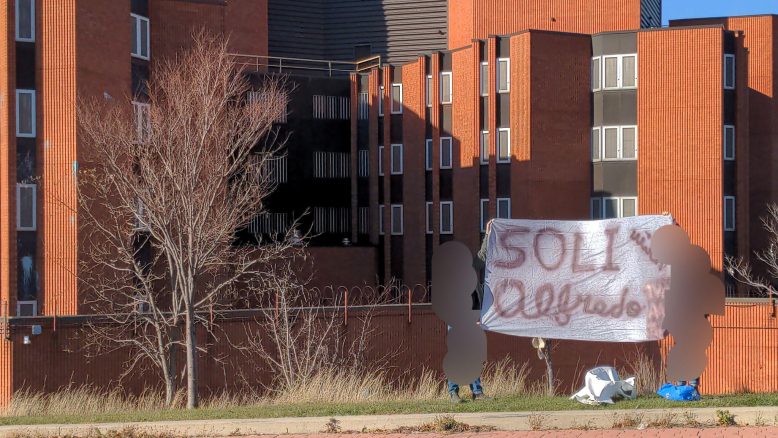
We were out holding up a banner with a phone number on it to connect with prisoners at the Barton jail in Hamilton, Canada, the way we usually do, but we thought we would also take a moment to express our solidarity with anarchist prisoners in struggle.
Alfredo Cospito has been on hunger strike in Italy’s Bancali prison since October 20th to demand that he be moved out of segregation and have his phone calls, mail, and visits restored. He was placed in these conditions back in May essentially to punish him for staying involved in the anarchist struggle from inside.
As the Barton Prisoner Solidarity Project, we strongly believe in not leaving prisoners behind and in supporting them when they struggle against the prisons that oppress them. Some of us have done time and others have supported their locked up friends, and we all know how important and valuable it is to keep anarchist prisoners present in our lives. Not as an act of charity for people who are locked up, but because of the comradeship and valuable contributions they can still make.
Ivan Alocco, Anna Beniamino, and Juan Sorroche are also anarchist prisoners who launched hunger strikes in solidarity with Alfredo, and we extend our solidarity to them as well. It is only through the multiplication and convergence of struggles that we gain the power to win, and know that as we work with prisoners in Barton to destroy prison here, all of you are in our hearts.
Our ugly, quick little banner is a small gesture, but know it represents your presence alongside us in struggle.
Comments Off on Announcing Creeker Vol 2 and The Creeker Companion Vol 2
Sep062022
Anonymous submission to MTL Counter-info
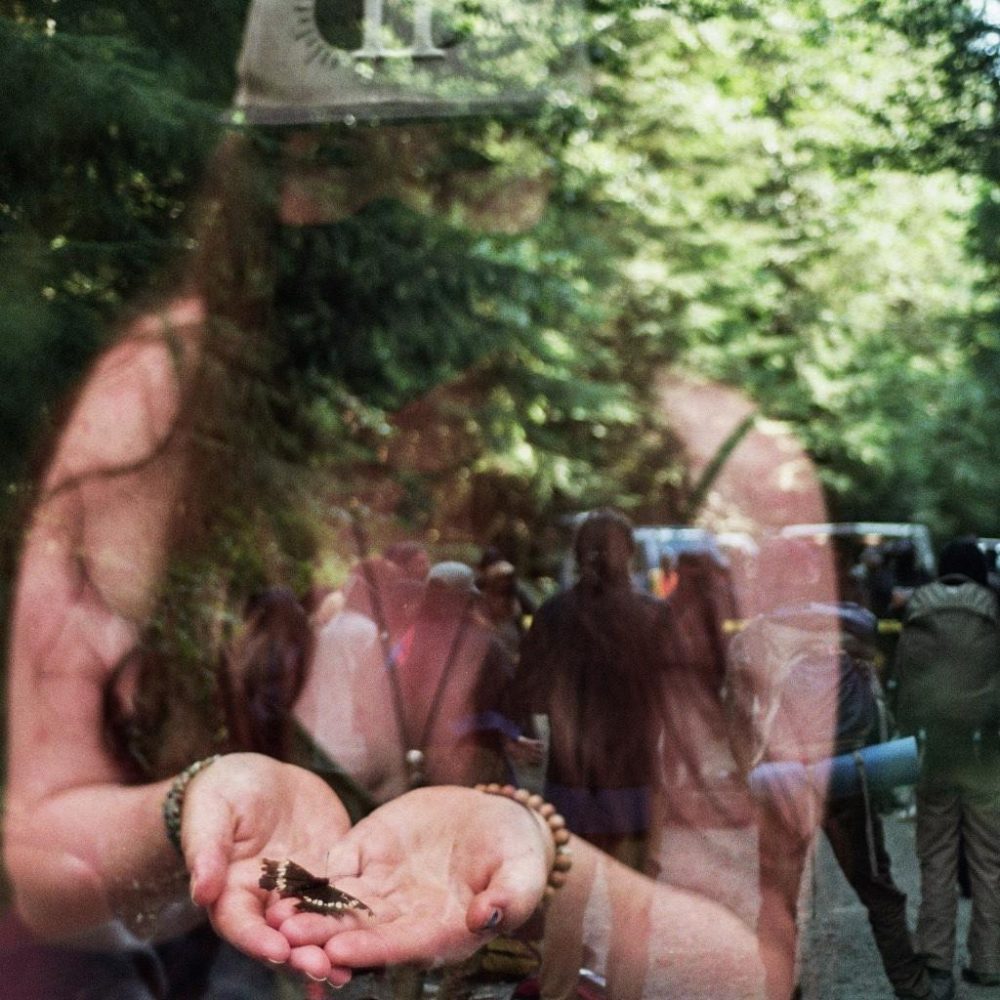
Creeker is a grassroots, anti-authoritarian zine series that aims to bring depth, variety, critique and continuity to the ongoing process of reflecting on the Ada’itsx/Fairy Creek blockade and related efforts. It is intended for creekers themselves, land defenders elsewhere, and the land defenders yet to come.
Last summer on so-called Vancouver Island, thousands of people moved through a de-facto autonomous zone spanning multiple watersheds. A constellation of struggle burned bright, welcoming into its fold a new generation of land defenders. We cannot begin to fathom the amount of stories of collective and individual experience that have piled up, but we also recognize how sleep deprivation, trauma loops, burnout, and the shock of returning to society can preoccupy our minds.
In response to an open invitation to contribute to this zine project, many have shared some of what they have begun to process. Creeker Vol 1 and Vol 2 include art, analysis, photography, history, personal reflection and poetry that were anonymously sourced from participants at the blockade.
Creeker Vol 2 expands on some of the themes of Vol 1 with eloquent and hard-hitting writing exploring the dynamics of autonomous forest defense in conflict with recuperative tendencies at Fairy Creek, and the ever-present treachery of environmental NGOs and the non profit industrial complex. Vol 2 also begins to revive vital histories of radical, uncontrollable resistance in the nearby Kax:iks/Walbran and Elaho Valleys, helping to bridge emerging generation gaps caused in part by decades of pacifist liberal whitewashing.
The Creeker Companion zines are curated to complement the Creeker zines with material that’s relevant to Ada’itsx and similar movements, but much broader in scope. Companion Vol 1 and Vol 2 both explore topics such as movement history, state repression, and thoughtfully critical approaches to identity politics. Vol 1 features mostly longer form pieces, while Vol 2 samples briefly from various material including essays, poetry, communiques and more, joined together with a playfully insurrectionary vibe.
At around 9am on Sunday, August 7th, Fierté Montréal informed the public via Twitter that they were cancelling the pride parade. While they initially claimed that there had been an impasse between organizers and the SPVM on questions of ‘security’ following early-morning negotiations, Fierté later retracted that statement, assuring the public that the SPVM had nothing to do with the decision. The current media line coming out of Fierté seems to be that the person responsible for making sure there were enough volunteers on the ground to block off the streets simply ‘forgot’ to do exactly that.
There is something surreal about the speed with which these stories are changing. It should anger us that Fierté can’t give us a straightforward, honest answer. Did they or did they not meet with the cops Sunday morning? What happened between the time they publicly announced that negotiations with the cops had led to an impasse and the time they retracted their statement to assure the public that the decision was, in fact, theirs and theirs alone? Why did Gamache later feel such a need to stress, publicly, how great the SPVM has been? The less said about the narrative according to which someone at Fierté simply ‘forgot’ to come up with 80 volunteers, the better. Why is it that they can’t speak to us plainly?
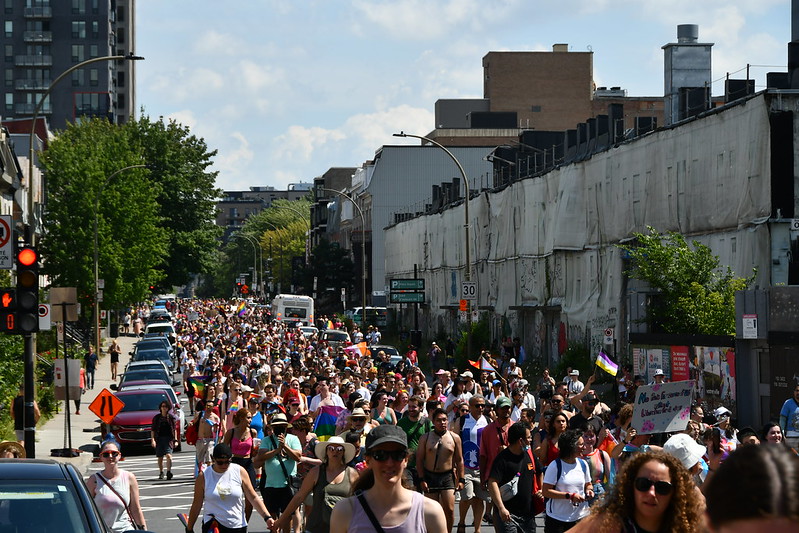
Angered by the decision to cancel the Parade, queers on social media called for the community to meet at Place Émilie-Gamelin. A spontaneous demonstration, led by queers and anarchists on site, left the square, heading West on Sainte-Catherine Street. There were no paid staff or trained volunteers, but there was a banner, black marker on cardboard, “Queer liberation without authorisation”, and another, “Fuck le cis-tème”. Rather than private security, politicians, or corporate sponsors, we had anti-police chants. We’d like to think the latter put out the right energy, because when we doubled back past the square, the street rapidly filled with more people.
The march continued through the Village, growing in size as it went, and up to Sherbrooke street, where it headed west. The demo was so big that we could never see the back of it from the front; one participant estimates we were at least 40,000 people. Bike cops surveilling the march were overheard telling participants: ‘You really don’t know where you’re going, do you?’ True, but as always, the cops missed the point. Folks might not have known where they were going, but they sure as hell knew exactly what they were doing. Refusing police presence at the march and pushing back against the anti-queer police/security logic which led to the cancellation of the parade, folks chanted, ‘La fierté, sans sécurité’. After the march turned north on Saint-Laurent, folks started chanting ‘Tou.te.s, uni.e.s, contre l’homophobie’, later holding a minute of silence for the victims of HIV/AIDS. The march then headed south and from afar, marchers could see the SPVM’s riot squad gearing up to protect… its headquarters. The march ended at the Quartier des Spectacles, with folks taking advantage of the water-works and blending into the crowd. As the march came to an end, a jock-strap sporting twunk said, ‘You see, this what happens when you say no to the gays’. Indeed.
Earlier that day, the SPVM had taken to twitter to let us know that “like every year, we were ready to oversee the event and we will be there for every edition”. It would seem, however, that very few cops were there for this year’s edition. While the SPVM did have a few bike cops present for the march, it was unable to adequately block streets, outpaced by the spontaneity of the march, as marchers looked out for one another rather than relying on police to keep us safe. This is precisely the kind of scenario that Gamache feared when he made a statement discouraging Pride-goers from joining “disorganized” marches throughout the city. This year, however, neither Gamache nor the SPVM had anything to say about what took place. Let’s make sure it stays this way.
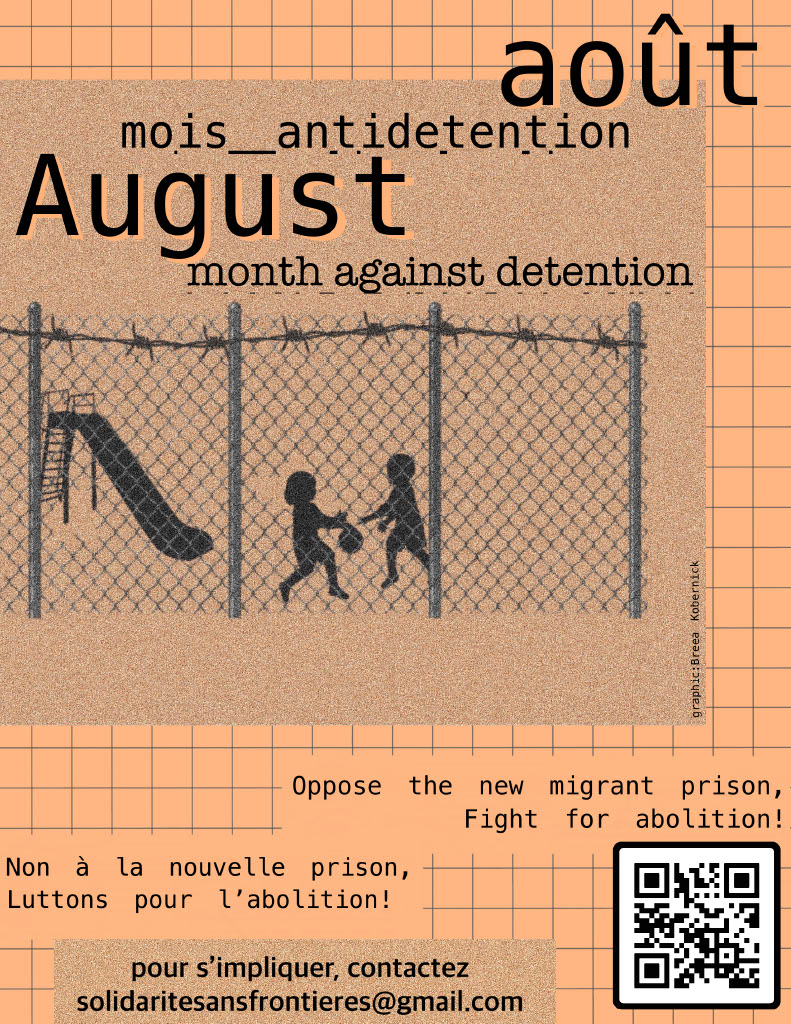
Month of Action Against the Migrant Prison. August 1-31, 2022.
Despite years of concerted opposition, construction is nearly complete on the new migrant prison in Laval. If it opens, it will maintain and expand the government’s capacity to detain, surveil and deport migrants. It will also serve to force migrants to remain in exploitative working and living conditions.
This August, Solidarity Across Borders will be holding a month of action to oppose the migrant prison, as well as to demand an end to all prisons. Join us for a series of workshops, film screenings, and demonstrations to assert: the only alternative to detention is status for all!
Oppose the migrant prison, oppose all prisons! Free them all! Status for all!
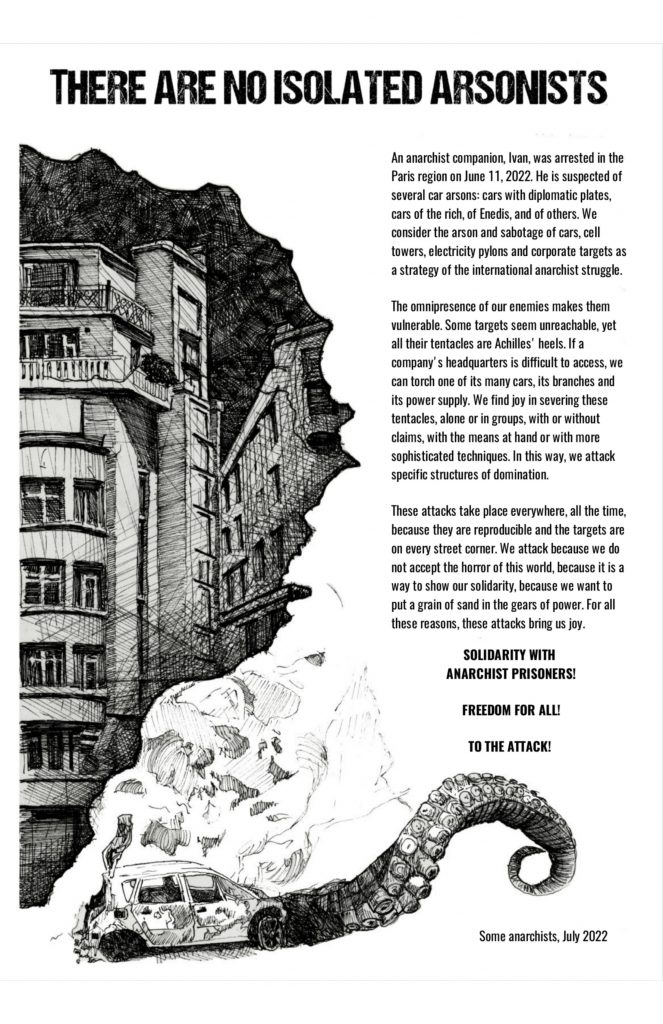
An anarchist companion, Ivan, was arrested in the Paris region on June 11, 2022. He is suspected of several car arsons: cars with diplomatic plates, cars of the rich, of Enedis, and of others. We consider the arson and sabotage of cars, cell towers, electricity pylons and corporate targets as a strategy of the international anarchist struggle.
The omnipresence of our enemies makes them vulnerable. Some targets seem unreachable, yet all their tentacles are Achilles’ heels. If a company’s headquarters is difficult to access, we can torch one of its many cars, its branches and its power supply. We find joy in severing these tentacles, alone or in groups, with or without claims, with the means at hand or with more sophisticated techniques. In this way, we attack specific structures of domination.
These attacks take place everywhere, all the time, because they are reproducible and the targets are on every street corner. We attack because we do not accept the horror of this world, because it is a way to show our solidarity, because we want to put a grain of sand in the gears of power. For all these reasons, these attacks bring us joy.
Solidarity with anarchist prisoners! Freedom for all! To the attack!
The anti-capitalist MayDay 2022 blatantly showed the limits of our offensive demonstrations. It’s a good thing that comrades were able to hit certain symbolic targets, but it’s a real problem that these attacks signaled the end of the demonstration instead of rekindling its momentum. We must therefore reflect on our means, our tactical choices, and our collective capacities.
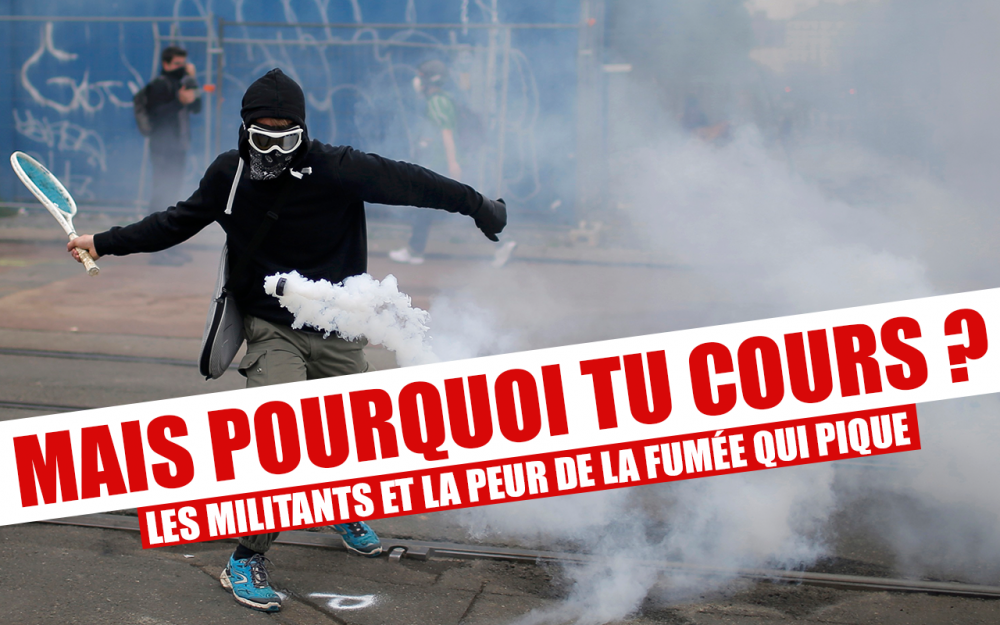
To start off, lets be clear that it is not the attacks that cause the demonstration to disperse. Some people will always leave an event when it starts becoming more offensive but this is not so much the case here, or only very marginally. We can assume that most of the comrades present know what they are getting into, and what to expect. In the same way, the massive police presence, sometimes sticking very close to the crowd, does not prevent the event from taking place (cf. the last COBP demonstration). The fateful moment arrives with the use of tear gas.
For some reason, the stinging smoke seems to instill a nameless terror in the Montreal milieu. Gas is certainly very unpleasant and can become a real problem for some people who are more sensitive to it, but this is certainly not the case for everyone and its use in other countries does not provoke the same reactions. In other places, the gas is often more concentrated and used more generously. So the problem here is most likely a lack of training and collective solidarity. I think we can identify several interrelated factors; fear of the gas and its effects, fear of arrest, collective panic/mob movement, and local culture.
I run because you run…
The fear of gas and its effects seems at first to be quite rational. It is normal to try to get out of a painful or uncomfortable situation. However, this fear of pain or discomfort is largely disproportionate. The problem with this phenomenon is that it acts as a self-fulfilling prophecy. Everyone knows that the effects of gas tend to worsen with fear or stress, especially for people who are not used to it. The act of trying to get out of the gas at all costs paradoxically reinforces its effects by contributing to collective panic phenomena. Moreover, when desperately trying to get out of the area, we are more likely to make bad tactical choices, individually or collectively. Some people choose to leave the demonstration in small groups, under the illusion that they will be able to rejoin later. In fact, the behavior spreads and the random calls to gather elsewhere only serve to camouflage the chaotic dispersal. It seems to me that this state of affairs must be radically changed.
First of all it’s good to draw the attention of the demonstration to what the police are doing, but shouting “they are gassing” seems to have the opposite effect of what is desired. Even before seeing the pucks bouncing on the ground, a wave of panic runs through the group and those with less experience already start to run. A solution should be found so as not to indirectly reinforce the effectiveness of the police attacks. Perhaps it would be good to punctuate these calls with encouragement not to panic, to stay together, and not to run.
When the capsules are on the ground, rather than trying to get away from them, it should be common practice to move them away from the demonstration, or even to return them to the sender (the cops on bicycles did not have masks on May 1st and seem to have been quite inconvenienced by the gas). When some people did try to move the capsules away, most of the observed attempts were to kick the capsules towards other parts the demonstration, even if this was not the objective. The intention of these comrades is good, but their initiative is made very complicated by the fact that the demonstration is already starting to break up, that the area to protect is becoming blurred, and that they risk finding themselves isolated.
Once the gas starts to spread, let’s invite the more panicked among us to take a second to analyze the situation. Is the gas really that bad? Are the police really getting too close? Does it look like they are targeting people or preparing to make arrests? Does it look like they are trying to set up a trap? If none of these conditions are met, running will only make the situation worse. Instead, we can stick with our buddy, stay with the group, follow the front banner, and try to remain calm to not to worsen the effects of the gas. To escape in small groups is an individualistic solution to a collective safety problem.
Of course, sometimes it is necessary to run, but again, there is no need to start a panicked sprint if the cops are not on your tail. In most cases, it is enough to jog a few dozen meters to get out of a dense cloud or to get out of the riot squad’s reach. Not running too fast also contributes to maintaining the coherence of the demonstration, prevents slower comrades form falling behind, and avoids the targeting of isolated individuals.
But… I run because YOU run…
The risk of arrest has been discussed above, but it seems important to return to it in more detail. This fear is much more legitimate than just the fear of gas. Getting caught can have serious consequences for the lives of comrades, especially if they have carried out offensive or criminalized actions. Again, it seems that the solution everyone chooses is to try to get out alone, or with their small group.
It should be remembered that currently the cops are trying to target certain people from the demo, but rarely the crowd as a whole. By running around unreasonably, we make their work easier; individuals and small groups are isolated, changing as best they can, without any protection, with the omnipresent risk of being arrested, especially for the slowest or least discreet. This provides opportunities for the police, whether the person has done anything or not. Most of the time the riot police charges are just to make us run or back up. Due to their heavy equipment, they will not try to follow us for long; their tactic is essentially to scare us by shouting “Boo!”.
However, there is no simple solution for how to resolve this issue of fear of the police and the lack of trust between comrades. It is a matter of learning to work together to develop the solidarity that is sorely lacking. It is also necessary to train collectively and to participate as groups so that there is a critical mass of people who know each other and are familiar moving together, to prevent our demonstrations from descending into “everyone for themselves”.
Should we stop running then?
It is therefore necessary to speak here about the question of collective panic and crowd movements. We have seen that these demonstrations exhibited patterns of irrational behaviors (fear of gas, arrests etc.) which provoke a form of collective panic. In my opinion this is the main danger in our demonstrations, before the police and their weapons. We should not be surprised by police brutality, arrests and trials. All revolutionary militants know these risks or have experienced them. Nevertheless, most of us began our involvement with the idea that collective force was the way to make change. But these moments of individualistic breakdown are a blow to the beautiful myth of solidarity in our movements; when the going gets tough, it’s every person for themselves and then we’ll see each other afterwards. For new people, this can put them off organizing with us for good. This problem on its own should encourage us to find solutions but unfortunately it is not the only one.
A crowd movement caused by panic can be particularly dangerous and difficult to stop. The size of the demonstration makes the danger limited in our case and should not cause any deaths. Nevertheless, it is not difficult to imagine that serious injuries could be caused by the movement of people trying to escape from the gas and/or the police; pushing and shoving making people fall down, trampling of people who have fallen on the ground, not to mention the inherent dangers of traffic.
It is very difficult to stop these kind of panicked movements once the phenomenon spreads through the group. Everyone has experienced it, it starts with a few people running or shouting and soon the panic spreads like a wave through the group to the point that even cool-headed people are forced to run or become isolated (thus participating in the reproduction of the phenomenon). It is essential to try to nip this panic in the bud. We must calm our panicking comrades and make them come to their senses. We must refrain from running as long as possible and regularly call on everyone to remain calm, grouped, and united.
…I’m lacking trust…
Here we must point out the underlying problem of everything that has already been raised; the lack of a culture of collective resistance that encourages united behavior. It is still incredible that, in a city that has so many revolutionary militants, better coordination is not possible. The lack of practice is definitely a factor, as offensive demonstrations are not so frequent throughout the year, but the problem remains. The work carried out by certain groups to organize these moments is disproportionate in relation to the duration and impact of the event. It is the responsibility of everyone to make the best use of these dates that we impose on the calendar of our enemies; 20 minutes of attacks in the city center should not be enough to satisfy us, nor should the disconcerting ease with which the police are able to stop the problem. Far from coming out of it energized, I am instead assailed by a feeling of great collective weakness. Comrades should forgive this conclusion which contrasts with the usual post-demo self-congratulations, but this text does not seek to play the role of a press release. There are clearly problems, and it is important that we address them collectively.