Montréal Contre-information

Prison, solidarity and isolation on New Years

 Comments Off on Prison, solidarity and isolation on New Years
Jan 132017
 

Anonymous submission to MTL Counter-info

On the night of December 31, a small group of people went to the Joliette federal prison for women, with a banner, casseroles (pots and pans) and fireworks, in order to continue the tradition of celebrating New Years with those locked up behind the walls of the State.

When we arrived, two women inmates were in the yard of the prison, and asked us to leave. One of them left running to potentially alert someone to our presence, while the other explained that if we don’t leave, their visits the next day will be canceled. Unlike last year, the women stayed inside the housing units while looking out the windows. We shot off some fireworks while leaving, not knowing how to react. We believe that the authorities punished the inmates last year for our presence and their enthusiasm by perhaps blocking their visits and putting them in lock-down. We don’t find this surprising on their part, given that they maintain their authority by imposing fear, and in this way, repressing desire for freedom.

Until the last brick, let’s destroy every prison!

150, 375: rebels come alive!

 Comments Off on 150, 375: rebels come alive!
Jan 132017
 

Anonymous submission to MTL Counter-info

This year, Canada is celebrating its 150th year of colonial existence, and Montreal its 375th. Throughout the next year, we’re going to be celebrating the histories of resistance to the colonial project of Canada, by continuing to bring them into our struggles in the present. This is a call for anarchists across the territory of so-called Canada, and everyone fighting against colonial society, to combine our diverse capacities to fight this ongoing nightmare in all the ways that we can.

The project of Canada has been one of ongoing genocide against indigenous people through various forms, from the intentional spreading of small pox to the conditions that create staggering numbers of missing and murdered indigenous women and men. Canada attempts to impose dependence on colonial society by destroying the autonomy of indigenous people to live off of their land base (through the reservation system), and through cultural genocide to instill generational fracturing and collective amnesia (institutionalized through the residential school system up until the 90s).

We want to sabotage the machinery that makes this colonial legacy function. This machine’s infrastructure and development projects of exploitation mean devastating the land that all life is nourished by. It means the policing apparatus of Canada, from the onslaught at Gustafsen Lake to the widespread sexual violence against indigenous women by the SQ. It means the projects of social control necessary for Canada to function; the systematic forced sterilization, the reservation system, and the mass incarceration of indigenous and black people. This machinery is also social – the social identification with the city, the nation and with whiteness.

375: Montreal comes alive! is a tourism campaign where each neighbourhood of Montreal has been allotted money by the State for their celebrations. This will be used as an opportunity to further gentrification and social cleansing, and to normalize the State’s narrative of a benevolent and inevitable colonization. The program of events, and promotional videos, primarily feature white francophone artists and musicians – demonstrating who they’re staking their bets on in this new project of development and control through nationalist and hipster artists and Quebec popular culture. Though this campaign is unabashedly white supremacist in who they are trying to mobilize, we’re also overly familiar with the script of Canadian multiculturalism – of representing and integrating different identity categories into the genocidal project, for a more insidious social control.

At the very least, we can show that there are people who Canada is attempting to integrate into this white supremacist framework who are in rebellion against it. Let’s find whatever ways that we can to connect across the segregated lives that we feel every day. Through such connections, we can look toward creating a project of rebellion that people can identify with, outside of the right hand of white nationalism, and the left hand of liberal multiculturalism.

Here are several ideas for how people can self-organize to respond to this call:

– Disrupting the festivities of 375 and 150, in every neighborhood of Montreal and across Canada.
– Fostering relations of solidarity between people who want to fight the project of Canada. In this, we think it’s crucial to not reproduce passive ‘ally’ politics, where ‘allies’ don’t carry their own reasons for fighting. Everyone has a stake in defending the land from colonial destruction. For anarchists, we have innumerable reasons to fight and be in reciprocal solidarity with anyone struggling against the borders, police, resource extraction, and the economic domination that Canada requires. We think that statements like ‘being an ally to indigenous people’ is contradictory and meaningless when we recognize that homogeneous categories of people don’t exist. In fact, there are often conflicts within indigenous communities around goals and tactics that shouldn’t be sidestepped. For instance, at Standing Rock the Red Warrior Camp (which employed confrontational and disruptive tactics against the pipeline) was asked to leave the camp by the chiefs who condemned any action outside of non-violent civil disobedience that appeals to white and media legitimacy.
– Creating counter-information to communicate anti-colonial perspectives.
– Confronting, disrupting, attacking all manifestations of the colonial order: the functioning of the capitalist economy, resource extraction projects and infrastructure, the repressive apparatus of police and prisons, the dominant narratives of colonialism (in statues, museums, churches, etc.), and however colonialism is being maintained where you live.

The existence of Canada and Montreal is inherently a project of control and ecological devastation – this is what ‘progress’ and ‘development’ looks like. These processes further fracture any semblance of community that we can even try to nourish, which in turn profoundly impacts our capacities to rebel. We want to break with the social relations of production, consumption, citizenship and whiteness. We want to create the possibility to live different relations, which also means creating opportunities to be uncontrollable. We want to disrupt the narrative celebrating a benevolent and friendly Canada. Let’s fuck with them at every turn. Let’s shut down Montreal, let’s shut down Canada.

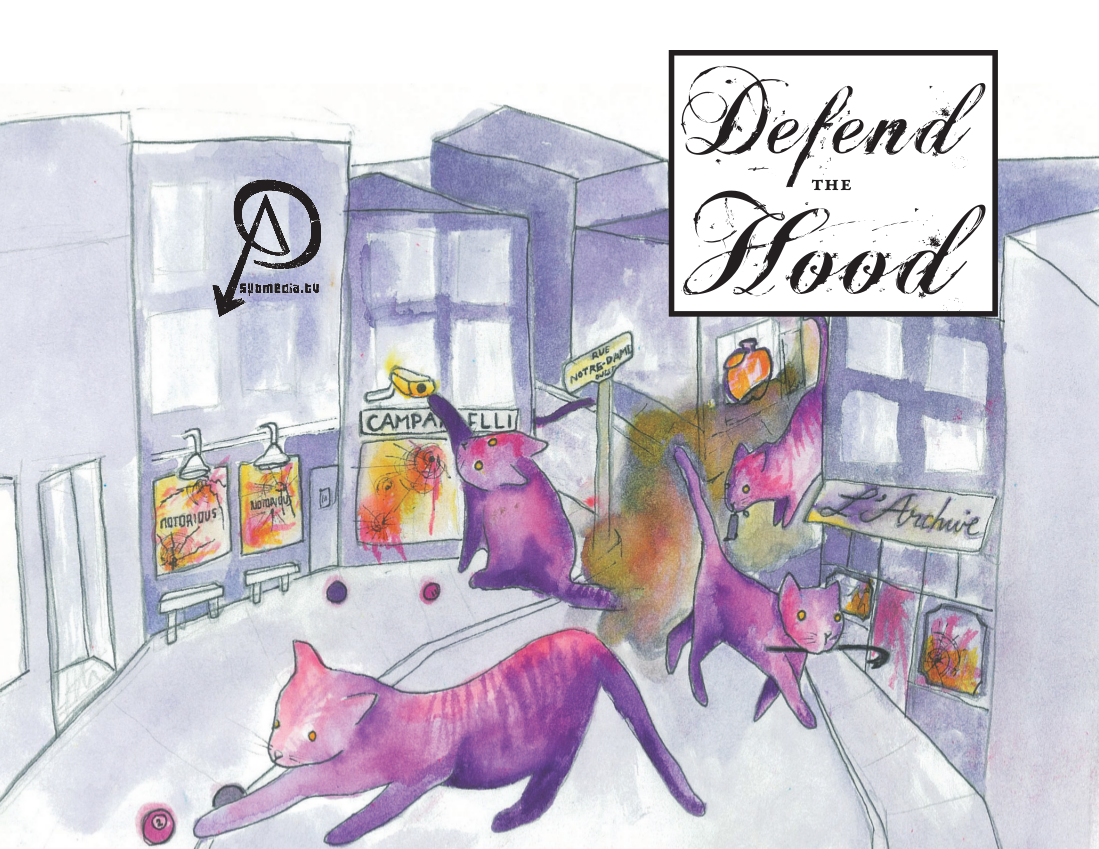
Defend the Hood

 Comments Off on Defend the Hood
Dec 222016
 

From subMedia.tv

Download zine (letter-sized)

Make sure to press CC on the video player for English subtitles

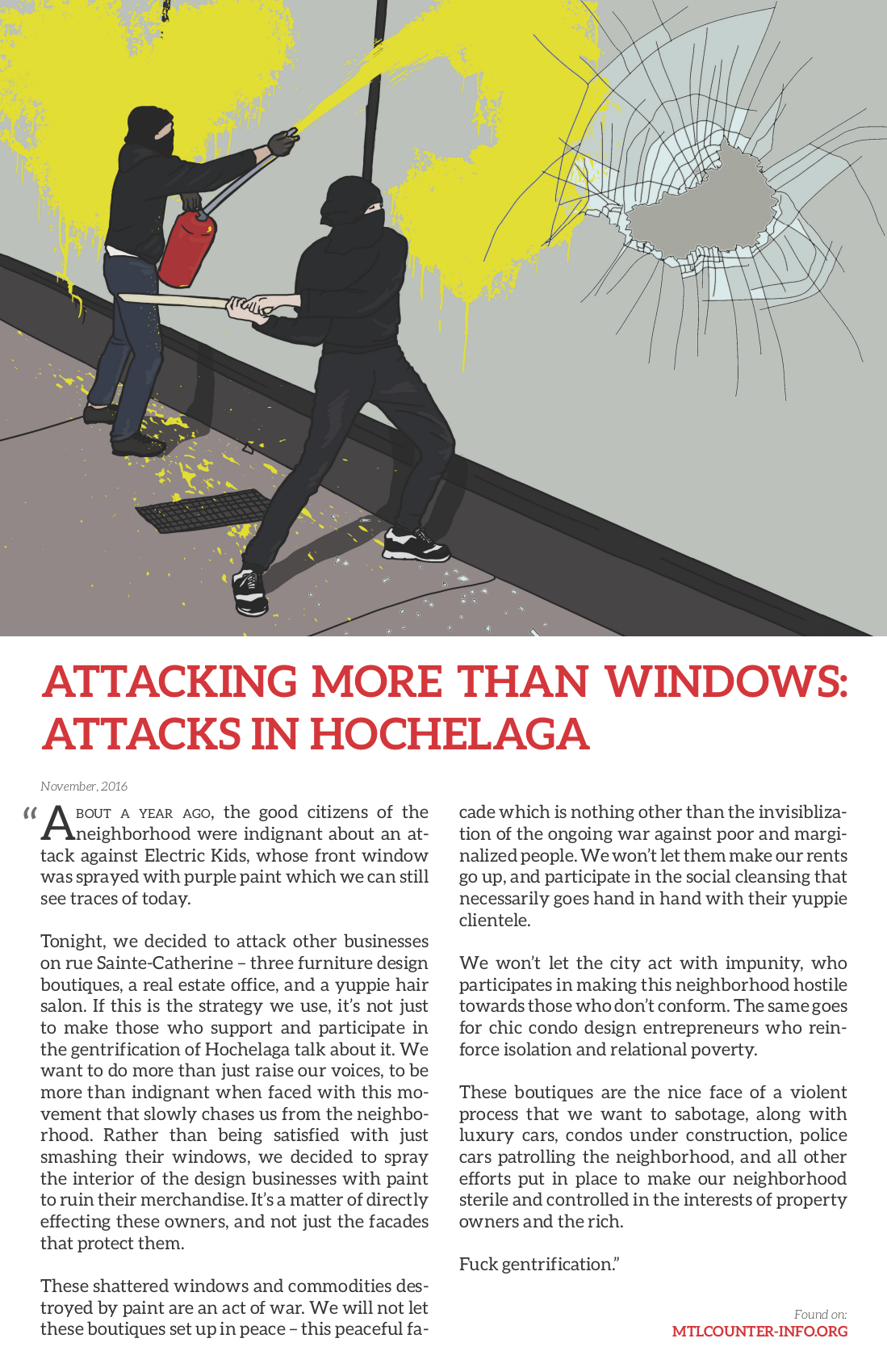
In 2016, numerous attacks were launched at diverse symbols of gentrification in the Montreal neighborhoods of Hochelaga-Maisonneuve and Saint-Henri. We wanted to give space to the people involved so that they can explain a point of view, that corporate media consistently ignore or misrepresent. subMedia has obtained an exclusive interview with two anarchists involved in the actions.

To protect their identities, the voices have been dubbed by actors.

What does it mean for you to fight against gentrification?

1. Before anything else, we’re just talking for the two of us, not for anyone else who participated in the action. We don’t want to represent anything.

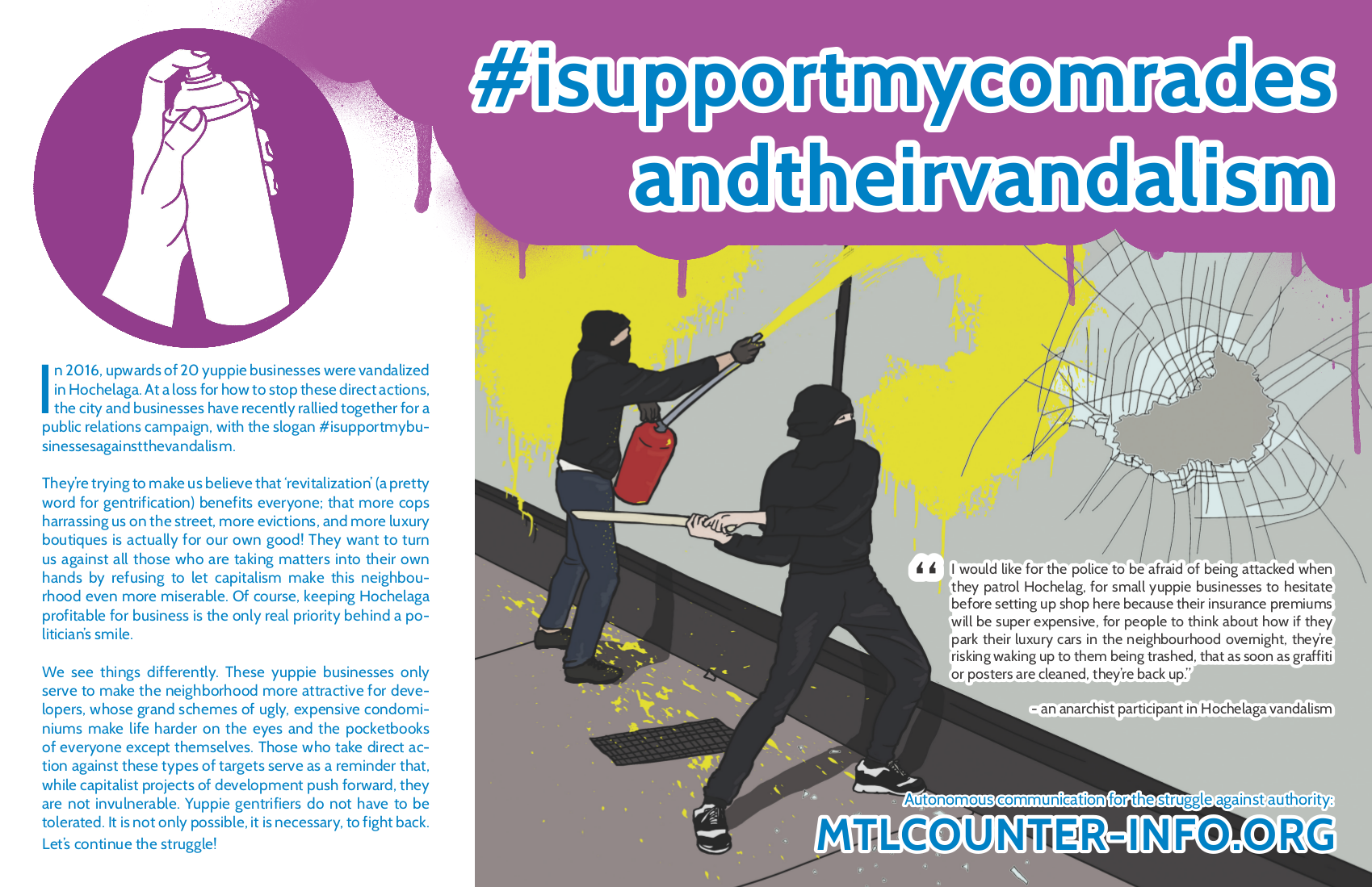
2. I don’t want to limit myself to fighting against gentrification, which I see as an intensification of the misery of capitalism. And I’m against capitalism in all its forms. I struggle against gentrification because it effects my life and the lives of many people, but also because it’s a context that allows the exchange of ideas and practices, to nourish a larger perspective of anarchist struggle. I’ve been inspired by anarchists in other cities who have anchored their struggles in where they live. They’ve managed to make certain neighbourhoods dangerous for the authorities and not very welcoming for capitalist businesses. I would like for the police to be afraid of being attacked when they patrol Hochelag, for small yuppie businesses to hesitate before setting up shop here because their insurance premiums will be super expensive, for people to think about how if they park their luxury cars in the neighbourhood overnight, they’re risking waking up to them being trashed, that as soon as graffiti or posters are cleaned, they’re back up.

1. And if we want these people to be afraid, it’s because we want the space to experiment with other ways of living, and cohabitation with them isn’t possible. Their world will always want the destruction of other worlds, those of freedom, of sharing and gifting, of relations outside of work and leisure, of the joy outside of consumption…

2. I think it’s worth being explicit about how the struggle against gentrification is inevitably a struggle against the police. The main tool that the city has to move forward with its project of social cleansing is the police and the pacification of residents. This reality is at the heart of the reflections that orient our actions. The pacification takes different forms: it’s the installation of cameras, the management of parks and streets, but also it’s the imaginary created by bullshit narratives like “social mixity”. The public consultations, the studies and projects of affordable housing are all just a facade: during this time, the social cleansing advances and more and more people are evicted. If these means of pacification don’t work, the city has recourse to repression, that’s to say, the police. It’s the police who evict tenants, prevent the existence of squats, etc. Every form of offensive organization that refuses the mediation attempts of the municipal authority will one day be faced with the police. So it’s also important to develop our capacity to defend initiatives against repression.

Without necessarily throwing aside community organizing, many anarchists prefer the method of direct action. Why?

1. We don’t have demands. We didn’t do this action to put pressure on power, so that they grant us certain things. For sure people should have access to housing, but I don’t think that we should wait for the State to respond to the demands for social housing that have existed since the 80s, in a neighbourhood undergoing gentrification. I’m more interested in seeing what it would look like for people to take space and defend it, without asking. I’m not interested in dialoguing with power.

2. Dialogue with the municipal authorities is, along with the threat of police repression, the principal method of pacification. To keep us in inaction, imprisoned in an imaginary where we can’t take anything or stop anything from happening.

1. What’s special about direct action is that you finally do away with the ultimate mediator, the State, by acting directly on the situation. Rather than giving agency to the city, in demanding something of it, we want to act for ourselves against the forces that gentrify the neighbourhood. The State is afraid of people refusing its role as the mediator.

Why choose a strategy of direct action outside of a context like those created during social movements?

2. Because we don’t want to wait for the ‘right context’. We think that it’s through intervening in fucked up situations in the world that we live in that we create contexts. The fact that this world is horrible is in itself a ‘good context’. Revolt is always worthwhile, every day.

1. I think that’s important to emphasize, I don’t believe in waiting for social movements to act. Acts of revolt have many impacts, even if they’re not inscribed in a social movement. And also, when the next moment of widespread revolt comes, we’ll be better prepared to participate.

Lastly, what do you say to those who say that gentrification is an inevitable process?

1. Gentrification is a process of capitalism and colonialism, among others. It makes itself seem inevitable, and maybe it is, but it’s nonetheless worthwhile to struggle against it and to not let ourselves be passive. In a world as unlivable as the one we’re in, I have the feeling that my life can only find meaning if I fight back.

2. At best, the process of gentrification will move elsewhere, if a neighbourhood resists. And yet, struggling against capitalism and the State opens up possibilities that otherwise wouldn’t have existed.

8.5 x 11″ | PDF

Fuck all pipelines: three banks sabotaged in solidarity with #NODAPL

 Comments Off on Fuck all pipelines: three banks sabotaged in solidarity with #NODAPL
Dec 192016
 

Anonymous submission to MTL Counter-info

On the night of December 13, 2016, three branch locations of banks invested in pipelines were sabotaged in different Montreal neighborhoods by coordinated groups. We glued locks and ATM card slots at branches of Toronto Dominion and the Royal Bank of Canada. We painted #NODAPL and ‘Solidarity with all land defenders’ on the walls outside.

TD and RBC are among the largest Canadian investors in the Dakota Access Pipeline. RBC is also a major investor in Enbridge’s Line 3, which was just approved by the federal government of Canada, and an investor in Kinder Morgan, whose Trans Mountain pipeline was also just approved by the federal government here. There has been resistance to Enbridge and Kinder Morgan for years. We are continuing it here and we expect it will keep happening. Fuck all the pipelines.

These actions were undertaken by anarchists in solidarity with the ongoing fight in Standing Rock to stop the Dakota Access Pipeline from being built, by whatever means necessary. We know the Army Corps of Engineers has refused to grant an easement to the Dakota Access Pipeline, but we also know that Energy Transfer Partners has vowed to build the pipeline despite this news. The struggle continues. We support land and water defenders all over the world who are fighting infrastructure projects that continue the genocidal march of colonialism and capitalism.

We know that it is necessary for us to come together to fight this system. Sometimes we are most effective out in the open in the fields and streets, and other times we can strike hardest in the quiet of the night. We look forward to joining you wherever the coming struggles take us.

#NoDAPL!

Water is life, oil is death!

Fuck the pipelines, fuck the banks!

Leave the oil in the ground!

Solidarity with #NODAPL: How to block trains

 Comments Off on Solidarity with #NODAPL: How to block trains  Tagged with:
Dec 132016
 

Anonymous submission to MTL Counter-info
Disclaimer: This video is intended purely for informational purposes only, and does in no way encourage or condone any illegal activity.

Trains are one of the main ways that oil is transported across Turtle Island. Physical blockades of the tracks have been used effectively many times to hamper ecocidal projects of “resource extraction”.

We can also block the rails in a sneaky way: by tricking the signalling system into thinking there is a train on the tracks. This trick will force train traffic to come to a halt until the signal blockage is cleared. It can be done in under a minute, and repeated many times to have a significant impact on train circulation. It can take hours to find and remove this blockage, stopping all train traffic in the meantime.

Here’s how their system works:
A low velocity current runs through each rail. The electricity runs across the junctions of an individual rail with copper wire connections. When a train passes, it forms an electrical connection between rails and signals its presence.

Here’s how we can block the signal:
Get some 6-gauge booster cables. You can paint the wire black to make it harder to find. Rust on the tracks can prevent a solid connection, so connecting directly to the tracks might not work. To avoid this problem, find a section of rail where two junctions are side by side, and connect the copper wires with the booster cable. You can hide the wire with snow or rocks. The connection will lower railway crossing barriers that are nearby.

More cameras, more targets!

 Comments Off on More cameras, more targets!
Dec 012016
 

camlolz

Anonymous submission to MTL Counter-info

Over the last few months, friends have been playing Camover in the neighbourhood of Hochelaga. We’ve destroyed around twenty security cameras. For your pleasure (and certainly for our own as well!), here’s a photo in which we see a friend sporting a necklace of optical trophies.

In response to the recent smashings of gentrifiers in the neighbourhood, and in the context of twenty-two businesses being vandalized in the last year, the city and the police have publicly announced a renewed collaboration. They’re desperately trying to reassert control, faced with people who “aren’t afraid of the police”, and their initiative to install more cameras shows it. Of course, the police know that it’s impossible to be everywhere all of the time. There will always be loopholes that allow those who are creative and well-prepared to attack. That’s where cameras come in: to make us feel powerless and watched. But our masks will continue to give us power against any camera. No face, no case. And so, to keep up morale, we’ve decided to see this increase in the presence of cameras in the neighbourhood as an occasion for more CamOver and increased sabotage of the mechanisms of control that the authorities put in place.

We decided to play, and will continue this game of revolt, which is simultaneously thrilling and frightening, where we learn to overcome fears, deal with stress, and expand our capacities, because this is ultimately about more than the gentrification of a particular neighborhood. What’s happening in Hochelaga speaks to a history of struggle against domination as old as civilization itself: a multiplicity of wild and uncontrollable worlds that resist and evade the world of order and ‘progress’.

Who is this ‘we’? We’re some friends who decided to autonomously destroy some cameras. Despite what the politicians and mass media want people to think, by trying to uncover who’s behind this ‘vandal group’, there is no mafia-like network to take apart. Anarchists don’t act from a chain of command, we act from the feelings in our bones. No police operation against any fictitious ‘network’ can stop people from deciding to self-organize, don a mask, and attack.

bye

11 x 17″ | PDF

Candies for children, rocks for the rich

 Comments Off on Candies for children, rocks for the rich
Nov 292016
 

Anonymous submission to MTL Counter-info

On Monday October 31, about 75 people assembled in Hochelag’ with costumes and candy for a Halloween demonstration against gentrification. In a carnivalesque mood, the small crowd took the streets and put up graffiti on the walls of the neighbourhood. In the wake of the demo’s path, one could read: “fuck homa”, “genre = cauchemar” (gender = nightmare), “tout le monde déteste la police” (everyone hates the police), “junkies contre la gentrification” (junkies against gentrification), etc. This gave a bit of colour and life to Hochelag’, a neighbourhood which is undergoing sterilization so that, slowly but surely, all that can thrive are condos, yuppie grocery stores and high-end clothing stores.

This demo intended to overturn the dynamics of daily life, in plain view of people who live in the neighbourhood, against the cops who protect the new businesses, putting up tags that won’t be cleaned by the next day. In the time of this demo, we could live in this neighbourhood differently, in a more uncontrollable way.

The demo strolled through the streets towards Ste-Catherine, while shouting chants like “ des bonbons pour les enfants, des cailloux pour les bourgeois” (candies for children, rocks for the rich). Given it was Halloween night, the streets were lively and the demo had several positive reactions from people on the street. Cops arrived after about twenty minutes. It was around then that a crew of teens who were chilling in a park came to join the demo. They went up to the person offering them candy, looted the entire bag, and made their getaway through the alleyways. But the excitement was too much to pass up, and they didn’t wait long to reappear and continue to follow the demo.

While the first police car positioned itself in front of the demo, a person ran ahead to cover the back of the car in graffiti scribbles, which caused the police to take more distance. After turning on Davidson, people started to smash the windows of luxury cars with hammer blows. This irritated the cops, who were more aggressive from then on. That’s when the first rock was thrown, followed by joyous shouts from the crew of teens. The demo busted through Davidson park, took Cuvillier and evaded the cops who were sticking close behind.

As soon as the demo got to Ontario, a group of people ran back to attack the police car with a dozen rocks. However, this caused the police to react by charging this small group with the car, rather than retreating from the attack, as one might expect. The cops could have easily ran over someone at that moment. We think that putting barricades between cop cars and projectile throwers could make these types of situations safer for us in the future. This could involve dumpsters on wheels that can move with the demo, or cars bumped into the street. Another thing to consider is that rocks can break through the side-windows of a car, but not the front windshield: so, if we’re aiming at the later, the cops inside are less likely to feel threatened and retreat. On top of that, people quickly exhausted their projectile reserves. The charging cop car sounded the dispersal: people fled through alleyways and adjacent streets.

We thought this demo was interesting for several reasons.

First off, we believe that it’s interesting to take advantage of Halloween to have a demo, because it’s possible to be masked in the street without looking suspicious. On this night of the year, everyone in the streets looks more or less sketchy, which facilitates the dispersal of the demo.

We were also into the emphasis that this demo placed on counter-information in the neighbourhood, with graffiti and posters, on streets like Ste-Catherine which are normally too patrolled by cops for people to dare put up graff. It’s powerful to be able to mark the walls of the neighbourhood without having to hide in the shadows of alleyways.

It was also interesting that this was a neighbourhood demo, compared to downtown demos with hostile routes walked a thousand times over, and where police repression is stronger and often makes us hesitate to act. Having a demo in a neighbourhood where we live and our friends live resonates with our resistance in this space.

[Best_Wordpress_Gallery id=”11″ gal_title=”Haloween demo”]