Montréal Contre-information

mtlcounter-info

Jun 212012
 

Download 11″x17″

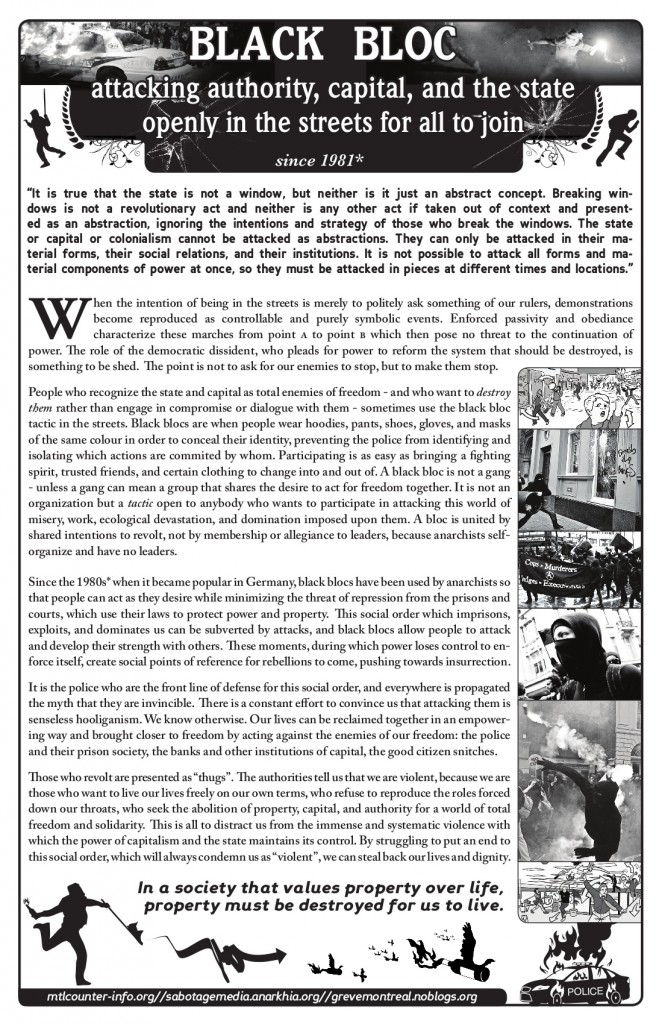
Black bloc: attacking authority, capital, and the state openly in the streets for all to join

“It is true that the state is not a window, but neither is it just an abstract concept. Breaking windows is not a revolutionary act and neither is any other act if taken out of context and presented as an abstraction, ignoring the intentions and strategy of those who break the windows. The state or capital or colonialism cannot be attacked as abstractions. They can only be attacked in their material forms, their social relations, and their institutions. It is not possible to attack all forms and material components of power at once, so they must be attacked in pieces at different times and locations.”

When the intention of being in the streets is merely to politely ask something of our rulers, demonstrations become reproduced as controllable and purely symbolic events. Enforced passivity and obediance characterize these marches from point a to point b which then pose no threat to the continuation of power. The role of the democratic dissident, who pleads for power to reform the system that should be destroyed, is something to be shed. The point is not to ask for our enemies to stop, but to make them stop.

People who recognize the state and capital as total enemies of freedom – and who want to destroy them rather than engage in compromise or dialogue with them – sometimes use the black bloc tactic in the streets. Black blocs are when people wear hoodies, pants, shoes, gloves, and masks of the same colour in order to conceal their identity, preventing the police from identifying and isolating which actions are commited by whom. Participating is as easy as bringing a fighting spirit, trusted friends, and certain clothing to change into and out of. A black bloc is not a gang – unless a gang can mean a group that shares the desire to act for freedom together. It is not an organization but a tactic open to anybody who wants to participate in attacking this world of misery, work, ecological devastation, and domination imposed upon them. A bloc is united by shared intentions to revolt, not by membership or allegiance to leaders, because anarchists self-organize and have no leaders.

Since the 1980s* when it became popular in Germany, black blocs have been used by anarchists so that people can act as they desire while minimizing the threat of repression from the prisons and courts, which use their laws to protect power and property. This social order which imprisons, exploits, and dominates us can be subverted by attacks, and black blocs allow people to attack and develop their strength with others. These moments, during which power loses control to enforce itself, create social points of reference for rebellions to come, pushing towards insurrection.

It is the police who are the front line of defense for this social order, and everywhere is propagated the myth that they are invincible. There is a constant effort to convince us that attacking them is senseless hooliganism. We know otherwise. Our lives can be reclaimed together in an empowering way and brought closer to freedom by acting against the enemies of our freedom: the police and their prison society, the banks and other institutions of capital, the good citizen snitches.

Those who revolt are presented as “thugs”. The authorities tell us that we are violent, because we are those who want to live our lives freely on our own terms, who refuse to reproduce the roles forced down our throats, who seek the abolition of property, capital, and authority for a world of total freedom and solidarity. This is all to distract us from the immense and systematic violence with which the power of capitalism and the state maintains its control. By struggling to put an end to this social order, which will always condemn us as “violent”, we can steal back our lives and dignity.

In a society that values property over life, property must be destroyed for us to live.
Jun 212012
 

Download

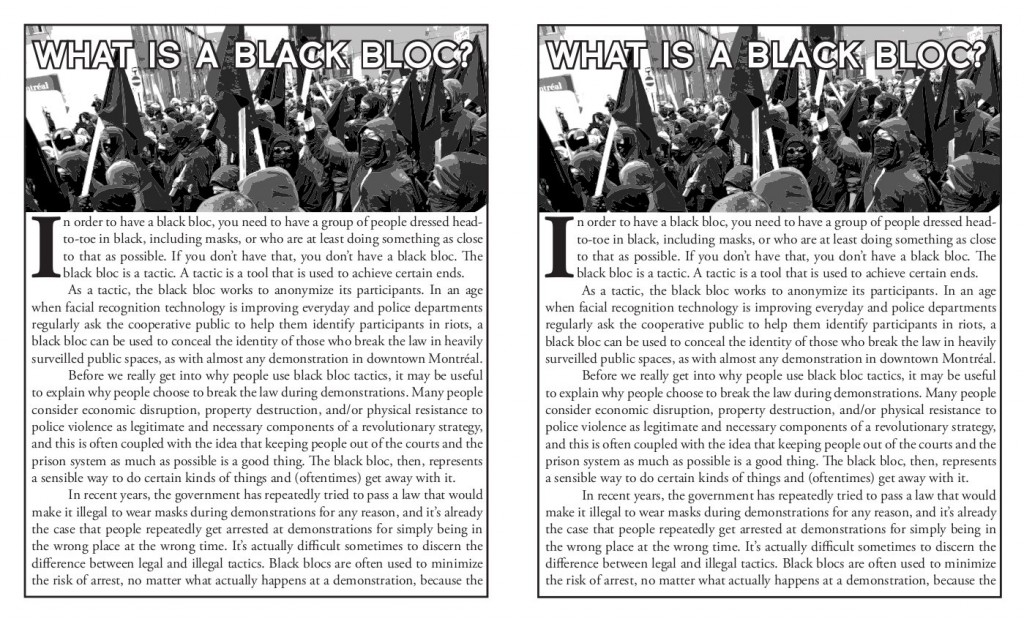
In order to have a black bloc, you need to have a group of people dressed head-to-toe in black, including masks, or who are at least doing something as close to that as possible. If you don’t have that, you don’t have a black bloc. The black bloc is a tactic. A tactic is a tool that is used to achieve certain ends.

As a tactic, the black bloc works to anonymize its participants. In an age when facial recognition technology is improving everyday and police departments regularly ask the cooperative public to help them identify participants in riots, a black bloc can be used to conceal the identity of those who break the law in heavily surveilled public spaces, as with almost any demonstration in downtown Montréal.

Before we really get into why people use black bloc tactics, it may be useful to explain why people choose to break the law during demonstrations. Many people consider economic disruption, property destruction, and/or physical resistance to police violence as legitimate and necessary components of a revolutionary strategy, and this is often coupled with the idea that keeping people out of the courts and the prison system as much as possible is a good thing. The black bloc, then, represents a sensible way to do certain kinds of things and (oftentimes) get away with it.

In recent years, the government has repeatedly tried to pass a law that would make it illegal to wear masks during demonstrations for any reason, and it’s already the case that people repeatedly get arrested at demonstrations for simply being in the wrong place at the wrong time. It’s actually difficult sometimes to discern the difference between legal and illegal tactics. Black blocs are often used to minimize the risk of arrest, no matter what actually happens at a demonstration, because the line between what is legal and illegal is never something that demonstrators in the streets get to determine; it is, in general, a tool of the state to repress us and delegitimize our struggles.

There are people who use black bloc tactics as a way to stay anonymous in order to commit illegal acts during a demonstration, but it’s important to note that folks who show to demos wearing all black may do so for a variety of reasons, and not necessarily because they intend to do anything in particular. Black blocs can be good for promoting a sense of solidarity and complicity amongst participants. They can be good for demonstrating a willingness to engage in militant action if it becomes necessary, as on February 12, 2010, during the Olympic Games in Vancouver; a contingent of Native warriors and black bloc participants were prepared to physically defend a march if the VPD attacked. Black blocs can engage in offensive action, such as when they attack particular targets, but they also frequently engage in defensive action. The first documented use of the tactic comes from Germany in the 1980s, where it was used by squatters to help defend their homes from eviction by the state.

Since black blocs can be used to demonstrate a willingness to engage in militant action, they are sometimes used outside the context of a demonstration in the streets. In Atlanta in late 2011, when a woman was being constantly harassed at home and her place of work by her abusive ex-partner, she showed up at his house with a black bloc in tow to announce there would be consequences if his behaviour continued.

The tactic is used, essentially, because it makes it difficult for police to identify which actions were carried out by which specific people during a demonstration. Even if people are caught by police or media cameras in the act of taking off their clothing, it is frequently the case that the only thing that can be proven against them in court is that they participated in a demonstration wearing that kind of clothing – not that they committed any specific illegal act.

All this to say that a black bloc has practical as well as symbolic purposes and the decision to employ this tactic must be based on the specific circumstances of a situation. To be clear: there is no such thing as the black bloc, nor are there black bloc anarchists or anything else like that. Such categorizations mistake tactics for ideology – or, even more ludicrously, an organization of professional rioters.

Jun 202012
 

Download

Two banners were hung in Montréal in solidarity with the G20 prisoners. Solidarity with the G20 prisoners / Tear Down the Prison Walls was hung from a building on St. Catherine street downtown. Solidarité avec les Incarcéré(e)s du G20 / Propageons la Révolte (Solidarity with the G20 Prisoners / Spread Revolt) was hung in the St. Henri neighborhood. Flyers were scattered at both sites, and further distributed in the metro system and on the street in the following days. We hope this counter-information action brings a smile to our locked up comrades.

[AFG_gallery id=’2′]


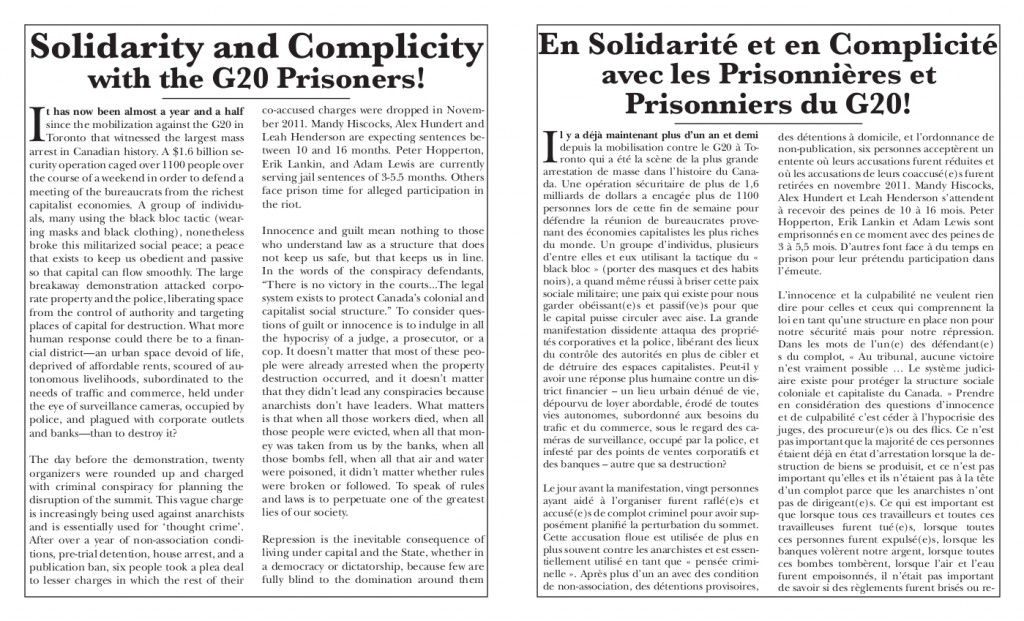
Solidarity and Complicity with the G20 Prisoners!

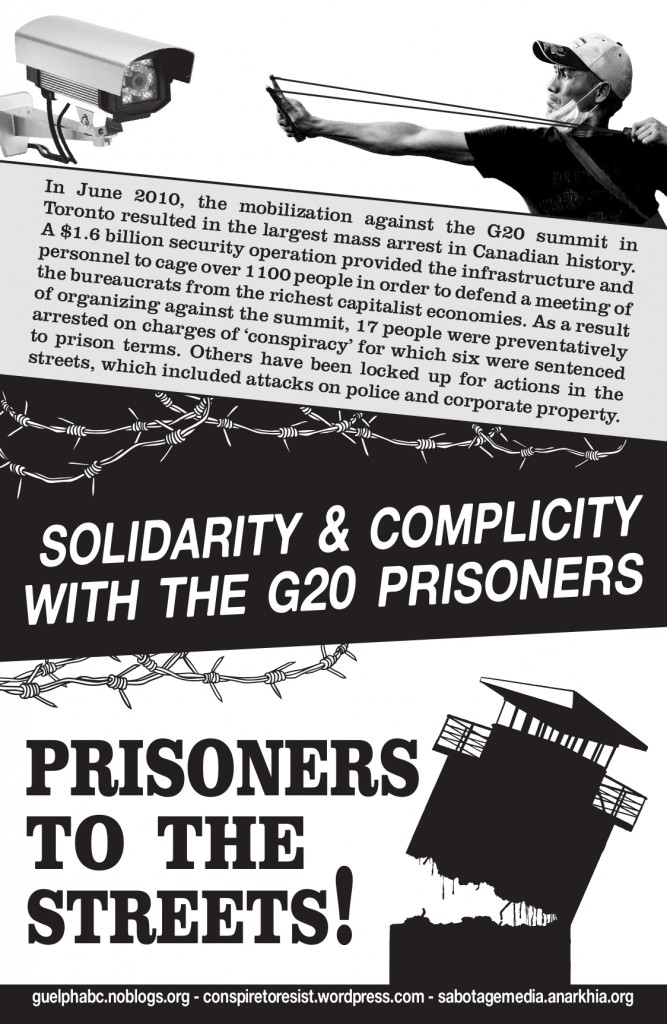
It has now been almost a year and a half since the mobilization against the G20 in Toronto that witnessed the largest mass arrest in Canadian history. A $1 billion security operation caged over 1100 people over the course of a weekend in order to defend a meeting of the bureaucrats from the richest capitalist economies. A group of individuals, many using the black bloc tactic (wearing masks and black clothing), nonetheless broke this militarized social peace; a peace that exists to keep us obedient and passive so that capital can flow smoothly. The large breakaway demonstration attacked corporate property and the police, liberating space from the control of authority and targeting places of capital for destruction. What more human response could there be to a financial district—an urban space devoid of life, deprived of affordable rents, scoured of autonomous livelihoods, subordinated to the needs of traffic and commerce, held under the eye of surveillance cameras, occupied by police, and plagued with corporate outlets and banks—than to destroy it?

The day before the demonstration, twenty organizers were rounded up and charged with criminal conspiracy for planning the disruption of the summit. This vague charge is increasingly being used against anarchists and is essentially used for ‘thought crime’. After over a year of non-association conditions, pre-trial detention, house arrest, and a publication ban, six people took a plea deal to lesser charges in which the rest of their co-accused charges were dropped in November 2011. Mandy Hiscocks, Alex Hundert and Leah Henderson are expecting sentences between 10 and 16 months. Peter Hopperton, Erik Lankin, and Adam Lewis are currently serving jail sentences of 3-5.5 months. Others face prison time for alleged participation in the riot.

Innocence and guilt mean nothing to those who understand law as a structure that does not keep us safe, but that keeps us in line. In the words of the conspiracy defendants, “There is no victory in the courts…The legal system exists to protect Canada’s colonial and capitalist social structure.” To consider questions of guilt or innocence is to indulge in all the hypocrisy of a judge, a prosecutor, or a cop. It doesn’t matter that most of these people were already arrested when the property destruction occurred, and it doesn’t matter that they didn’t lead any conspiracies because anarchists don’t have leaders. What matters is that when all those workers died, when all those people were evicted, when all that money was taken from us by the banks, when all those bombs fell, when all that air and water were poisoned, it didn’t matter whether rules were broken or followed. To speak of rules and laws is to perpetuate one of the greatest lies of our society.

Repression is the inevitable consequence of living under capital and the State, whether in a democracy or dictatorship, because few are fully blind to the domination around them and many are willing to fight back against it. To combat this social unrest, the State responds with repression. Many systems of oppression target various identities daily for being a potential enemy to the social order; whether colonized, genderqueer, or not white, to name a few. Imprisonment is structured to perfect control over anybody who’s locked up, and manifests itself outside its walls as a threat towards those whose privileges don’t fool them into identifying with power. Repression tries to prevent us from making the all-too-sensible decision to revolt against the systems that destroy our lives and future.

The new omnibus ‘tough on crime’ bill is an intensification of social control, as is the federal prison expansion that will see expansions at 36 federal prisons between now and 2014, along with provincial prison expansions in every province. Correctional Services Canada will be the largest building contractor by 2012. The Montreal police even have a new ‘anti-gang’ police squad, GAMMA, dedicated to the surveillance and repression of anarchists and other ‘marginal movements’.

Prison is the concrete intensification of the alienation, isolation, and exploitation that surrounds us in our daily lives. With a desire for freedom comes the simple realization that prisons, and the world that needs them, must be attacked with revolutionary intentions. The urgency for rebellion makes itself even clearer when the State is tightening its grip on our throats in times of austerity.

As anarchists, we understand solidarity as lying in action. When we act we expand our own freedom as well. When the State takes anarchists and other rebels captive in its cages of democracy, revolutionary solidarity involves continuing the struggle that they are imprisoned for. Solidarity with prisoners in struggle should not be due to debt or sacrifice, but because our own liberation is intrinsically tied with their liberation and the destruction of prison. By actively pushing their struggles forward outside the prison walls, our solidarity ensures that the State’s attempts to intimidate and control us are only met with escalated resistance. Our struggles against the State and capital must grow into a force that their cages cannot contain.

Let’s lose our fear, and spread rebellion against authority.

Prisoners to the streets!

For more info:
conspiretoresist.wordpress.com
sabotagemedia.anarkhia.org
guelphprisonersolidarity.wordpress.com

Jun 202012
 

Download 11″x17″

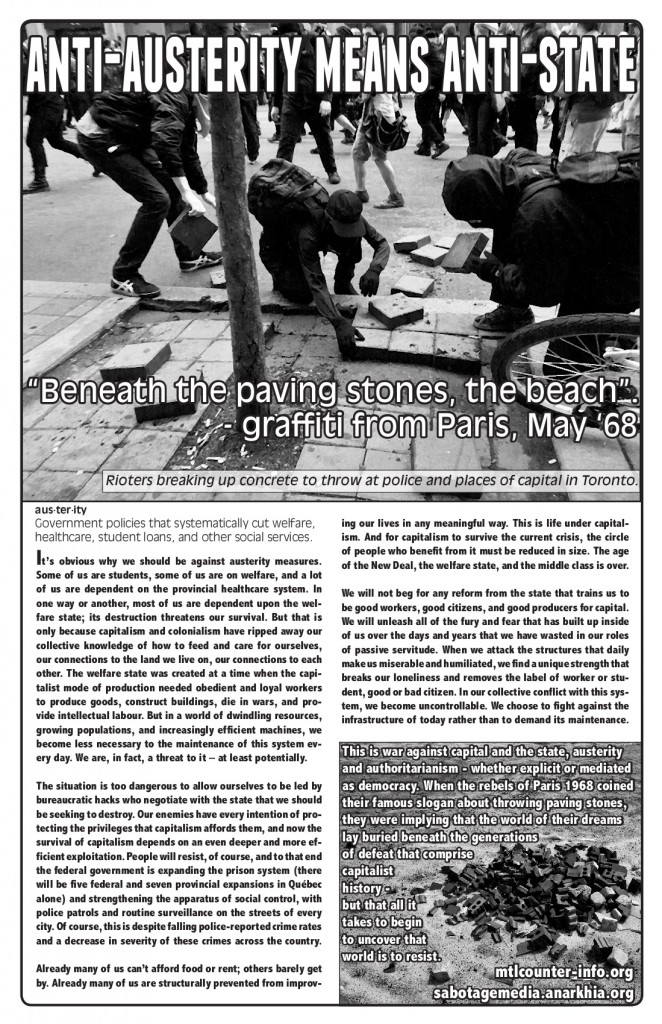
ANTI-AUSTERITY MEANS ANTI-STATE

“Beneath the paving stones, the beach”. – graffiti from Paris, May ‘68

aus·ter·ity

Government policies that systematically cut welfare, healthcare, student loans, and other social services.

It’s obvious why we should be against austerity measures. Some of us are students, some of us are on welfare, and a lot of us are dependent on the provincial healthcare system. In one way or another, most of us are dependent upon the welfare state; its destruction threatens our survival. But that is only because capitalism and colonialism have ripped away our collective knowledge of how to feed and care for ourselves, our connections to the land we live on, our connections to each other. The welfare state was created at a time when the capitalist mode of production needed obedient and loyal workers to produce goods, construct buildings, die in wars, and provide intellectual labour. But in a world of dwindling resources, growing populations, and increasingly efficient machines, we become less necessary to the maintenance of this system every day. We are, in fact, a threat to it – at least potentially.

The situation is too dangerous to allow ourselves to be led by bureaucratic hacks who negotiate with the state that we should be seeking to destroy. Our enemies have every intention of protecting the privileges that capitalism affords them, and now the survival of capitalism depends on an even deeper and more efficient exploitation. People will resist, of course, and to that end the federal government is expanding the prison system (there will be five federal and seven provincial expansions in Québec alone) and strengthening the apparatus of social control, with police patrols and routine surveillance on the streets of every city. Of course, this is despite falling police-reported crime rates and a decrease in severity of these crimes across the country.

Already many of us can’t afford food or rent; others barely get by. Already many of us are structurally prevented from improving our lives in any meaningful way. This is life under capitalism. And for capitalism to survive the current crisis, the circle of people who benefit from it
must be reduced in size. The age of the New Deal, the welfare state, and the middle class is over.

We will not beg for any reform from the state that trains us to be good workers, good citizens, and good producers for capital. We will unleash all of the fury and fear that has built up inside of us over the days and years that we have wasted in our roles of passive servitude. When we attack the structures that daily make us miserable and humiliated, we find a unique strength that breaks our loneliness and removes the label of worker or student, good or bad citizen. In our collective conflict with this system, we become uncontrollable. We choose to fight against the infrastructure of today rather than to demand its maintenance.

This is war against capital and the state, austerity and authoritarianism – whether explicit or mediated as democracy. When the rebels of Paris 1968 coined their famous slogan about throwing paving stones, they were implying that the world of their dreams lay buried beneath the generations of defeat that comprise capitalist history – but that all it takes to begin to uncover that world is to resist.

Sep 232010
 

July, 2011

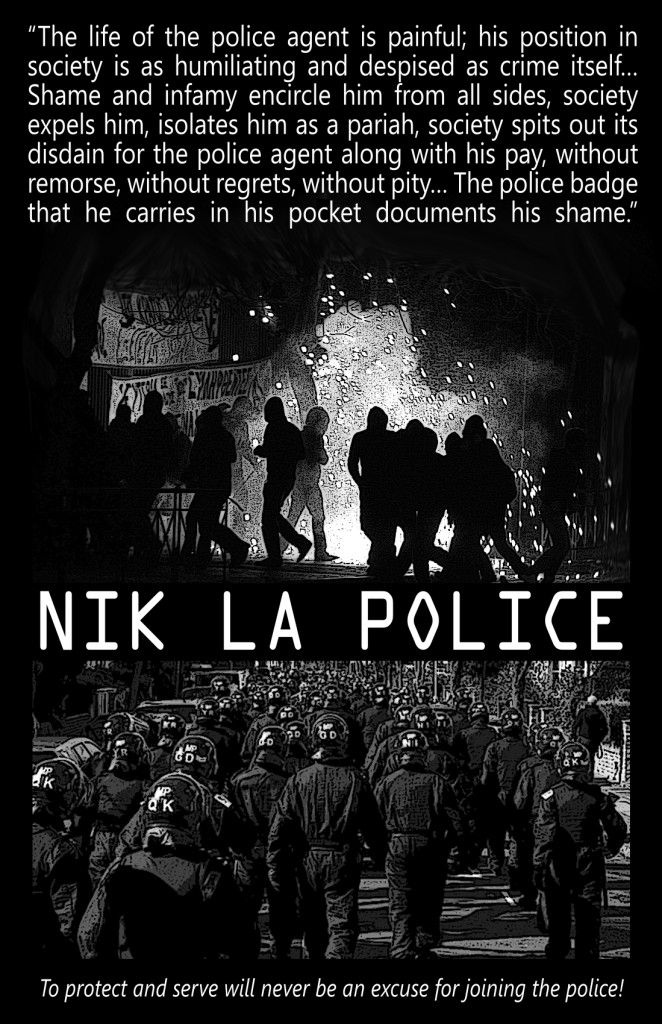
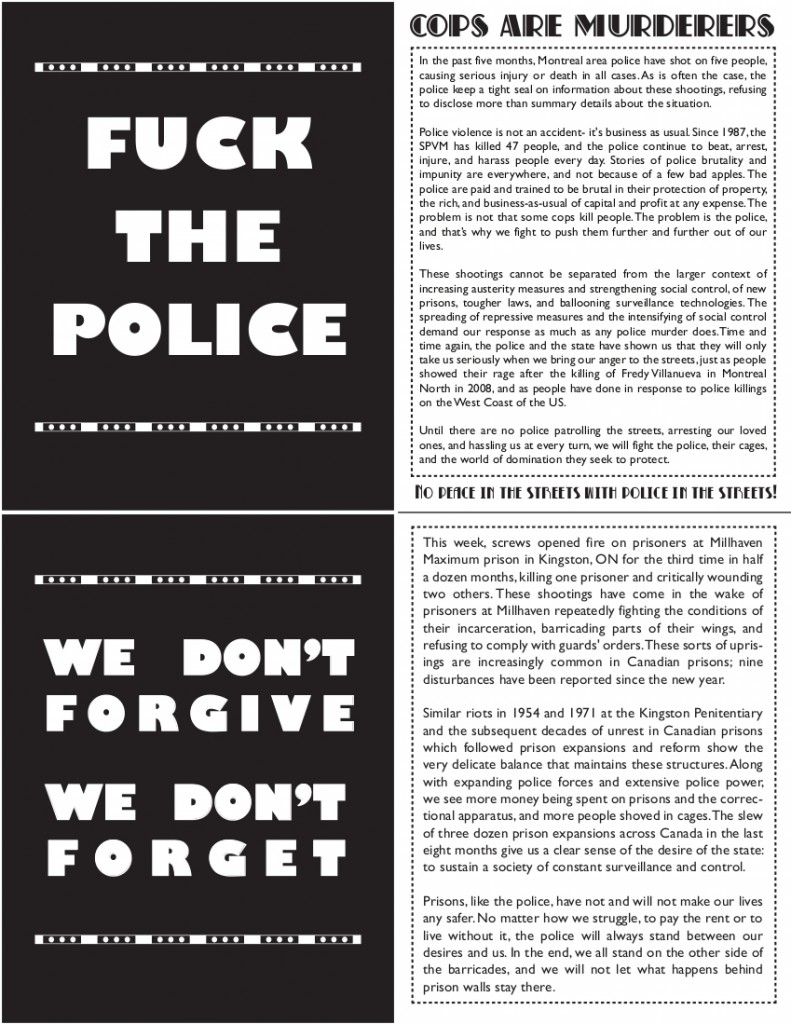
Cops-Pigs-Murderers
No State ‘Justice’
Rage is our best weapon.

NEVER FORGIVE, NEVER FORGET

In Montreal, a banner against police was dropped from a highway above rue Atwater in the early morning. Two thousand fliers were thrown and the banner stayed up for over 30 hours on a main artery into downtown. We did this over a month after pigs murdered Mario Hamel and Patrick Limoges on June 7, which was followed by a small riot on the night of June 8 targeting police and the world of capital and domination that they defend.