


Beginnings
I.
Anarchist ideas are not dead things, to be viewed as a logical conclusion of certain ideas of justice, equality or “humanity.” There is no logical series, no precise and irrefutable argument that must convince a rational person. It is a certain relation to power, a certain disgust at authority and its pretensions, a certain sensitivity to the coercions of daily life that inform and inspire these explorations. That to a degree one must want to be anarchist, look toward revolt, have a desire to act and a feel for the immediate, a will for domination to not merely be resented but actively opposed—toward an eradication of guilt and other emotional forms of social control. That without these inclinations no logic would suffice to convince anybody, and that even if it did, enough belief in certain abstract ideas remains nothing but abstract as long as one does not engage with those other ideas through all parts of her awareness, in every aspect of her life, in defiance of the fear that is the final wall protecting society from all our passions, all our charged will.
II.
This text aims to fit in a space between constantly evolving ideas and active anarchist struggle—a thing long suffocating in North America. To counter the accumulation of books on disparate struggles and political events without a critical eye to their relevance, often becoming one more relic in a bottomless pit of information. I propose the diffusion of anarchist ideas for that end specifically, anarchist theory as a tool continuously honed, sharpened, experimented with, shaped by and for people thinking and struggling right now, for the context in which we exist.
Too often anarchism appears an old idea from the early days of industry, a thing we dust off and try to reckon with today. This may mean an anachronistic reviving of outdated analysis, or a superficial interpretation of anarchist practice applied to myriad isolated struggles. To a point, it doesn’t matter where good ideas come from. Yet it makes one wonder, that so much of the explicitly anarchist analysis of recent decades comes to us from Italy.
Revolt is not a linear process, beginning in the development of ideas and proceeding to acts, with the occasional symbolic return to old ideas. An idea is like a gun. You cannot stick it on a shelf for a hundred years to collect dust, occasionally going in the closet to peer at it from the door, all the while using various other tools in your daily life until the day comes to go armed. Surprise! The gun will not shoot.
Ideas require constant upkeep. They must be oiled, cleaned, played with, taken outside, loaded, tested. They ought to be somehow practiced or used in our daily lives, not something kept away for one day, later, nor to be stored in a closed room only for leisure purposes. Let us dismantle the lazy approach to anarchist theory in which one states merely “I like Goldman, but not Bakunin” or where one determines in advance to like primitivist writers and hate communist ones, or vice versa, without actually reading (really reading), without treating ideas as things alive.
I wish for anarchist writings that span the entire space between ideas and action, that ruthlessly address every form of coercion, see our society from all angles, analyze and critique two-dimensional dogmas, and explore new forms and ideas relevant to anti-state conflict. An anarchist theory that is integrally part of practices of today, with no contented affirmations of the status quo (of rebellion), that generates reflection, debate and discussion, that contributes to the living continuum of anarchist struggle in ideas and practice.
III.
Anarchists often trip on the question of what comes after: the insurrection, the revolution, a moment of break with all structures of domination. Many bicker and fight, drawing lines in sand, sharpening spears to defend different models of self-organized society, different conceptions of freedom. Others say that such visions are so far off, that the opportunity to shape our lives and communities are so distant that it is useless to even think of such matters. It is a more realistic, more constructive approach I think—doing away with hypothetical discussions that we may never have to hold practically, immediately, in relation to our lives. And yet, something else still lies hidden from the whole debate.
I cannot even imagine freedom, never having tasted it, beyond the illusions captured in moments of escape, in parties or drugs, wanderings in the desert, staring at the stars, losing one’s inhibitions in hours of intense conversation until the hum of the outside disappears into silence. I say illusions not because moments of escape are inherently useless, but because the sense of freedom resulting is an invention, derived from wanting more. In this sense memories are little different from hallucinations: a moment past is no longer tangible, possesses no more weight in the world. We can remember perceptions and emotions from specific moments, but this is little different from remembering such aspects from dreams. The only way past events become tangible is through the inspiration they invoke in the present, to seek after and surpass what has already been done. It is little different from acting upon a dream, or an idea, a thing read or heard speak of. We are drawn to certain ideas through our hatred of domination, of privilege and oppression, of work, property and police. Yet anarchy is not only the negation of such things: it is something else. But what?
IV.
As a child, sometimes I cried and lay awake for hours at night, contemplating with dread the idea of heaven, of living forever. I could not explain why better now than I could then. It was not a choice, or a consequence of outside influence. It is not that I preferred hell, nor even oblivion, to simply disappear after death. None of these appealed to me particularly, but the reason my mind lingered so long on heaven is because that is where I thought I should go, where I would expect to go if I was good. There would be no end to my questions: what is it like in heaven? Is it really forever? Do we get any breaks? Do we come back to earth sometimes?
The best explanation I can attempt to give is an emotional one. Deeply contentious feelings at the thought of living forever, but more importantly, a choking anxiety at the uncertainty of it, at committing myself to go somewhere when I couldn’t know what it would be like, when it was already set up, and I would have no control over it myself. I can put words to it now, but at the time it was very much indescribable.
This may sound foolish, but to me it goes a long way to explain why I am an anarchist today. It is not a reaction to specific events or forms of oppression, nor a consequence of being radicalized through disillusionment in activist projects. Those things play a part in the how I have become what I am, but the why was already there. I was six years old when I first remember these episodes of anxiety and insomnia, before encountering most figureheads and forms of domination that I now have names for. The simple fact of being born into a world that I have no say over, with a million mechanisms of coercion to ensure the smooth functioning of its parts—a world pre-determined from birth to death, with plans already in place for us after death. Or to one who is unexposed to religion, there is no formula after death, but the thought of slipping into nothing offers little, unless viewed as a soothing end to a hateful world, or as an acceptable resolution to a life well-lived. One of these involves giving up on life, and the other a willing acceptance of life for what it is—and neither assumption is truly satisfying by itself. So the emphasis falls back into this world, the immediacy of our lives.
V.
All the pieces are in place. It is quite clear and hard to miss. That we have little choice in how to live our lives, that certain paths are plotted for us from the beginning, that the “choice” of jobs, occupations, and commercialized hobbies is little more than the choice of products on supermarket shelves, that these options are whittled down further and further through various angles of exploitation, that suppression of one’s will, desires and unique ideas is the only socially acceptable way to move forward when placed in subordinate roles, that “self-advancement” is a glorified mixture of method acting and manipulation, and that a thousand curtains exist to obscure these material functions of society from us—and often fail hopelessly. It is not necessary to read anarchist theory, or Capital, or even first-person accounts of exploitation in its myriad forms to understand this. Perhaps some are blissfully unaware, and others use unawareness as a façade to mask their complicity, or simply to override any doubts that might slow them down in profiting from this society—but many of us are quite aware of it, and more often then not, running away from that awareness in movies, books, drugs, partying, sex and other diversions.
Yet even as our climate suffocates rebellion, it is not necessary to make distinctions between acting now and preparing for future eruptions, between sabotage and building links of solidarity, between coordinated resistance and affinity-based actions, between interacting the way we want to now and articulating offensive modes against what represses us, between an analysis of dominant power structures and one of everyday life. All of these things fit together into an anarchist practice in our immediate realities. We need no illusions such as building a revolutionary commune today to justify mutual aid between comrades and collectives; no myths such as a peaceful evolution toward a society based on liberty to justify creating the relationships and modes of expression that we thirst for now; no fairy tales like bankrupting capitalism through financial damage to justify attacks on property, expropriations, occupations and other disturbances of the social order. Onward! To the crushing of all illusions, as the merry march to revolution hides no pots of gold, and the only gifts and cached arms on the way are the future products of hands that refuse the arthritis of thoughtless repetition.
On choice, decision and will
Throughout our lives we are bombarded with series of choices, one after another. To go to high school or tech school, what path or specialization to follow, to work or study, stay home, travel or move. The spectacle of choice spans from the smallest scale to the largest: what toothbrush to buy, what to make for dinner, which type of rice, which brand of sliced bread, what party to go to, who to vote for, to have kids or not, to cheat or not, up to the narrow range of named sexual orientations, political identities, religions—the alleged big questions which define our lives, or so we are led to believe.
Not infrequently, we breathe a sigh of relief when presented with the most banal of options—yes or no, spicy or mild, this color or that color. As if to say, finally! Nobody is making us think so much, turning the most insignificant question into a philosophical inquisition. And it is thus that sometimes having no choice at all, the fact of somebody else making a decision for us, can grant a feeling of liberation. For the at-times agonizing process of reflection that precedes a choice; but also for the feeling of responsibility washing off, the anticipation of guilt gone. I don’t think it entirely exaggerated to say that this is a major contributor to the allure of fascism.
It is an interesting process. Society grants us free will, in a manner of speaking. It says, go forth—you can do whatever you want, be who you want to be, buy what you want to buy, eat what you want to eat. It backs this up by reel after reel of choices seemingly in every aspect of existence. At a certain point, one is tired of choices, overwhelmed by this spectacular personal liberty, longing for obligation, wishing to act without thinking, dreaming of orders to follow. So we crash in front of the TV, or go to bars, restaurants, cinemas, clubs, and other harems of entertainment, seeking a kind of amnesia.
Yet the greater picture comes not in asking in which contexts we have choices, what choices we have, and where these different choices might lead. The bigger questions are in what context these choices arise, which choices are available and which not, and where, or who, choices come from. The spectacle of choice comes always in the garb of legitimacy, or law and authority. It is only one with authority who is in a position to offer choices. Imagine a child asking her parents what they would like for dinner, or which fast food joint they wish to stop at on the road. It strikes me as strange, this reversal of roles, of who is asking the questions. Of course, this is an example in which one person is clearly providing the choice for another—how it often is in simple and direct power relations, on the scale of one person to another. However, in society at large, power relations are often much more complex, indirect and obscure, lacking for a single individual to which one may attribute authority in a given situation. Categories of self-definition, like good or bad, rich or poor, married or single, straight or gay, seem to come from everywhere and nowhere at once. There is no person, no institution that presents these questions to us. They are absorbed throughout our lives from countless different sources—school, family, media, work. And these ideas, these dynamics spread like rumors through friendship networks, social media, and all other informal and seemingly less authoritarian social settings, until they produce an atmosphere that is inescapable. In other words, socialization, from the perspective of choice.
And in this whole equation, individual will appears only as a shadow, just tangible enough that we don’t doubt its existence.
We see the same dynamic play out in radical milieus, in the production of revolutionary ideologies. One chooses to be a socialist, communist, or anarchist, in much the same way as one chooses to be a social democrat, a Republican, a Golden Dawn member. One finds the ideology that most closely approximates her own inclinations, the dogma closest to her own views, the social group that feels most appropriate. One chooses to be a syndicalist or a primitivist, to involve herself in Earth First!, the IWW or ABC through a similar process. And like in most choices, it feels more like a compromise than a thing entirely willed, as a desire that one must convince herself she possesses. And when various sub-ideologies are critiqued, it is usually from the view of what they lack, toward the creation of a new tendency that more closely approaches one’s own perspective, one’s own desires.
In this way we construct ever more barriers between what we really want, what we really feel, and an unimpeded chase after these.
Are we fearful? Perhaps because the will is fickle, because if one doesn’t have the label “anarchist” to hold onto, she may suddenly believe in capital, want a society of laws and police? Yet such are meaningful questions, to know when ideas are true expressions of a person, andwhen they are shields to hide behind. At the same time, one may resent the prevalence of differing wills in the world, of the active desire for money, luxury and security—that most people are not driven by an antipathy to domination, and that wills are harder to combat than ideologies and political groupings. After all, a person who chooses to be communist might well be convinced of anarchism. It is on these grounds that it is easiest, perhaps even most effective to build an anarchist struggle—or so it would seem. Yet what significance could this struggle have, if it relies on the same political forms that it wishes to destroy, or claims to?
It is with great pain that society ever allows us to really want, to possess a will in this world. And it is always too fleeting, rapidly channeled into some existing form in which desire becomes a “preference,” and will is something criminal. It is a thing we approach with careful steps, not knowing what to expect, fearful to awaken a dragon. Yet this strange act, fraught with danger and risk, is what distinguishes our task from that of political groups of all forms and perspectives.
The Marxist develops a party for revolution, because the transformation she wishes demands a certain medium to direct the masses into that path; and because regardless of the means, the ends sought, the type of society to be produced—require a certain medium, a certain mold to create the desired form. The famous notion of breaking eggs to produce an omelette can be read in a different light. Not the tragic sacrifice of a few lives in order to produce a society good for all who remain, but the demolition of deviant wills, the sacrificing of what is unique, passionate and ever wanting more, in favor of a smooth, sculpted society. “Making revolution” by this means could be easily rephrased as making capital, making school, or making social control anew.
In contrast, the anarchist vision requires no medium to create or maintain it. In fact, there is no anarchist vision, only a gleeful constellation of possibilities—to filter these through a single medium would inevitably destroy them. As an anarchist world can have no medium, an anarchist rebellion cannot pass through a single means, a mediated form. It must either burst the bounds of any organized frame, or be destroyed by the form through which it is organized. This is not to say there cannot exist organizations, strategies, popular forms of attack, common analyses, histories, and tendencies based in method and affinity—but we cannot mistake the thing itself for the complex of relations that encircle it. There is no shortcut to the unhindered exploration of ourselves, our affinities, our wants, and the development of unflinching wills against the full assault that we call society—with all its choices, benefits, and mystifications.
On desertion
Desertion has gained a lot of steam in certain anarchist circles in recent years. A disillusionment with already-practiced forms of organization and agitation, the actions that lead nowhere, the efforts at counter-info that rarely yield discernable results—alienation in the city, in social norms, and the mounting weight of committing to an anti-political project that is at once daunting, frightening, and without any solid basis for hope. All are reasonable ideas, yet they must be taken into a context, into a direction that maintains conflict with the state and capital, and not merely a back-to-the-land resurgence with anarchist bells and whistles. I have seen a great deal, individuals with a fierce hatred of civilization, retreating to the woods. The operative term here is not “the woods,” but retreating, as neither struggle nor desertion may be defined in terms of population density. The reasons I can imagine for this step are: a dearth of hope in any meaningful action, a hedonistic abandon of a broader anarchist project, and a faith in impending collapse of industrial society.
There is a more fantastic alternate explanation, in which one deserts, and fights from the fringes of society. Yet this cartoonish scheme imagines a land with unmapped frontiers, spaces where authorities venture cautiously, where one can disappear into the wilderness. In few places now could one still live self-sufficiently on land, go armed, and move into guerrilla warfare against agents of development. And where this is possible, the possibilities of repression are equally unrestrained. Particularly in North America, the state is far too present to permit such lawlessness.
To follow, two major questions must be asked. For one, what is it we wish to desert, and what can we desert, specifically? Secondly, to the degree it is possible, in what context does desertion make sense as a strategy—for self-preservation, attack, or both and other reasons? In an army, deserting makes sense when you can get away, hide, find comrades to protect you, change your appearance and identity, and depending on your intentions, find materials and comrades to strike back, to disrupt their operations, to create space for more defectors to escape, revolt, frag.
To the first question, one must be very careful to avoid falling prey to various traps and diversions. It cannot be precisely the city, the electrical grid, the use of automobiles, or one’s “dependence” upon capital, technology and social infrastructure that she wishes to escape, if we still place any interest in opposition. As far as capital penetrates the entire space of the globe, and its domination is far more complex than simple consumer dependence, the notion of material independence from infrastructure diverts active struggle into an illusion of coexistence. Modern capitalism is unique as a social-economic-technological system in its ability to consume all, its openness toward many different ideals, even “radical” ones, even autonomy and independence, so long as one forgets that autonomy is impossible in capitalist society.
So what can we desert? Old practices, habits, forms of organization that serve only to reproduce a spectacle of opposition, that lend weight to the illusion of choice, power and liberty, that hold up the dead weight of reforms as concrete steps in a revolutionary project. The empty ideas of progress and victory, the self-congratulatory response when the state throws back a few dollars to appease the special-interest group of the day. The idea that structures of power and domination will ever dissipate gradually, that revolutionary ends can be achieved without a backlash of bullets, prisons, shackles, and more and more, technological invasions to repress any attempt at liberty that refuses to confine itself to the world of ideas, dreams and literature.
What has always distinguished anarchist ideas from other revolutionary tendencies is the immediacy of the desire to revolt, recognizing the omnipresence of domination and the alienation that is produced even in so-called radical and revolutionary organizations. That we want relations without measure, a dissolving of coercion in all forms, space liberated from the incursions of the law—that we want these all right now, that waiting is slow suicide, that hope is a shot of poison, that it is our own actions and convictions, our wants and affinities, that in any way take us down a path toward liberation. That all these things combine toward a fullness in the anarchist’s life, that no one element is enough by itself, that all together make up an anarchist practice in ideas, relations, spaces, attacks and interventions. Also, that there is no lawful escape from the hands of the state within this context, that it is only through evasion, self-protection, invisibility and solidarity that we stay free to continue our joyous revolt against this world.
Hence, the point here is not to contrast desertion from active revolt. Rather, that desertion must be seen as a single method, a certain unfolding of desire, which has a place within the at-once individual and communal project of liberation, but cannot be seen as a general strategy. The greatest danger is in a certain dialectic of industrial collapse—one which overstates the irrelevance of social organizing, the mounting frequency of crises, and the inevitability of ecological and economic collapse. The given answer? Give up hope, give up organizing, give up on revolutionary ideas because the chart is set and in motion; all that is left is to get away, find a patch of woods or fields and prepare oneself for the mythical “after.”
They make a good case, but this is the deceit inherent in any dialectic, be it one of ecological crisis or class struggle. Looking at history from a certain angle, there was once a “good case” for the evolution of class struggle into a revolutionary attack on capital, preparing for communism as a ubiquitous socal/economic relation. History, and the present, have no shortage of evidences, of patterns and trends, fodder for every Jane Doe and her pool-hall theories. This is not to discount the extinctions, the ravaging of sundry ecosystems, the depletion of certain resources, the potential consequences of an oceanic die-off, as well as the already evident—the forests turned to tree farms, the dead rivers, the moonscape oil fields, the spread of uranium, the wolf hunts, the towns and cities unknowingly turned into test populations for dangerous chemicals, disease control strategies, the rapid conversion of a city into a camp, a landbase into a mine, “territorial autonomy” into occupation. We don’t need clairvoyants to see trends. We are tricked only when we mistake the evident for one possible outcome of what is already in motion, losing the distinction between possibility and present fact.
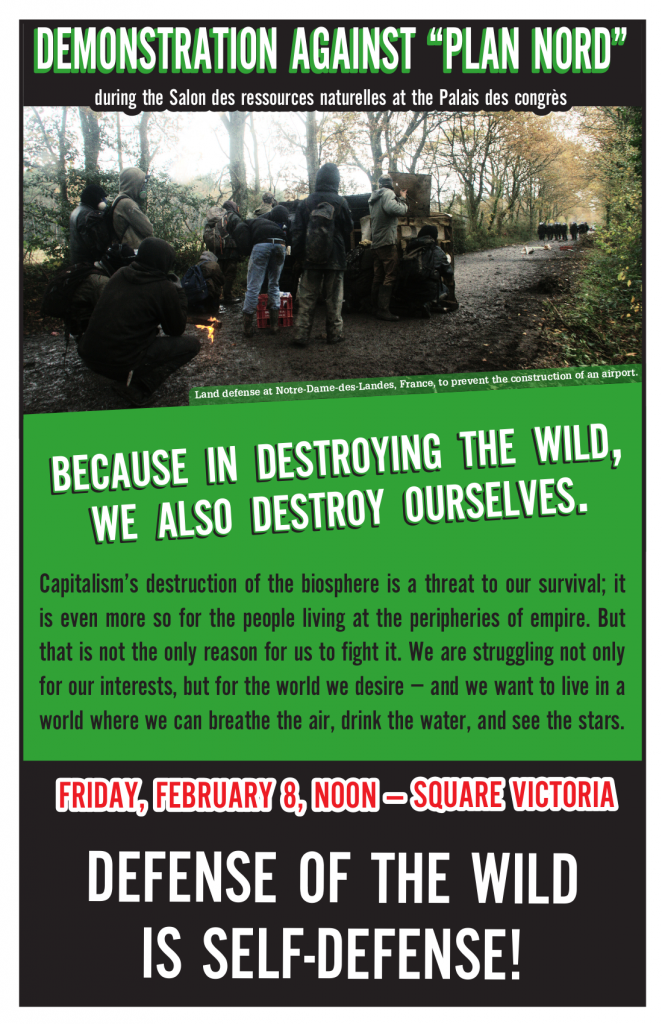
Awareness of the ecological state of the world, in the end, is a point against desertion as a geographical concept. Politically speaking, it is impossible to escape society and attack from the fringes in a world mapped to the square inch, perpetually circled by drones and satellites. Some of the more interesting rural struggles in recent history, the anti-road struggles in the UK, the No TAV struggles in Italy, the current fight against the airport at Notre-Dame-des-Landes, are especially interesting because of the interaction between urban radicals and land-based struggles, because of the spread of ideas and discussions coming from these sites. There is no more frontier where forest squatters may escape to after making war on development. Rather, we move between different spaces in the interconnected sphere of global metropoli. Tragically, the lack of communication and barriers to solidarity render the land struggles of indigenous peoples in the Pacific, in the Amazon, and worldwide, far more precarious. Yet these spaces are no more off the map than elsewhere. They simply fall lower on global capital’s scale between all-seeing and convenient blindness.
We do not wait for a total economic collapse, for the further articulation of ecological catastrophes, with the glazed eyes of a filmgoer. Neither to flee to the woods and prepare oneself in isolation, reading one’s playbook for chronologies of economic deterioration. It is a curious mode for the anarchist, waiting for the best course of action to be elaborated, for the world situation to become undeniably clear (whatever that could mean). It is a worldview that sees politics as a world apart, static to a point, or changing with a clear direction—not a thing dynamic, unpredictable, ever in flux. That society is constantly negotiated through conflict (most of the time suppressed), that openings for opposition always exist, that time warps around our reaching for liberty and the wild—these are bases for any insurgency, any anarchist act.
Capitalism, as well as the structures and relations that pre-date it, has always been a “situation,” has always existed in a net of opposition, of crises, of new technologies, of failed cities and starving populations. To think that current trends and limits are insurmountable in the present, in contrast to all other crashes and depletions of the past, seems unlikely. If capitalism is indeed “unsustainable,” incapable of surviving another five hundred years without turning the earth into a lifeless moonscape, on a certain level this is irrelevant. Crises, crashes and collapse will surely play into the topography of the near future, but there is a great difference between elements and dynamics within a political-economic context, and inflated stories like worldwide industrial collapse at the flick of a switch.
It is not enough to describe limits, even with irrefutable logic and evidence, to make capital implode, to set about a rapid dissolving of society. Desertion is not an ecological necessity, nor a moral imperative. It is a single action within the sphere of social relations, a particular movement and vantage from which one may prepare and compose herself, from which to pose acts, questions, invitations. Moral limits and predictions have never proved to hinder the march of wealth and industry in the past. And even if such a collapse is inevitable—what does it mean to us right now, if the stock market crashes forty years from now and doesn’t come back up, if banks no longer exist in a hundred years, if in two hundred years there isn’t a single nation-state left, if a mythical state of primitive freedom encircles the globe long after we are worm-food and dirt?
Community
The question of community is inherently different from that of organization, federation, strategy. It cannot be viewed as a means, as a path to achieve certain ends, to confront the existent; it is rather a complex of relationships and a certain identity, or belonging, which exists above these individuals and relationships. On the one hand, we face the impossibility of community within capitalist society, the difficulty of authentic relationships that would compose it within the complex of repression, inhibitions and inward violence that we live. Yet to simply pose community as something that happens after a revolution imposes still more limits on the way we approach daily life. So here the challenge is to think of community now, without a nostalgia for small-town social dynamics, without a valorization of our social networks that still carry the burdens of society, without a whitewashing of the coercion that often exists in collectives.
I approach the question of community from two sides. From the one, as I would a world of free relations and interactions; from the other, as I would a world of mediated relations, hierarchies and deception—in other words, the world we live in. I have the distinct sense that I have never truly experienced community. At the same time, I have been in, and through, many communities. Often, I have felt as a stranger floating through an alien landscape, torn between a sense of belonging and a scorn for the contrived interactions that surround me. I do not wish to twist a definition of community into one serving my egoistic ends. However, I note a bipolarity of experience. In moments of strength, I have the courage to be honest, to criticize or abandon the alienated interactions that make up various communities, to tear back illusions of approaching my desires through mere social or subcultural acceptance. In moments of weakness, I fall back into unwanted patterns and pursue relations of comfort, fixating on fleeting convivial moments, erasing my critiques under an imagined “collective good.”
Here one must ask: what is community? And then, is it truly something we seek, and why? And while this questioning may take certain utopian angles, it must also take place in the context of real relationships, our immediate lives, the definitions that exist regardless of intentions to the contrary. Community may be defined in the most simple way, as a group of people living in or in some way sharing the same space. This could be a village or small town, or a group of people within a city or larger area, sharing space in terms of relationships, events and ideas.
One cannot ignore the aspects of living community plagued by mediation, how these establish privileges and informal hierarchies. Take the case of anarchists, where knowledge of certain texts and websites, dress, musical taste, and social networking abilities may stand in for one’s ideas and passions, placing her on a scale to be judged.
Communities of choice play large in this discussion. Punk, squatter, anarchist, traveler, queer. I have at least dipped my feet in all, come and gone, come and gone. I have often felt somewhat at odds with these groupings, conflicted in the identity that draws me in, and all the implications that follow. Sometimes it is more comfortable to stay on the fringes, the greater downside being the unease that a stranger brings, making closer interactions and shared experiences difficult. Yet at the centre of these communities, their contradictions become more clear. They tend to revolve around certain ideas, practices, lifestyles, music, dress and other factors. Along with an affinity for shared interests, and the relationships that may come of this, we see a variety of social codes that determine who belongs and who doesn’t, that may establish credibility and trust. The most immediate danger here is where relations are determined by things other than the sincere and open interactions that may concretely develop closeness and trust.
Now there are serious limits to any community based on circumstance, living in the same place or sharing the same political label. Yet these material forms are still more interesting than certain utopian ideas of community, because of their imperfections, the divisions and conflicts that exist within them. After all, I do not seek to escape the tyranny of this world for the tyranny of a “perfect” community—sustainable, non-hierarchical, whatever formula one might choose to erase the tensions that inevitably exist between people in any setting.
One need not choose between escape and complacency. I wish to define community so that it may be confronted, acted upon. It may not be possible to infuse existing communities with new ideas and different interactions, especially where these are foundational to that space. The question then grows broader: to create new and desired communities, and to approach existing communities as sites of conflict. One may halt upon this point. Anarchist community as site of conflict? I am not proposing a mud-slinging between clans, yet neither need all that calls itself “anarchist” be sacred. Where a community produces deceit, exclusion, repressed passions, inertia and defeatism—these are grounds on which to fight. Little has ever come of merging with a mass and wishing for it to be different.
The question falls onto the commune, and communization. And these are large questions, for in spite of the great volume of text on communization in recent years, most explorations are still very much tentatives, remaining in theoretical spheres, barely broaching the subject of material practices. And why? Because it is at great risk that one endorses specific visions and describes concrete forms, in so doing already opening the gates to recuperation. I hold no pretense that the sharing of food and rent, the creation of certain collective resources, the opening outward of individual property, are communization. After all, this is only one form of property, and collective dynamics are merely a different dynamics that exists within capitalism—while I seek the abolition of property, the destruction of capitalist social relations, for the creation of different relations outside. Things which are difficult to speak of in the present, though we cannot forever speak of them in the abstract, in the future. Hence, I have little empathy for those who wish to create different settings and different dynamics within capitalism, for a pat on the back, a sense of living out one’s values. These are the same limits posed on any anarchist practice in the immediate. Values are cheap, and I disdain their spreading through moral imperatives, when already capitalist society accomodates an immeasurable diversity of values within its sphere.
Communization cannot be defined in the collective application of “anarchist values” in daily practices. Rather it is how we envisage the abolition of capitalist relations, how we project ourselves toward these ends. As we cannot produce relations outside of capitalism, or an ideal of free association, the question is always how we imagine and tend toward these ends. As there is no “outside” of structures of power, there are no non-hierarchical collectives, no non-dominant relationships. There are only anti-hierarchical collectives, acts and intents against domination, as we adopt a shared antagonism, and live this tension together in our lives.
Anarchists do not anticipate the total realization of our will or an end to struggle within our lifetimes—and to expect such as the future product of a certain dialectic requires a great deal of delusion. While it is easy to be disheartened at this, and many take it for a reason to develop comfortable lives and social networks, to approximate their ideas and values in certain relationships or scenes, the question of communes and communization is elsewhere.
We can view these things in two ways: as forms, and as tendencies. To me, the commune is not a thing to generalize at all costs. It is a certain form in which to strengthen affinities and develop practices, to tend toward a struggle that embodies the relations we want. Yet it is one path toward liberatory struggle, one form through which we may flesh out a shared will against domination—not the only one. Communes are interesting where they are developing ideas and perspectives, sharpening attacks and spreading through autonomous and willful means. Yet the anarchist struggle is large, and liberty is a wide, unknown land—to be approached from many sides, with different tools and methods, by people with different ideas and wants, always deepening one’s sense of her own position, always creating new forms from which we may heal, grow stronger and attack. The moment the commune is articulated as the form to adopt, the moment that communization becomes the perspective that seeks to shape and control anti-capitalist struggle—is the moment to attack, burn down its edifice of superiority and expertise, and return it to its proper place among all other forms and tendencies through which we explore our potential toward liberation.
Community differs from the commune in that it is broader; not inherently larger in numbers, but broader in the scope of life it incorporates. It does not imply the same intensity of shared space, of shared time and intentions, of a singular will to exist as a commune. There is a degree of shared will, in terms of seeking affinity between the different forms within it, in terms of a will to take something from the shared space, the communication and relationships that make up this community. It may include communes within it, but also individuals, affinity groups, collectives, and varied relations between all these entities—including conflict and tension between them. People may come into it and leave it according to their will, and it may split up, or dissolve, when no longer desired. It is not based on an intensely shared analysis or perspective, as an affinity group, nor is it exclusive based on existing social relationships and dynamics. Yet neither is it a welcome center for subtle coercions, for sabotage or abuse, after a hollow principle of inclusivity.
But what is the point of such a community, if it is not an organization seeking to diffuse anarchist ideas, and build up specific structures and resources? It is a space for experimentation, where one may explore the terms of her alienation, the limits and social constructs that pervade our lives, seeking out ways to eliminate the dependence and pressures that characterize much of what we call friendship; to develop different ways of interacting, different types of relations that are more true to our wants, exploding shells and habits of submission to social roles.
And where we seek to build communities in revolt, these cannot remain focused on interior relations, on the experiments that happen within their bounds. Where the will to break down social pressures and patterns of manipulation drives us to community, to act and interact differently, we seek simultaneously to explode the bounds of these communities, to spread our sentiments more broadly, to share our explorations so that others may learn from them, adopt or alter them to their own desires, generalizing the intent to destroy commodified social relations. Within this dynamic, the community is only one form, one aspect. The point is not to fixate on this one constellation of relationships, but to address all in relation to each other: the idea, the act, the individual, the one-on-one, the gang of friends, the affinity group, the commune, the community, the broader spectrum of relationships expanding from there, each form fulfilling certain functions in the demolition of society.
The other piece of community is in generating strong ideas: debate, critique, and a sharpening of analysis and practice. In isolation it is difficult to push one’s perspective farther, for the lack of conflict, of external input, of exposure to different perspectives. Without discussion one gains little confidence, thoughts grow increasingly abstract and impractical, and we grow lazy and timid in our ideas. As well, in a closed group sharing one dogma, individuals develop their ideas further, but do so through an ever-further removal from the outside, where the only criticism and doubts come from the initiated, and thus become further armor around their ideology—ever growing deaf as they dig deeper and deeper tunnels. Yet neither do I wish for a community of loosely defined affinity, where dissent is suppressed on the pretext of working together, where the lowest common denominator is sought and the more critical and radical ideas and acts are outlawed for the purpose of accessibility, of waiting for some later date on the calendar of a forgotten prophet. No, I wish for community based on a general will to revolt and to deconstruct the inter/personal dynamics of society, allowing for different perspectives on how and with open discussion and debate, a breeding ground for revolutionaries of various chosen forms and methods, a springboard for reflection and acts, and a den of solidarity and silence, defended without hesitation from encroachments by the state and other forces of the social order.
Such a community will inevitably hurdle down a dark path, plumbing deeper mysteries and desires. Its scope is as broad as learning how to live, together. The relations explored within burst the bounds of identity, attacking every coercion and laying bare every act and artifice of power. This can include the twisting and breaking of gender roles, eliminating manners and codes of presentation, destroying invisible patterns of competition and mockery, attacking the subtle pressures to conform that exist in radical circles as elsewhere—meanwhile, building up a culture of mutual honesty, directness, critique, unrepressed passions, openness to negative sentiments without personal offense, to positive sentiments without mockery; an immoral willingness to cooperate and compete without value judgments, to confront deceit and passive manipulations; while keeping the humor for play and games, and the deception and subterfuge that these can include, without allowing deception to subtly pervade and dominate our ways of interacting.
The attack
This may seem out of place following various discussions on social forms in relation to the practice of revolt. Or it may seem perfectly in place after these, given the notion of the attack as the end-form of anarchist practice, where all developing of affinities, all organizing, all propaganda, all pieces of struggle come together at the end into one road toward attack, then more attacks, spreading into days of rioting, barricades, insurrection, and finally, after the insurrection—the beginning of any concrete discussion on liberty, on how we wish to live, to work or not, to secure our needs and relate to each other how we wish. Now, I don’t disagree with the need for a revolutionary break with society before any total leap forward into lives, relationships and communities in the absence of capitalist relations and other dominant structures can happen. And I don’t entirely disagree with the above sequence of events as a very rough summary of a build-up to a revolutionary moment, from where greater explorations become possible. Yet this is one specific angle in which to view the struggle. Physical acts of aggression and sabotage against the state and capital, while very relevant in an arsenal of practices, cannot be taken as the single ultimate act to be reproduced and spread, or as a make or break of “revolution.” Meanwhile, many things may be done in defiance of capital, long before its influence is physically destroyed.
One must take into account that the attack is a social form in itself, not merely the consequence or end goal of social forms. We cannot take the attack in isolation, without seeing the relations that inspire and sharpen it, and the relations that it creates in turn. “Propaganda by the deed” is not simply a euphemism for attack, sabotage, destroy. Bombings, arson, assassinations and other acts were not always viewed as ends in themselves, nor even acts to be reproduced such that once a certain frequency of offensive acts would be attained, the state would collapse, capital would retreat, and we would begin discussing how to live our lives. Instead, attacks were viewed as forms of communication, as much as a poster or pamphlet, communicating the impulse to act immediately on our wills, and hence deepening the force of ideas behind one’s antagonism.
This understanding of attack as a single element within the larger context of struggle has been often lost within the issue-based, anti-corporate, fragmented grounds on which anarchists of today tend to act, blending into a hard-to-define radical milieu. Even if we take the ALF and ELF, two of the longer lasting clandestine radical groups1 in recent North American history—much of the discourses in their communiqués, as well as that which tends to surround them in broader discussions, describes a form of arsonist activism, the furthest extension of nonviolent direct action. Within this context we hear the rhetoric of property damage, the loss in dollar amounts incurred through the destruction of certain buildings or infrastructure. Here, one envisions success in the idea that she can “defeat” certain corporations by bankrupting them through economic damages—or, that she can defeat a development project by preventing the construction of a road or the logging of a forest.
Now, these are useful and interesting acts, but when one’s analysis is constricted to the stopping of one project, then perhaps another one, and another after that—or even to destroying one fur farm after another until the entire industry is destroyed—the greater context, the greater potential and relevance of these struggles and these acts is lost in the narrow vision through which they are communicated. Take the SHAC2 campaign of the early 2000’s, attacking Huntingdon Life Sciences through its scientists, its executives and the banks funding it, toward intimidating its staff and bankrupting the corporation, on the basis of its exploitation of animals in testing, primarily for pharmaceuticals. It was radical for the convictions and tenacity of actors, and perhaps for its “effectiveness,” or its expansiveness, yet starving for ideas. Or take the ELF’s first guideline: To inflict maximum economic damage on those profiting from the destruction and exploitation of the natural environment. So car culture and the petrol industry are attacked in the Romania SUV arson; the development of dwindling lynx habitat is sabotaged by the Vail ski lodge arson. Or in the case of Earth First!, the coal industry is stabbed in the heart by blocking the entry to a single power plant for a single day. In all these cases, where they are “successful,” we hear a similar rhetoric, an analysis of dollars of damage incurred—one step closer to destroying coal, logging, mining, petrol, cars, dams and airports.
We stumble on the absurdity of a specific opposition to earth-exploiting industries when in the end, few industries are not earth-exploiting; and what form of production is not also one of pollution? What form of development, of research, of work, is not in some way an attack on the wild, a further encroachment of capitalist and technological logic into every space, on every scale, while simultaneously erasing its tracks so that “paperless offices,” paying for plastic bags, ridges flattened for windmills, mountains blasted open for high-speed trains, and giant magnifying glasses in space produce the illusion of a society in harmony with “nature” through its total enclosure, commodification and control—as much in a supermarket as a forest, as much in a river as a farm as a city street.
Granted, every attack must by nature be specific, and even if our ideas are general, there is little to gain in choosing targets that could only be understood by those who are already anti-capitalist, anti-civilization or anarchist, if more comprehensible targets could be chosen. Communication is important outside of the act, but if an attack can be easily understood without the need to seek out and read a communiqué, its social effect is likely to be much greater. The destruction of turnstyles following a fare hike is an obvious example. An attack on a widely opposed development project, a corporation in a maligned industry, or a recruitment center in times of war preparation may all be aptly chosen targets. And if people are able to stop a development project, to destroy a laboratory that won’t be rebuilt, or bankrupt a corporation, all the better of course. But regardless of capacity, of the scale of attack, the way one approaches the act need not change. To attack a corporation in order to then communicate facts about that corporation, or to stop a project in order to communicate “victory!” is a great waste of the attack’s social potential. It can be useful to communicate the facts regarding this specific opposition—but also to communicate a broader analysis and opposition to all domination and exploitation (without subcultural slang and other insular language), the need for not only an increase in number and intensity of attacks, but also a broadening of scope beyond certain industries, beyond corporations generally, toward generalized attacks on the state and capital, against all signs of our alienation, on the perpetrators, exploiters, bosses and landlords that haunt our daily lives.
We cannot separate the attack from the ideas that inspire it and that it inspires, from the space in which it occurs, the other struggles that surround it, the communications of these struggles, the passions that drive individuals within them, the intense relations that deepen ideas and produce more attacks, the knowledge that from the street to the workplace to the home to prison to the forest, while different settings demand specific approaches, the struggle against this world and for a full possession of our lives takes place globally in any place at any time, independent of popular opinion, of social movements, economic collapse, and other social forces that will affect and shape our struggles, but that we must not chain ourselves behind.
On play and social forms
I remember when I was a child, seeing the world with wide eyes, the raw intensity which I felt in my approach to the world. How clear it was that I felt at odds with my so-called education, with the time spent sitting in a classroom, how strange to be forced to listen, to take notes—and the element of distrust with which my responses were taken. That an answer would not suffice, if I did not show how I arrived at this answer; that an idea was taken for plagiarism if I didn’t say whose idea it was, or where I found it. The frequent idea that children cannot properly think, that they are mere conduits for the intentions of others, to quote, puppet, or mimic what they see and hear. All this at the form of school, before even mentioning my response at certain facts and ideas presented by teachers, which struck me as forms of subtle deception and coercion, in that we must accept their facts, their ideas.
I remember the oddness of table manners, of certain conventions of behavior, of how to act, talk and speak in particular social situations—with little sense of where these things come from, why we play out these roles and games, with no explanation. When I read a piece that described a group of monkeys sitting around a dinner table, with their own forms of etiquette, it struck a chord inside me. It captured perfectly the absurdity of social forms and conventions, how ridiculous that billions of people pass through their entire lives reproducing what we call society, never questioning it, beyond certain undirected “what if” explorations, while in the grasp of various substances.
These days, I am not against table manners in the same way I am against police, prisons and class society, but the initial response is much the same.
I remember the bitterness with which I faced exclusion, mockery, the development of hierarchies and competitive relations among kids; the artifical kindness, the shifting of allegiances and reputations by association, the rumors that unload faster than a Kalashnikov clip. The alienation I felt carried a full range of responses, from envy to rage, from fleeing to crying, acting to developing a hard, silent face. From feeling left out in a setting to feeling distinctly at odds with the setting and all that created it—the wholesale reproduction of society in age-segregated groups of youth, complete with work, sabotage and cheating, with police and criminality, with responsibilities and incentives, with social capital, with proles, with racist jokes, with hot girls, dick-measuring and the reproduction of sexual norms.
I remember discovering that I could be funny, that I didn’t have to be uniquely silent, serious and strange—the immediate joy at filling a role that was socially rewarded, satisfying in different ways than any I’d occupied before. But the feeling does not take long to grow hollow. To be a funnyman my whole life, to live for these moments of wit, for a form of collective entertainment, would have been a grand ploy, an easy way to ride through life, until the bottom falls out and reveals the gaping chasm of a whole world belying the joke.
I remember racing through the woods, climbing trees, forging new trails, looking with the eyes of a warrior out on clean-cut lawns, white aluminum houses, aboveground swimming pools, the road full of cars—another world entirely. I built forts and shacks, imagined building a house in the woods and living in it for a whole summer or longer. Exploring the far side of the mountain behind our house, finding trails and roads I’d never seen before, I imagined hidden towns and villages unseen by other eyes. I ran away in the middle of winter, built an igloo and slept in it, only to go back home through the basement around three in the morning.
I laid awake, my eyes wide, forcing out any encroachment of fatigue—waiting to be sure my parents were asleep. When the night was sufficiently advanced, I slipped out the basement door, made my way through the woods, across the neighbor’s yard and down their driveway to the road. From there I walked the two miles into town, ducking in a ditch at the sight of headlights, heading for the 24-hour store to buy a box of donuts, a candy bar or a soda—and come back home. Sometimes I did this alone, sometimes with friends.
I recall one night in particular when the wind was so loud we could barely hear each other talk. The trees were almost galloping upon us, the phone poles shaking. We watched an electric wire throwing sparks, and I wondered what might happen. Would we lose power? Would we be cut off from the rest of the world? Yet this cut-off feeling is nothing new, just a reflection of the dissonance between the hours drawn out under the spotlights and microscopes of authority, and the moments stolen from these intruders—when my voice, my body and my acts are my own, imagining if time, the world, and I could be cut off from these permanent attacks. Each body to itself, each act for its own pleasure, the wild world left to its own spitting desires.
If I can name one feeling I have had for most of my life, it is the feeling of waiting for something. For more than twelve hours in the woods, more than a vague excitement when the windows were broken out in my high school, more than one night of good sex, more than a mushroom trip, more than feeding people, more than a protest, more than a riot. More than one social space, more than one close friend, more than a sick show, more than books, movies, fleeting passions, parties that are always the same, friendships that slowly fizzle out, strikes that get sold out, trendhopper revolutionaries that come to the street when it’s the cool thing, and radicals who are in it for the long haul—if the long haul only means the upkeep and maintenance of a radical scene, of institutions that lend the appearance of an anarchist movement (or museum?). Before one reacts—it’s not that I’ve been sitting in my room observing, hoping for new revolutionary developments. Rather, that participating and acting can take on the character of waiting when one’s acts do not carry the full weight of her dreams and desires, when her affinities become containers for her passions, when her projects become more and more like work.
When I first discovered the existence of anarchists in my city, and then anarchist texts, publishers, convergences, houses, squats and other fixtures, I felt that I had really found it. I remember the excitement I felt for months after, in reading, discussing, participating in anarchist events, learning the slang and expressions, discussing non-monogamy and gender non-conformity, or “the collapse,” and hearing about different campaigns and spaces. Yet it didn’t take terribly long for the excitement to hollow out. Like any new discovery, a new passion or love, it is easy to throw your heart and body into it, project your spectrum of desires onto it, believe it is everything you’ve wanted and that it’ll be there to take care of you for the rest of your life. There are many—the anarchist “lifers” we read of elsewhere—who settle into a happy married life with what they call anarchy. It is largely these who maintain the long-term structures of anarchist organizing and cultural production.
Once my doubts began to surface, my excitement didn’t vanish instantly. For a long time excitement coexisted with certain critiques, a feeling of something lacking. The excitement declined to a lower intensity, much as with any hobby or interest, while the early critiques were difficult to put to words, the lack was felt but just what was missing—impossible to describe.
To the professional revolutionary, this may all seem like so many childish responses, so many petty acts of rebellion, so many emotions—nothing political, nothing serious. They may call this all distracting from the point, obscuring the greater subjects of power and domination. However, we have plenty of studies and explorations into capital and the relations it produces, into the forms and functions of state power, the role of the police in society, patriarchy and its many faces and tentacles, extinctions and other afterthoughts in the strip-mining of the earth. We also have many personal accounts and memoirs, documenting the alienation and oppression of so many individuals, creating an invisible network of support, waving the tag of “personal as political.” Yet the production of binaries, whether one favors one side or values both, does us little good—and less often do we fill the space between personal experience and revolt against larger structures of domination.
A conversation with a friend recently gave this insight. Friendship is more than just a combination of shared social projects and emotional support. There are many other aspects and nuances that fall between the two, that embody both, and that cannot be contained by this spectrum between the emotional and the social/political. In the same way, the anarchist project is not the adding of social/emotional support networks, or myriad ways of dealing with the alienation of capitalist society, to anarchist organizations and physical attacks on the state and capital. To say each has their place misses the point. Each may have its place depending on the social context, the individuals involved, the ways they are approached, the greater ideas surrounding them. Anarchists do not seek a combination of discrete practices, but even a continuum is insufficient as it imposes boundaries and limits, beginnings and ends. Any act, any idea is anarchist as far as it seeks the destruction of all structures and relations of domination, the razing of society as a fixed constellation of practices, the pursuit and exploration of liberty at every scale of life, and the development of free relations of willed solidarity and affinity. Any action that doesn’t carry these intentions within it, even a practice commonly affiliated with anarchist struggle, even one that calls itself “anarchist”—misses the mark.
The anarchist approach to rebellion is unique in that it cannot develop or follow a revolutionary science, there can be no defined mode of struggle, no anatomy of an anarchist organization, no singular process or political form—despite the prevalence in recent decades of formal consensus. Anarchists recognize the limits of organization and organizing (or so I hope), the impossibility to project certain forms onto a desired future, the inability to draw a model for what we want through our collaborations and collectives.
Since we cannot describe what our lives would become, what communities could look like, what a world free of domination could be, the projection of an anarchist vision takes on the form of play. I do not mean that it is a joke—but that it seeks ever to surpass boundaries. From where we stand, we have no ability to describe a single unrepressed individual, freed from all relations of domination and submission. So how could we describe a community, or further still, a society free of all the dynamics and pressures into which we are initiated from birth—and still harder if we take society itself to be the entire agglomeration of social behaviors, interactions and forms, which we have little choice in reproducing?
If we dismiss play, we adopt the constrained attitude that there are avenues, forms and systems established through which we may channel our revolt—and that we must take these, if we wish to have an effect, for our voices to be heard. It is as true with molotovs and guns as with petitions, lawsuits, and party politics. Changing the system from within, joining the structures and parties of power, does not equal seeking revolutionary transformation through time-tested, pre-determined forms of organizing, counter-power, sabotage and revolt. But they spring from the same logic of follow my lead, of doctrines of practice, of imitation, of seeking indescribable ends through means already drawn out and defined, in a certain sense permitted. It is a similar process as that of the child learning to fulfill social roles—and the same way a child may grow up to be a social worker, council-member or military sniper, she may call herself a radical with a rocket launcher or a thousand signatures, failing to see the limits of mere acts, the impossibility of destroying domination through even revolutionary social roles.
To return once more to childhood, we see that there are two different ways children learn. One is through play, and the other through social forms. In language, a child plays at speaking before she speaks, officially. She imitates sounds, repeats words, invents new words, and approaches language organically. It is only when it comes to grammar and syntax, to the rules of language (as much in forbidden words as in sentence structure), that language takes on a pre-existing social form, and hence a structure of domination. Yet it is when we choose to make incomplete sentences, to speak in codes, to make games out of conversations, to invent slang, to create our own meaning for words, that we abandon the structures and rules of language, and treat communication as a form of play, a tool we can shape to our own will in defiance of social norms and authority.
It is the same in sports. Where anything can be a toy, one can easily invent games with what is at her disposal, as of course children always do. Even with official sports, one might watch a game of soccer without knowing how it works, and then play at soccer, having a ball and some friends to play with. The result will not likely be the same game, with the same rules, the same positions, the same time limits—but it will probably be far more interesting and fun to those who play. Likewise, one may go build a shelter in the woods and sleep in it without all the established norms and practices of camping, the “necessary” equipment, the mowed and surveilled capitalist campgrounds, or the facilities of National Parks with their own infrastructure, their own police, their own laws.
It is the same way that finding a book and reading it out of a desire to do so, learning or taking what one can from it, is far more interesting and useful than any book one is required to read for school—and will hence avoid reading, skim or find notes and summaries, in order to shirk the obligation.
And how many people will say they’ve gained more in life from school or from job trainings than from their chosen relationships, the books they wanted to read, their spontaneous adventures, the pursuits that are driven by their passions and interests? There is a qualitative difference between someone who becomes a mechanic through a fascination with motors, a love of tinkering, an irresistible draw to the smell of grease—and one who pursues a career, submitting to social pressures, seeking stability or modest wealth, who goes to the same job five days a week, from twenty five to sixty five, living for weekends, holidays and vacations, waiting for retirement to retreat from the pressures of the world and live out her last years in rest and relaxation. After all, is not any society that produces cars, or computers, or roads, or ships—purely to serve a social necessity—in itself totalitarian, even if it calls itself anarchist? Is this not the fundamental difference between work and play, desire and fear, obligation and the willingness to go forth into what is unknown, full of risk and danger, but at the same time so attractive we cannot peel ourselves from it? Is this not why we are anarchists—yet hate to put too much intention into a single word, wary lest it become a prison, like so many other words?
And before one brings up the fear of marauding wolves, communicable diseases, deadly plants and famine—people die all over the world from most of these things today. And these are not people living in a “state of anarchy,” rather in the poverty and disorganization produced by colonization and capitalist society, from which a small number of people are wealthy beyond our imagination. In the meantime, the roles and tasks which demand such precision that failure would mean death are incredibly few compared to the things which nearly anybody can do with a year or two of learning through practice—and even if it is longer, what is five or ten years spent learning to do something that you really want?
As well, humans have lived for thousands of years without the benefits of modern architecture and engineering, so that today the amount of people that die in bridge and tunnel collapses, buildings falling in earthquakes, car crashes, trainwrecks and other routine technological failures casts a shadow over the deaths by attacking predators and poisonous mushrooms of past ages—things which still kill people today. (For the record, I am making a qualitative argument and absolutely not a statistical one. Even if wolves killed proportionately more people in 1000 BC than workplace accidents and engineering disasters do today, it is irrelevant—we are seeking more life, not more and longer lives.) If progress and civilization are measured by life expectancy, prevalence of certain diseases, or the amount of junk we can shove in our mouths, as we are often misled to think, the issue is not that civilization has not progressed far enough, that we merely lack for time or technology, that more specializations will come to fix the problems created by the specializations we have—rather that civilization and progress are in themselves vampiric, that all we have are facts and statistics to mask the profound discontent and alienation we feel, that suicide, addiction and insanity are the most prevalent and reliable responses to the murderous enclosure of our social relations, as long as revolt fails to destroy them.
Now it is a fearsome thing, letting go of organizing forms, not trying to plan, and hence to own, a revolt against society and the venturing forth into what comes after. We are used to situations where we are in control, or where somebody is—so that a lack of control and panic become nearly synonymous. And even when one lets go of the impulse to plan and organize all, even to the point of laughing at rigid ideologies—the anticipation of failure or defeat is an easy excuse to avoid the fearful endeavor of thinking about what we really want, how we can launch ourselves toward these ends, and what that means for us today, right now. As long as our ideas and desires, our forms and acts of revolt are mediated through existing groups, defined ideologies, developed practices, milieus in which we find comfort and acceptance, actions that only parrot others of five, ten or fifty years ago—we feel safe. Our risks are limited, taken in a known context of support and solidarity. Our sense of failure today mimics the sense of failure we anticipate five years from now. Our nostalgia, our memory of small moments of excitement, our small perceived victories, all serve the daily reproduction of “radical politics” and its subsumption into society.
After all, the imagination can be a tyrant, play can be dangerous, children can be cruel, and the world is a dark place far from streetlights, highways and supermarkets. To not have plans means to relinquish control over the future, even if right now we control only the smallest grain of sand on the beach under this city. To unleash the fullness of a revolt against society, the tidal force of rage against all the humiliations inflicted on us, the mass of writhing desire and repressed poetry hidden inside us, is to set loose a horde of Vandals in the world, a plague upon all power and exploitation. It lends a new sense to the word “mass,” in which the mass of will in one individual may be greater than the power in a mass of thousands with their heads down, seeking only to express their protest at certain injustices, ready to go home with a few concessions, or without. So we play, with whatever tools, toys and playmates we can find, with science and magic, with new and old skills, with all the world hanging in the balance. We have little to bet, yet we gamble on the far, distant possibility of the smallest taste of a world full of unshackled joys, of one day free of ill-cached contempt, of five minutes of love free of inhibitions, without discomfort and the encroachment of cafés, diamonds and other cogs in the machinery that we have come to call life.
And yet, what good anarchist, seeking greater equality and the welfare of all, would take such a risk—would release such a danger into the world? Should we not first wait, to be sure that the world is ready?

 That’s about the only time when they clean up their mess.
 When: December 31, 2012 at 2pm