Comments Off on Attack on Nouveau Monde Contractor ABB, Two Vehicles Burned
Jun162026
Anonymous submission to MTL Counter-info
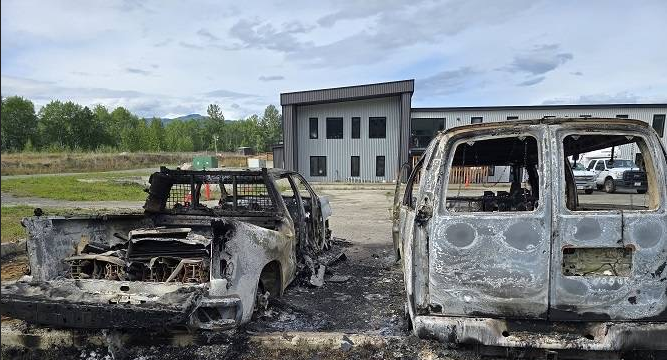
Earlier this spring, two pickup trucks belonging to the industrial technology company ABB were set on fire in the parking lot of their main Montreal office. ABB specializes in the electrification and automation of industry. They are a cog in the machine of the devastating “ecological transition” on an international level. ABB has a contract with Nouveau Monde Graphite (NMG) to build a substation for the Matawinie graphite mine in Saint-Michel-des-Saints, recently declared a project of “national interest” by the government of Canada. NMG claims this substation will eventually allow the mine to run fully electrically.
We are writing this zine as anarchists living in so-called Canada seeking to spread attack against extractive projects of the state and capitalism. We come from an insurrectionary, eco-anarchist, anti-extractivist, and anti-colonial background, and draw inspiration from the methods and tactics employed by eco-saboteurs in the ecological movement in North America through the 1990s and early 2000s. Building off of various monkeywrenching techniques from this era, this zine will focus on updating information around tactics and techniques of sabotage against heavy machinery.
1. Introduction
The goal of our experiment was to find a method of sabotage that would be undetectable by our enemies until much later, long after we were gone and the damage was done. This means, in short, without using incendiary or explosive devices, or any kind of obvious visible destructive techniques. While being undetectable, we wanted to find tactics that would cause the maximum amount of damage throughout the whole system of the machine, causing the longest delays and most expensive continuation of the extractive project. We hoped to find an easily replicable, difficult to trace tactic that could be proliferated, especially at sites where there was not yet widespread attack against the project (so as to keep a low profile and not immediately raise the stakes), or at sites which were already attacked and under surveillance (to allow our friends time to escape without suspicion).
We tested a variety of techniques from the ecological movement, as detailed in Earth First! and ALF/ELF manuals, the Monkeywrenching Handbook, and other online resources (see Resources). We wanted to see if these techniques were still applicable, several decades later, as much of the technology around heavy machinery has changed. We applied as close to a scientific method as we could given the circumstances, wanting to be certain our techniques worked. We wanted to be able to share our research with our comrades of a similar mind so that they could take and use these techniques without having to recreate the same months and years of testing and experimentation.
Our goal ultimately is that these techniques, if successful, would be applied to relevant targets. In the context of Canada, which is and always has been an extractive project, extractivism is essential for the economy, state power, nation building, and the war machine. The heavy machines that do the work are tangible, exposed, expensive, and an attack on them has the potential to set a project back directly and significantly. If we’re lucky, we can destroy the machines before they carve open the earth. As anarchists who are against the destruction of nature and for the destruction of the Canadian state, we ground this technical and practical text in a political theory of anarchist direct action.
Ultimately, the techniques we wanted to experiment with failed, which is valuable to know. And we still think there are valuable things that we learned as part of our experimentation, which we want to offer to our friends and comrades. We want to share this information so others don’t need to reinvent the wheel when researching, and to give a basis for understanding what does or doesn’t work. We also welcome being told what we did wrong, or hearing if others found things that worked.
2. Update of Old Information
To begin our research, we read through known resources. Namely, we looked at Ecodefense: A Field Guide to Monkeywrenching (Third Edition) by Dave Foreman and Bill Haywood. This book, published in 1993, is available online, and has 350 pages of advice, skills and knowledge about direct action and sabotage. We mainly focused on Chapter 5: Vehicles and Heavy equipment.
Unfortunately, a lot of the information found there was somewhat outdated, as the machinery has evolved since the 1990s, hence our need for experimentation and exploration. The logic behind the techniques are still applicable however, and the authors mainly argued for sabotaging the lubricating systems of the heavy machinery, as this is a slow technique that provides a time delay between when the saboteurs attack and when the machine is crippled. From there, we were inspired by the idea of abrasives (carborundum, or silicone carbide) inside the fuel system and oil lubricating system. The manual is not very specific in terms of quantities, and the procurement of the abrasives became the most clear barrier: the abrasives are only found in specific sandblasting industrial shops or in car mechanic shops. Buying it in person in large enough quantities without drawing attention was complex, and we could not figure out how to order it online anonymously, as we always had to order it from very specific retailers that required a lot of company information for the order.
We also looked over the Office of Strategic Services 1944 Simple Sabotage Field Manual, which was the precusor to the CIA. This manual is a primer by the USA forces to encourage European citizen to sabotage their enemies during the Second World War, and must be understood as facilitation of USA control and imperialism. Again, the information here, while hilarious in some sections (specifically when they speak about sabotaging meetings), is mostly outdated. The MonkeywrenchingHandbook spoke about “caccolube”, which were used to destroy tanks, but the instructions on how to make it are not found in this manual. With further research, we narrowed down the caccolube recipe to a condom filled with abrasive dropped into the oil tank. The hot fuel melts through the condom and releases the abrasive into the machine’s lubrication system. Unfortunately, in today’s engines, the oil filter blocks the introduction of a filled condom. We did not test this method exactly, but we took the logic of introducing abrasives into the oil tank from this text.
We also read through the ALF Primer, but again, not much information seemed to have been thoroughly tested, and most was repetition of the Monkeywrenching handbook. We will discuss a number of these techniques in this text, going over the pros and cons with what we know and stressing over what we do not know .
Based on these sources and the lack of updated information that applies to our current situation, we began creating our own research into slow methods of destruction, looking mainly at sabotaging the oil lubrication system using bleach and liquid glass.
3. DNA Measures
When playing with any machinery, one must think about the DNA traces left on site and on the machines themselves. This section will go over briefly some key takeaways about DNA safety in the field and will refer to other existing resources.
The No Trace Project (https://www.notrace.how/) is an excellent resource hub for surveillance. The zine DNA You Say? Burn Everything to Burn Longer: A Guide to Leaving No Traces (https://www.notrace.how/resources/download/blabladn/dna-you-say-read.pdf) is the main source of information used. We will not go into detail into the DNA-safe protocol they highlighted, rather we recommend you read the whole zine and then come back to this section to have some useful updates from field testing. We cannot recommend enough the zine, please do read it before adding our tips.
There are three broad areas that you move through while doing an action. The first one is the baseline of your normal life, where it makes sense for you to be and is not linked to doing an action. When you move into the action area, this is the broad space where it is dangerous for you to be seen and recognized. Then there is the target area, where you will be doing your sabotage. Somewhere between the action area and the target area is where you will set up a DNA-safe changing zone.
During transportation, you are in your clothes or new clothes (outfit #1), as it is not sketchy for you to be seen there. Outfit #1 is a normal enough outfit that you can be seen in without any security nor surveillance risk. You need to determine where it starts becoming unsafe for you to be seen in the area to determine the threshold for changing into your action clothes. Close to the action area, which can either be before leaving your main transportation, or before getting into the action area, you change into your action clothes (outfit #2), which are non-descript and fully anonymizing (face covered, all skin covered). This outfit #2 is composed of new clothes and shoes that are not your own nor similar to ones you own (and can be bought at a second-hand store to reduce costs). You will then arrive to your DNA-safe zone and change into your DNA-safe clothes (outfit #3). After moving to your target and doing the action, you can return to the DNA-safe zone and change back into outfit #2. You will exit the action area, get into outfit #1 and destroy both outfit #2 and #3 (and outfit #1 if necessary; i.e. if you have a suspicion that you were seen in it in the action area) before returning home.
There is not an exact science to where the DNA-safe changing zone should be, as it varies based on the action site. Some guiding principles would be:
The zone is close enough to the target + that once people are in their DNA-safe getup, they minimize the risk of getting DNA contaminated by moving through the field (i.e. ripping the clothes, hurting themselves);
The zone is far enough that it would be hard to trace back one’s steps from the target to the zone;
The zone is secluded and far from any surveillance infrastructure;
A person can easily scout while the others change;
You can comfortably be in the zone for up to half an hour;
You have scouted the zone and are knowlegeable about it.
We tried using painters suits, which are full white suits that zip up with a hood, leaving the hands and feet outside. These suits are not ideal for actions done in the woods, as the white is a dead visual give-away against the darkness of the night. They are also quite hot, get sweaty fast, and and don’t stretch, so can easily rip (especially if you have a fat ass).
We suggest instead to get second-hand clothes that are dark and non-descript or of a camouflage suitable for the area. These clothes should be acquired in a way that minimizes your DNA put onto them. To limit DNA transfer, always wear gloves when manipulating them, carefully and quickly put them in plastic bags that are tied by the cashier and then wrap that internal bag with an additional external plastic bag. Essentially, you do not want these clothes to touch you in any way, neither your body nor your hands, nor your breath nor hair. In some second-hand stores, especially huges ones, it is not strange to be wearing gloves to touch clothes. Otherwise, you can just put on your best germophobic acting skills. These clothes will then stay in the double bags until you are at the DNA changing zone at the time of the action.
These clothes should cover your whole body, ideally going over your outfit #2, and be anonymizing in the same way. DNA You Say? covers this in more depth, but our essentials include:
Full body cover (hoodie and pants that will still cover you when you move)
Goggles to stop eyelashes and eyebrow hairs from falling OR use vaseline to stick them to your face and wear safety goggles if necessary for safety
Face mask that fully traps all the air you breath in the mask
Shoe covers that will cover your socks and pants, such as an additional pair of socks you can put around it all or bags. Latex waterproof shoe covers can also be used t minimize footprints however they don’t cover the whole foot and ankle in a way that traps your DNA inside.
Gloves (several pairs)
To know how to change in the zone, please refer to the DNA You Say? zine. Ideally, you will need two if not three people, so one person can scout will the other two are changing. One person is always looking at the other one changing and making sure they aren’t making any DNA mistakes. If they do, pack away the item and take a double. Take your time with the changing, do it in a controlled and methodological way.
The whole goal of the DNA-safe protocol is to minimize the DNA left on site. Practice changing beforehand so it will go without DNA mistakes on the day of action. Between yourselves, based on your threat model, you can decide which DNA mistakes are okay and which mistakes will mean that the action must be terminated. We recommend that no mistakes are made during the DNA changing process, as any mistakes essentially cancels out the usefulness of the process. The DNA-safe protocols only minimize DNA left, but we can never be fully certain that nothing will be left on the site, especially as forensic technology keeps improving. We are by no means forensic data specialists, but from what we have read, any DNA at the action site can be incredibly dangerous. Inform yourself on the essential use of DNA-safe protocols before taking on actions that could result in forensic investigation.
4. Machine safety
After talking about our own safety it is important to consider the safety of the workers using this heavy machinery. They are humans stuck in a destructive system just like us and even if they have shit politics or work in a bad industry it is not a reason to put their lives in danger. As such none of the techniques we propose in this text are dangerous for the next operator. We chose not to put contaminants in fuel as uncontrolled mixing of chemicals which are used in a combustion engine could cause unforeseen emission of gasses or out of control burning while someone is in the cockpit.
We did not try to sabotage the hydraulics of the excavators for similar reasons. Hydraulics are the pressurized liquid inside the machine that enables it to do heavier tasks. For example, it is the hydraulic system that enables the excavator bucket and arm to move and to stay upright. Most of the time, when excavators are off, the bucket is resting on the ground. However, for some bulldozers, telehandlers and motor graders, their buckets or arms are still in the air and are maintained in that position thanks to the hydraulics, even when the machine is turned off. Sabotaging them would mean that the pressure in the hydraulic system is released, leaving the buckets or arms to fall in unpredictable ways. This is very dangerous. Also, if a hole would be made in the hydraulic cables, the potential resulting jet of pressurized oil is able to pierce throught a human body. This would cause instant blood poisoning, which requires going to the nearest hospital and having your blood drained and replaced. Good luck explaining what caused that to the doctors. Despite much research, we do not know how and have not tested how to sabotage the hydraulic systems in a way that is safe for the saboteurs or the workers. Most other guides mentioned arrive at the same conclusions.
5. How It Works
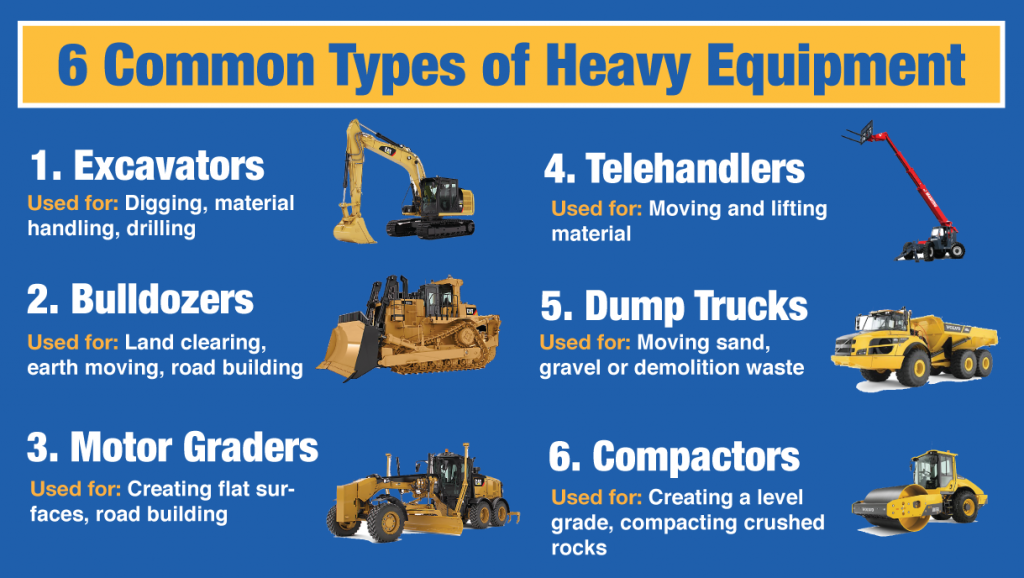
Machinery can seem very complicated when you open it. Understanding all of it is a whole field of specialization. There is a long list of different machines with different purposes (which you should learn how to differentiate to be able to communicate clearly), but to destroy it we do not need to know every single working part. A broad understanding of the main components is enough to make us efficient at recognizing what we can work with, what we can ignore and what we need to keep away from.
Most heavy machinery is, at its core, a combustion engine plugged to a lot of hydraulics. To function, the engine needs four main components: air, fuel, energy and oil. Each of them have an asisgned system that connects to the engine block and to all of the other systems (hydraulics, transmission, joints, cooling, etc…). These are the main ones because if one of these doesn’t work, neither the engine nor the other systems will work and we will have decomissioned an expensive machine.
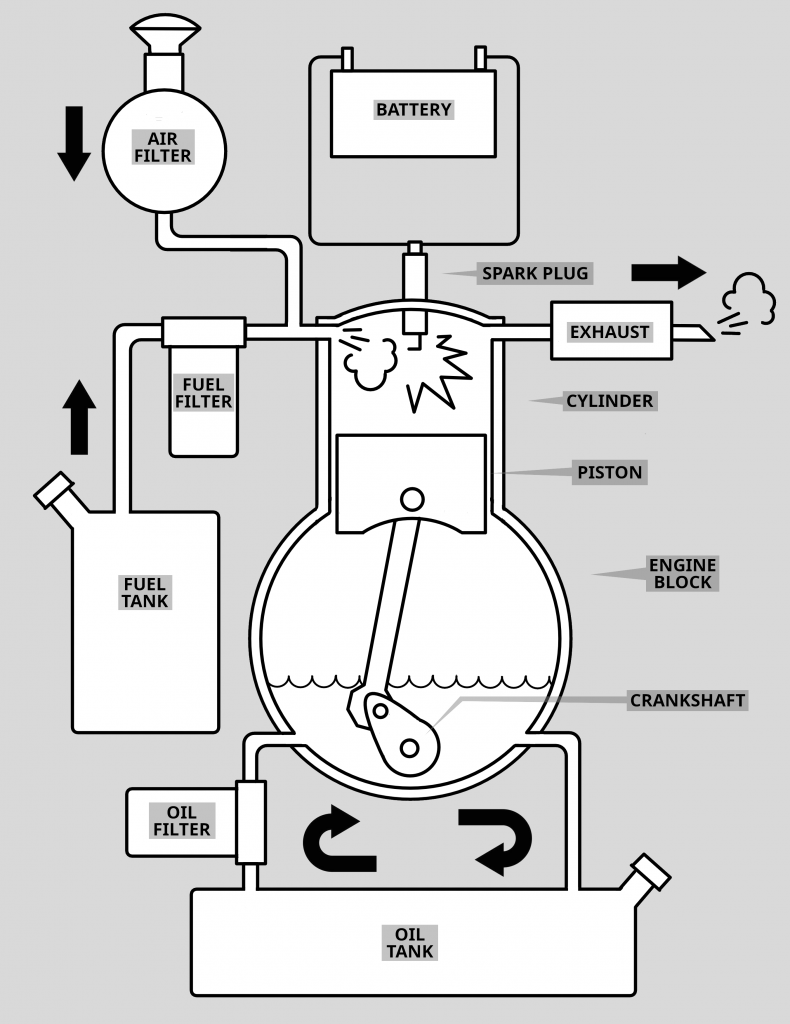
Here’s a simplified diagram to show you how an engine works. This diagram uses official terms which enables you to research more and understand better how any of this works if you are up to it (we strongly recommend it).
The engine will pump a specific amount of fuel and air (which pass through their own filters) inside the cylinders located inside the engine block. This mix will be lit by the spark plug (which is connected to the battery) to create an explosion which pushes the piston down. This action moves the crankshaft and distributes the energy to the transmission and the rest of the machine. The resulting gasses are then taken out of the cylinder towards the exhaust and replaced by a new mix of air and fuel which starts the cycle again. This system needs to be well oiled so it does not break apart or gets overheated as most of it is metal rubbing against metal powered by explosions. The oil gets filtered and distributed through the whole engine by its own system. The specific entrypoints of the oil vary on the specific engine and are therefore not accurate on this diagram.
Usually, on any working site the drivers need to inspect the machinery before using it. Obvious alterations to the systems will be picked up unless the workers don’t do their job (don’t count on that).
6. Different Techniques
Subtle techniques
Air filter
The air system contains some of the easiest parts to access and tinker with. Once we go past the filters we can clog the air intake, and without air, no combustion can take place inside the engine. It is an efficient way to stop the engine, but definitely not to break it. Depending on the action we take once we have access past the filters, the outcome can vary greatly: from instantly stopping the machine, to subtly breaking costly parts.
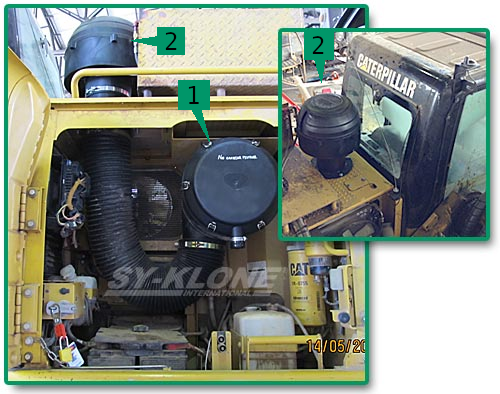
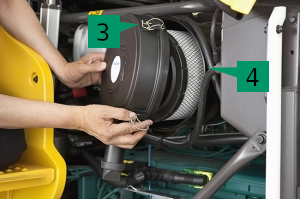
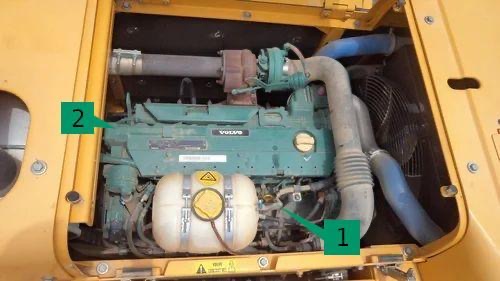
The air intake brings the air throught two filters, one inside the other, so rocks and dust can’t enter the engine block. The filters are inside a plastic or metal drum the size of a small trash can¹. On most equipment the filters are near where the air intake is located², otherwise it is usually easy to find the drum as it’s one of the biggest filter in the whole machine. The lid, about the size of a record, is held on with metal clips³. Use a screwdriver to pop the clips open. Always work carefully and methodically, as sometimes they will pop open fast and break skin. Once the lid is open the main filter is exposed⁴, and we can pull it out, exposing the safety filter⁵ which we can also take out with a simple pull, giving us access to the air system.
At this point we can choose what to do.
Dispose of the filters somewhere. Dust and debris will get in and either clog or eventually wear down the valves and pistons, but only if no one notices that the filters are missing. If workers inspect the machine it will be incredibly obvious that the filters are gone and the machine won’t be started until they are replaced.
Pierce the filters. They are made of plastic and paper, making it easy to do. Dust and depris will eventually get in.
Insert solid contaminants, like rock, sand or silica which will wear down the turbocompressor and the intake valve. It will take a long time to do substantial damage.
Insert liquid contaminants, such as water or expansive foam to clog the air intake and immediately stop the engine from starting.
Tools needed include a screwdriver, your contaminant of choice and (depending on the machine model), and a funnel. Here’s a detailed to-do list on how to put contaminants inside the air system:
Locate the air filter.
Open the lid with pliers/screwdriver.
Take out main filter and safety filter.
Insert your contaminant of choice down the inlet.
Put back the safety filter and the main filter.
Close the lid.
Leave.
We did not test this technique yet.
Oil filter
The oil distribution system is a direct path to some of the most expensive parts of a machine, namely the engine block, pistons and the crankcase. Corrupting its capacity to keep everything well lubricated can break all the most important pieces of the engine all at once, leaving the contractors with no other choice than replacing the whole machine or expensive repair costs.
In the old documents we researched, the writers present this as a magic bullet that would instantly shut down the machines. Dropping a handfull of abrasive material or even sand in the oil tank, and the machine can’t continue its business as usual. In our experience this is far from the truth – the action is slow and it is hard to confirm its efficiency.
Nonetheless it is clear that adding contaminants that can’t be filtered in the oil distribution system is bad for these giant machines. The oil filters are designed to be more and more efficient at blocking the tiniest of impurities, so we need to find ways to circumvent them. Not an easy task, especially since most of the interesting contaminants (silicon carbide, aluminium oxide, titanium oxide) used by the old timers in the U.S. are really hard to find here in Canada. However, it is possible to enter the oil distribution system if the contaminant we are introducing is a liquid. The filters need to let the oil pass through them for the engine to work, therefore anything with a similar consistency will pass throught the system without issue.
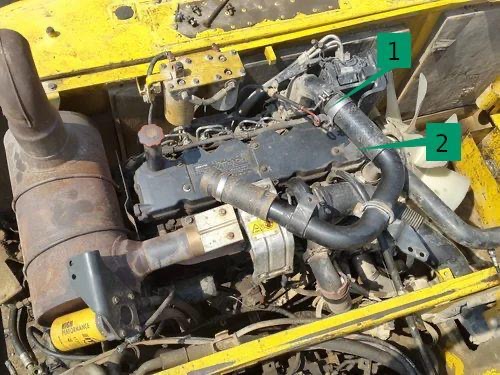
Another problem to account for if you want to insert contaminants is that the oil filler neck is sometimes hard to find on these machines. Machine grime obscures the indications on the caps and sometimes the indications are just not there to begin with. It is possible to circumvent this problem if we pour the contaminants through the engine oil dipstick, which is usually easier to find and identify. To find the dipstick we often need to climb on the machines and open some of the hoods as every machine has it in a different place. The dipstick is a long metal strip with a small circular handle that fits into a long slender tube¹. It is used to look at the level of oil inside the engine block. Depending on the model there are a bunch of different dipsticks, so its important to find the right one. A good way to find it is to look for the one that is the closest to the engine block². Afterwards the only question is which contaminant is the best for what you want to do.
Here’s a list of some interesting choices for us.
Inserting a mix of engine oil and abrasive material like silicon carbide, aluminium oxide, titanium oxide. The finer, the better. We tried to get access to all these materials without success, as the only way we found to buy it was by direct contact with the producers which was not possible to do anonymously. And even if we could have, individuals buying these materials in small quantities would have been really suspicious and the filters might be too good now to let these contaminants through, therefore we did not test this technique.
Adding anti-freeze to the oil tank. Supposedly, because it can’t compress, it breaks gears inside the transmission system, and as it is non-lubricating it would not protect the parts it is supposed to. We tested this mix inside a 500ml metal bottle with a ratio of 1 part anti-freeze to 4 part oil. After 19 hours the oil became opaque. As the workers typically need to inspect oil before using any machine we felt that this technique would be rapidly discovered and we did not test this technique any further.
Inserting gasoline inside the oil tank. Supposedly gasoline breaks down oil and renders it non-lubricating. We tested this mix inside a metal bottle and while it definitely reacts together (there is visible slow swirls moving in the liquid) it does not seem to render it less lubricating. The test was run for 19 hours in a 500ml bottle with a ratio of 1 part gaoline to 4 part oil. Since it looked inconclusive, we did not test this technique any further.
Inserting water inside the oil tank. As oil floats on top of water, it’s the latter that would be used in the system before the oil and would be useless as a lubricant. This technique seemed like the least efficient of all so we did not test this technique any further.
Adding bleach to the oil. It breaks down oil and renders it non-lubricating. We tested it but cannot confirm nor disprove that it worked and cannot tell how fast or slow it worked.
Inserting liquid glass inside the oil tank. There is a whole chapter dedicated to liquid glass and how to prepare it. We tested this more extensively.
Tools needed include a clean funnel (with a really slender opening as the dipstick has a really small opening), and bottles of your preferred contaminant. Here’s a detailed to-do list on how to put contaminants inside the oil system:
Find the engine oil filler cap or the engine oil dipstick.
Open it.
Pour the contaminant. (This step can take a considerable amount of time as some of the contaminants have a thick consistency and pour slowly in a small opening. It took us over 5 minutes for a single machine.)
Slip the dipstick back into place. (This can be tricky as the dipstick is very long and bendy.)
Grab the empty bottles, lids and close the hood.
Leave.
Zerts/Nipples
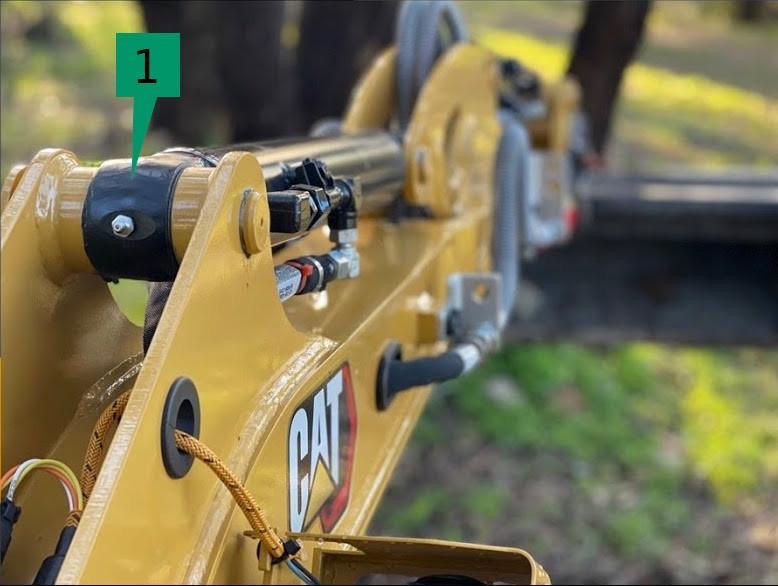
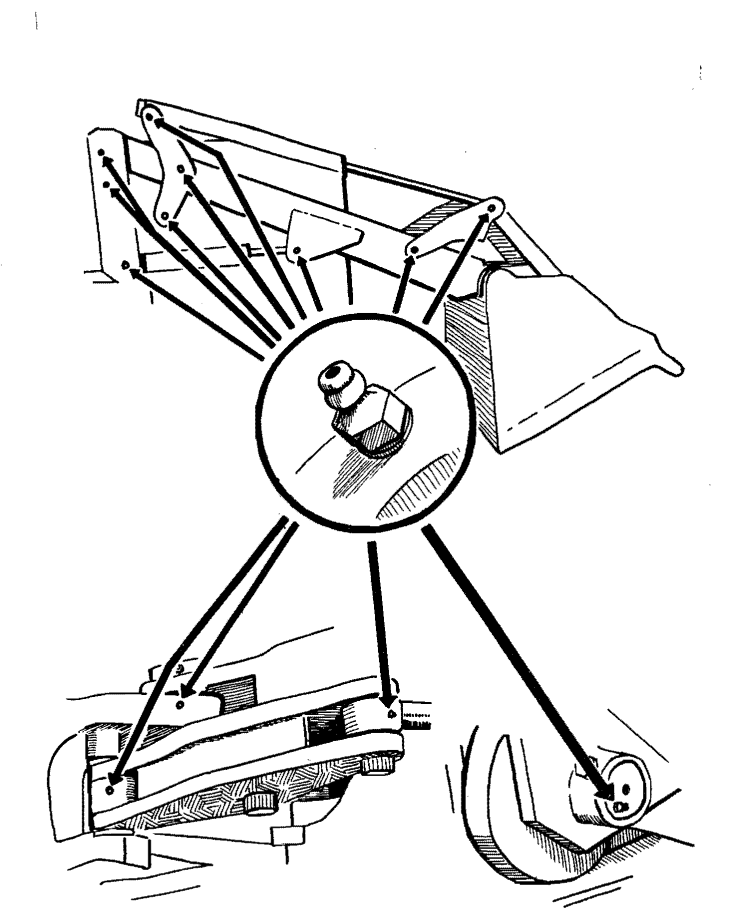
Every moving joint of the machines must have some type of lubrication to prevent overheating and premature wear out. This lubrication is provided through small openings called zerts or nipples¹. It is theoreticly possible to insert abrasives in these joints and wear the machine out in places where it would be harder to repair or replace. This is also one of these techniques that our outdated sources present as a magic bullet: they would insert the abrasives and the machine would grind to a halt without anyone noticing.
Per experience, this is hard to believe. These zerts are filled with grease using a grease gun, it is a regular maintenance obligation and are therefore constantly refilled with new grease. It is possible (and easy) to push out the old grease withe the new one that is inserted. All of that means that whatever we would be able to put in the zerts would be just as easily removed at the first sign of a problem, probably way earlier than it would become effective. As with the oil filter, the main difficulty with testing this technique was the ordering of the abrasive material. Taking all of this into account we did not test this technique as it seems worthless. We encourage you not to waste your time with this.
Mix and match
As is written in other sections of this text, many liquids in these machines do not react well if they are mixed. Fuel is supposed to break down the lubricating properties of oil, anti-freeze doesn’t compress and can’t be used as lubricant, fuel is worthless as a coolant, etc… Being able to mix the liquids of the machine itself without the need to bring something more to the location is alluring. It has the potential to leave no trace and when a problem would arise, seem very serious as it would indicate major leaking of most of the systems.
The problem with this technique is finding a way to pump the liquids into another’s tank. We haven’t found any way to do that safely and as such, we did not test this technique.
Non-subtle techniques
Final Drive
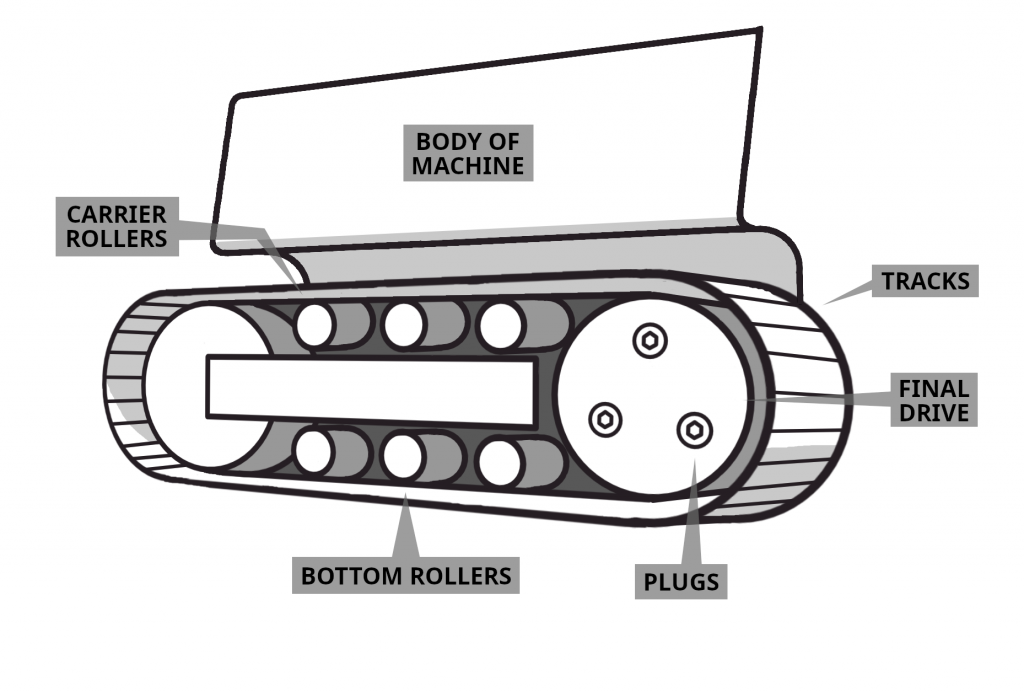
The final drive is, in short, the end of the transmission system which brings the engine’s power to the tracks on heavy machinery. The final drive is filed with gears and bearings which all require a lot of oil to function without problem. Without this oil the gears would grind against each other and potentially break if used. As with every other oil, it needs to be changed as part of usual maintenance. The part where it gets interesting is that while usually engine oil (and filters) needs to be changed every 200 hours of work, the final drive’s oil needs to be changed every 800 hours of work. It is more unlikely that the workforce using the machinery will have the necessary oil at hand when working in a remote location, and draining that oil would halt their work quickly. As with every other technique in this section, this would not be subtle. The final drive is filled with approximatively 5 gallons (22.5L) of oil, and draining it (even really carefully) would leave traces, stains or us with a container filled with 5 gallons of oil. Nevertheless, if our plan is just to stop the workers from continuing with business as usual, it is a simple option.
Tools needed include a long and sturdy ratchet and associated sockets. Here’s a simple diagram to help you find the final drive.
Here’s a detailed to-do list on how to drain the final drive:
Find the final drive.
Warm up the final drive by running the excavator a few minutes and position the final drive so the lower drain plug is at the 6 o’clock position and the fill plug at 12 o’clock.
Carefully remove both the top (fill) and bottom (drain) plugs using the ratchet. Take care not to soil yourself with the oil coming out.
Either reinstall the plugs using the ratchet or dispose of them.
Oil Filter
There are easier ways to stop the lubrication of the whole system, but these techniques would be discovered instantly. But if our plan is just to stop the machines, they are good and reliable. We could either remove or pierce the oil filter (or any filter at hand for that matter). Usually, the workers would see in the morning that the filters are missing or broken as the machines are supposed to be inspected every day before work, and they wouldn’t start the machines without replacing the missing parts. Their access to new filters and oil depends entirely on their preparedness, so how effective and long-lasting these techniques depend on this
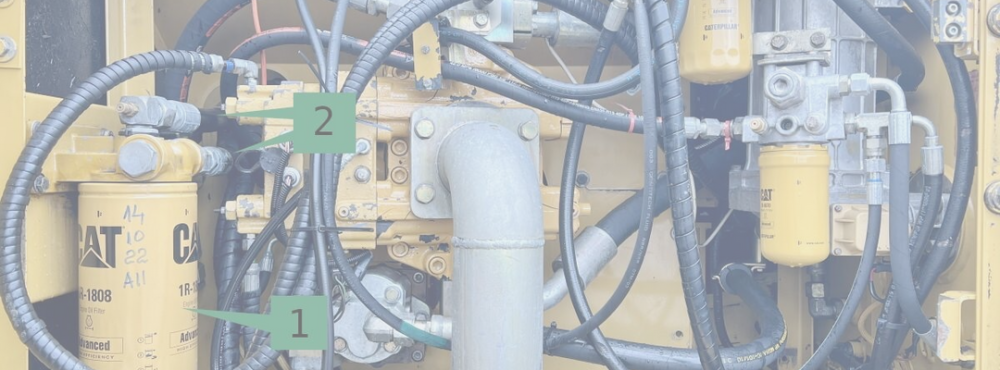
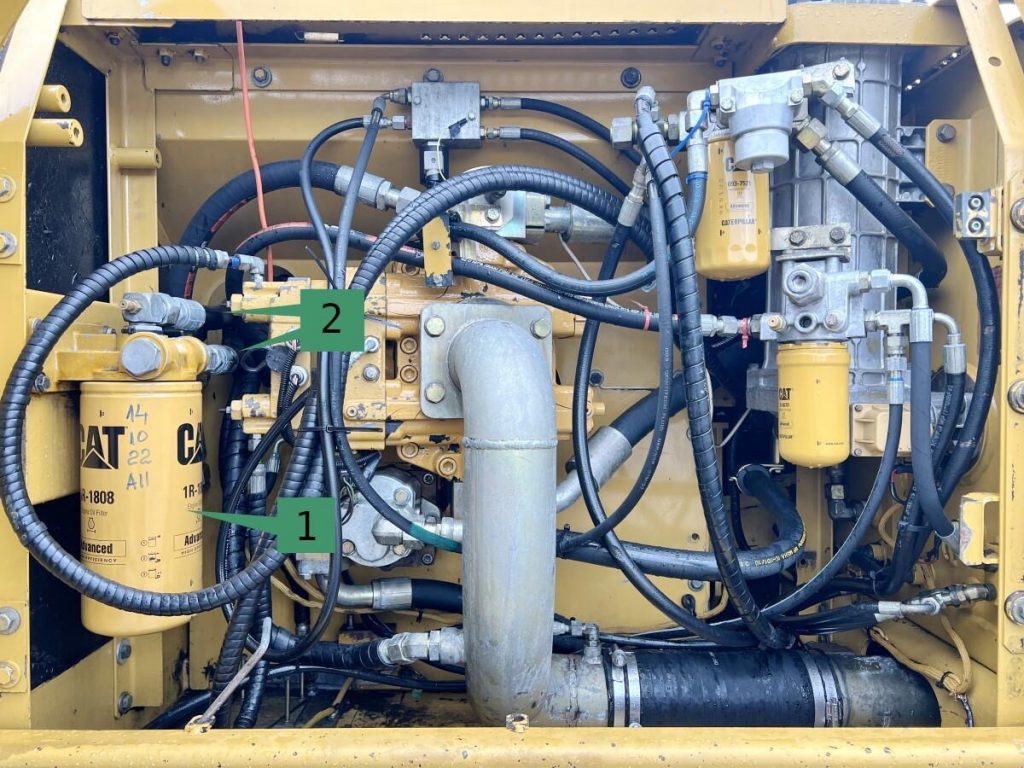
Finding the oil filters is an easy task. The filters look like this¹ and are usually close at hand once you open the hoods as they are supposed to be changed regularly. The amount of different filters depends on the type of machinery and the model, but the filters are all identified clearly. (Again, we could also break or steal any filter, but the oil and fuel one are the most important.) Once we have located the filter, we can start working. Removing or piercing the filter will release a huge amount of oil, as the filters are screwed on to the throughlines² and can hold up to two liters of oil. All of this oil is a liability to leave prints and traces everywhere, so as always, be careful.
Removing the filter
Tools needed include a specialised oil filter wrench and a clean plastic bag.
Here’s a detailed to-do list on how to remove the filter:
Find the oil filter.
Find a secure grip on the filter with the wrench (be mindfull on the oil coming out)
Put the filter in the plastic bag and close it securely.
Leave.
Dispose of the filter or burn it.
Piercing the filter
Tools needed include a screwdriver, a screwpunch and a hammer.
Here’s a detailed to-do list on how to remove the filter:
Find the oil filter.
Pierce the filter using the screwdriver and hammer. (Try to punch the hole near the top of the filter, it might sound really loud.)
Leave.
Lock Jamming
Jam door and ignition locks with slivers of wood, and a hard tough cement like “super glue” or silicone rubber sealant.
7. Liquid Glass
While reading around, we stumbled upon “liquid glass”, a solution of sodium silicate, made of sodium hydroxide (NaOH, known as caustic soda or lye) and silicon dioxide (SiO2, known as silica). Silicon dioxide is found in nature as quartz, and is an essential component in making glass. Essentially, this is an aqueous (water-based) solution that when heated transforms the dissolved silica into its hardened state. In theory, this very thick liquid can be poured into the oil engine reservoir, will go to the bottom as it is more dense than oil and remain there inertly until the engine is turned on. Once the engine is on, the high heat would transform it into a hard abrasive, effectivly destroying the engine.
In 2009, there was a state-run program in the USA called Car Allowance Rebate System or Cash for Clunkers, that would pay-off car owners to trade in their used cars. The program instructed the car dealerships to disable the engine by draining the engine oil, filling it with two quarts (1 quart = 0.95L) of a solution of 40% sodium silicate/60% water and then running it at 2000rpm for at least 7 minutes. Once this was done, the engine was completely disabled.
Appendix B to Part 599 – Engine Disablement Procedures for the CARS Engine Disablement Procedures for the CARS Program
THIS PROCEDURE IS NOT TO BE USED BY THE VEHICLE OWNER
Perform the following procedure to disable the vehicle engine.
1. Obtain solution of 40% sodium silicate/60% water. (The Sodium Silicate (SiO2/Na2O) must have a weight ratio of 3.0 or greater.) 2. Drain engine oil for environmentally appropriate disposal. 3. Install the oil drain plug. 4. Since the procedure is intended to render the engine inoperative, drive or move the vehicle to the desired area for disablement. 5. Pour enough solution in the engine through the oil fill for the oil pump to circulate the solution throughout the engine. Start by adding 2 quarts of the solution, which should be sufficient in most cases. CAUTION: Wear goggles and gloves. Appropriate protective clothing should be worn to prevent silicate solution from coming into contact with the skin. 6. Replace the oil fill cap. 7. Start the engine. 8. Run engine at approximately 2000 rpm (for safety reasons do not operate at high rpm) until the engine stops. (Typically the engine will operate for 3 to 7 minutes. As the solution starts to affect engine operation, the operator will have to apply more throttle to keep the engine at 2000 rpm.) 9. Allow the engine to cool for at least 1 hour. 10. With the battery at full charge or with auxiliary power to provide the power of a fully charged battery, attempt to start the engine. 11. If the engine will not operate at idle, the procedure is complete. 12. If the engine will operate at idle, repeat steps 7 through 11 until the engine will no longer idle. 13. Attach a label to the engine that legibly states the following: This engine is from a vehicle that is part of the Car Allowance Rebate System (CARS). It has significant internal damage caused by operating the engine with a sodium silicate solution (liquid glass) instead of oil.
Excited about this discovery, we set out to make sodium silicate, using this formula:
2NaOH + SiO2 → Na2O∙SiO2 + H2O
To destroy one engine, we found the engine oil capacity of the targetted heavy machinery (by looking up the specs for the precise machine, using Ritchie Specs website), which ranged from 25 to 35L. We went back and forth about the appropriate amount of solution to make. On one hand, we were not going to drain 25 to 35L of engine oil in the wild, as it would contaminate the soil, leave evident traces of tampering for the owners of the machines, and be a complex task to do without getting any on ourselves. We also did not know how full the oil tanks would be and did not want to risk overfilling them. We also needed to balance how much we were able to carry. Based on the Cash for Clunkers program, we remembered that it took 1.8L to disable a car engine, which ranges from 4 to 8L in capacity (ratio of 1/5 to 1/4 solution to engine oil).
We set out to make 5L of the solution, which would have given us a ratio of 1/5 of solution to engine oil. This amount was large enough to make a difference in the oil, as it would descend to the bottom due to its heavier density, and thus be used first. It was a low enough amount that it would not risk overflowing the oil tank capacity. Could we have made more? Perhaps, and this might be a reason why it did not work.
To make our liquid glass, we followed this ratio of ingredients, which would give us the 40/60 ratio used in the Cash for clunkers program.
1/4 cup (30g) uncrushed silica + 1/2 cup (118g) water + 20g lye crystals
The silica was found in silica cat litter. The sodium hydroxide was found by buying lye crystals used in soap making. Essentially, both ingredients are normal things to buy and easy to find.
Materials
Silica litter bag (roughly one bag at 3.8L, the full amount was not used. It is alright if the silica is colorless and some crystals are colored, they will just dissolved at different speeds)
Lye crystals (roughly 1lb or 454g)
Water
One or several thick plastic containers that one can pour out of and that were made DNA safe beforehand ideally (the solution is also going into an engine hot enough to destroy DNA, so its mainly the filled container that needs to be made DNA-safe afterwards)
A source of constant heat, like a small burner or a rice cooker
A metallic bowl that can sustain direct heat
A metallic mixing spoon
* This method makes roughly 500ml of the solution at a time. Repeat as many times as desired. We found that increasing the amount of silica and lye just made the solution-making time increase, and made it harder for the silica to dissolve.
In a medium heated metallic bowl, mix 1/4 cup of silica with 1/2 cup of water until much of it has dissolved;
SLOWLY add 20g of lye crystals, in roughly 5g intervals as you keep stirring. This will make the solution exothermic, meaning it will bubble and release heat. If you add the lye too fast, the solution will bubble over and risks overflowing.
Keep stirring until the silica has dissolved and you are left with a viscous solution.
Pour the solution into your container, and repeat until you have the total desired quantity.
Make sure to not pour the hot liquid into a plastic bottle or it will melt through the plastic.
Once we had made the solution, we decide to test it directly in the field, which would involve turning on heavy machinery. Before this, we had tried without turning on the machines ourselves and by monitoring the site, but it was often impractical or impossible to watch the site or retrieve a camera from it later. We shifted to a testing model that then involved turning on and running the machines after applying the method. In theory, based on what we had read from blogs about decommissioning car engines, it should take anywhere between 10-30 minutes to hear a result from the running engine of a heavy machine breaking down. Unfortunately, after testing the liquid glass this way, and spending long periods of not-so-subtle time running heaving machinery in the middle of the night, we concluded that the liquid glass method we were trying to employ was ineffective at breaking down the engine. For the bleach, we unfortunately were not able to determine if it had been effective.
There are a lot of variables we were working with:
Type of destructive agent (liquid glass or bleach)
Quantity and ratio of destructive agent to the engine oil capacity
Point of insertion (the engine oil tank)
Length of time running the machine
Any adjustment of these variables could have been the magic answer to our question, but we came to the conclusion that the liquid glass method was not effective. The bleach method would require testing in the similar way as the liquid glass, meaning turning on and running the machine for 10-30 minutes until it breaks down.
8. Heavy Machinery Keys
Through much research, we were able to find that the keys for heavy machinery are not unique to the specific machine, rather a CAT/Caterpillar excavator key will work with all CAT/Caterpillar excavators of the same general model. You should bring all the keys that could potentially work on your model, and use them in a DNA and fingerprint safe way. We have acquired keys and have successfully turned on several types of excavators from different companies.
9. How to Turn on an Excavator
After applying the liquid glass technique (pooring it into the oil tank), we needed to run the machines for a minimum of 15 minutes to test if it worked. The start up instructions can vary by machine, but you can find video tutorials online that detail how to operate most common machinery.
Unlock the driver’s door. The same key should unlock the driver door and start the engine.
Get into the machine. Only one person will be able to sit inside, but you can leave the door open while starting and running the machine to keep in communication with your team.
Put the safety bar up. This is a lever on the left side of the seat, between the door and the seat, and it needs to be raised to get into the machine and operated. In practice however, we found that on some machines it was the opposite, and on others it didn’t matter whether the bar was raised or not.
Put on the seatbelt. Some machines will not turn on if the seatbelt is not on.
Start the engine. Insert the key into the key slot and turn it to the start position. When the engine turns over, you can release the key back to the run position.
Observe the inside of the machine’s cab. Check for warning lights. See if you can identify the controls and indicators. Make sure to keep the parking brake engaged. Avoid touching the hydraulic system – this can be extremely dangerous if you don’t know what you’re doing.
Let the machine idle. After a few minutes of warming up, you can increase the speed of the engine using a dial usually identified with rabbit and tortoise icons.
10. Miscellaneous
Some random bits we learnt along the way!
Do all your research on Tails!
You can watch YouTube videos anonymously on DuckDuckGo’s video tab
There is A LOT of radio interference in quarries and construction sites, due to the change in terrain elevation and the presence of rock/barriers to radiowaves
Walkie talkie radios are good, but encrypted DMR radios are way better and the radio range is longer
People use quarries for late night parties or for dirt biking. Be careful when you go, you might unexpectedly run into people
Faulty machines can sometimes not turn off, even when the key is removed. Look into how to emergency stop your specific heavy machinery: some of them have emergency shut down cables that you need to pull on, or emergency stop buttons.
11. Final Conclusions
Our main takeaway is that doing substantial material damage to heavy machinery in a slow and undetected way is not as easy as old information leads us to believe. We describe in detail many different techniques, with their pros and cons. We have yet to find other techniques that look promising that fit this criteria (slow and undetected). The technique we tried, liquid glass, failed to destroy the machine. The other technique tried, bleach, was inconclusive. We might try it again, and then update this information with our findings.
We encourage saboteurs to look to other methods of sabotage, namely incendiary devices. These types of techniques are not subtle, however including timers (clocks and electrical relay timers, among other available information) can make them slower to ensure adequate time to get away.
Another takeaway from this is also that there are a lot of techniques that should work really well to stop the machines instantly without destroying them, which is less dangerous for everyone. These techniques are also faster than everything else, but prove much less permanently destructive.
We encourage others interested in heavy machinery sabotage to fact check and update this information. So far, there is no magic bullet, but we may have found some things that aren’t so good for the machinery. Most of these techniques can be practiced with fairly low stakes, and with minimal tools and machinery knowledge. We encourage the proliferation of more experiments against heavy machinery and towards the destruction of the techno industrial society.
Good luck and have fun!
12. Resources
ALF Primer
Ecodefense: A Field Guide to Monkeywrenching (Third Edition) by Dave Foreman and Bill Haywood
Comments Off on “FUCK TON NOUVEAU MONDE”: Vandalism at Nouveau Monde Graphite’s Downtown Montreal Offices
Feb272026
Anonymous submission to MTL Counter-info
Red spray paint spelling “FUCK TON NOUVEAU MONDE” (translation: fuck your new world), and a large amount of green paint were recently seen on Nouveau Monde Graphite’s Griffintown offices. Nouveau Monde Graphite is a Quebec company specialized in graphite mining and refinement. They plan to build the world’s first all-electric open-pit mine a couple hours north of Montreal, in St Michel des Saints, with construction projected to begin this year.
Comments Off on Nussir is a mountain, not a mine! – Call to action against the “Nussir mine” beyond liberal environmentalism in Norwegian-Occupied Sápmi
This is a global call to action against the copper-mine currently under construction in Riehpovuotna (called “Repparfjord” by the colonizers), in Norwegian-occupied Sápmi.The Canadian company Blue Moon Metals (BMM) – full owner of the mine’s operator Nussir ASA – is actively involved in the colonization of Sámi ancestral lands through the construction of two copper and precious metals mines in the region. This is part of a rapid expansion of corporate extractivism stemming from the EU’s Critical Minerals Act, as the “Nussir mine” has been named a “Strategic Project,” allowing for large land grabs and cutting through any environmental or Indigenous land protection under the banner of a so-called “Green Transition”. More information on the history of the land and the numerous Sámi-led struggles, can be found in the later sections.
2. WHAT CAN BE DONE?
Besides the Nussir copper-gold-silver project, BMM is currently advancing two other brownfield polymetallic projects, Nye Sulitjelma Gruver (NSG) copper-zinc-gold-silver project in Norway and the BMM zinc-gold-silver-copper project in California. All 3 projects are located within existing local infrastructure including roads, power grids, railways, and/or previous extractivist projects. This makes them desirable for investors, but also more easily accessible for those who wish to intervene.
In December 2025, the first phase of the Nussir-mine project was completed, by detonating an entrance tunnel through the mountain. The next phase entails preparation of surface areas, which means more activity above ground and around the mine. This is a crucial moment, as BMM now depends on much more investments to further pursue their operation. So let’s make this a nightmarish quest! We believe that there is a possibility to win this fight if we broaden our ways of attack and internationalize the struggle. We do not want to define your means or your targets. Do whatever feels in line with your way of acting and existing skills. It could be organizing a blockade, a banner drop, or a solidarity photo, while emphasizing the need for the most materially impactful actions at this time. We welcome your creativity and experience, and hope to see many different approaches on all kinds of platforms.
MAIN INVESTORS: These are the main targets on which we suggest to put pressure.
– Hartree Partners LP has invested $140 million USD in BMM, in conjunction with subsidiaryOaktree Capital Management, in the Nussir mining project, and is one of the largest investors in BMM. They have offices all over the world in, New York City, Istanbul, London, Geneva, Hamburg, Oslo, Cape Town, Dubai, Shanghai, Melbourne, Mexico City, Santiago, Lima, Houston, St. Louis, Washington DC, Tokyo and Toronto.
– Oaktree Capital Management has offices in Stockholm, London, Frankfurt, Amsterdam, Luxembourg, Zurich, Paris, Madrid, New York, Los Angeles, Dallas, Houston, Sydney, Singapore, Dubai, Bejing, Mumbai, Hyderabad, Hong Kong, Seoul, Shanghai.
– Monial Norwegian LLC, owned by the Holta family, owns 10% of the shares in Blue Moon Metals and 32% (6,74 mill NOK) of Nussir ASA. Office is outside of Oslo.
OTHER KEY COLLABORATORS/COMPANIES INVOLVED: Engage with these based on where you are located and what’s possible for you.
– Wheaton Precious Metals operates and invests in mining projects and contributes 3% of BMM’s funding as a strategic shareholder.Wheaton has offices in Vancouver, Cayman Islands and Luxembourg.
– Altius Minerals Corporation is a 2% shareholder and Canadian company that owns royalties for 12 mines producing Potash and “High Purity” Iron Ore, Gold and Base & Battery Metals as well as 13 renewable energy projects worldwide. Exploration for more possible mining activities in Swedish-occupied Sámpi is currently happening through the Canadian-based mineral exploration company Gungnir Resources around Knaften. Their offices are located in St. John’s, Newfoundland, Labrador and Surrey, Canada.
– Baker Steel Resources Trust(BSRT) Guernsey registered investment company. BSRT have 7,5% ownership in BMM.Owned by Baker Steel Capital with offices in London and Perth.
– WG-Wergeland Group is a Norwegian investment office with interests in the maritime and industrial sectors, and a 5% strategic shareholder inBMM.They are an important base for the Norwegian shareholders and provide economic stability as “a trustworthy investor in the European market”. Locations in Dalsøyra and Sløvåg.
– LNS AS (Leonhard Nilsen og Sønner AS) is a Norwegian company working onsite digging the tunnel, roads and building barracks. They’re a 3% strategic shareholder in BMM with offices in Risøyhamn and Andøya. The largest owners of LNS are:
– 28,59% Tuncomp AS, consulting (Risøyhamn) – 21,6% Malmat Invest AS(Narvik) – 20% Hospitality Invest Capital AS, electrical installation work (Oslo) – Entrepenør Harald Nilsen AS is a Norwegian construction company based in Alta. Owns 3,48% shares in Nussir ASA. – Anlegg nord AS is a Norwegian machinery contractor based in Alta and owns 1,69% shares in Nussir ASA. – Alessa AS/Multi Service Nord AS is a Norwegian company based in Kvalsund and works on site renovation and building maintenance, cleaning services, snow removal, providing security guards, etc.
RESEARCH INSTITUTIONS: – UiT The Arctic University of Norway – Norwegian Mining Museum – Norwegian University of Science and Technology – Norges geologiske undersøkelse (NGU)
3. WHY TO ACT NOW
Just like other projects that are currently attempting to colonize Sápmi (e.g. North Bothnia Line Railway,Beowolf’s Gállok Iron Ore Mine, LKAB’s Per Geijer mining expansion in Giron, 420kV power lines), the “Nussir-mine” is still vulnerable. Its completion depends on funds that are still lacking, as well as on unfinished or non-existent infrastructures. So, while any form of attack weakens the full realization of these projects, the success of any one such project will also open the door for many more land grabs and the finalization of Norway’s and Europe’s white supremacist colonial expansion on the continent.
In the case of Riehpovuotna, we can already see how Nussir ASA aspires to follow the footsteps of LKAB in Giron, Swedish-occupied Sápmi. There, an entire village was transformed into a corporate nightmare, where, in addition to lost reindeer herding grounds, the city center and several homes had to be resettled due to sinking grounds caused by mining. Currently, Nussir ASA is exploring the potential of platinum and palladium deposits to possibly extend the current mining project throughout the region. To increase their influence and secure future control over the territories, they also plan to finance local startups (e.g. Alessa AS, see targets below) and homeowners.
BUT: To realize their colonizer fantasies, Nussir ASA still needs to acquire funds and will make a final investment decision in March 2026. They will go public on the NASDAQ in April 2026, making the company’s shares available for purchase on the stock market, also in an effort to secure more capital and funding. In short: the infrastructures of present day colonialism are being built and financed now and must therefore be attacked now. This is why we urge actions to happen in January through March, although extended pressure will be needed to discourage future extractivism in the region.
4. BRIEFLY ON SÁMI HISTORY
The Sámi are the Indigenous people that together with other minorities have been inhabiting the region of Sápmi for several thousands of years. Today Sápmi encompasses vast areas in the northern parts of Norway, Sweden, Finland, and of the Kola Peninsula in Russia.
Sámi traditional livelihoods and survival include mainly reindeer herding, fishing, and hunting which depend on access to large areas, at the same time as maintaining a reciprocal, non-exploitative relationship to these lands. For hundreds of years these traditional activities have been (and still are!) under constant pressure by land theft and destruction associated with the construction of ever new cabins and roads, power lines, wind factories, hydroelectric power stations, data centers, towns, tourism, etc.
Settlers have also violently attacked Sámi and other minorities’ traditional ways of life through religious indoctrination and assimilation, forced settlements, child theft, forced sterilization, enslavement, and installing capitalist economies which push them into more and more so-called “modern” ways of existing. This is the ugly truth we forget when simply thinking about North American boarding schools in Turtle Island and rubber plantations when speaking of colonialism. The Sámi face a multi-faceted oppression which has many layers worth attending.
This text, however, will focus on the material aspects of colonial expansion and the accelerated exploitation that is being imposed through multinational co-operations and their “democratic processes” to extract from the land for the sake of the “The Green Transition”
5.”GREEN” COLONIALISM IN SÁPMI
Located on the ancestral territories of several Sámi communities, the “Nussir mine” will make it impossible to continue traditional Sámi practices. Remarkably, the company’s name itself embodies colonial theft and violence, as “Nussir” is the traditional North-Sámi name for the mountain which Nussir ASA’s machines and dynamite currently eat up.
As such, this project presents one (of many) of the latest manifestations of Norway’s and Europe’s white supremacist colonial expansion unfolding right in front of our eyes in Sápmi. All of these projects are connected by being critical infrastructures of extraction necessary for feeding the so-called “Green Transition”.
What’s happening at Riehpovuotna is yet another gruesome example which should clarify once and for all that so-called renewable energy technologies are actually made with non-renewable source materials and produced with high-powered fossil fuel machines. We refuse to call them wind or solar ‘farms’. We refuse to call them ‘forests’. They are colonial industries, factories and plantations. Wind, solar, biomass, are all just new ways to maintain industrial civilization’s deathly grasp on the world. As slick and well-marketed products, they give the illusion of change, while in fact feeding a society that nurtures itself on the destruction of ancestral life ways.The global demand for “green energy” doesn’t lead to less consumption, rather it means an explosion in overall energy use and the need to extract critical minerals with no end in sight. It is a race to the top, and therefore the “Green Transition” is a militarized proxy war of influence fought between powerful nation states for control of the world’s energy infrastructures and economy. Instead on the ground, these extractivist projects are met with attack and resistance everywhere. We refuse to let Sápmi be an easy target.
6. HISTORY OF RESISTANCE IN RIEHPOVUOTNA
The region around Riehpovuotna has witnessed a long history of resistance against this and similar projects, and has especially been shaped by large protests connected to the Áltá hydroelectric power station in the 1970s and 80s.
From these struggles emerged an autonomous movement with the Sámi resistance call to “ČSV!” (Čájet Sámi Vuoiŋŋa!/”Show Sámi Spirit!”) and a demand to take back the languages, culture, and land that had been stolen through colonization. This ultimately lead to a number of societal reforms, such as state investment in cultural production and the creation of the Sámi Parliaments, among other forms of “acknowledgment”, although without the material transformation needed to end centuries of dispossession.
Mining activities in Finnmark date back to at least 1826, with the first mine at Riehpovuotna opening in 1905. From 1972-1979, mining company Folldal Verk promised riches for the community, only to shut down 8 years later leaving behind a scarred mountain, sick reindeer and toxic tailings in the fjord that poisoned fish leading to deformities. Current plans include, again, to dump two million tons of mining waste annually into the protected salmon fjord.
While more aggressive actions have taken place over generations of resisting Scandinavian colonialism, for a long time the Sámi people have tried to navigate the colonial legal avenues and “democratic processes.” This has included talking to politicians and companies, engaging in peaceful actions and filing suits and cases through the judicial system. All they have gotten are weak compromises and a government institution to document the “truth” about the horrible mistakes made by the Norwegian state and suggested ways for superficial reconciliation, while material colonization continues as before, and even accelerates. In the Fosen case the Norwegian Supreme Court ruled that the wind factory destroyed traditional reindeer herding grounds and violated human rights. Yet, it is still operating, with no intention for it to be dismantled. As said by the former President of the Norwegian Sámi Parliament, Aili Keskitalo, these processes are intentionally designed as a form of endless distraction where they “can kill us with dialogue”.
This call to action is an attempt to diversify and move beyond the dogmatic approach of liberal environmentalism propped up by the state, NGOS, non-profits, and other related actors. There already is a strong desire to broaden and diversify the resistance emerging among Sámi, non-Indigenous locals and supporters.We need to regrow our imagination of what is possible, necessary, and legitimate to stop this colonial expansion in all its dimensions. We need this imagination, because we cannot take down the colonizer’s house with his own tools. If we want to make more than mere dents in the “green” colonialist machinery, we need to intertwine a plurality of approaches and spin a web of affinities, tactics, and attacks. We need to fight by the means each of us aligns with and use our creativity, skills and experience. Against investors, contractors, infrastructure, politicians, equipment and machines. Resistance against the “Nussir mine” is (or should be) resistance against white supremacy and the settler colonial state. Otherwise, how is this struggle supposed to be successful if it acts exclusively within the laws and boundaries set by the colonial system?
7. WHO ARE “WE”?
This communique has been authored by a loose group of people. Some of us who decided to write this are non-Indigenous, some are Indigenous. Some of us identify as anarchists. We all share the desire to dismantle systems of domination and destruction, like those we can see currently enforcing colonial plunder in Sápmi.
We have found our own reasons to act and invite the reader to do the same. When our fighting is rooted in relationship – to the land, to the people most impacted, to the spiritual realms – it tends to lend itself to respect and love-filled resistance; while those fights rooted in pure politics or excitement to break things often end up being saviouristic.
We do not wish to speak on behalf of all Sámi people, to romanticize Indigenous life ways, or to tokenize their struggles for ours. We support Sámi claims of autonomy and freedom, and aim to understand and recognize a history that has been erased or attempted to be erased. We hope and strive for collaboration and crossing paths, and mutual respect as accomplices to oppose this ongoing violent extractivism and insatiable destruction. We believe, simply said, that we should all work together because everyone’s liberation is entangled.
Please read more about indigenous and anarchist critique of activism in our resource section.
Following the approval of the PRGT in June, dozens of track circuits throughout BC have been shorted, disconnected, or otherwise tampered with.
The vast majority of track circuits operate on direct current (DC) and are relatively easy to induce a fail state. The quickest and most discreet method has proven to be the simple snipping of the cable bonding track blocks, requiring little more than a good pair of cutters. Alternatively, a 4 AWG copper wire (commonly found connecting residential main service panels) can be securely fastened to the rail head. And, of course, there is always the option of disabling the power supply. This may include damaging the grounding, which is more time-consuming but notably harder to detect and locate.
Technical details and diagrams of track circuits, and specifically how to compromise them, are readily available in engineering textbooks at your local library, past communiqués, and even neatly presented in certain PDFs hosted on the Government of Canada’s website.
Not much more needs to be said. However, recall that one of the discursive characteristics of the Canadian state is its spatiality, which is also, perhaps, its most exploitable vulnerability. Reflect on past moments in struggle and assertions of sovereignty and recall how strategically positioned rail blockades effectively stretched and divided state forces, offering land defenders at key rupture points critical time to reorient and regroup. That said, disrupting the logistics of extractivism is often most effective when undertaken unilaterally.
Look no further for evidence of the effectiveness of such actions against a wholly undefended infrastructure than in the words of one counterinsurgency state operative:
“If ever there was a military showdown between Indigenous people and the Canadian army, the first target would be the railway lines and burning cars would be on every railway line in Canada … would almost be impossible to stop despite all the Canadian military and police alerted to the potential. A burning car on a railway track is not simply a blockade, it is also a very efficient and economical weapon. A car with a full fuel tank would burn at a temperature high enough to warp the track and require extensive repairs.”
Until paths cross in the night, on the frontlines of the only good war: the war against PRGT, against Empire, and against all forces that seek to estrange and domesticate.
An interview with two settler anarchists in northern British Columbia who are active in a growing struggle against the Prince Rupert Gas Transmission Project or PRGT.
Resistance to the project has been heating up all summer as government approvals have been issued and construction work is expected to begin in the fall of 2025.
Discussions includes history and overview of the project, the changing context of the Canada-US trade war, anarchist-indigenous solidarity, and taking some lessons from Shut Down Canada.
Throughout the last decade, both in Europe and beyond, a new generation of activists has brought the climate movement to the forefront. Groups such as Extinction Rebellion, Fridays for Future, and Ende Gelände have succeeded in breaking out of the sidelines, convincing millions to commit themselves in defence of the planet. It wasn’t so long ago that few were even aware of the possibility of climate catastrophe – nowadays the very opposite is the case. I have no intention to downplay these achievements. What I do want to draw attention to, however, is that climate activism has made little or no difference to something very important, to the only thing which really counts: to actually lowering the amount of carbon emitted by humans across the planet. Such emissions continue to increase every year, as do average global temperatures, weather catastrophes, and rates of species extinction. Earning recognition from across society has not been enough. In all of its core aims, the climate movement remains a decisive failure.
I have a suggestion as to why this is the case. Because the climate movement remains stuck in the assumption that those in power must be convinced to bring about the necessary changes for us. Despite utilising a direct action aesthetic, most climate activism focuses on getting media attention (including mainstream social media, which is as much an extension of capitalist power as television or the newspapers) in order to achieve social recognition, ultimately in order to lobby politicians. However, the political elite will never be able to solve this crisis, because the system which grants them power is also a system which literally thrives on wrecking the planet. What we call “the economy” is an out-of-control megamachine which deems anything short of unlimited expansion (a process which entails ecological devastation) some kind of disaster. No matter their affiliation or the promises they offer, all the politicians and corporations pledge allegiance to the backward logic of this world-eating monster.
Some would argue that certain elements of the climate movement escape this concern. Contrary to Extinction Rebellion and Fridays for Future, anti-capitalist groups such as Ende Gelände do not make explicit demands of politicians, instead focusing on disrupting critical infrastructure directly. However, we cannot suppose that peacefully occupying a coal mine (or its arteries) for a few hours is a realistic way of shutting it down for good; this is just another way of getting the media interested. Such actions make no sense unless one hopes, consciously or otherwise, that they might serve to convince politicians to step in and reform the economy for us. Other mass organisations (for example, Soulèvements de la Terre/Earth Uprisings) might seem like an improvement, given that they favour sabotaging ecocidal infrastructure, and in this sense encourage something resembling direct action (albeit directed by a secretive vanguard). Again, however, this might only be a more seductive way of receiving media attention; for such attacks would be far more effective if performed by small, autonomous groups who strike under the cover of darkness, especially where the authorities do not expect it.
In short, most climate activism is fixated on requesting help from a system which is inherently incapable of responding. It therefore spreads an ethos of disempowerment and infantilisation, implying that ordinary people are incapable of addressing the climate crisis for ourselves. But really it is the other way around. We will all be burnt to a crisp before the governments will do what needs to be done. It therefore falls on unspecialised, dedicated rebels to begin solving the crisis directly. What might that look like? Enacting without delay the necessary changes which those in power will never seriously consider. By this I mean, shutting down the power stations, airports, motorways, and factories, whilst arranging decentralised (and therefore ecologically-minded) means for sustaining ourselves without them. This proposal no doubt involves a massive escalation in strategy. Nonetheless, given the severity of the situation, combined with the fact that current methods have proven insufficient, I think it’s about time we considered radically overhauling our approach.
Inspiration is already out there. For example, the Switch Off! campaign (initiated in Germany in 2022, and since spreading beyond Europe) forgets about reforming capitalism, instead focusing on directly incapacitating the infrastructure responsible for wrecking the planet. Such instances of sabotage are spreading, whether they are associated with the above banner, another one, or are not claimed at all. To mention but a few of many relevant actions: In September 2023, the railway network outside Hamburg was sabotaged at multiple points, majorly disrupting one of the largest ports in Europe; in March 2024, an arson attack on the electrical grid nearby Berlin closed down the huge Tesla Gigafactory for multiple days; in May 2025, a double arson on a power plant and a high-voltage pylon caused a blackout in a sizeable portion of France, depriving an airport, various factories, and the Cannes film festival of electricity. One might also recall that London Gatwick airport was closed down for multiple days in 2018, reportedly (and for motivations unknown) because a handheld drone was flown over the runways. Despite massive police efforts, those who performed this readily reproducible action were never found; nor have any of the other actions mentioned here yet led to any arrests. By contrast, conventional climate activist tactics (for example, usage of lock-ons, tripods, superglue) take getting arrested for granted, thereby sacrificing our comrades to the courts, prison, and ongoing surveillance. This is a high cost for actions which, besides fostering a submissive attitude towards the authorities, have little or no impact on the capacities for climate-trashing industries to function.
In order to begin addressing a problem on the scale of climate change, however, attacks against ecocidal infrastructure must become more ambitious still. This might be phrased in terms of moving beyond a focus on specific industries towards targeting industrial civilisation altogether. The relevant centres of production, extraction, and research must be targetted; so too the electrical grid that binds them together, namely, the very network which gives the system of destruction its power (in both senses of the term) in the first place. Such a bold vision will seem out of place to many. But it is too often forgotten that climate change and industrial civilisation are in fact the very same problem. The human degradation of the climate is not something ancient; it is only as old as industrialisation itself. Since roughly 150 years, human life has increasingly centred on the usage of machines which convert fossil fuels into energy, thereby emitting carbon dioxide. Human culture, in other words, has been forced into a relationship of dependence upon an ever-expanding infrastructure which cannot function without poisoning the climate. The Industrial Revolution was only initiated a few generations ago, and already its consequences have led many to question the viability of life itself outlasting the century. There could not be a more damning indictment of this relatively recent technological shift.
Some will respond, of course, that industrial civilisation is not inherently earth-wrecking, and is already in the process of being reformed. We are talking here about the so-called “Green Transition” being heralded across the political spectrum as the solution to the climate crisis. However, it is a common mistake to think that wind, solar, or hydroelectric power represent genuine alternatives to conventional methods; for in reality they are being harnessed in addition to fossil fuels, which are currently being burnt in higher quantities than ever. To think the capitalist economy would ever consent to leaving untapped reserves of coal, gas, or oil in the ground misunderstands the core logic of a system based on unlimited growth. The consequence of record investment in green tech, therefore, has only been to catapult global energy usage to unprecedented levels.
Moreover, besides failing to involve a transition, the economic restructuring underway is anything but green. Firstly, fossil fuels are highly dense sources of energy, which neither the power of sunlight, wind, or water comes anywhere close to matching; it follows that “renewable energy,” if expected to maintain current levels of intake, must consume far greater areas of land than are already dedicated to energy production. Secondly, the key technologies of such restructuring depend heavily on the extraction of minerals, especially through mining. For example, nickel and rare earth minerals are required to construct solar panels and wind turbines; lithium and cobalt are key components of their batteries, as well as those of electric cars, e-bikes, and smartphones. As such, and in the name of going “green,” the capitalist economy is plundering every corner of the globe in search of lucrative resources, thereby driving ecological devastation, forced labour, and geopolitical conflict. Even the uncharted depths of the oceans are in the course of getting ransacked; next it will be asteroids and other planets. In sum, then, what has been hyped as the technological solution to the climate catastrophe is but a massive lie cloaking the further expansion of the megamachine.
Present in the speech of almost everyone you meet nowadays is an understanding that humans are wrecking the biosphere – and simultaneously committing suicide. Yet far fewer are willing to comprehend the crisis for what it actually is, namely, the outcome of runaway technological development. This is not a problem which can be addressed by voting, petitioning, protesting, boycotting, or investing. The only realistic response to the climate crisis is to attack industrial civilisation. I do not expect that this proposal is about to receive widespread popularity; after all, it guarantees to destabilise the only world almost anybody has ever known. However, we might have to reckon with the fact that many or most humans will forever insist on keeping their cars, fridges, and smartphones running – even at the cost of forsaking the very air we breathe. It therefore falls on those whose priorities lie elsewhere to proceed to brave and uncompromising action.
––––––––. (2024) Mapping the Megamachine: Microchip Production (from Tinderbox #5)
––––––––. (2024) “Nonhuman Comrades” (from No Path #2)
––––––––. (2025) “Subteranean Constellations: Lighting Up the Machinery of War and Ecocide” (from Tinderbox #7)
Gelderloos, Peter (2010) An Anarchist Solution to Global Warming
Pantarai (2024) “Nothing is True, Anything is Possible” (from No Path #2)
Roos, Andreas (2023) “We need to address the root issue, which is the aggregate, overall material-energy throughput” (from No Mine in Gállok: Ecocide and colonialism in Swedish-occupied Sápmi).
Wemotaci region in Quebec (wikipedia). On the left, Dave Petiquay from the First Nation MAMO collective, faces Dany Grenier (on the right), forestry entrepreneur from Dolbeau-Mistassini (image by Lisanne Pittikwi on Facebook).
« … the state, the bourgeoisie and even the working class have been constituted in part through the destruction of First Nations, the dispossession of their territories, the extortion of their resources and settler colonialism– Francis Dupuis-Déri et Benjamin Pillet, 2019. L’anarcho-indigénisme. Lux Éditeur, Montréal. p.35
Over the past few weeks, blockades of forestry roads have been carried out in Haute-Mauricie and in the north of Lac-Saint-Jean by the MAMO Alliance (First Nation). These actions, conducted to contest Bill 97 on forestry regime reform, have interrupted or disrupted forestry operations.
Uniting First Nations for Sovereignty and Territory Protection
It was on April 11, 2025 that an assembly was held in La Tuque to found the MAMO Alliance. This alliance, whose name means « Together » in the Atikamekw (Nehiromowin) and Innu (Innu-aimun) languages, aims to bring together First Nations in exercising their sovereignty. It was initiated by the land guardians of Nehirowisiw (Atikamekw), Nitassinan (Innuat) and Ndakina (Abénakis).
Opposition to Bill 97 and Sovereignty
The land guardians express their disagreement with Bill 97, which modifies Quebec’s forestry regime. They believe this law endangers forest caribou and forest sustainability, thus compromising the traditional Indigenous way of life during the climate crisis.
Numerous blockades and demonstrations of sovereignty have generated tensions between Indigenous protesters and (non-Indigenous) forestry workers, also fueling hateful comments on social media. In response to this situation, the Quebec government has promised to negotiate with First Nations to find consensus and consider amendments to the bill.
Traditional Indigenous groups (like the MAMO alliance), who rely on ancestral rights and traditions, maintain that true authority over forestland belongs to families and land guardians. They consider that current band councils, established by the Canadian government’s Indian Act system, do not reflect traditional sovereignty and are perceived as accomplices of the colonial system. These groups believe that band councils cannot negotiate on behalf of all members of the nations.
The Petapan Treaty and Forest Management
This tension between band councils and traditionalists is not new; it also appears in other negotiations, such as the Petapan Treaty. Under negotiation for more than forty years, this draft treaty involves the Petapan Group, which brings together the First Nations of Essipit, Mashteuiatsh and Nutashkuan, as well as Canada and Quebec, and aims to recognize, confirm and protect Innu rights. However, traditionalists oppose this treaty, claiming that the traditional governance of hereditary chiefs and territory guardians is being set aside in favor of band councils.
Conclusion
There will be no reconciliation without reparation. The Canadian and Quebec states were established on the appropriation of Indigenous peoples’ lands and resources. To achieve true reconciliation, it is essential to support and engage in decolonial and environmental struggles. It is crucial to become true allies in this battle to protect the living world. That is to say, to avoid in our relationships between non-Indigenous and Indigenous people within decolonization movements: « the invisibilization of Indigenous people or the appropriation of their voice, the use of token Indigenous people, the imposition of tactical and strategic choices or a general attitude of guilt relief to give oneself a good conscience » (L’anarcho-indigénisme, p.10)
Footnote:
(1) Unlike other regions of Canada where historic treaties were signed, vast expanses of territory, notably in British Columbia and Quebec, have never been subject to land cession treaties.
On Monday, in New Hazelton four Gitxsan Development Corporation vehicles were burned.
Gitxsan Development Corporation works with McElhaney Geomatics Engineering which had vehicles destroyed by fire in Smithers and Terrace.
McElhaney Geomatics Engineering is contracted to build roads for Prince Rupert Gas Transmission Line (PRGT). More information is available on their involvement in Against Extractivism: PRGT and its Actor
Comments Off on Enbridge Sabotage: Disruption of Service on Line 9B
Aug202025
Anonymous submission to MTL Counter-info
The boreal forest is burning, the water is being poisoned, all the trees are being cut down, and the treaties are being betrayed. The mirage we call “liberal democracy” bows down to the oil lobby. There is talk of new pipelines that will cross the country like scars, new gas projects that will disfigure the land.
Our history has always been that of an extractive colony founded on plunder and dispossession. It’s up to us to put an end to this disaster.
Last night, we attacked line 9B. This pipe of death snakes through lands stolen from Indigenous peoples, transporting the world’s dirtiest bitumen through waterways, cities and our lives. We hit two control valves, destroying the electronic equipment before vanishing into the night.
Now more than a dozen kilometers of pipeline can no longer be controlled by Enbridge. Until these installations are repaired, it is as dangerous as it is illegal to flow oil through them.
We choose to disarm Enbridge because the current system protects profit and lets ecosystems die. We are taking action because every barrel poisons us, kills us, flows against the grain of history. We are those who face the truth, who recognize the urgency of the situation. We choose to obey the love of life and the future.
Line 9B carries the end of the world barrel by barrel. It’s time to take direct aim at the infrastructures that are responsible.
The facilities concerned are at Saint-André d’Argenteuil (45°33’25.1 “N 74°20’53.7 ”W) and Mirabel (45°36’42.3 “N 74°04’46.6 ”W).