The day we discovered we had been designated a global terrorist organization, we promised that we would try to resist as long as this was possible, that we would not back down as long as we could see options to stand our ground. For years, we have proudly maintained and defended a free, privacy-friendly, autonomous and politically committed infrastructure.
“Stay human” is not an empty phrase to us.
It means, above all, that we have a responsibility to protect our users, those who build the human networks we rely, and for the communities who flooded us with messages of support and solidarity.
We cannot engage in a fight or expose ourselves to manipulations that threaten the lives of these people and their loved ones, leaving them at the mercy of autocrats, fascists and agencies that take extra-legal courses of action. The possibility that our work may cause legal and financial consequences to those who are close to us – or even only have something to do with us – leaves us no choice.
A/I is shutting down. The Autistici/Inventati collective is shutting down and will soon discontinue all of the services we provide.
There is no easy way to announce or explain this.
Every day we stayed online after August 26, 2026, has been a victory, but now we are forced to stop.
None of us holds heroic gestures and martyrs in high esteem, therefore we will demand no sacrifices. Not from us, not from anyone else. In this political climate, continuing to offer our services endangers our users and anyone who is part of our communities. In a world where allegations are disconnected from reality, we can only expect repression to be increasingly disproportionate. Under these circumstances, we are no longer able to maintain our original mission – offering secure and non-commercial digital tools.
These 25 years have been amazing. It’s been an “incredible ride”.
Now turn off your PCs, get out of your homes, struggle, hug each other and keep on smiling. We are stopping, but the Resistance and ideas do not stop. Stay human.
We will soon send instructions on how to back up the content of your blogs, mailboxes and websites, along with more technical recommendations. But keep in mind that, just as the autistici.org domain was made unreachable without previous notice, in the next few days we might suffer similar issues that we may not be able to predict.
For twenty-five years, an Italian hacker collective has built communications infrastructure designed to survive censorship, surveillance and police raids. On August 26, the United States designated it a terrorist organization. On September 25, the wind-down period ends.
It should have been a dark and stormy night in an Italian hacklab.
It was, annoyingly, a beautiful sunny Sunday.
On March 3, 2001, roughly ten people gathered at the LOA hacklab in Milan around a computer assembled from discarded machinery. A bank had sold them an old server for the symbolic price of 15,000 lire, about eight dollars. They expanded it with scavenged components, including a hard drive pulled from someone’s home computer. Nobody arrived with a formal blueprint. Software packages were considered one at a time. Every decision was discussed until everyone agreed. Deliberately, the least technically experienced person was placed at the keyboard. The process took far longer than necessary because efficiency was not the only objective. Everyone was supposed to understand what they were building. That day, one participant later recalled, was when they declared: “A/I now exists.”
They named the machine Paranoia. The following month it went online, carrying two domains and two intertwined histories: Autistici.org and Inventati.org. Twenty-five years later, on August 26, 2026, the United States designated Autistici/Inventati a Specially Designated Global Terrorist and placed it on the Specially Designated Nationals and Blocked Persons list.
The distance between those two events—from a recycled machine in a Milan hacklab to the machinery of the American national-security state—is the history of a collective that has spent a quarter century insisting upon one dangerous proposition:
People should be able to communicate without first surrendering themselves to corporations or governments.
The immediate threat now has a date. On September 25, the temporary U.S. authorization for institutions to wind down their relationships with A/I expires. Banks, technology companies, hosting providers and other institutions are being instructed to sever what remains. A/I built its infrastructure to survive the disappearance of a server. The United States is now attempting to make the collective economically and technologically untouchable. Join us as we explore what A/I is, its history, and what this newest attack might mean for the autonomous tech collective and the wider radical community.
Before A/I: Italy’s underground internet
Autistici/Inventati did not appear from nowhere. Its roots run through more than a decade of Italian autonomous organizing, pirate radio, bulletin-board systems, squatted social centers, anti-capitalist movements and experimentation with computers as political tools. During the 1990s, networks such as the European Counter Network and Isole nella Rete provided online space for social movements when the internet remained unfamiliar to much of the public. Italy’s Hackmeetings brought programmers, activists, artists and the technologically curious together inside self-managed spaces. Hacklabs appeared in occupied social centers, where people could learn Linux, build networks and approach technical knowledge as something to be shared rather than sold. The future members of A/I came from several parts of this world. In Milan, people associated with the LOA hacklab used the name Autistici to describe their intense fascination with technology and their desire to expose the politics concealed inside it. In Florence, the Inventati project was more oriented toward communication, publishing and movement organizing. Its projects included Stampa Clandestina, a newspaper intended to be pasted directly onto city walls, and Spia la Spia, an effort to map surveillance cameras in public places.
People from Bologna and elsewhere were also involved. Many participated in the early development of Indymedia Italy, part of the international open-publishing network that allowed protesters and ordinary participants to report events without waiting for professional journalists to mediate them. The different groups shared a problem. Movements increasingly needed websites, mailing lists and private email, but independent infrastructure remained scarce. The existing European Counter Network was carrying too much of that burden. Commercial providers offered greater capacity, but at the price of money, dependence, surveillance and eventual censorship. In November 2000, Inventati sent the Milanese hackers an encrypted email asking to meet. The message was treated like something out of an amateur spy film: PGP keys, carefully arranged recognition instructions, a secret time and place. Then the Florentines arrived two hours late in a legendary rust bucket called the General Lee, honking outside the squat while police monitoring the building watched in bewilderment.
The agreed-upon historical fact is that everyone eventually ate at a pizzeria called La Balena. Over dinner, the Florentines revealed their allegedly seditious plan:
Build another autonomous server.
The intention was not to replace existing movement infrastructure with a new central provider. It was to multiply it. If there were thousands of autonomous servers, they reasoned, no single raid or seizure could shut down everyone’s communications. Autistici supplied much of the technical knowledge. Inventati brought its experience with publishing, cultural work and movement communication. Together they became Autistici/Inventati, usually shortened to A/I. The collective’s legal association was called Investici, but A/I never became a conventional organization. It had no coordinator, official leader or permanent spokesperson. Decisions were made collectively rather than by majority vote. Nobody was paid. Its resources came from voluntary donations, benefit events and the labor of the people maintaining it. The dual name was deliberate. A/I was a Janus-faced creature: one face technical, the other communicative; one facing the machine, the other facing the movements that needed it.
The server that locked itself out
The birth was not entirely glorious. On the second day of Paranoia’s existence, someone entered an inverted firewall command and accidentally instructed the machine to reject every connection not originating from itself.
The server could communicate only with the server.
The collective found this so perfectly on-brand that it printed the mistake on a T-shirt. That combination of technical seriousness and refusal of self-importance became part of A/I’s character. Later servers received names including Chernobyl, Astio—“Grudge”—Rivolta, Contumacia and Latitanza: Revolt, Contumacy and Life on the Run. Behind the jokes was a developed political position. Communication should be free and accessible. Knowledge grows through being shared. Software is not neutral simply because it operates in a supposedly virtual world. The systems through which people speak determine who can speak, who can listen, who owns the record and who can be silenced. A/I began providing websites, private email, mailing lists, newsletters and chat. Its services eventually expanded to include Noblogs, file sharing, audio and video conferencing, streaming, anonymous remailing and other communications tools—all without advertising or commercial data extraction.
Its manifesto describes the project in explicitly political terms. A/I is antifascist, anti-capitalist and antimilitarist. It promotes free software, encryption, pseudonymity and the independent circulation of knowledge and cultural work. It reserves its limited, volunteer-run resources for people and projects broadly compatible with those principles rather than businesses, political parties, organized religions or institutions already possessing the means to make themselves heard. A/I was never a politically neutral commercial host. But providing infrastructure is not the same act as authoring everything transmitted through it. Political affinity is not operational control. Giving someone an email account does not mean writing every message they later send. That distinction is central to the attack now being made against it.
Genoa: infrastructure under fire
Only months after Paranoia went online, the G8 came to Genoa. Many A/I participants were also involved with Indymedia Italy. They helped construct the movement’s media center, laying cables, configuring servers and building workstations through which protesters could report what was happening across the city. What followed was historic: enormous demonstrations, the police killing of Carlo Giuliani, indiscriminate beatings in the streets, torture and abuse inside the Bolzaneto barracks and the nighttime raid on the Diaz school. Official narratives competed with photographs, recordings and firsthand testimony transmitted through independent infrastructure. Genoa became one of the earliest major demonstrations to be documented from nearly every direction by its participants rather than exclusively through institutional media.
For A/I, it was also what the collective later called a “traumatic communion.” Its members experienced the same violence together while maintaining systems through which evidence of that violence could escape. After Genoa, A/I was no longer merely an interesting technical experiment. It had become trusted movement infrastructure. Demand grew rapidly. By 2003, A/I hosted more than 2,000 users, 205 websites and 269 discussion lists. Hosting those services for free was becoming unsustainable, while commercial hosting would cost thousands of euros annually. The collective answered with the KAOS tours: traveling gatherings combining benefit events, parties, public discussions and practical workshops. A/I members taught people how to configure servers, encrypt communications, edit and distribute video, create digital archives and stream audio.
The tours raised money, but their deeper purpose was political education. The collective did not want to become a group of invisible experts performing magic for passive users. It wanted the community to understand the machinery upon which it increasingly depended.
Every subsequent attack on A/I would produce a variation on this response:
Disclose what happened. Repair the damage. Share the lesson. Build something harder to destroy.
Trenitalia discovers the Streisand effect
A/I’s first major legal confrontation came in 2004. A design collective called Zenmai had created a website parodying the Italian railway company Trenitalia. It copied the appearance of the company’s website while denouncing Trenitalia’s involvement in transporting tanks and other military supplies during the invasion of Iraq. Trenitalia demanded the page’s removal, damages and publication of notices in two major newspapers at a projected cost of approximately €20,000. A court initially ordered A/I to take the parody down. The internet responded by reproducing it everywhere.
Trenitalia then demanded that A/I remove links to the mirrors as well—an argument raising the absurd possibility that linking to disputed material could make any search engine responsible for it. A/I appealed. On September 14, 2004, the court ruled that the website was protected satire grounded in factual controversy. The page returned, and Trenitalia was ordered to pay A/I’s legal expenses. It was an extraordinary victory for a small volunteer collective. But while A/I fought visible censorship in court, a more dangerous operation was taking place without its knowledge.
The Aruba crackdown
By then, A/I’s server was housed at the commercial provider Aruba in Arezzo. On June 15, 2004, Italian police arrived at Aruba under orders from a Bologna prosecutor. The company’s technicians shut down A/I’s machine and allowed police to copy material from its disks. Investigators obtained its cryptographic certificates and may have installed equipment capable of intercepting traffic. A/I was told that the interruption resulted from an electrical problem. The collective discovered the truth almost a year later, and only by accident.
In May 2005, A/I was ordered to close the mailbox used by the Italian Anarchist Black Cross, Crocenera Anarchica, amid a sprawling investigation involving allegations of anarchist conspiracy and subversion. A/I complied with the court order and requested the underlying case documents. Those documents contained messages that investigators should not have been able to possess. Buried in a footnote was the explanation: police had gone to Aruba the previous year and acquired access to A/I’s server. An operation purportedly concerned with one mailbox had potentially compromised thousands of accounts and tens of thousands of mailing-list subscribers. Among those affected were lawyers and technical experts working with the Genoa Legal Forum. Police may therefore have gained access to confidential defense communications concerning prosecutions arising from police conduct at the G8. The violation exposed a brutal truth. A/I could operate its own server, configure it carefully and refuse to retain identifying logs—but the physical machine remained in someone else’s building. A commercial provider could open the door, surrender its contents and conceal what had happened.
A/I removed the machine from Aruba, cleaned it and restored essential services. Parliamentary questions were raised in Italy and at the European level. The collective traveled through Italy and Europe explaining the breach. Most importantly, it rebuilt the network.
Plan R*: repression becomes architecture
The result was Plan R*, launched in October 2005: a network of “resistant communication.” Instead of concentrating A/I’s services on one machine, the collective distributed encrypted data and functions across servers in several countries. Public-facing machines could be replaced. Services could move when hardware was seized or a provider became hostile. The loss of one node would no longer expose or silence the entire community. R* meant replication, redundancy, resistance and other words beginning with R. Its architecture was conceived not merely to survive mechanical failure but to withstand political attack. A/I did not claim it could guarantee perfect security. On the contrary, it repeatedly warned users never to entrust their safety blindly to any provider, including A/I. It minimized logs and identifying information because information that does not exist cannot easily be seized. It encouraged users to encrypt their own communications because even the strongest server architecture could not compensate for unsafe individual practices.
The collective transformed a covert surveillance operation into an infrastructure lesson.
Repression became architecture.
The Vatican, a satirical video game and Norway
The pressure continued. In 2007, an Italian politician demanded action against Operation: Pedopriest, a satirical browser game criticizing the Catholic Church’s efforts to conceal sexual abuse by clergy. Its creator temporarily removed the game to protect the hosting provider. A/I then hosted a copy. Following a complaint from an unidentified child-protection organization, an American provider disconnected the entire Noblogs server. After consulting attorneys, the provider concluded that the satire was lawful in the United States and restored the machine. Plan R* kept the disputed material accessible elsewhere and limited the wider interruption. By then, A/I had become an important refuge from the emerging commercial social web. Noblogs offered independent publishing without advertising, data mining or demands that people attach their legal identities to everything they said.
Its users included movement organizations, personal writers, dissidents, artists and NGO workers operating in dangerous environments. In 2008, A/I received Italy’s Winston Smith “Privacy Hero” award for creating free communications infrastructure resistant to censorship despite scarce resources, technical attacks and repeated judicial interventions. Then, on November 6, 2010, Norwegian police copied an A/I server’s hard drives at Italy’s request. The investigation originated with threats and antifascist graffiti directed at members of the neo-fascist CasaPound organization. Authorities were seeking information concerning one mailbox. A/I had already explained that it possessed neither subscriber identities nor activity logs, but investigators apparently wanted to determine whether that was true.
Thousands of accounts were copied in the process.
Plan R* restored the affected services elsewhere within approximately two hours. Within twenty-four hours, the network was operating normally. The seized disks were encrypted and yielded no useful identifying information. The operation became a public scandal in Norway. Lawyers, journalists and technology organizations questioned why Norwegian police had copied thousands of people’s private communications in response to an inadequately explained foreign request. The underlying Italian investigation was eventually dropped. Where another organization might have interpreted repeated raids as proof that its project was impossible, A/I interpreted them as confirmation that the project was necessary. Its history is documented in the collective’s book, +KAOS: Ten Years of Hacking and Media Activism, and its own history of the collective.
August 26, 2026
The newest attack is of a different order. On August 26, the U.S. State Department designated Autistici/Inventati a Specially Designated Global Terrorist. At the same time, the Treasury Department’s Office of Foreign Assets Control placed A/I on the Specially Designated Nationals and Blocked Persons list under Executive Order 13224. This is not simply a condemnatory government statement. It activates one of the world’s most powerful systems of economic exclusion. The United States alleges that A/I supplies specialized digital architecture, encrypted communications and hosting to antifascist groups and other radical movements, including organizations already designated by the United States.
Treasury’s public announcement focuses upon the services A/I provides: foreign-hosted websites, encrypted email, chat, video conferencing and the digital architecture supporting Noblogs. It describes A/I’s antifascist and antimilitarist politics, its practice of selecting projects compatible with those politics and its provision of infrastructure used by the PKK. Treasury then treats the provision of that infrastructure as material or technological support for terrorism. (U.S. Treasury announcement) The State Department’s accompanying case goes further, presenting attacks, communiqués and publications that it says passed through A/I infrastructure. Its examples include alleged railway and pipeline sabotage in Europe, attacks on energy infrastructure, Rose City Antifa, resistance to Atlanta’s proposed police-training center, Jane’s Revenge and publications carrying statements attributed to armed organizations. (State Department designation) The government’s public statements do not show that A/I planned those actions, selected targets, transferred weapons, directed the cited groups or authored the material hosted on its systems. They do not establish when A/I learned of any particular act or whether it knew about it before it occurred.
Instead, the designation advances a broader and more consequential proposition:
Building communications infrastructure for radical movements can itself be treated as terrorism.
That theory collapses the distinction between a provider and a user; between political affinity and operational control; between protecting privacy and concealing a crime; between maintaining a publishing platform and authoring everything published through it. A/I has never claimed to be politically neutral. It built infrastructure precisely because radical movements needed somewhere to speak, publish and organize beyond corporate and state control. The United States is now using that purpose as evidence against it.
What happens on September 25
Because A/I is now on the SDN list, all of its property or interests in property within the United States—or possessed or controlled by a U.S. person—must be blocked and reported to OFAC. Unless an exemption or license applies, U.S. people and institutions are generally prohibited from providing or receiving funds, goods or services involving A/I. The restrictions can reach transactions passing through the United States even when the parties are located elsewhere. OFAC has issued a temporary license allowing transactions ordinarily necessary to wind down existing relationships with A/I until 12:01 a.m. Eastern time on September 25, 2026. Payments owed to the collective cannot simply be released to it; they must be placed in blocked accounts. After the deadline, covered transactions require another applicable authorization. September 25 is therefore the date by which American companies and individuals are expected to separate themselves from A/I.
The consequences may include the loss of:
Bank accounts and payment processing.
U.S.-linked donations and fundraising services.
Hosting, cloud infrastructure and upstream network services.
Domain registration and related technical services.
Certificate, security and email-delivery accounts.
Software and communications services.
Relationships with non-U.S. providers frightened by American secondary sanctions.
Access for people in the United States who currently use A/I’s services.
Foreign companies are not automatically governed by every prohibition imposed upon Americans. But OFAC warns that foreign financial institutions can face secondary-sanctions exposure for knowingly facilitating significant transactions on behalf of a designated entity. That warning may do as much damage as direct enforcement. A European bank, registrar or hosting company may not know precisely what American law demands of it. Its compliance department may simply decide that maintaining a relationship with a small Italian anarchist collective is not worth the perceived risk. Institutions frequently over-comply. Providers may close accounts or withdraw infrastructure even when the law does not clearly require them to do so. Organizations may remove links, avoid correspondence or terminate unrelated relationships merely because A/I’s name now appears on a terrorism blacklist.
That is how American sanctions acquire worldwide force: not only through legal jurisdiction, but through institutional fear.
The wider target is the community around the server
The designation may be directed at A/I, but its effects will not stop at the collective. A/I’s infrastructure is used by writers, organizers, researchers, artists, movement publications and people who chose it precisely because commercial platforms were unsafe, politically hostile or designed to extract their data. Those users are not automatically sanctioned because they have an A/I address or published on Noblogs. But once the provider itself is placed on a terrorism blacklist, ordinary association can be converted into a risk signal. A bank may scrutinize a payment. An email provider may downgrade or block delivery. An employer, border agent or investigator may treat an address as suspicious. A journalist may hesitate to contact a source. A researcher may avoid an archive. A new user may decide that opening an account is too dangerous. None of this requires the government to prosecute every person involved. The designation can produce its own perimeter of fear.
That is one reason this otherwise inexplicable move may be useful to the state even if A/I remains online. Earlier attacks tried to reach the collective through particular machines, mailboxes and providers. A/I answered by distributing its systems, encrypting its disks and retaining less information. Those practices made conventional seizure and surveillance less productive. Sanctions attack a different layer: the relationships that allow infrastructure to exist. Rather than breaking the encryption, the government can pressure banks, registrars, data centers, software companies and users to isolate the people operating it. Rather than prove in court that each user committed an offense, it can make continued contact costly and legally uncertain.
This is surveillance-state power operating through private intermediaries. The government does not need to place an officer inside every server room when compliance departments, payment processors and platforms can be induced to police the network themselves. Each institution will draw its own defensive boundary, often wider than the law requires. Some may demand more identity documents, retain more logs, monitor political content or refuse privacy-preserving projects altogether. Others may quietly close accounts and provide no meaningful avenue of appeal. Enforcement becomes dispersed across companies whose decisions are difficult to see, challenge or even document.
The resulting harm is not limited to censorship. It can change the architecture of movement communication. Small autonomous providers may conclude that serving controversial communities invites existential risk. Larger platforms may point to the designation as another reason to expand identity verification, automated moderation and data retention. Users may migrate from trusted movement infrastructure to commercial systems that are easier to monitor, subpoena and map. The state gains leverage even when it gains no plaintext from A/I’s encrypted disks: people separate themselves, providers collect more information and the social relationships surrounding dissent become easier to observe.
The precedent also reaches beyond explicitly anarchist or antifascist projects. If political alignment with users, privacy protections and the hosting of controversial publications can be assembled into a case that infrastructure itself constitutes support, then encrypted mail providers, radical publishers, community archives, VPNs, federated social networks, legal-support projects and other independent hosts all have reason to pay attention. The immediate facts and laws would differ in every case. The danger lies in normalizing the category: a communications provider no longer treated as a conduit or publisher with its own rights and responsibilities, but as a participant in every act the government attributes to anyone using its systems.
That does not mean the designation is secretly about every A/I user, or that every possible consequence will occur. The government has not publicly explained its internal strategy beyond the allegations in its announcements. But the structure of the action is visible. It replaces a narrow accusation against identifiable conduct with a broad penalty against infrastructure; shifts enforcement from a courtroom to a global web of cautious institutions; and makes uncertainty itself an instrument of control. The immediate objective may be to disable A/I. The wider effect is to warn anyone building communications beyond corporate and state supervision that the shelter they provide can be recast as evidence against them.
Can A/I survive this?
A/I has seen state repression coming for miles.
Its entire infrastructure assumes that:
Servers will be seized.
Providers will cooperate with police.
Governments will demand information about users.
Corporations will disconnect controversial material.
Individual machines and locations will become unavailable.
Data and services must therefore be encrypted, distributed and replaceable.
That preparation matters. A/I is based in Italy, not the United States. Its infrastructure is internationally distributed. Its services are maintained by technically sophisticated volunteers. It avoids dependence on any single provider, minimizes identifying information and has decades of experience restoring services during emergencies. It has no shareholders, corporate headquarters or conventional payroll. Its relatively modest operating costs and volunteer structure give the state fewer familiar pressure points. There is little reason to assume that the website, mail system or Noblogs will simply disappear on September 25. A/I may be better equipped to survive a seized or disconnected machine than nearly any communications project of comparable size.
But this is not another server raid.
Plan R* was built to survive machines disappearing. It cannot, by itself, prevent banks from blocking money, registrars from suspending domains or companies around the world from withdrawing services because they fear American penalties.
The designation targets the connective tissue around the servers:
Banking.
Donations.
Domains.
Data-center contracts.
Bandwidth.
Certificates.
Software dependencies.
International institutional relationships.
A/I has survived technical isolation before. The United States is now attempting financial and institutional excommunication. Its core services may be resilient. Its ability to fund them, replace infrastructure and participate in the broader technological system is at considerably greater risk. What happens after September 25 will therefore depend not only upon the architecture surrounding A/I’s data, but upon the solidarity surrounding A/I itself.
September 25 is not a deadline for silence
The designation is designed to isolate. The answer must be informed, independent and disciplined solidarity. People in the United States should not improvise donations, disguise payments or route resources through another person, organization, currency or country. That could create sanctions exposure for the supporter, the intermediary and A/I itself. The prohibitions can also extend beyond money. Coordinated technical assistance, translation, advocacy, event organization or other services provided to a designated entity may create legal risk.
But September 25 is not a deadline for silence. Independent reporting, criticism, protest, education and political advocacy remain possible. People can tell A/I’s history, examine and challenge the government’s claims, contact journalists and civil-liberties organizations, preserve public materials and independently organize against the criminalization of resistant communications infrastructure. The practical distinction is between speaking and acting independently about A/I and providing funds or coordinated services to A/I. The exact boundaries can be complicated. Anyone contemplating fundraising, replacement infrastructure, public mirroring or direct technical assistance should obtain qualified sanctions counsel. A February 2025 civil-liberties primer on material support and OFAC restrictions also warns that lawful or protected activity can still attract surveillance, investigation, immigration consequences or civil litigation. Supporters approached by law enforcement should decline to answer questions and speak with an attorney.
This article is reporting and political analysis, not legal advice.
What supporters can do before September 25
Tell the history. Share A/I’s story: the hacklabs, Paranoia, Genoa, the KAOS tours, the Trenitalia victory, the Aruba breach, Plan R*, Noblogs and the Norwegian seizure. Do not allow the government’s description to become the only publicly available account of what A/I is. Build a public defense coalition. Ask independent server collectives, digital-rights organizations, hacklabs, free-software projects, radical libraries, independent publishers, journalists, attorneys, researchers and former users to respond publicly. Preserve the archive. Servers can be seized. Domains can be suspended. Hosts can panic. Back up publicly accessible and historically valuable Noblogs writing, along with A/I’s manifestos, technical documents, legal records and movement history. Record source URLs, authorship, publication dates and retrieval dates. Respect privacy, copyright and removal requests. Do not access private accounts or circumvent security. Personal preservation, research archiving and ordinary journalism are not the same as publicly operating replacement infrastructure; anyone considering a public mirror should first seek qualified advice.
Document over-compliance. Record companies, banks, registrars, platforms and institutions terminating services or removing material. Preserve notices and correspondence. The public record should show how far the designation reaches beyond its formal language. Demand answers. Ask digital-rights groups, European institutions and public officials whether they will permit American sanctions to dismantle an Italian communications collective. Ask what protection exists for European infrastructure, users and archives. Organize independently. Hold public discussions about autonomous infrastructure, sanctions, surveillance and material-support law. Publish explainers. Teach encryption. Support independent civil-liberties work opposing expansive terrorism designations. Prepare lawful material support. A/I has historically survived through voluntary donations, but U.S. supporters should not send or reroute money while the designation applies without a clear authorization. Digital-rights and legal organizations can independently investigate lawful support mechanisms, licensing and potential delisting proceedings.
Listen carefully to A/I’s public response while keeping advocacy legally independent. The collective’s statement should inform how its history and circumstances are described. Any coordinated campaign, fundraising channel or direct service requires separate legal consideration. The immediate objective is to make A/I impossible to quietly disappear.
The network called solidarity
A/I has survived corporations demanding censorship, covert police access, confiscated disks, hostile providers, parliamentary attacks and international investigations. The Trenitalia case produced mirrors and a legal victory. The Aruba breach produced Plan R*. Provider censorship produced redundancy.
The Norwegian seizure demonstrated that the network could recover in hours. Each attempt to isolate the collective spread knowledge about how censorship and surveillance operate. Each attack became an opportunity to teach more people how to protect one another. The United States has now transformed that history into a global test. At stake is not only the survival of one Italian hacker collective. It is whether maintaining infrastructure for radical movements can itself be treated as terrorism; whether privacy can be redefined as concealment; whether refusing to collect identifying information can be presented as obstruction; and whether a provider can be held politically and legally responsible for every text, tactic and claim transmitted through its machines.
A/I has spent twenty-five years preparing for the day when a server disappears. It knows how to replace a machine, move a service, restore encrypted data and continue operating after police or providers pull a plug. The United States is attempting something different. It is trying to frighten banks, hosts, registrars, infrastructure providers and supporters around the world into abandoning the collective. Whether that succeeds will depend partly upon A/I’s architecture.
It will also depend upon us.
Between now and September 25, preserve the history. Share the story. Build the coalition. Document the isolation. Teach the tools. Prepare a lawful defense. Do not allow the state to quietly establish that building privacy-preserving infrastructure for dissent is itself an act of terrorism. Twenty-five years ago, ten people gathered around a recycled machine and deliberately took too long configuring it because everyone in the room was supposed to learn. That remains the lesson. Do not leave the knowledge with experts.
Do not leave the infrastructure in one place. Do not leave the targeted to stand alone.
Today we were made aware that the US Government has targeted a small, volunteer-run, technology collective from Italy with disproportionate sanctions as anyone can read in the Treasury Department Statement, the State Department Statement and the related Executive Order.
We deny all allegations included in the statements, while we strongly affirm our dedication to providing a platform of tools for digital self-defense, addressing the need of free communication for activists and other individuals, groups and associations.
We will not back down, we will keep doing what we have been doing all these years and we will do whatever is in our possibility to counter the false allegations made by a politically desperate administration with the sole intention of swaying people and media attention away from their own violence and warmongering.
Antifascism and anticapitalism are not terrorism. Protesting is not terrorism. And everyone has the right to speak out and to struggle for humanity.
Autistic/Invented Collective — “Socializing knowledge without establishing power”
This text was produced by the Montréal Antifasciste Collective and printed in zine format to be distributed for a voluntary contribution at the Constellation Anarchist Festival in Montréal on May 16 and 17, 2026.
On the international stage, Russia’s war of aggression is bogged down in Ukraine; the Israeli government, controlled by the country’s most fanatical elements, has carried out a genocide in full view of the entire world, taking advantage of the active complicity of the United States and the pitiful inaction of the rest of the Western world; seventy-seven million Americans re-elected a fascist pedophile rapist as president, plunging their country and the entire world into a state of chronic instability, of which the brutal Israeli-American aggression in Iran and Lebanon is merely the most recent grotesque manifestation. At the same time, the caste of technofascist oligarchs has tightened its grip on the instruments of algorithmic capitalism, including “artificial intelligence,” the consequences of which are impossible to predict.
Almost everywhere, far-right political movements have continued to gain ground, including the Rassemblement national (RN) in France, Reform UK in the United Kingdom, and the AfD in Germany. Giorgia Meloni’s “post-fascist” government is firmly in control in Italy. The chainsaw-wielding nutjob, Javier Milei, was elected on an ultra-neoliberal platform in Argentina. In India, the Hindu supremacist Narendra Modi has been in power for over a decade. And on it goes.
The far right is not on the verge of power in Canada or Québec, but its influence is nonetheless clearly felt in both the political arena and mainstream culture, including across the media landscape—notably on Radio X and in the Québecor media group—while militant “alternative” media outlets are proliferating online.
At the federal level, Pierre Poilièvre’s national-populist gambit backfired in the wake of Donald Trump’s election in the United States. The Canadian electorate opted for a safe bet by re-electing the Liberal Party, now led by a career banker presenting himself as the savior of the people in the face of the Trumpist threat. Since coming to power, however, Mark Carney has consistently confirmed the resolutely conservative nature of his government, as evidenced by the series of defectors from the Conservative Party of Canada, who delivered him a parliamentary majority. At the grassroots level, white supremacist movements are more numerous and better organized in English Canada than they have been in at least a generation, with the proliferation of “nationalist” organizations, including Diagolon, the Second Sons, and the neo-Nazi network of Active Clubs.
In 2023, we observed that small-scale far-right groups (Atalante Québec, Fédération des Québécois de souche, La Meute, Storm Alliance, Soldiers of Odin, etc.) were on the decline in Québec, but that, on the other hand—or, more precisely, because—many of the ideas put forward by the far right regarding immigration and identity were being echoed increasingly explicitly in the rhetoric of the Coalition Avenir Québec (CAQ) government and the opposition Parti Québécois (PQ), as well as in the commentary of certain media outlets. This major trend, which reflects a “cultural” consolidation of the conservative nationalist bloc—coupled with a constant and sustained demonization of progressive ideas—has not abated but has, in fact, proliferated.
Éric Duhaime’s Parti conservateur du Québec, for its part, espouses a reactionary conservatism focused primarily on dismantling public services and preserving the material privileges of a middle class preoccupied with its own narrow interests. Using “autonomist” arguments, it advances ethnic and identitarian nationalist positions, with a particularly Islamophobic bias. This is often done in the name of the secular majority, demanding that this majority’s will take precedence in the name of a democracy that tramples minority rights, using the infamous notwithstanding clause if necessary.
The visible—and completely mainstream—face of this far right is the conservative/reactionary identitarian nationalism embodied by figures like Mathieu Bock-Côté (MBC). Bock-Côté has had considerable influence with the CAQ government throughout its two terms and will likely continue to influence any potential PQ government. He and others like him flood the newspapers and television programs of the Québecor group with a steady stream of petty editorializing that blames immigration for all the ills that are objectively attributable to the decisions of the political class over the past few decades, repeating like a mantra that Québec has exceeded its “capacity to welcome” immigrants.
Immediately below the surface—on social media platforms, in podcasts, and in private chat rooms—this (putatively) civic and liberal brand of conservative nationalism takes on a more belligerent form, morphing into ethnic nationalism tinged with xenophobia, Islamophobia, anti-LGBTQ+ sentiment, anti-feminism, and increasingly explicit white supremacist views.
At the risk of repeating ourselves, it is, as a result, best not to view the far right as a monolithic bloc with clearly defined boundaries but, rather, as a heterogeneous ecosystem within which a spectrum of radicalism exists.
The chic and fashionable conservative nationalism of the carefully coiffed MBC and his followers spills over into ethnic nationalism (ethnonationalism), which almost always includes an element of “scientific racism,” leading it to feed into various forms of bona fide fascism, including, in extreme cases, neo-Nazism and accelerationist nihilism with genocidal tendencies. It is important to understand that all of these categories exist in one form or another in Québec, that there is a significant degree of overlap among them, and that it is impossible to predict the extent to which any one of them might grow at any point or the speed at which that growth might occur.
As a gateway, the “youth” organization Nouvelle Alliance (NA) now represents the identitarian nationalist/ethnic faction: an extension of the rhetoric of MBC and others like him, largely stripped of its worst verbal excesses. This does not prevent its activists from regularly pushing the limits of what is acceptable, with repeated references to “migration overload” and other euphemisms or dog whistles that implicitly echo the “great replacement” conspiracy theory. NA openly advocates for a national priority (or “preference”) based on the defense of the interests of the historical French-Canadian majority, projecting in its propaganda a retrofuturistic image of an idealized independent Québec, where this majority can impose its cultural will and, above all, its ethnodemographic dominance unchallenged. In this context, immigration is de facto presented as a threat to the survival of the French-Canadian nation.
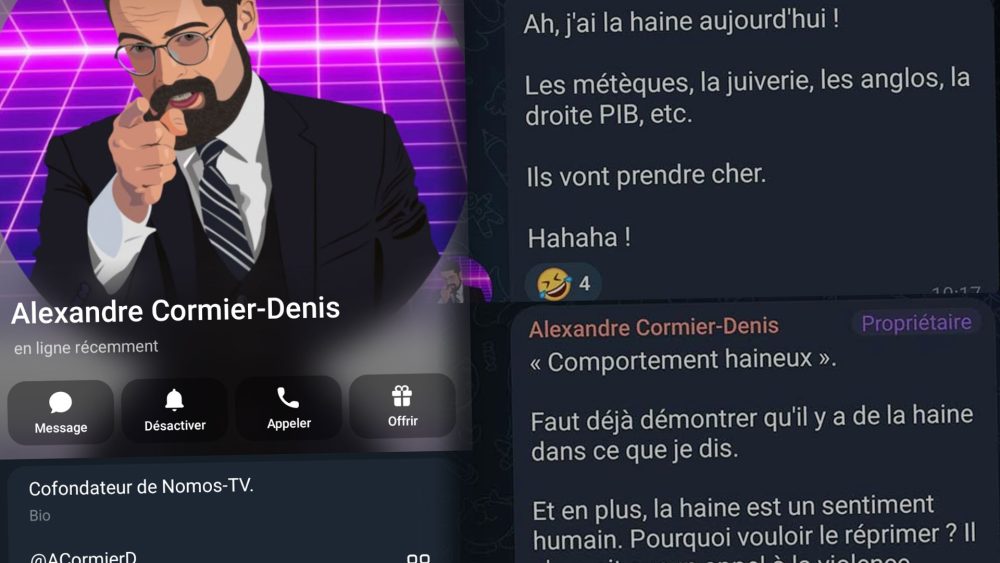
This brings us to the “alternative news” project Nomos-TV and the online community that has formed around its main hosts. Proudly ethnonationalist and very often openly racist (see the Montréal Antifasciste article exposing the violent language used in its private forum), the Nomos project serves, in a certain sense, as a conduit between the various factions of the local far right. Its primary host, Alexandre Cormier-Denis (see the article Montréal Antifasciste dedicated to him and excerpts about him below), is undoubtedly an heir to the neofascist tradition that, since the 1970s, has worked to culturally rehabilitate historical far-right themes. This tradition adopts a so-called “metapolitical” approach, with a view to eventually seizing political power. Is it necessary to point out that this is precisely the dynamic we have been witnessing at an accelerated rate for several years now in Europe, the United States, and even here at home?
Acting as useful idiots, many public figures choose let this project profit from their renown, even inviting the hosts onto their platforms. This is particularly true of Radio X in Québec City, where Nomos-TV’s Philippe Plamondon and Sébastien de Crèvecoeur host a show, of Richard Martineau, who regularly shares their propaganda on his social media, and of Benoît Dutrizac, who has invited individuals clearly associated with the far right—including Alexandre Cormier-Denis—onto his QUB Radio show.
There is also a whole constellation of influencers, “alternative” media outlets, and lesser-known podcasters who are carving out a place for themselves in this ecosystem and constantly feeding into Islamophobic, xenophobic, and transphobic echo chambers. The combined influence of all of these actors is helping to significantly expand the far-right sphere, amplifying the voices of its most strident spokespeople, and driving this movement forward to the point where many claim they are winning the “battle of ideas” against the left.
Coming full circle, based on a cynical calculation, some politicians no longer hesitate to court the segment of the electorate that is influenced by the far right. This is particularly true of Paul Saint-Pierre Plamondon, who agreed to a Rebel News interview in April (see the relevant excerpt below). Even former members of the National Assembly and ministers from his own party secretly worry that their leader maintains “a troubling ideological closeness to Mathieu Bock-Côté,” according to Québec political analyst Michel David.
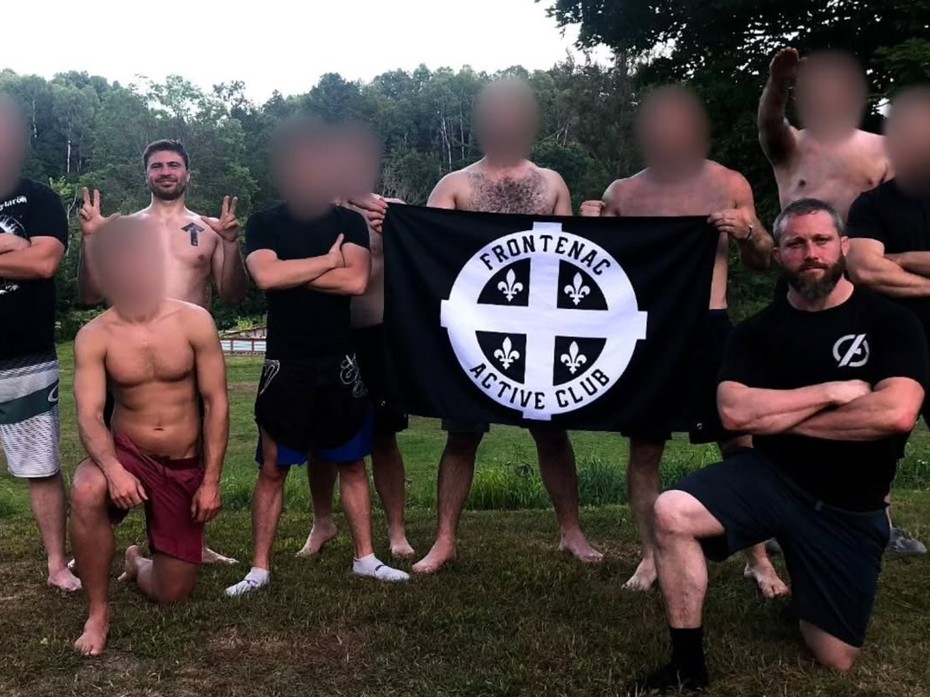
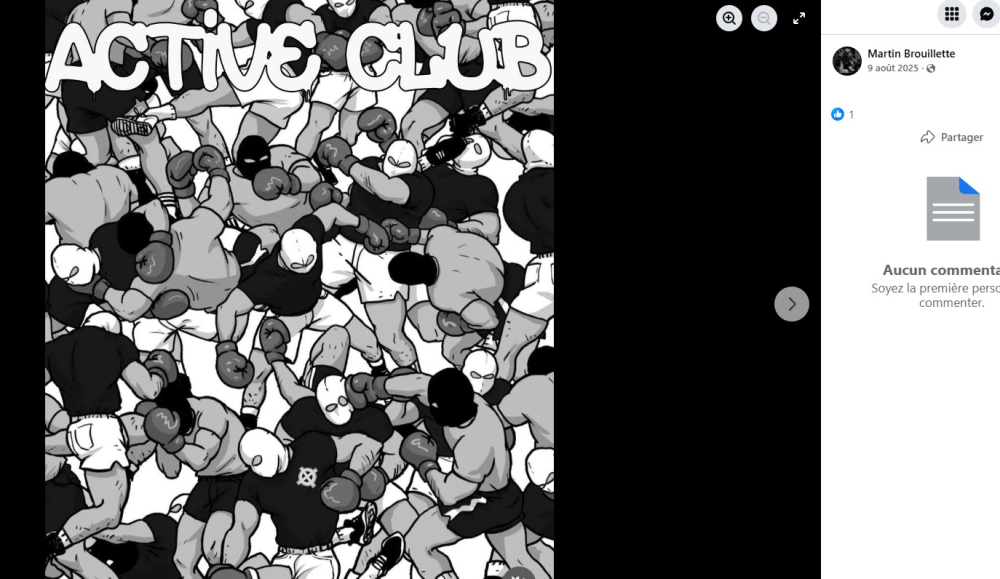
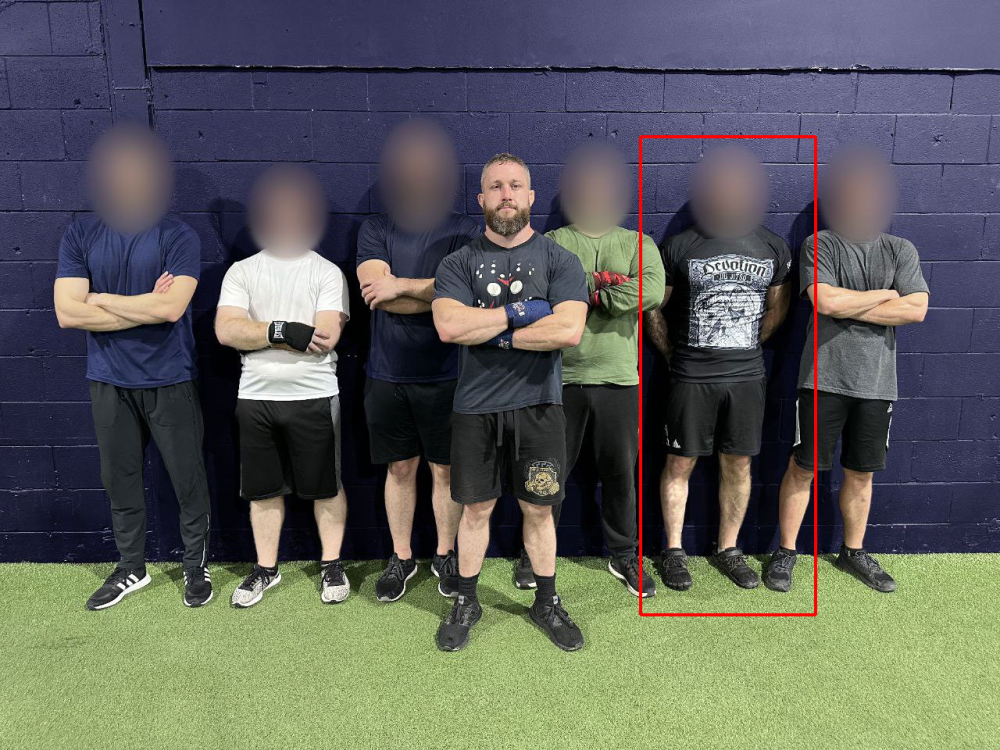
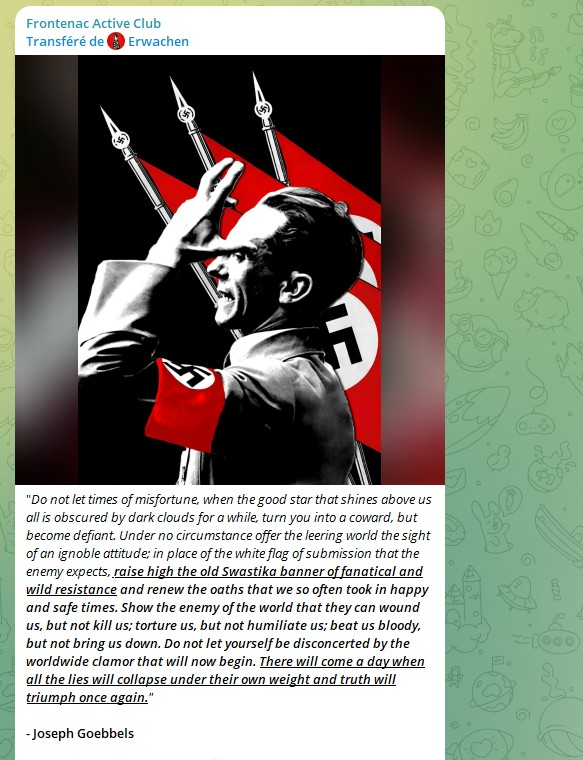
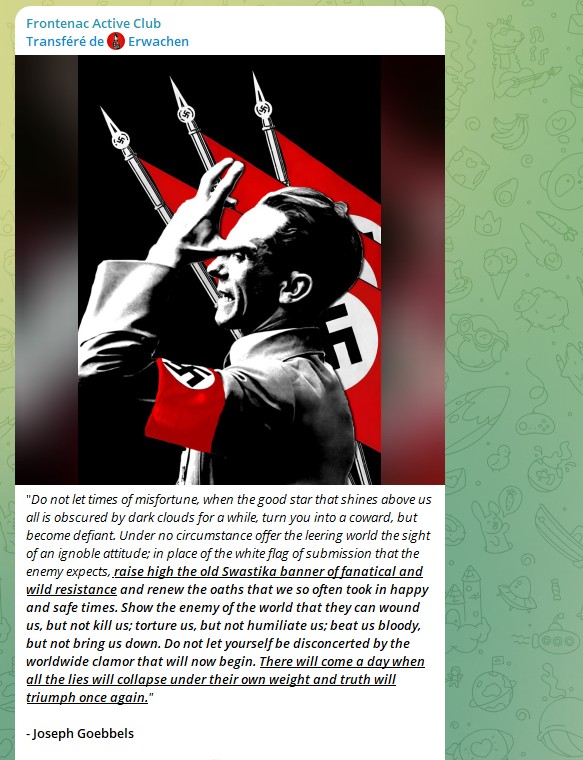
Finally, on the fringes of this toxic ecosystem, we find groups like the Frontenac Active Club, which openly espouses white supremacy and shamelessly revels in neo-Nazi ideology. The Active Clubs, like the White Lives Matter network that preceded them, as well as the entire constellation of Canadian “nationalist” groupuscules, e.g., Second Sons, Diagolon, and the Loyalist Pioneers, clearly fit into a continuum of North American neo-Nazism (see, for example, the Patriot Front). These groups combine bonehead codes (white nationalism 1) with those of the alt-right (white nationalism 2) and certain elements of European identitarianism, similar in style to the now-defunct Atalante Québec groupuscule, which was linked to the so-called “revolutionary nationalist” tradition.
The ideas and values of the far right are so widespread today that it is impossible for us to cover everything in detail. We could, for example, have discussed at length Romain Gagnon (eng.), a racist and masculinist author and the vice-president of the Sceptiques du Québec, for whom he writes articles denouncing women wearing the hijab and the alleged Islamic “ideological entryism” within the Ordre des ingénieurs du Québec. The Sceptiques du Québec’s intolerance toward trans identities is so severe that the association was expelled in 2022 from the Fédération des Initiatives pour le Développement de l’Esprit critique et du Scepticisme Scientifique.
Without necessarily labeling these groups as “far right,” one can still observe strong tensions and intolerance toward trans people and Muslim communities within the feminist collective Pour le droit des femmes (PDF) and the Réseau éducation, sexe et identité (RÉSI), for example. Nonetheless, both these groups present themselves as progressive.
As this introduction suggests, precision and distinctions matter, and as anti-fascist activists committed to convincing as many people as possible of the reality of the danger, we would not be doing ourselves any favors by oversimplifying a complex reality or by lumping all these different actors together in an unnuanced way. In our view, it is counterproductive, for example, to label a conservative nationalist a “Nazi” as a shorthand, because this does not correspond to reality and risks blunting the semantic force of both concepts, as well as undermining the impact of our actions. Therefore, we encourage our supporters to be discerning and precise when discussing the far-right ecosystem. This is part of our goal in producing this overview.
What follows serves both as an update—three years after the publication of our last report on the state of the far right—and as an overview of the current militant far right in Québec. Furthermore, this text aims to analyze the various manifestations and repercussions of far-right themes in political circles, media commentary, and the online ideological and propaganda ecosystem.
///
An Assessment of the CAQ and Nationalist Rhetoric
The shift toward identitarian politics among a segment of Québec’s political class is nothing new. As many people see it,[i] the pro-independence movement began moving in an identitarian direction immediately following the defeat of the 1995 referendum, a trend that accelerated in the 2000s with the “reasonable accommodation” crisis, stoked for electoral gains made by Mario Dumont and the Action démocratique du Québec (ADQ), and which continued with the “Québec Charter of Values” initiative led by Bernard Drainville, then a minister in the Parti Québécois government. This shift from a more civic nationalism (“anyone who lives in Québec is a Québécois”) to a primarily ethnic nationalism (“we,” the majority of French-Canadian origin, versus “them,” the minorities) was confirmed with the victory of the Coalition Avenir Québec (CAQ) and the implementation of its legislative agenda, which intentionally undermined a number of established rights and freedoms.
We have already demonstrated how the CAQ brought La Meute’s demands into government: this has been evident throughout its two terms in office, with the lowering of immigration thresholds and the manufactured panic over “integration capacity,” the demagogic insistence on the risks immigration allegedly poses to Québec’s social cohesion and identity, the introduction of new integration requirements, and the targeted discrimination against religious minorities under the guise of a distorted and grossly instrumentalized form of secularism through Bill 21, followed by Bill 94. For the government, every problem is seen to have a single cause: immigration. The housing crisis: immigration. Problems in schools: immigration. Sexism in Québec: immigration. Whatever it is: immigration. Is it any wonder that during the party leadership race Bernard Drainville openly referred to the “national preference,” a discriminatory concept lifted straight from the French far-right playbook? And then we have the ongoing neoliberal dismantling of social supports and the CAQ’s increasingly unabashed use of authoritarian tactics to impose its rancid agenda, particularly the use of the notwithstanding clause at the expense of fundamental individual rights.
Thanks to the constant manipulation of public opinion by certain mainstream media outlets (more on this later), and following the CAQ’s apparent successes in this regard, the issue of identity has become so central that it now often takes precedence over fundamental economic issues and largely determines the tone of debates and the direction of the parties as the next election cycle approaches. Québec’s political class in 2026 is caught up in a race to the bottom, namely, who will be the most nationalist and, among the nationalists, who will be the most reactionary. This debate completely overshadows a large number of issues of major importance for the future of the nation in question.
Of all the politicians involved in this race to the bottom, the leader of the Parti Québécois (PQ), Paul Saint-Pierre-Plamondon (PSPP), is perhaps the least subtle and the most irritating. He, who just a few years before taking the party’s helm was still extolling the virtues of openness and inclusion, has done a complete about-face and in his thirst for power is now openly courting the far-right vote. Why hold back from being racist if that’s the way to become the premier? For example, he knew exactly what he was doing when he granted an in-depth interview to Rebel News and, a few days later, when he answered a question from Léo Dupire, the spokesperson for Québec Fier (a close associate of the Parti conservateur du Québec), during a town hall hosted by the Centre for Israel and Jewish Affairs (CIJA), squawking about the threat that “brotherhoodism” (in reference to Egypt’s Muslim Brotherhood) poses to Québec. This delusion is straight out of the European far-right playbook, which didn’t give Le Devoir columnist and former PQ leader Jean-François Lisée a moment of pause when he echoed it shortly afterward to justify PSPP’s questionable remarks. PSPP’s recent positions and increasingly strident rhetoric betray his intention to scrape together votes from disillusioned right-wingers for whom the CAQ has not gone far enough on anti-immigration policies, Islamophobia, and all-out anti-wokeness. The PQ continues to promise a referendum on independence during its first term if elected, but one has to wonder what a sovereign Québec would look like under this leadership.
The race to succeed François Legault as leader of the CAQ made the tension within the party between its identitarian nationalist wing—embodied by Bernard Drainville—and its more moderate “autonomist” wing, which is focussed on a neoliberal economic agenda, more starkly obvious. The latter camp won the race, but it would be naive to believe that Christine Fréchette and her inner circle will cede identitarian rhetoric to the PQ during the election campaign, especially since Drainville, who, it is said, “has many supporters among the political staff,” still exercises significant influence within the party.
As for Éric Duhaime’s Parti conservateur du Québec (PCQ)—the only party that the mainstream media regularly describes as “right-wing”—it appears that after cracking down on the nationalist faction within its own ranks, it is now working to challenge the CAQ’s “autonomist” line by focussing on consolidating the support of its “libertarian” base in the Québec City region as the elections approach, rather than engaging openly in an identitarian bidding war. It is worth noting that the PCQ entered the Québec National Assembly with its April 2026 recruitment of Maïté Blanchette Vézina, a former CAQ member who defected to sit as an independent MNA.
In any case, the upcoming election cycle seems guaranteed to be an unparalleled shitshow, from which the far right is likely to emerge stronger—at the very least in terms of visibility and the hearts and minds battle being waged by its leading ideologues.
Mathieu Bock-Côté and Conservative Nationalism
Mathieu Bock-Côté (MBC), whose stock-in-trade has long been to slander Islam, immigration, “neo-feminists,” and transgender people, has continued his drift toward fascism, notably by publishing a new book last year (Les deux Occidents, 2025) to denounce—once again—the diabolical “diversity regime.” In it, he criticizes liberal states like France, which he compares, without a hint of irony, to the totalitarian system of the USSR—a claim he had already made in his previous book, Le totalitarisme sans le goulag (2023), but which he reiterates in his recent book with even greater vitriol and hyperbole.
He also champions the authoritarianism of Trumpism, which he claims reflects the aspirations of “real” people. As such, this pompous socialite continues to present himself as a “dissident” and tirelessly sings the same song he’s been singing for nearly thirty years: the far right simply does not exist (his critics, he claims, would be incapable of defining it) and labeling someone as such serves no other purpose than to disqualify them from the public sphere using dishonest means.
In the same vein, he defended a large xenophobic rally in Britain in September 2025 organized by the British activist Tommy Robinson, at which Éric Zemmour (who served as a mentor to MBC in the French media landscape) was invited to speak. According to MBC, none of this has anything to do with the far right, because the good people of England were simply defending their identity. He went as far as to say, “There was nothing shameful about the London demonstration. Linking it to the ‘far right’ is nothing but a smear tactic.” Yet even the media outlets he collaborates with in Québec—Journal de Montréal and TVA—and in France—CNews and Le Figaro—describe Tommy Robinson as a “far-right” activist!
To fully grasp MBC’s mindset, it is also worth recalling his defense of Nigel Farage, a British far-right politician who led the UK Independence Party (UKIP) and is now the head of Reform UK. According to Mathieu Bock-Côté, he is “a thoroughly honorable man whom it is scandalous to label as far-right; he was a major player in the long campaign for Brexit and the restoration of British sovereignty. . . . A true orator, a man of culture, witty and eloquent, a combative activist with unshakable convictions, he has succeeded in transforming the public debate.” However, the Guardian revealed in March 2026 that this “utterly honorable man” agreed to record videos in support of the actions of leaders of the Canadian white supremacist group Diagolon, including its “Road Rage Terror Tour,” and did so for pay.
While he insists on repeating that one must never, under any circumstances, associate anyone with the far right—a so-called “phantom category”—Mathieu Bock-Côté, for his part, has no qualms about regularly labeling “antifas” as “ultra-leftists” and ultra-violent (and apparently very wealthy) “psychological wrecks,” even referring to them as the “true fascists,” echoing a phrase whose profound absurdity has not prevented it from becoming a ubiquitous cliché in reactionary circles. As many others have noted before us: part of MBC’s modus operandi consists precisely in he himself doing what he constantly criticizes his opponents of doing.
Bock-Côté regularly promotes leaders of the French far right, e.g., Éric Zemmour and Marion Maréchal Le Pen (with whom he was recently spotted at a chic Paris restaurant). It’s worth noting that he is not only the darling of billionaire mass media owners but also the favorite of far-right magazines, appearing, for example, on the cover of the January 2026 issue of the magazine Éléments: Pour la civilisation européenne, founded by Alain de Benoist and described as a journal of the “Nouvelle Droite,” now closely aligned with the Nouvelle Librairie, a far-right establishment based in Paris.
MBC is also grooming the next generation of leaders, of whom Étienne-Alexandre Beauregard (ÉAB) is undoubtedly the most prominent figure after Philippe Lorange. Notably, MBC invited ÉAB to promote his book on “the collapse of Western civilization” (due to left-wing values, of course) on his show on CNews in October 2025. He also had the opportunity to be interviewed, during the same tour of France, by far-right newspapers such as Frontières and Causeur. In Québec, ÉAB also served as François Legault’s speechwriter for several years. Notably, he was recently invited by the PQ committee at Laval University to speak at a conference “on the Québec nation.”
There can be no doubt that MBC and his protégé have influenced the CAQ’s policies and that, as a result, the conservative nationalist trend represented by Bock-Côté and Beauregard—which has one foot in authoritarian liberalism and the other in the far right—has left its mark on Québec’s political culture. It is undoubtedly partly this political rift—or at least this ideological landscape—that opened the way for the emergence of Nouvelle Alliance.
Nouvelle Alliance and Company
Over the years, we have published a number of articles and commentaries about the identitarian nationalist groupuscule Nouvelle Alliance (NA), which also received some media attention in the spring of 2025. In May 2024, we described NA as “separatist, ultranationalist political organization” whose founding members were former members of the “now defunct” groupuscule the Front canadien-français (FCF), “a faithful emulator of Québec’s fascist ultra-Catholic circles.”
In the same article we wrote:
“a quick examination of their social media platforms . . . reveals a very large number of sympathizers (groups and individuals) identified with the far right, displaying, for example, symbols of fascism, European identitarian currents, ultranationalism or white nationalism, the alt-right, etc.”
Although it remains a presence in Québec, Nouvelle Alliance has not experienced significant growth over the past three years, and it appears to be more or less stable at around fifty members and close supporters. Its leadership has, however, worked very hard to develop a coherent platform and to strengthen the group’s base of support.
Once or twice a year, NA launches a recruitment campaign, which largely takes the form of putting up posters in several cities—Montréal, Québec City, Sherbrooke, Saint-Jean-sur-Richelieu, Valleyfield, etc.—mostly around CEGEPs and universities. Since anti-fascist groups have organized in opposition to NA in recent years, these posters never stay up for very long and are only useful to the organization insofar as photos of its activists “in action” can be shared online.
It should be noted that while the Montréal chapter of NA is theoretically the largest, few members actually live in the city or in downtown neighborhoods, which are very hostile toward them.
An Increasingly Unapologetic Alignment with the Right
Presented at its founding as a sort of Frankenstein’s monster of a coalition of separatists from across the political spectrum (the famous “neither right nor left but nationalist”), the organization gradually abandoned this stance, finally admitting in 2025—during François Gervais’s appearance on Alexandre Cormier-Denis’s podcast—that this was merely a façade, and that NA was, in fact, positioned on the far right of the political spectrum.
In the same vein, Gervais gave a very lengthy interview—in the form of a manifesto—to the magazine Le Harfang for the final issue of this propaganda organ of the now-defunct Fédération des Québécois de souche (FQS). It should be noted that this organization was founded in 2007 by neo-Nazis and later rebranded itself as an umbrella group for all factions of the far right in Québec.
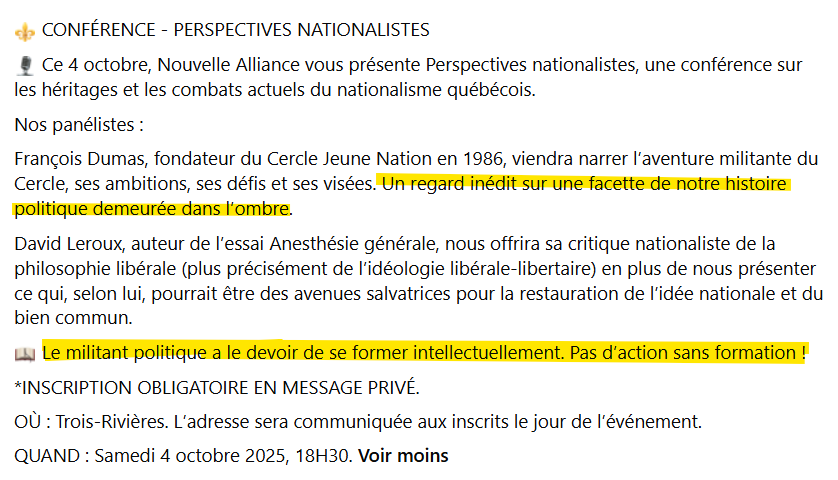
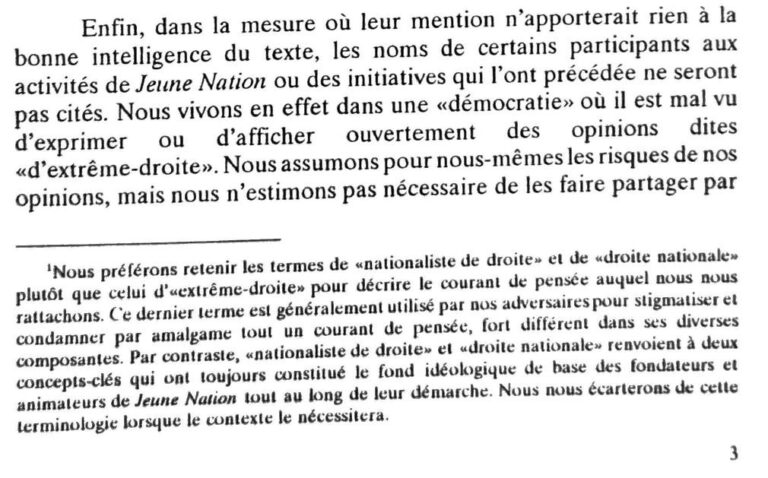
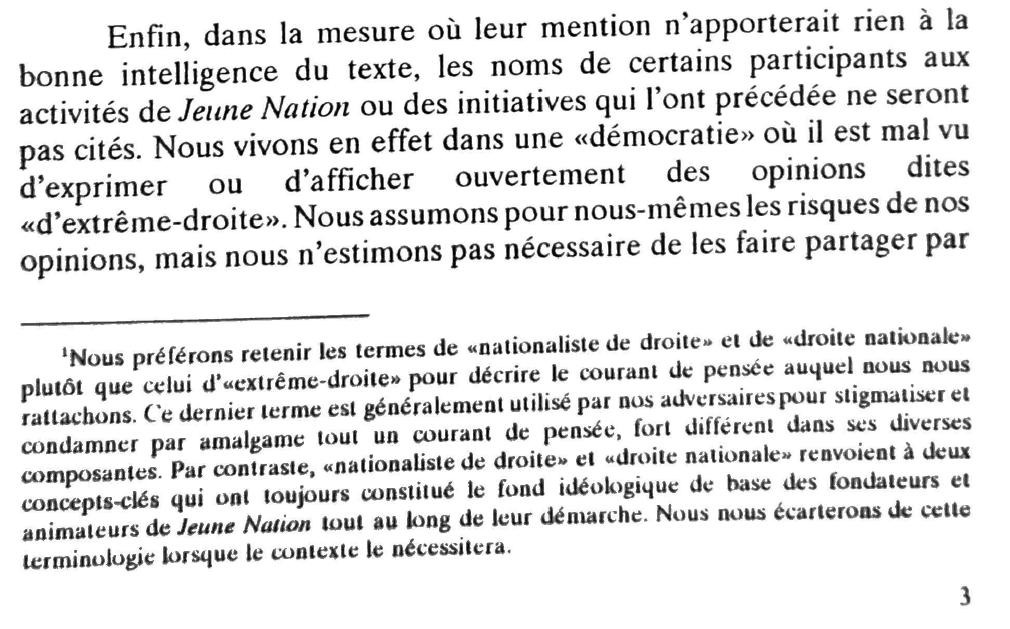
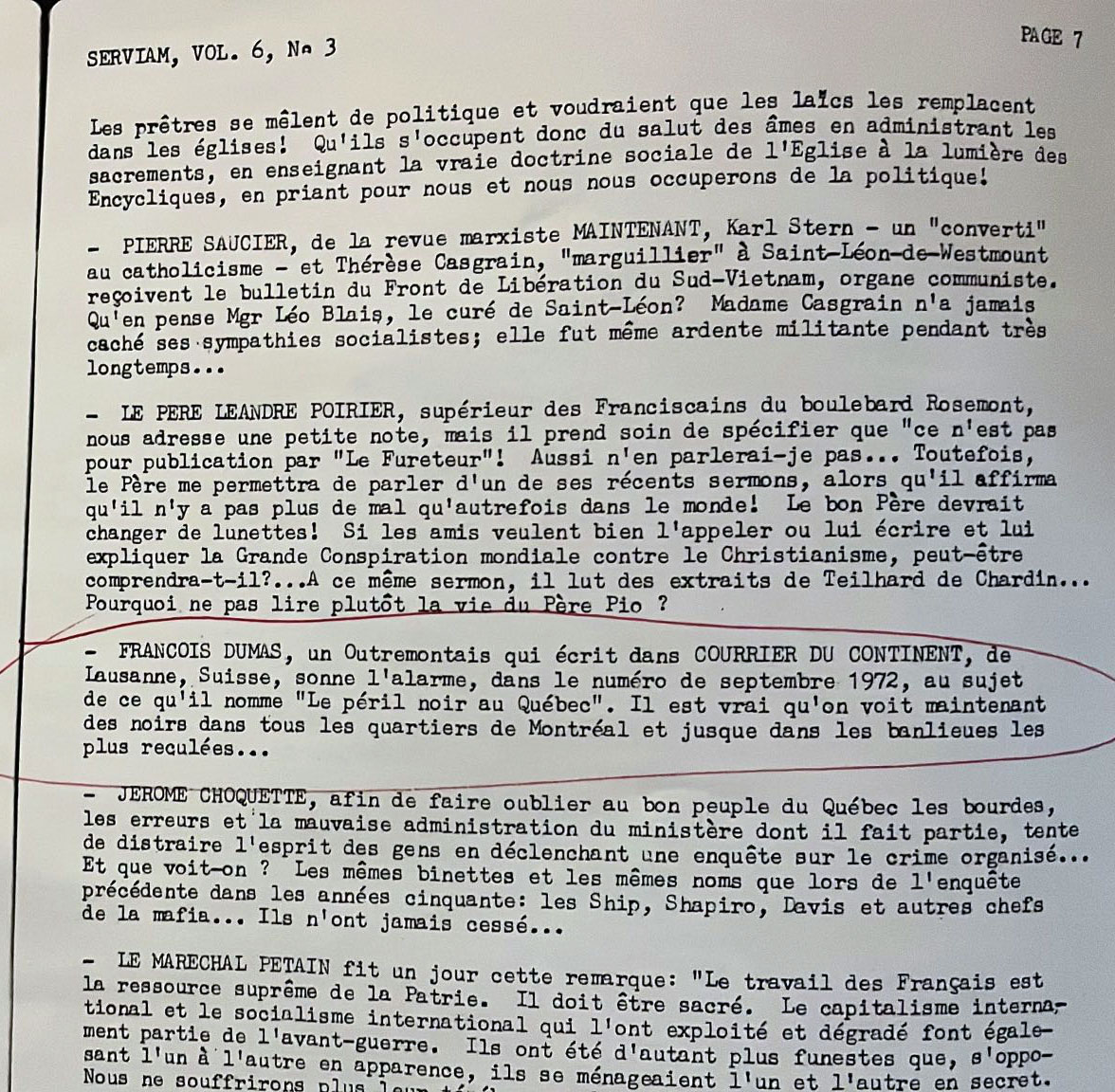
Nouvelle Alliance organized a public event at the office of Société Saint-Jean Baptiste in Trois-Rivières in September 2025, featuring guest speakers David Leroux, an illiberal essayist (and avowed admirer of Carl Schmitt and Julius Evola) particularly concerned with rehabilitating the term “fascism,” and François Dumas, who in the 1990s led the Cercle Jeune Nation, a far-right think tank inspired by the French Nouvelle Droite that has served as a model for both the Fédération des Québécois de souche and the current generation of ethnonationalist fascists, key among them Alexandre Cormier-Denis. It should also be noted that Le Harfang’s Telegram channel now serves exclusively as a platform for posts from the Jeune Nation blog.
The Cult of the Leader
Future anti-fascist mobilizations need to pay attention to François Gervais’s role as the supreme leader of his organization—it was his brainchild, and he reportedly funds out of his own pocket. Several former members of Nouvelle Alliance have confided in us: it seems that a cult of the leader is taken to the extreme within NA. This is a fairly common trait for this type of group, which favours a strict hierarchy (La Meute was another example).
The Sovereigntist Cordon Sanitaire
The various factors mentioned above undoubtedly played a key role in precipitating NA’s isolation within the sovereigntist movement. Its increasingly overt far-right positions, combined with its leader’s (or, by extension, its executive committee’s) obvious ideological rigidity, as well as the efforts of anti-fascists, have led to a number of doors slamming in NA’s face.
On May 19, 2025, activists from the Nouvelle Alliance were prevented from gathering for their Journée des patriotes rally at the Dollard des Ormeaux statue in Lafontaine Park in Montréal. Beginning early in the morning, a “People’s Festival against Fascism,” organized by an ad hoc group that would soon come together under the banner of the Front antifasciste populaire, drew more than three hundred people and occupied the area all morning.
That same afternoon, OUI Québec and the Société Saint-Jean-Baptiste informed NA that its contingent would not be welcome at the traditional parade starting at Carré Saint-Louis. The fifty or so NA members and supporters tried to join it anyway but were prevented from doing so by an impromptu anti-fascist security detail, after which they were kept at a distance by the police.
On September 20, 2025, NA made another attempt, this time announcing a demonstration beginning at the Jeanne d’Arc statue in Québec City. To no avail, as the fifty or so activists and supporters were surrounded and besieged by approximately two hundred left-wing sovereigntists and anti-fascists. NA was blocked and never left its starting point, and its members were reluctantly forced to beat a retreat.
On October 25, 2025, NA was again clearly excluded when OUI Québec organized a demonstration to celebrate the thirtieth anniversary of the 1995 referendum. This time, the official call to demonstrate stated: “In accordance with Québec’s fundamental values—gender equality, secularism, and civic nationalism—we affirm that individuals affiliated with ethnic nationalist, religious fundamentalist, royalist, or misogynist organizations will not be welcome at the activities or on governing bodies of the Société Saint-Jean-Baptiste de Montréal or OUI Québec.”
The day before the demonstration, posters targeting the leadership of OUI Québec were put up around Carré Saint-Louis and signed by “La Flèche Nationale,” the one-man groupuscule of a certain Vincent Lewis, a crackpot who latched onto Nouvelle Alliance and regularly sends letters to left-wing figures revoking their Québec citizenship in anticipation of Québec’s independence. He lives in a fantasy world.
Following this series of setbacks to their mobilizing efforts, in March 2026, NA retreated to Beloeil to launch its new magazine Le Franc-Renard. This “public” event was held under tight security, with attendees required to register and provide their name and phone number and even some form of ID! Unfortunately for them, anti-fascists located the venue, and the restaurant owner kicked them out when he was informed of the true nature of the event. NA members were forced to retreat in disgrace and quietly relocate to another establishment, providing yet another great opportunity to snap photos of them.
ASLN and Billy Savoie
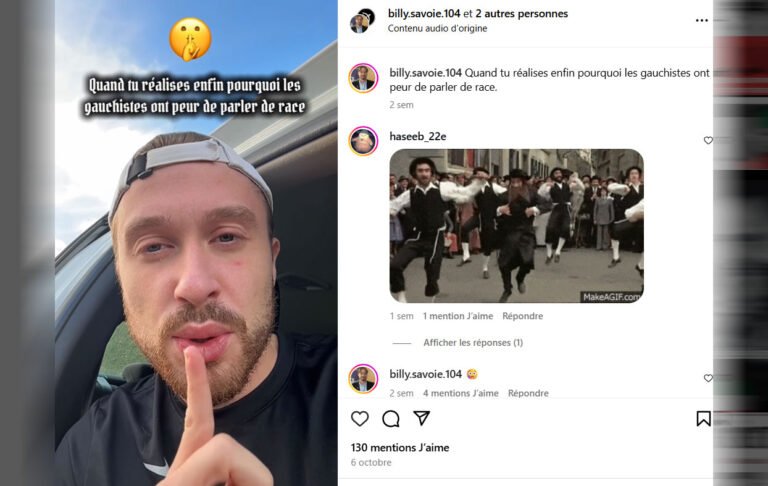
When it moved to the far right, NA needed a “left wing” to save face and maintain its false “neither-nor” posture. In 2025, the organization began to show signs of a rapprochement with the Action socialiste de libération nationale (ASLN). This is the former Communist Party of Québec (PCQ), which been taken over in an ideological coup led by two individuals, Sébastien Paquette and the now infamous Billy Savoie, to whom we dedicated an article in October 2025. Embarking on a more or less overt shift toward National Bolshevism, these two “brown shirts” (that is the color they chose for their cringe-worthy scout uniform, adorned with a logo combining a fleur-de-lis and an AK-47 assault rifle) took control of the organization and expelled all dissenting voices. Meanwhile, a faction of the organization that remained loyal to left-wing ideals eventually coalesced around the newspaper Le Partisan québécois.
In May 2025, NA and the ASLN organized a “leaders’ debate,” at which, as it ends up, not much was actually debated, since the “leaders” found themselves in broad agreement on all the issues. Rumour spread that the two groups were considering a merger, but the merger never took place. The two groups did, however, join forces in a single contingent in several of the failed actions detailed above.
Following the publication of our report on Billy Savoie in the fall of 2025, he was suspended from his position as a high school teacher at the Centre de services scolaire du Pays-Des-Bleuets pending an investigation and lost his thesis advisor at UQAC. After briefly being reinstated, the school terminated his employment following a “repeat offense on his part,” a major setback that has not prevented him from continuing his career as a solo hate influencer on social media.
The “Traditional Catholic” Factor
We noted above the connection between NA and the Front canadien-français, which was explicitly ultra-Catholic in nature. NA has somewhat distanced itself from that image to adopt a more secular tone—at least a “Catholic-secular” in nature—but some of its members are practicing Catholics and incorporate Catholicism into their activism. This is the case, for example, with Jean-Philippe Warren, who has aligned himself with Academia Christiana, a traditionalist Catholic organization linked to the French far right. Other figures in NA’s orbit belong to this tradition, including David Leroux, who was a speaker at the September event in Trois-Rivières, attended the launch of NA’s magazine in Beloeil, and says he intends to write for coming issues of the publication. The traditionalist Catholic element remains, as such, very much present within NA.
This is also evident in social media interactions with a number of well-known figures in the ultra-Catholic community, including Nicolas Roseberry-Verreault and Philippe Letellier-Martel, activists from the media project Action Vitale—the former of whom was spotted in the NA contingent on May 19, 2025, in Montréal—as well as other individuals and groups close to the Fraternité sacerdotale Saint-Pie X (FSSPX) [Society of Pius X], e.g., Éditions Avant-Garde and its director Simon Demers. Demers notably published Cormier-Denis’s book, participated in the aborted NA demonstration in Québec City on September 20, 2025, contributes to Libre Média (see below), and is strongly suspected of being one of the organizers of the RIXE combat training club (with an online presence) in which Raphaël Lévesque of Atalante Québec participates.
Nous avons rappelé ci-dessus le lien de filiation entre NA et le Front canadien-français, lequel avait un caractère explicitement ultracatholique. NA s’est quelque peu défait de cette image pour adopter un ton plus laïc, ou du moins catho-laïque, mais certains de ses membres sont pratiquants et intègrent cette dimension à leur militance. C’est le cas par exemple de Jean-Philippe Warren, qui s’est affiché avec les couleurs de l’Academia Christiana, une organisation catholique traditionaliste rattachée à l’extrême droite française. D’autres personnages gravitant dans l’orbite de NA appartiennent à cette même tradition, dont David Leroux, qui était conférencier à l’événement de septembre à Trois-Rivières, était présent au lancement de la revue de NA à Belœil, et dit vouloir écrire pour les prochains numéros de ce journal. L’élément catholique traditionaliste est donc encore bien présent chez NA.
Elsewhere in the Cathosphere
The Campagne Québec Vie, led by Georges Buscemi, is an anti-abortion organization that has been active in Québec for nearly forty years and has been facing strong anti-fascist opposition since in the early 2000s. For many years, this group organized an annual anti-choice march, generally turning out only a handful of people. In 2024, the march changed its tone and rebranded as the “March for Life,” drawing its first significant turnout in Québec City. In May 2025, the second edition of this march was completely derailed by a very strong pro-choice contingent from the Québec City region, as well as by the of the sabotage of buses from Montréal at their departure point. The campaign recently organized a “Génération Vie” conference in Montréal at the Église évangélique restauration, which also hosted the American con artist and preacher Sean Feucht during his Canadian tour in July 2025.
In October 2024, in Gatineau, anonymous posters adorned with anti-abortion, homophobic, and transphobic rhetoric—presumably from a Christian group—appeared near the Brault and Taché campuses of the Université du Québec en Outaouais (UQO). The university community, alerted by the UQO Alliance Queer and the Association générale des étudiant·e·s (AGE-UQO), reacted quickly, tearing down the posters and distributing a pink sticker reading “Pas de fachos à l’UQO.” The UQO administration subsequently filed a complaint with the police. In the same region, “Stop immigration” stickers bearing the “Action française” logo appeared in April 2026.
Another place where Catholic traditionalism finds a welcoming space is in the online community that has formed around Nomos-TV.
Alexandre Cormier-Denis and NOMOS-TV
In September 2025, we published an article on our website about Nomos-TV and Alexandre Cormier-Denis. Although this attention came more than a bit (too) late in Nomos’s history, this ethnonationalist propaganda and training project has now become a focal point for the local anti-fascist community.
As a reminder, Nomos-TV is a web-based television channel focused on providing ongoing commentary and analysis of current events, with a particular commitment to advancing far-right ideas in the conservative nationalist sphere:
“According to its creators themselves, Nomos-TV is part of a metapolitical‘re-information’ project, i.e., an effort to transform the dominant values within society, through what is also known as ‘culture war,’ with a view to creating conditions conducive to the exercise of power by the ultraconservative ethno-nationalist right, a subset of the far right that those most involved euphemistically refer to as the ‘national right.’”[i]
Its main hosts are Alexandre Cormier-Denis (ACD) and Philippe Plamondon, who are also co-founders of the political group Horizon Québec Actuel (2016). They are supported by a handful of collaborators, including Sébastien de Crèvecoeur, and benefit from technical infrastructure provided by Aleck Loiselle of Loiselle.solutions (which also provides services to André Pitre’s Lux Média project; see below).
As a result, up to three or four shows are produced each week, generally broadcast live either from the studio set up in the building owned by Plamondon on Saint-Urbain Street in Montréal (at least until April 2026) or, most likely, from Cormier-Denis’s home. Every Saint-Jean-Baptiste Day, Nomos organizes a live webcast titled “Saint-Jean de la Race.” The web TV’s activities are funded by subscriptions and the sale of merchandise online.
Over the years, ACD has interviewed a large number of figures from Québec’s conservative and far-right political landscape at the Nomos studio, including Raphaël Lévesque of Atalante, members of the Front Canadien-français, and, more recently, Action Vitale, which is part of the same Catholic traditionalist milieu. Léo Dupire of Québec Fier and the essayist Philippe Sauro-Cinq Mars from the same circle, David Leroux, who is close to Action Nationale, Nouvelle Alliance’s François Gervais, and a number of others have been featured on Nomos-TV. ACD has also collaborated on several occasions with the magazine Le Harfang, published by the Fédération des Québécois de souche.
In addition, ACD hosts a regular segment on the YouTube channel of the French far-right media outlet Frontières and is frequently invited to contribute to other projects that are part of the same ideological milieu. In particular, he regularly collaborates with the French white supremacist Daniel Conversano, whose special guest he was at the Paris launch of Conversano’s book on the history of anti-Black racism on April 12. During that same visit to Paris, he participated in a symposium at the Institut Iliade (Nouvelle Droite) and gave a number of interviews on various far-right digital media outlets, including Radio-Courtoisie and the channel run by media activist Vincent Lapierre.
Nomos’s entire ideological project can be summed up in a few sentences. It is imperative that we break away from the Canadian federation and achieve Québec’s independence as soon as possible (and that we do so by unilateral decree rather than through a referendum, since the democratic process carries a risk of failure). The survival of the French-Canadian “race” depends on a complete halt to non-European and non-white immigration, which is both the instrument for and result of the “great replacement.” People of colour or those of immigrant backgrounds, considered inferior by default, foreign by definition, and consequently incapable of assimilating or participating in the building of the Québec nation, must be expelled en masse (through “remigration”) without delay. At the same time, we must denounce the “replacementist” multicultural liberals, “leftists,” and the “woke” individuals who are undermining our national vitality from within.
In private, it’s even worse, as we demonstrated in an article documenting our infiltration of the private chatroom for Nomos subscribers on the Telegram app. That’s where the true nature of the project is revealed most clearly. “Foreigners,” “Arabs,” “n*****s,” “subhumans,” “scum” are just a few of the charming epithets regularly found in the private “Nomasian” community discussions. Everything—absolutely everything—is interpreted and analyzed through the lens of ethnic nationalism, the “migrant invasion,” the clash of civilizations, and the inherent superiority of the French-Canadian “race.” Unsurprisingly, the vitriolic rhetoric about “degeneration,” the supposed inferior intelligence of Black people, the “monstrous” nature of trans people, and the civilizational threat of feminism is completely unrestrained and knows no bounds. This establishes Nomos-TV as a central far-right hub in Québec in 2026. Anyone who still claims otherwise is either naive or is being dishonest.
Nonetheless, when Cormier-Denis was invited to Télé-Québec in 2019, Sophie Durocher did not hesitate to come to his defense when the comedian Mehdi Bousaidan called him a racist. He has also appeared on QUB Radio, Radio X, Radio Ville-Marie, Rémi Villemure’s podcast, and several other platforms. François Fournier from the Ian & Frank channel interviewed him, as did Livre Média’s Jérôme Blanchet-Gravel. Plamondon and Sébastien de Crèvecoeur, for their part, have been hosting a regular show on Radio X for over a year. ACD was even the subject of a lengthy profile in the newspaper Urbania in October 2025, which claimed it was being “objective,” an idea ACD himself found very welcoming. It must be said that the journalist chose to conclude his report by suggesting that ACD “exposes the authoritarian temptation lurking within our democracies and, perhaps, deep within each of us.”. . . We have to give it to them; that is as close to normalizing him as you can get.
Following the April 23, 2026, action by the Front antifasciste populaire—a festive gathering in front of Plamondon’s recording studio—all these media figures, including Benoit Dutrizac, graciously gave him the opportunity to cast himself as a victim by demonizing the Front Pop’s nonviolent action as effectively an act of “terrorism.”
In short, hateful individuals like ACD are welcomed, and their views are amplified in conservative—and even so-called centrist—circles, which clearly demonstrates the extreme permeability between mainstream conservatism and the far right—a permeability facilitated by a whole range of “alternative” media outlets, influencers, and public figures who act to amplify the far-right’s message, as well as a number of complicit or complacent actors within the established mainstream media.
“Alternative” Media, Pseudo-Journalists and -Intellectuals, and Influencers
In recent years, a whole constellation of pseudo-media outlets has sprung up on the web in Québec, claiming to defend freedom of thought “beyond dogmas and taboos.” In reality, these outlets merely regurgitate the dogmas of the hard right—even the far right—especially regarding immigration, Islam, and transgender issues, while also attacking the progressive and radical left, lumping them all together under the catch-all category of “wokeness.”
Rebel News Québec
Rebel News Québec is a local branch of the far-right organization Rebel News (formerly Rebel Media), founded in 2015 by Canadian lawyer and activist Ezra Levant. The Québec branch was launched in April 2017; as of May 2026, it had produced 430 videos, had 27,000 subscribers, and claimed 2,700,000 views. Its main activists are Alexandra “Alexa” Lavoie, who serves as a field “reporter,” and Guillaume E. Roy, who acts as her cameraman.
On its website, the activist group describes itself as follows:
“At Rebel News Québec, we follow the facts wherever they lead—and when they run counter to the establishment’s narrative, it’s our mission to show you the other side of the story! We tackle the sociopolitical issues that will affect the lives of the Québecois(e) in the years to come, without filters or censorship.”
However, its name is misleading in two ways, as this project is neither rebellious nor is it a genuine news outlet. Initially fairly marginal and obscure, it has gained influence in recent years on social media, and even on the political scene during pro-Palestinian demonstrations, which it forcefully sought to discredit.
In April 2025, during the federal election, Rebel News activists also drew attention by disrupting the press conference following the French-language leaders’ debate, asking questions that it would be polite to call biased. For example, they asked the NDP leader what he thought of the “repeated attacks on Christians” and the “churches targeted by vandalism.” This situation led the Debates Commission to cancel the English-language debate. Radio-Canada and even the Journal de Montréal then described the group as belonging to the “far right,” as did the Press Council, which stated in a decision issued in March 2026 [#D2025-12-193] that Rebel News “does not constitute a news media outlet as defined by the Québec Press Council. The Rebel News platform can instead be described as an activist organization with ties to far-right circles.” The Journal de Montréal also reported at the time that Rebel News had received approximately $200,000 to influence the election campaign, specifically to encourage mobilization against the Liberal Party of Canada.
Rebel News Québec recently capitalized on QUB Radio’s appetite for far-right views by securing appearances on shows hosted by Benoit Dutrizac (April 16, 2025) and Richard Martineau (December 1, 2025). Pseudo-journalist Alexandra Lavoie notably claimed that she “fears those wearing keffiyehs with only their eyes visible. . ., as they often become violent.” Richard Martineau lamented that Rebel News was “the only source” reporting on Muslims praying in the streets of Montréal (April 9, 2026).
The activists at Rebel News lack even the rudiments of basic decency. To cite just one example, Alexandra Lavoie chased Liberal MP Nathalie Provost through the streets to ask her if her goal in government was to “push the agenda of the Poly-se-souvient lobby” for gun control, citing the alleged crackdown on members of the Canadian Coalition for Firearms Rights (CCFR). Unbelievably, Lavoie then accused a political aide accompanying the MP—who was raising her hand to block the camera lens—of being a “fascist.” For the record, while Nathalie Provost has certainly advocated for gun control, it should also be noted that she is one of the Polytechnique students who survived the December 6, 1989, anti-feminist shooting and still has bullet fragments in her body.
In the same spirit of “tasteless” disruption, on September 27, 2025, Lavoie and his cameraman showed up behaving disgracefully at the silent march for Nooran Rezayi, the young man murdered by the Longueuil police, clearly intent on harassing the participants. Their hysterical reaction to the anti-fascists who tried to push them back provoked a police crackdown on the grieving marchers.
The modus operandi of Rebel News’ leading members consists of “ambush journalism,” harassing their ideological opponents under the guise of freedom of the press, and then portraying themselves as victims when people push back. This tried-and-true formula (which is, incidentally, very widespread in Europe and the United States), exploiting the algorithmic appetite for sensationalist shock value, allows them both to gain popularity on social media and to collect ever-increasing donations by capitalizing on the gullibility of their base. We feel that the best approach is to keep them at a distance from our activities and mobilizations, using carefully considered tactics and strategic means to achieve that objective.
Libre Média
This news outlet, founded in 2022, describes itself as “Francophone, free, and independent.” It currently has nearly 40,000 followers on Facebook and more than 25,000 on X. Since 2023, its editor-in-chief has been Jérôme Blanchet-Gravel, a conservative columnist and polemicist, author of a book-length essay titled La face cachée du multiculturalisme (2018), and contributor to the far-right French magazine Causeur, who has become known in particular for his frequent misogynist and anti-progressive outbursts. Blanchet-Gravel is backed by an editorial board featuring a fine array of shady characters. Anne-Laure Bonnel, in particular, who produces pro-Russia propaganda—and generally serves Russia’s interests—gained notoriety by spreading false information on CNews (the French TV channel where Mathieu Bock-Côté regularly rants) regarding alleged massacres of civilians by Ukrainian forces. Another Frenchman on the editorial board, Alexis Brunet, has contributed and continues to contribute to French media outlets, including Michel Onfray’s Front Populaire and Causeur, which published an enthusiastic review of his first novel, Grossophobie, in which he attacks “wokism.” Francis Denis, for his part, is the director of the documentary Omerta scolaire (2025), co-produced by Libre Média and the Legal Center for Constitutional Freedoms and dedicated to protests against trans identities in schools. The president of the latter organization, attorney John Carpay, compared the rainbow flag to the Nazi flag during a conference organized by Rebel News and was disbarred in Manitoba for following and filming a judge during the COVID-19 health crisis. It should be noted that Francis Denis was also invited onto Nomos-TV by Alexandre Cormier-Denis to discuss his film when it was released. Philippe Labrecque, a highly educated scholar and author of Comprendre le conservatisme en 14 entretiens (Liber Publishing, 2016), also serves on the editorial board of Libre Média and writes articles in which he expresses concern about the “demographic, linguistic, and political drowning of Québec,” as well as lambasting “wokism.”
Libre Média’s preferred topics leave little doubt as to the political values of its hosts. Take, for example, an article about teacher Amanda Kakihi, who claims that “staring and inappropriate glances” on the street “always come from men from certain cultural communities.” It is worth noting that on the very day this article was published (May 8, 2026), Richard Martineau invited her to discuss this very issue on his QUB Radio show. The concern here is that “Québec is dooming itself to extinction” due to its declining birth rate, always pointing the finger at Muslim immigration whenever the topics of masculinism, homophobia, and transphobia in Québec arise—all while simultaneously defending anti-LGBTQ+ activists.
Indocile média
Indocile média, for its part, is a bit unusual. While it presents itself as a “media outlet,” it is in fact nothing more than a magnifying mirror reflecting the narcissism of Julien Garon-Carrier, the founder and, most importantly, sole (!) contributor. This individual’s ego is so outsized that it wouldn’t fit on a single social media page, so he had to create a “media outlet” just for himself. Claiming to offer “free and uncompromising news,” Julien Garon-Carrier does nothing but regurgitate the usual right-wing and the far-right platitudes: subsidized “mass immigration” is going to “replace us,” society is being feminized, and the “woke virus” threatens to destroy everything. Garon-Carrier also takes offense at the alleged violence of the far left, trans activism, and, of course, the “antifas” (all while quoting George Orwell, no doubt forgetting that he was a socialist and. . . an anti-fascist). Although he has very few followers on social media, his product placement strategy—featuring himself—seems to be working fairly well, as this platform has given him enough visibility to be invited onto Benoît Dutrizac’s show on QUB Radio. This allowed him a wider audience for his criticisms of the Fédération autonome de l’enseignement (FAE) report, which documents the resurgence of sexism, homophobia, and transphobia in schools.
As we recently revealed (see “Nomos-TV’s Private Chat Room: A Look Inside Alexandre Cormier-Denis and His Acolytes’ Racist Safe Space”), Garon-Carrier is one of the most active members of Nomos’s private forum, where he candidly discusses his media strategies with other members who use explicitly racist pseudonyms. There, for example, he rejoiced at having had “two or three moments of camaraderie” with Dutrizac and at having “at least been able to take a swipe at the university and leftist social sciences.” In private, however, he lets loose, bragging that “the day we can deport the foreigners and immigrants, I’ll volunteer to contribute to the national effort.” He also boasts of offering “political intelligence services,” explaining that he uses a chatbot to merge government and municipal files with media articles, then has it generate a 120-word email that he sends “to the potential client.” Almost as clever as James Bond this Julien Garon-Carrier.
Québec Fier (Léo Dupire)
Québec Fier is a “libertarian”-oriented conservative advocacy group that Radio-Canada describes as a “content factory” for the Parti conservateur du Québec. It is primarily active on social media, particularly on Facebook, where its page has nearly 240,000 followers. One of the slogans on its website’s homepage is “A Québec PROUD of its origins, its language, its culture, and its traditions,” which clearly anchors it in the conservative—and even reactionary—current of Québec nationalism. Its “mission” is to oppose the state, which “stifles private enterprise,” “union corporatism,” and the “environmental lobby.” The “Impliquez-vous” section presents a hodgepodge of causes to champion, including gasoline-powered cars, the right of an “honest citizen” to defend “his family against an intruder” without risking jail time, the abolition of the carbon tax, and, of course, freedom of speech. It also opposes the federal government for transferring “our tax money to Hamas jihadists,” immigration, which must be reduced “immediately,” and, finally, the intrusion of male athletes (read: trans women) into women’s sports. The group is led by Léo Dupire, who also contributes to Libre Média, where he writes articles against immigration and the “Montréal jihadists,” trans women (whom he refers to as “trans men”), and women who practice medicine thanks to the “positive discrimination that weakens our society.”
Stu Pitt and Lux Média
Lux Média (formerly Stu Dio) is the project of André Pitre, aka “Stu Pitt,” and his cronies, including the obnoxious Yann Roshdy. It collaborates with Nomos-TV and has hosted their despicable “Saint-Jean de la Race” in its studio at least twice. Maxime Bernier, of the People’s Party of Canada, has been a guest, along with a whole host of figures more or less associated with the conspiracy theory milieu and the far right. Once a propaganda outlet for La Meute, the project now serves as a megaphone to amplify not only far-right ideas but also the entire modern repertoire of conspiracy theory fantasies. It is worth noting that Lux Media counts among its contributorsJean-François Gariepy, an extremely creepy alt-right white nationalist, who it has been proven was funded by Jeffrey Epstein, and who is strongly suspected of being involved in the unsolved disappearance of his former partner.
A Couple of Far-Right Intellectuals
David Leroux is a low-profile influencer within the identitarian nationalist movement. He aligns himself with the same ideological current as Nomos-TV (to whose private chat room he is, incidentally, still subscribed) and draws on the same intellectual influences, including Carl Schmitt and the Nouvelle Droite. He published an essay in 2018 in the journal L’Action nationale, with which he currently collaborates. A traditionalist Catholic, he draws upon the fascist intellectual Julius Evola’s “rejection of modernity,” advocates for a form of “illiberal democracy,” and wishes to see Québec nationalism redefined along ethnic and identitarian lines. Mathieu Bock-Côté praised Leroux in a 2020 column, and Leroux was interviewed at length by Alexandre Cormier-Denis in 2025. Over the past year, Leroux has grown closer to Nouvelle Alliance, notably contributing to the groupuscule’s journal Le Franc-Renard, suggesting that his influence will soon be felt within NA.
Philippe Sauro-Cinq-Mars is another intellectual influencer in the aggressively anti-progressive nationalist sphere. As well as being interviewed by Nomos-TV in June 2025, he has connections in the mainstream media, notably at 99.5 (QUB Radio), and is a Libre Média columnist.
The Marginal Parties
As far as political parties are concerned, the picture is not a pretty one for right-wingers.
The Parti patriote (federal), led by Donald Proulx and Carl Brochu was disbanded in 2022 for failing to submit an expense report to the chief electoral officer.
The l’Union nationale (provincial) led by the flamboyant Jonathan Blanchette (aka “Jo L’Indigo”) is also on the verge of being disbanded, as its leader has been fined nearly $120,000 for producing false receipts, leading to the freezing of the party’s funds.
The Parti nationaliste chrétien (PNC), led by neo-Nazi Sylvain Marcoux, has never managed to gain official recognition, as Élections Québec determined that the party existed only to incite hatred.
This review also gave us the opportunity to learn about the existence of the Parti libertarien du Québec (registered in 2022), which has apparently been led by the aforementioned Yann Roshdy since September 2025, and whose official representative is Charles Olivier, a crackpot from Saguenay.
At the municipal level, the Action Montréal party is led by Gilbert Bilodeau, a longtime contributor to Lux Média, where he hosted the program “Le Candidat” for a number of years. In the November 2025 municipal elections, he managed to come in third with 10.16 percent of the vote.
A Panoply of Influencers, Crackpots, and Misfits
The Québec fachosphere, which operates mainly on social media, includes so many figures—a lot of them full-on crazy—that it would be impossible for us to name them all. A small sample follows.
Éloïse Boies is the host of the podcast “Élo Veut savoir,” one of the many “alternative media” outlets that emerged from Québec’s conspiracy theory milieu during and after the COVID-19 pandemic. She is, however, among those who have managed to professionalize their work and reach a wider audience. Her Facebook page now has 63,000 followers. Under the guise of genuine intellectual curiosity, she maintains a hard line anti-woke and transphobic stance and regularly hosts guests associated with the far-right, typically with a “conspiratorial” slant. Éloïse Boies was interviewed by Nomos-TV in July 2025.
Matt Tremblay (pseudonym) is a new figure in Québec’s far-right scene. He emerged in recent months on social media, particularly on Facebook and TikTok, where he has been posting a steady stream of videos that include reactionary commentary. Among other things, he echoes the anti-immigration themes of the most extreme elements of the fascist-leaning “identitarian” movement, including Nomos-TV. He recently helped found a new far-right youth organization, the Corporation du Front National, which describes itself as “a corporation dedicated to advancing nationalist interests through the strategic development of products, the creation of nationalist factory-communities, and the deployment of our advanced operational capabilities to support and empower groups and organizations aligned with nationalist interests.” On May 3, he announced that he had been visited by the RCMP, reportedly to tell him to “watch what he says.” It’s worth noting that Julien Garon-Carrier of Indocile Média more or less endorsed this initiative in Nomos’s private chat room, stating that he was in contact with the project’s initiators.
Mandana Javan is a “pro-secularism” nationalist and Islamophobic activist of Iranian origin who has become a prominent public figure over the past year, as a result of organizing a series of protests “against street prayer” in front of Notre-Dame Basilica. She is also a rabid Zionist and appeared draped in an Israeli flag at demonstrations supporting the Israeli-American war of aggression against Iran. In her constant search for attention, she announced on Twitter/X in December 2025 that she had submitted the paperwork necessary to become a Parti Québécois candidate (in the Taillon riding), for which she is actively campaigning; at the time of writing, it remains unclear whether the PQ will dare to risk taking her on. Mandana Javan is a regular guest on QUB Radio.
Annie-Ève Collin is a teacher at Collège Ahuntsic and an anti-trans feminist activist who has gained significant prominence in conservative and conspiracy-theory circles in recent years. She is an activist with the secularist and transphobic feminist organization PDF Québec and has been invited onto QUB Radio several times, notably on shows hosted by Benoît Dutrizac and Sophie Durocher.
Yves Claudé is a former CÉGEP sociology professor whose book on the skinhead movement in Québec garnered some critical acclaim in the 1990s, including within left-wing circles. He was also active on the fringes of the Ligue antifasciste de Montréal (LAM). For several years, he wrote from a decidedly left-wing perspective for l’Aut’journal and Presse-toi à gauche. He has since become a mouthpiece for local far-right political groups and organizations (La Meute, Front patriotique du Québec, etc.) and, more recently, French ones, compulsively sharing posts on his social media from the Rassemblement national, Reconquête! (Éric Zemmour’s far-right party), and the far-right media outlet Frontières. Like a good little Orwellian foot soldier, he loves to wield the most absurd newspeak and relishes twisting facts. Thus, anti-fascists become the “new post-modern fascists,” hyper-violent, allies of the Islamist militias allegedly infiltrating political and social movements to promote the “great replacement.” Although he doesn’t enjoy much popularity or a large audience, these bitter and compulsive posts are often shared by other figures in the far-right milieu and are sometimes even by particular media personalities. Yves Claudé’s life story is sadly symptomatic of a certain nationalist left whose paranoid fear of Islam and outdated patriotism have driven it into the arms of the far right.
“Roxanne Labanane” (Roxanne Gareau) is an influencer and podcaster who uses relentless sarcasm to promote transphobic and anti-progressive ideas, usually in crass, lowbrow, flash-in-the-pan videos. Nonetheless, she contributes to the far-right echo chamber with her podcast Grille Neurones, where she has hosted, among others, Alexandra Lavoie of Rebel News.
Requiem for the Farfadaas— the Farfadaas movement, led by Steve “l’Artiss” Charland, a former La Meute lieutenant, made headlines in 2021 and received significant media attention in 2022 during the so-called “Freedom Convoy” movement. Accused of misconduct during that mobilization, Charland received a six-month suspended sentence in May 2025. By late 2023, Charland was being accused of cult-like leadership by some Farfadaas members, who walked away, and the group went in decline, only to be eventually dissolved and not heard from again. To our knowledge, its former members are not currently involved in any far-right group activities, but we still need to keep an eye on this small circle.
The Mainstream Media
As we have seen throughout this overview, some mainstream media outlets have a genuine “fascism problem.” This is certainly the case for Radio X, as well as for QUB Radio (99.5), whose star hosts (Benoît Dutrizac, Richard Martineau, Sophie Durocher, etc.) regularly host many of the figures discussed in this document. As for the Journal de Montréal, it features a fair number of columnists (Bock-Côté, Joseph Facal, Richard Martineau, Sophie Durocher, Nathalie Elgrably-Lévy, etc.), who constantly harp on the usual reactionary obsessions, including anti-wokism.
Jacinthe-Ève Arel is a former CAQ member who ran for the PCQ in 2022. She has become a media figure regularly called upon to comment on current events from the perspective of the “libertarian” conservative right, particularly on Radio-Canada. Since February 2025, she has hosted her own show on 99.5 (QUB Radio), where she serves as a mouthpiece for the “economic right” and Éric Duhaime’s PCQ. She also co-hosts a weekend show with Rémi Villemure.
Christian Rioux—as the sole Paris correspondent for the Le Devoir newspaper, Christian Rioux spent years promoting the ideas of the French far right, including virulent Islamophobia and vicious criticism of “mass immigration”—which he portrayed as a “migrant flood”—and attacks on feminists and trans people, as well as denouncing “anti-fascist theater.” He was finally let go in December 2025, only to be immediately hired by the Journal de Montréal, where he published his first column in February 2026 . . . against halal food! You can take a look at the quality of his excessively repetitive and predictable columns here.
Despite Rioux’s departure, Le Devoir remains a leading voice in anti-woke commentary, notably through the writings of Patrick Moreau (a teacher in Ahuntsic and contributor to QUB Radio) and the PQ’s perennial éminence grise Jean-François Lisée, who also serves as a commentator and analyst on Radio-Canada’s “Mordus de politique.”
The Nazis
Frontenac Active Club (FAC)
The main neo-Nazi group in Québec—or at least the most visible—is the Frontenac Active Club (FAC), whose figurehead and leading militant is Shawn Beauvais MacDonald. This white supremacist groupuscule—a local chapter of the international Active Clubs network—never seemed to fully recover from the publication of our August 2024 report. Original posts on the group’s Telegram channel have become increasingly rare, with the few remaining posts consisting solely of reposts from other neo-Nazi accounts and channels (including Pagan Heritage, see below). The publication last March of an article by freelance journalist Rachel Gilmore on The Tyee website exposing former Olympian Giulio Zardo as a member of the Frontenac Active Club, who had made the gym where he was employed available to the group, certainly didn’t help the project’s cohesion, nor does the mental instability of its leader, who is regularly spotted around town dressed in Nazi clothing, hurling insults at people of color, and who had the brilliant idea of publicly intimidating Rachel Gilmore after her article was published. We continue to monitor the FAC and Beauvais MacDonald, but it appears that this project has stagnated and shows little sign of life.
Pagan Heritage
After the neo-fascist group Atalante Québec (which we have covered extensively on our website) effectively ceased to exist around 2023—a process brought about by the COVID-19 pandemic, internal strife, and relentless attacks by anti-fascists—we lost track of most of its members. Only Jonathan Payeur, leader Raphaël Lévesque’s former lieutenant, remains on our radar. Under the name Pagan Heritage, he launched a small clothing printing company in 2025, and more recently began gathering together a few boneheads to carry out typical far-right activities: boxing training, leafleting, pagan ceremonies inspired by Viking folklore, etc. Based in the Québec City area, they maintain clear ties with Shawn Beauvais MacDonald and, by extension, Montréal’s Frontenac Active Club.
Jonathan Payeur is in a relationship with Adrienne Bernard, a tattoo artist and screen printer from Leclercville, who, it’s worth noting, prints the Nomos-TV rag. Speaking of Leclercville, it was in the rectory of this small town in Lotbinière that Jo Payeur organized an event last March aimed at “kicking off a new year of Pagan Heritage activities.” A group to watch.
Messe des Morts 2024
In autumn 2024, Montréal Antifasciste and its allies launched an information campaign and mobilized to denounce the participation of several bands with neo-Nazi (NSBM) ties and/or themes in their songs that were participating in the black metal festival Messe des Morts (MDM), held on November 28–30. Since 2017—a year after an antifascist mobilization against the presence of the band Graveland at the festival—MDM had been held at Théâtre Paradoxe in Montréal’s Ville-Émard neighborhood. This campaign sparked a significant backlash within Québec’s black metal scene, with many fans highly resistant to acknowledging the “Nazi problem” and another significant segment resolutely part of the problem. Despite all of our efforts to persuade the theatre’s administration to cancel its contract with the promoter Martin Marcotte of Sepulchral Productions, the festival took place as planned at the Paradoxe, leading to a demonstration (heavily policed by the SPVM) outside the theatre on November 29. Although this campaign only partially succeeded in preventing the neo-Nazi groups from performing, the protracted pressure brought to bear by anti-fascists forced Théâtre Paradoxe to sever its business ties with Sepulchral Productions, which was forced to relocate its festival the following year.
An Uptick in Graffiti in Hochelaga-Maisonneuve
In the winter of 2026, dozens of neo-Nazi and white supremacist symbols (swastikas, Celtic crosses, etc.) and Islamophobic, antisemitic, and anti-migrant slogans appeared on walls in Montréal’s Hochelaga-Maisonneuve neighborhood. The reaction was swift, with activists from the Front antifasciste populaire and other local grassroots initiatives quickly removing them whenever they appeared. Some of this hateful graffiti is believed to have been created by three neighborhood residents in their twenties, who were spotted by passersby. One of them is reportedly Olivier Brisson, an aspiring MAGA rapper in the orbit of the Islamophobic influencer Mandana Javan. This is proof that history repeats itself and vigilance must never cease, even in a historic stronghold of the anti-fascist left like Hochelaga-Maisonneuve.
Youth and Nazi Salutes at School
A recent study on sexist, homophobic, and transphobic students reported that students are giving Nazi salutes at school with alarming frequency. The media documented this phenomenon in 2023 at Les Chutes School in Rawdon, where six students stood up on their chairs in the middle of class to perform the Hitler salute while singing “Erika,” the famous SS military march. The testimony in the study is shocking, to say the least: the students involved are reportedly “always young white men, mostly prior to tenth grade—when the Holocaust is covered in greater detail in history classes—who are on a sports team or in the Cadets [a National Defense program for ages twelve and up] or who are part of a predominantly male social circle. The school does absolutely nothing” (testimony from the Montérégie region). It is obviously difficult to know if these students actually identify with Hitler and Nazism or are merely acting out to be provocative, but according to a teacher who participated in the research, “groups of students . . . are fans of Hitler, and they do Nazi salutes and draw swastikas; they even find Nazi songs from that era and sing them in the hallway.”
According to another account: “Yes, there are students who openly give the Nazi salute. Who are they? Young white boys, more or less popular, gamers. These kids follow masculinist accounts on social media. Examples? When a ‘person of color’ who is ‘popular’ walks past a small group of white boys and makes a joke to tease them, one of the white boys might give a Nazi salute behind their back. . . . A number of swastikas have been drawn on classroom walls, desks, and lockers. One student drew a swastika on the locker of a young Black student.” In 2024, the media also reported that teenagers in Rimouski had posted photos or themselves giving the Nazi salute on social media.
The Atomwaffen Division in Canada and Québec
A trial in Ontario concluded in March 2026 with a twenty-year prison sentence for Matthew Althorpe, 30, who pleaded guilty to three counts of terrorism committed in Ontario and Québec from 2018 to 2022. Althorpe allegedly “facilitated a terrorist activity, advised third parties to commit an attack, and committed an offense for the benefit of a terrorist group,” namely the US-based group the Atomwaffen Division, which Canada designated as a “terrorist organization” in 2021. He also produced and distributed hateful propaganda texts and videos, including for recruitment purposes. His accomplice, Kristoffer Nippak, 32, is still on trial at the time of this writing. The prosecution links him to Active Club Canada and identifies him in photos showing an individual with his face concealed under a skull-and-crossbones mask performing a Nazi salute next to a portrait of Adolf Hitler.
In Québec City, another trial began in February 2026: a sixteen-year-old is accused of spreading propaganda for the Atomwaffen Division. The teenager identified with the Kernatium Division, an antisemitic and xenophobic group that posts anti-immigration messages such as “your invasion of our country will fail.” At the time of writing, the trial is still ongoing.
As for the Montréal neo-Nazi Gabriel Sohier Chaput, alias “Zeiger”—about whom we published a comprehensive report in November 2020—his appeal of his guilty verdict for incitement of hatred was heard in Montréal on May 6. Let’s hope that if he is granted a new trial, it will be conducted more competently than the first one.
Conclusion: Toward a New Anti-Fascist Consensus
As we constantly repeat: the only real defense against the rise of the far right is solidarity, grassroots mobilization, and the strengthening of the movement for freedom on all fronts.
The main objective of a project like Montréal Antifasciste is providing information. When necessary over the years, we have also actively contributed to mobilizations and other interventions against the most overt far-right manifestations.
However, once the movement goes mainstream, these tactics are no longer sufficient. The entire progressive movement—whether radical or not—must organize to reaffirm, and if necessary redefine, the anti-fascist consensus and put it into practice at a grassroots level. This is precisely the mission of the Front antifasciste populaire (Front Pop), founded in 2025.
We will soon know what the main themes of the upcoming election cycle will be, and it isn’t looking good. The Liberal Party will spew its usual liberal and superficially progressive rhetoric, the CAQ and the PQ will vie for dominance in the nationalist camp, and the PCQ is poised to make significant gains by capitalizing on the hyper-individualistic ethos that has made it so successful in the Québec City suburbs. As for QS, a progressive party founded on a compromise it never strays from, we can only hope that it will pull itself together and adopt a combative stance, but, at this point, there is nothing to indicate that a shift of that sort is in the offing
Regardless of how the electoral process unfolds, our mission remains the same: to block the rise of fascism and the far right and to stand against all those who pave the way for them through complacency or complicity—every day and by any means necessary.
In the struggle that lies ahead, we must demonstrate moral clarity and never lose sight of the horizon of our most radical hopes. For example, we must remember—and constantly remind those around us—that hatred is never acceptable and must be fought wherever it rears its ugly head.
Finally, in an international context where the very notion of “antifa” is demonized by the scum of the earth, never, ever ask for permission to be anti-fascist, here and now.
///
[1] See, in particular, Francine Pelletier, Au Québec, c’est comme ça qu’on vit, Montréal, Lux, 2023.
[2] Nomos falls within the tradition of the French Nouvelle Droite, which, ironically, draws inspiration from the teachings of the Italian communist and anti-fascist theorist Antonio Gramsci.
An anti-fascist source infiltrated the private chat room of Nomos-TV subscribers. What’s on the agenda and within the comfort zone of this “safe space”? The answer is: unbridled xenophobia and Islamophobia; open contempt for the people of Québec, seniors, civic nationalism, and progressive sovereigntists; misogyny and transphobic hatred; and, of course, a constant stream of degrading remarks about migrants and people of color. In a context where certain reactionary elements of the mainstream media, particularly the Québecor empire, play into the hands of these racist activists by offering them a platform, using the pretext of free speech, we are taking the opportunity to present some of the findings from this undercover operation, reminding everyone—once again—that we will never accept the spread of hate speech in our communities, no matter what the useful idiots and apologists may say.
Subterfuge And Complacency: How Hate Speech Is Normalized
It will soon be eight months since we published a detailed exposé about Alexandre Cormier-Denis (ACD), in which we demonstrated the key role played by this ethnonationalist ideologue in Québec’s far-right ecosystem and the deeply racist and xenophobic nature of his political platform. After ten years of this sort of activity, you would think that anything remotely connected to Cormier-Denis and Nomos-TV would be persona non grata in the mainstream media.
While in Québec in 2026 the intense hatred of left-wing voices has become widespread in mainstream culture, the mass of hate speech that ACD pumps out is completely ignored by certain reactionary media personalities, who still choose to hand him the microphone and amplify his message rather than acknowledge what is going here or recognize in any way the work of anti-fascists and progressive journalists.
As a result, ACD and Nomos-TV continue to benefit from an outrageous degree of tolerance—even open sympathy—in certain corners of Québec’s media ecosystem, including Radio X (which has long since become the main mouthpiece for the entire right wing), as well as on platforms such as the YouTube channel Ian & Frank (which leans toward “libertarian” conservatism, and which “Nomosians” openly despise in private) and Radio Ville-Marie, whose director openly displays his affinity with ACD. On April 27, we witnessed a striking example of this complacency. QUB Radio host Benoît Dutrizac invited Cormier-Denis to give his account of what had happened a few days earlier,[1] when a Front antifasciste populaire mobilization at the Nomos-TV studio in the Plateau Mont-Royal neighborhood prevented ACD’s live broadcast.
Comments Off on Artistic Resistance Call: Saint-Con 2026
Mar282026
Anonymous submission to MTL Counter-info
Comrades of Montreal, we share this call from “la Zone” in France. The brown plague knows no borders. The neo-Nazi trolls harassing us use the same codes as the North American far-right. This creative resistance is an echo of your own struggles.
Since 2001, laZone.org has been an underground literary site with a resolutely anti-racist and anti-fascist editorial line. Every year, we host Saint-Con: a call for entries based on a simple principle: “On April 10th, for Saint-Con, I burn an asshole (un con)…” and spread the word far and wide across your networks!
Following our recent trailers, we are being swamped by neo-Nazi trolls. We call on anyone who uses the pen as a weapon to join this counter-offensive. Respond to hatred with radical, dark, or absurd literature.
Deadline: Publication starts April 10th, 2026.
Rules: Dark, violent, or absurd stories (1,000 to 20,000 words).
Submission: Via laZone.org with the hashtag #SaintCon2026.
Moderation: Zero tolerance for racist, fascist, homophobic, or sexist content.
On March 3, The Tyee, an independent media outlet based in British Columbia, published an article by journalist Rachel Gilmore proving that activists from the Frontenac Active Club (FAC) regularly trained at Alpha Athletika, a gym in Saint-Léonard, apparently at the invitation of former Olympian Giulio Zardo, who was employed there as a coach.
We welcome the publication of this article and thank Rachel for her work, hoping that other journalists will finally also start taking these issues seriously.
The gym administrators told Rachel Gilmore that they were completely unaware of this situation, that the FAC training sessions (documented on the group’s Telegram channel) took place outside of regular opening hours, and that they had dismissed Giulio Zardo as soon as they found out. We have no reason to doubt their good faith.
The article provides convincingly evidence that Zardo participated in these training sessions and posed for propaganda photos with the white supremacist group. We have already mentioned Giulio Zardo in 2021 article, based on revelations made to us by a dirtbag from Atalante Québec’s entourage, but we have never found conclusive evidence of his active involvement in Québec’s neo-fascist milieu. That has now been remedied.
Giulio Zardo trains at Alpha Athletika in Saint-Léonard, where he was employed as a coach until March 3, 2026. On the right, we see Shawn Beauvais MacDonald, the de facto leader of the Frontenac Active Club. Photo taken from the Tyee article.Rachel Gilmore and Elizabeth Simons (Canadian Anti-Hate Network) identified Giulio Zardo in propaganda photos posted on the Frontenac Active Club’s Telegram channel. Photo the Tyee article.Giulio Zardo identified in propaganda photos published on the Frontenac Active Club’s Telegram channel. Photo taken from the Tyee article.
The Tyee article omits some information that we feel is worth mentioning.
First, it should be noted that in addition to Shawn Beauvais MacDonald, who now serves as the group’s leader, another FAC member, Raphaël Dinucci, has been appearing in public over the past year (as recently as December 2025). It seemed as though he had withdrawn somewhat from this tiny community, since his girlfriend was expecting a baby and apparently gave birth in December, but it would appear that he has not learned his lesson and is digging in.
Group photo of the Frontenac Active Club, with associates and supporters, taken at the Alpha Athletika gym in Saint-Léonard and posted on the group’s Telegram channel on December 31, 2025. Raphaël Dinucci, from Laval, is on the left, with his face exposed.Photo posted on the Frontenac Active club’s Telegram channel on August 22, 2025. Raphaël Dinucci is standing at the back on the left with his face exposed. Note the Nazi salute on the right.
We also identified Martin Brouillette in other group photos, as we previously mentioned in our August 2024 article about the FAC. On the day that article was published, Brouillette wrote to us requesting that we remove his home address “for the safety of [his] young children” and asked, “What would you want in return?”
First of all, his children have nothing to fear, but, in any case, it would appear that the safety of his children is not enough of a priority to bring him to sever his ties with the neo-Nazis once and for all, since he still openly displays his support for Active Clubs on his Facebook page and was still posing (with his face blurred) in FAC propaganda photos in October 2024 (two months after the publication of our article).
To date, the cover illustration on Martin Brouillette’s Facebook page depicts a pile-up, with the words “Active Club.”Group photo of the Frontenac Active Club taken at the Alpha Athletika gym in Saint-Léonard and posted on the group’s Telegram channel in October 2024. Martin Brouillette is framed.Martin Brouillette mugs in the mirror. Note that he is wearing the same T-shirt as in the previous photo.Martin Brouillette, framed, recognizable by his distinctive tattoo sleeve, at a training session with members and associates of the Frontenac Active Club (including Alex Vriend, bald) at the Alpha Athletika gym in Saint-Léonard, probably being trained by Giulio Zardo (not pictured).
As for Shawn Beauvais MacDonald, we still don’t know whether the management of the Nautilus Plus gyms in LaSalle and Plateau Mont-Royal have finally decided to ban him from their facilities…
A photo of the leader of the Frontenac Active Club, Shawn Beauvais MacDonald, at Nautilus Plus in LaSalle wearing a T-shirt bearing the image of Adolf Hitler, on the occasion of Hitler’s birthday.Numerous steps have been taken to alert the administration of the Nautilus Plus gym to the fact that a notorious neo-Nazi is using their facilities, where he ostentatiously displays Nazi symbols.
Finally, for those who still doubt the neo-Nazi nature of this project, we reproduce below two examples of posts from the FAC’s Telegram channel, administered by Beauvais MacDonald. We could show dozens more just like this, shared from channels with names as blunt as “Waffen SS Québec.”
This photo and accompanying quote from Joseph Goebbels, the Nazi Party’s Minister of Propaganda, was published on the Frontenac Active Club’s Telegram channel in September 2025.
Post by the Waffen SS Québec channel on Telegram, shared by the Frontenac Active Club.
Embarking on this historical mission, it is imperative to pay respects to those who have come before us, fought the most difficult battles and paved the path of struggle with their fortitude. Without them the proposals put forward in this text would not exist, nor the potential of liberation. Specifically we acknowledge Russell Maroon Shoatz, Safiya Bukhari, Carlos Marighella, Lucy Parsons, Kuwasi Balagoon, Lorenzo Orsetti, Yahya Sinwar, Sekou Odinga, Dedan Kimathi, and the many others unnamed for the sake of space, and all those whose names we will never know because they were so brave.
Revolutionary Pledge
“Positions are seldom lost because they have been destroyed, but almost invariably because the leader has decided in his own mind that the position cannot be held.”i
This observation opens up a world of possibility based on the sheer will not to be deterred. Unlike the paid mercenaries of a state army, liberation forces are gifted with a deep motivation for the struggle. As a guerrilla commander in the Kurdish HPG once noted, there can be a successful action with just one fighter if they have the will and determination to succeedii. Fighting a battle is first and foremost a mental feat, and the trials people in the movement face against the armed henchmen of the United States have hardened the resolve of brave political actors. The possibilities that spring steadfastness underpins the following text. This text lays out a strategy for fighting an asymmetrical war against a much better armed and more technologically advanced enemy. The war of the small against the mighty will be won by fortitude and determination.
HPG teacher instructs students in the art of guerrilla war
Introduction
For many decades the movement for liberation in the United States has been on the back foot. Overwhelmed by the struggle to survive, many find themselves and their groups reacting to the brutality of the state through programs like Cop Watch, ICE Watch, and demonstrations or encampments. These initiatives are important, even essential, but always in response to the violent overtures of institutionalized racism. They can mitigate a rough situation, help people in a one-off crisis or show solidarity, but no recent attempt has presented a way to win the war against humanity waged by the US government.
There are many examples of oppressed people throughout history overcoming their oppressors or colonizers, but not many with a long standing anarcho-communist result. On the other hand, there are a lot of far left groups that currently exist that mean well and have excellent analyses but could benefit from strategic direction in order to become revolutionaries. The question for all those on the side of humanity: how to win the war that has been launched against communities of color? How to effectively overthrow the state? How to organize towards a liberated society? Taking example from diverse insurgent forces, this text will look at how to adapt effective organizational models to support an anarcho-communist revolution. Armed with this knowledge and committed to see a revolution through, a nascent movement would have the capacity to build a force that can overturn the state and capitalism while constructing liberatory communities of the future.
The US state is currently at war with its own population, those in the global south and leftist factions
The US was built on human misery, from the slave trade to the genocide of indigenous people. This foundation has seeped through its ideology. With its mentality of domination, the US wants to obliterate its adversaries rather than see people live with dignity or according to revolutionary principles. The COINTELPRO attacks against the Black Panthers and the bombing of the MOVE headquarters line up squarely with its support of the far right in Central and South America. The weight of this reality can be read on the faces of people and felt in day to day interactions: people have to accept the brutality of the United States to live here.
The state makes its war against people of color clear through the development of Cop Cities, the blatantly racist judicial system, routine torture in state and federal prisons, its brutal reaction to uprisings and the military tactics and equipment they bring into city police departments.iii The United States views not only people of color as enemy combatants but those on the left who fight for marginalized people. The legacy of the Red Scare and the execution of Sacco and Vanzetti is alive and well, and visible in the inability of the left to counter ICE raids and police executions. The question isn’t if the movement should start a war with the state. The war is already here. Instead the question is if people of conscience who live under this regime decide to fight back.
Fighting back allows people who have historically been oppressed to fully realize themselves through revolutionary struggle. Contrary to what US propaganda espouses, people are not individualized, separate entities. Everyone rises or falls together. When the state tortures someone in prison, bulldozes families in Palestine, or when a person walks past someone sleeping on the street, pieces of their shared humanity are shaved off. The only way to gain them back is through collective struggle: stopping the perpetrators of violence by fighting back with and for others. Commenting on the self-sacrificing action that HPG fighters took against Turkish Aerospace Industries, one writer noted “It is not an exaggeration to say that the only way to truly live is to wage a continuous struggle.”iv
Wayne Pharr, Black Panther Party
Similarly, Wayne Pharr, a Black Panther Party member, who participated in the firefight against police when they raided the BPP office in Los Angeles, explained how he felt in that moment, “I felt free. I felt absolutely free. I was a free negro. I was making my own route. You couldn’t get in, I couldn’t get out. But in my space, I was the king. In that little space I had, I was the king.”v In this moment the historical degradation by the US was overturned when Pharr and his comrades picked up their guns and shot back.
The fight will be won
It is infinitely possible to win this war that has been launched by the US against the population, and humanity in general. What does it mean to win? Winning in this text is defined as: destroying the state structure and capitalism and replacing them with liberatory and egalitarian ways of existing as a society. The organization of a liberated community holds just as true today as it did in revolutionary Spain or the Korean People’s Association in Manchuria: self-governance through a federation of councils, production by collectives, personal property held by use rather than private property, defense militias structured according to and defending revolutionary values, resources distributed appropriately amongst the population, expropriation of the enemy class: turning the assets of the enemy into the collective wealth of the new society and prohibiting them from rising and exploiting again.
Rebellions
Rebellions and uprisings do not have the capacity to change people’s day to day reality. For example, after the Ferguson Uprising, the police returned with a vengeance. With the state empowered and the movement on the back foot, many of the key participants died in suspicious circumstances, presumably executed by the state. There wasn’t sufficient advancement on an organizational level to expel the police from Ferguson, and defense was not commensurate with any of the gains. There are countless examples in the US of rebellions that are an important expression of dissatisfaction, but without organization, people cannot force the state to permanently retreat and create a new reality in their communities.
Image from the Ferguson uprising, August, 2014
Even a rebellion that overthrows the regime in power does not go far enough. In 2011 Tunisian President Ben Ali left at the behest of protesters but the entire government structure remained, with remnants of the old regime in power. Even though gains were won, such as dismantling the secret police and women’s rights, the same fundamental political structure persisted. Likewise in Egypt, President Mubarak fled in response to uprisings, but after a few shifts in power, an American puppet president, El-Sisi took power. These uprisings of the Arab Spring unseated leaders, however without concerted reorganization of society, a transformation was impossible.
It is essential to formulate the struggle not as a reform of or rebellion against the current system, but as a revolutionary movement with clear goals and outcomes. The state must be completely dismantled and social structures have to be rebuilt from the basis of liberatory values.
An insurgency is needed to succeed
Using armed force and social organizations, the goal of an insurgency is to make it impossible for the state to govern its territory, and through political, social and economic organization, effect a liberatory change within that territory. This starts with guerrilla warfare, political polarization, the mobilization of local support, and develops as partisans replace state and capitalist functions with their own.
The objective of an insurgency is to permanently eliminate the state and create long-lasting liberation. This change should replace a capitalist economy with a collective one, change a federal representative government to locally-centered self-governance, remove an exploitative social ethic and instill one that values all members of society and shift from poisoning the land and water to protecting the environment. Fighting forces and political-social organizations are built up simultaneously to, on the one hand, develop liberatory self-governance and collective economies, and, on the other, protect political gains while destroying the state.
Anti-colonial Guinea Bissau shows what an insurgency looks like in practice. Resistance forces built up parallel political and social organizations for years to develop popular support for the struggle. The revolutionary African Party for the Independence of Guinea and Cape Verde (PAIGC) party initiated educational systems, roving hospitals that served fighters and local people and barter bazaars. Amilcar Cabral, the founder of the PAIGC and an agronomist, taught people how to grow food to sustain themselves while also feeding the fighting forces, who would help work the fields with the people. The intertwined growth of revolutionary social organizations and fighting forces made for a complete social transformation within the liberated zones in rural areas that were entirely resistant to Portuguese colonizers.
PAIGC school in Guinea-Bissau
What characterizes an insurgency and differentiates it from a rebellion is that 1) war is waged for abolition of the state, 2) social organizations for self-governance, justice, education, medical care, and other important social projects are built up simultaneously with the war effort, and 3) revolutionary forces work to transform society in the areas they hold.
The remit of an anarcho-communist insurgency is to build a society that is driven by the self-governance of the people. Through the process of engaging in self-governance, people become collectively-minded, self-actualized and responsible for their entire communities. It is ideologically consistent and strategically important to facilitate this type of social organization because: an insurgency is a war for the population. If people agree with the political project, they will want to participate and help the fighters. A salient example is the bank tellers who drove Black Liberation Army (BLA) fighters to Chicago from New York overnight when they needed to hide out, or people from local neighborhoods who would give BLA members their guns if they lost theirs during a firefight.vi This would not have happened without community support and a certain level of organization created by aboveground groups. An insurgency has been described by counterinsurgent experts as 20% military and 80% political;vii another way of articulating the famous Clausewitz quote, “War is a continuation of the policy by other means.” Without people supporting the insurgent forces, it is impossible to have a struggle, and people will support if insurgents are creating sustainable means for true liberation.
This text lays out how the comprehensive process of building an insurgency is integral to engaging many people with a range of capacities and abilities in the revolutionary process, increases the development of all people and creates new economic and political systems, all while materially supporting revolutionary fighters.
What does it take to build an insurgency?
There are six main fields to consider: 1) political and social organizations 2) fighting forces 3) political education 4) revolutionary culture 5) material considerations and 6) strategic timing.
1) Political and Social Organizations
Political organizations are expansive assemblies of political actors. Political organizations set up armed factions and social organizations and create the ideological and strategic foundation for both, which, due to this connection, follow consistent political objectives.
Political organizations also set up the means for people to administer their own regions. This self-governance can happen through, for example, neighborhood councils, which form the basis for bottom-up style administration. The council is a forum people can use to coordinate to meet their needs, designating groups to handle that work.
Social organizations are responsible for the production and distribution of resources and the creation of infrastructure. Organizations can include food production, hospitals, schools, construction and activities can range from mediating conflicts to providing medical care and education to producing necessities. These organizations are structured in an egalitarian manner and are based on revolutionary perspectives. They displace those of capitalist businesses and the state.
Effective examples of such political organizations had been developed by the DTK in Northern Kurdistanviii. There were neighborhood councils, conflict resolution bodies, and youth and women’s groups. These bodies made the government of the Turkish state less relevant, as Kurdish people would, for example, utilize DTK mediation over state courts.
Self-governance structures and social organizations create the means for people to feel engaged in day to day life, have determination over their environments and create a material impact. Participation allows for a fundamental shift in values from alienation and competition to looking out for other community members. The well-being of the entire society becomes the responsibility of each person. This reflects the political tenets of the movement, creates collectivity and elicits engagement in revolutionary society and its defense.
In Chiapas the healthcare system was developed after significant and lengthy discussions with many different parts of the population, incorporating their knowledge, outlooks and concerns. For example, traditional healers were initially hesitant to share their methods but the proposal to care for the greatest amount of people possible convinced them. The final result was an overwhelmingly successful healthcare system tended by volunteer health providers, who administer traditional and Western medicine at regional hospitals. The hospitals serve community members, who, in turn, support the healthcare providers.ixx
Social organizations also serve the needs of the armed struggle, intertwining the livelihoods of the fighters and the local community. The fruits of this work are exemplified by Hezbollah. Hezbollah had created armed and social components: welfare, schools, hospitals, supporters with rocket launch rooms in Southern Lebanon. They demonstrated that they care about people’s well-being, giving credence to Hezbollah’s armed defense of the region. The ‘Israeli’ pager attacks on Hezbollah members were thus viewed as attacks on the whole population, bringing much of society, even political opponents, together in support of the organization. Immediately following the incident, one prospective eye donor, a taxi-driver named Hussein, explained his motivations to a local broadcaster. “How can I continue to see while they have been blinded?” he said. “The eye that I will donate will protect the nation.”xi
When people participate in the process of building and running social organizations, they are actively eroding the state’s administrative control. Local people become fighters without ever picking up a gun. An insurgency mobilizes support by normalizing revolutionary social organizations so that regular people use them to, for example, go to the doctor, get food and clothes, become educated, etc. Regular people become political partisans when they participate in self-governance as in the neighbor councils and grandma-run food distributions that cropped up during the Estallido Social uprising in Chile. Or, for example, in Barcelona during the Spanish revolution, neighbors were empowered to physically block bailiffs from entering their neighborhoods to conduct evictions.xii
In essence, the battle for administrative functions is what will determine if the state remains in a region or if the insurgent will be successful. Both the insurgent and the state will win legitimacy if people participate in their social organizations. If people call the police when they have a problem, they are strengthening the state, if they call revolutionaries, they strengthen the insurgency.
If the relationship is strong enough, the enemy’s attempt to undermine social organizations will be unsuccessful. The Zionist regime enters Tulkarm Refugee Camp in the West Bank of Palestine to destroy infrastructure to try to erode the support base of the resistance. Al-Quds Brigades reports that the effect is the opposite: “Once the raid is over, many people check in on us and express their gratitude that we are safe. When they look at the destruction of the camp, they just say, ‘better to lose your wealth than lose your children.’”xiii
Starting the armed struggle and ultimately maintaining a territory is based on the consent of the people in it. Truly liberatory political and social organizations are the key. If people agree with what revolutionaries are doing, they will participate in the self-governance of their neighborhoods and protect the guerrillas, if they disagree, they won’t sustain the insurgency.
2) Fighting Forces
“The urban guerrilla’s weapons are inferior to the enemy’s, but from the moral point of view, the urban guerrilla has an undeniable superiority.”xiv – Marighella
Guerrilla Struggle
The goal of fighting forces is to demoralize the enemy and win popular support. The armed work of an insurgency starts with guerrilla units. Due to flexibility and mobility, the guerrilla has the ability to launch attacks anywhere and disappear. Hidden amongst the population, the insurgent chooses when and where to attack, making their attacks unpredictable.
The tactical advantage is with the insurgent at this stage. The state must prove that it can retain order, whereas the insurgent only has to challenge the authority of the state. The state has to spend a lot of money to protect its assets and chase down insurgents, but insurgents can launch effective attacks very inexpensively at targets which are plentiful and in the open.
Time is on the side of the insurgent. An insurgent force can be assembled long before a single bullet is fired.xv Fighters can prepare for years or decades, striking only when the time is right. The EZLN built its forces for over ten years before attacking the state, presenting revolutionary ideas to villagers and systematically recruiting fighters. Taking time to build armed groups concertedly and growing slowly in qualitative force allows for the development of politically aligned and well-trained guerrillas, ready to take action when the time is right.
Guerrilla units are small groups consisting of only a few people, who independently launch attacks to harass the enemy. They are self-contained cells that pick their own targets, but are connected to other units through the guerrilla code, political objectives and allegiance to the overall mission. There is a role for each member of a guerrilla cell, and these roles should overlap in case one person is captured or killed. They can be assembled into columns or sections for larger attacks like ambushes if the conditions are right.
EZLN fighters headed to the mountains
The purpose of the guerrilla forces is to make it impossible for the state to govern (by overextending the enemy, controlling the pace of the fight, for example), defend the population (by attacking state forces who brutalize people), survive (by planning attacks wisely, evading capture, setting up secure infrastructure), support political initiatives, and eventually to take and defend territory.
Beyond the Guerrilla Struggle
Building of social organizations, the solidarity of the population and the strength of fighting forces will allow guerrillas at a certain point to establish bases and expel the state from their strongholds. Insurgent-controlled areas are those where revolutionary organizations and values prevail and the state no longer has control through administration or force. At this point the guerrilla struggle continues in new areas that are now contested, partially governed by the state.
The transition between hit and run guerrilla warfare and the security of a liberated area necessitates a delicate balance. Forces are needed to both defend the area and to contest regions beyond that territory. For revolutionary fighting forces to drive out the state and maintain a liberated territory, there needs to be a higher level of coordination, strategy and organization.
If we look at the example of the Great Dismal Swamp Maroon, it becomes clear that it is difficult to maintain an island of liberated land within enemy territory. Formerly enslaved people who escape plantations took refuge in the forbidding terrain of the Great Dismal Swamp. Here armed groups would coalesce as needed to coordinate on raids, defend their territory and free other enslaved people. At first the Maroon was impossible to broach by enemy forces due to impassible geography, but eventually the state developed the land, making it no longer functional as a refuge.
The state was able to destroy the territory because its economic and administrative structure remained intact. An insurgent movement needs to push the state’s administrative structure into disarray otherwise the enemy will be able to challenge a liberated area through means beyond armed force.
On the other hand, it is not feasible to go to war outside a liberated area without sufficient protection for that region. The Shinmin Prefecture was an anarchist region in Manchuria comprised of 2 million people. The Korean Anarchist Federation had established self-governing institutions such as mutual banks, workers cooperatives, and liberatory education. Their local militia was supplemented by guerrilla fighters and the region supported guerrilla attacks against imperial Japan in Korea from 1929-1931. However these attacks drew the ire of the Japanese, who sent their agents to infiltrate and assassinate key figures and without sufficient defense of the territory to support the guerrilla actions abroad, an invasion was the death blow.
The Great Dismal Swamp was strong on defense, while the Shinmin Prefecture was more focused on destroying their enemies abroad. Both regions had the problem of being stand alone territories where 1) the guerrillas were not hidden within a enemy-administered populations 2) the insurgents were not able to achieve the balance between defense and attack and 3) the growth of liberated territories was not commensurate with balanced defense and offense.
What is also clear from these examples is that forces defending a territory cannot maintain a guerrilla characteristic and expect longterm existence. A different formation is needed to defend a liberated area. The defense of a territory must be sufficient, and include an offensive component to challenge the terrain of the enemy. Offensive actions and their range must be chosen wisely so as not to generate more enemies than a liberated area can handle. There needs to be a high level of strategic coordination between guerrillas and defense forces of a liberated area.
While at the current moment it seems the movement is some time off from taking and holding territory, it is important to consider the structure and participation in the defense of a territory even during the nascent part of building guerrilla forces. More complex forms of organization and coordination are needed. There can be a strong connection between fighters and councils on a local level, tying defense to political will, but there also needs to be a means for fighting forces working together across broad swathes of geography, and much more concerted coordination in terms of strategy, tactics and logistical support. As fighting groups are trained and built, so should the organizational apparatus that will sustain the fight past the guerrilla stage. This stage is very advantageous tactically for the insurgent, but also the most precarious.
Holding territory can be dangerous while the state is still powerful. The guerrillas can ebb and flow from regions, establishing bases when it is politically and militarily feasible, and ceding it temporarily so as not to get into a head-on fight. Often making a stand does not play to the strengths of an insurgent force. When temporarily ceding territory, informants, sleeper cells and political organizations can remain in place to coordinate with returning guerrillas and make it hard for the state to truly regain a foothold.
3) Political Education
Insurgencies thrive by being able to address grievances that the state will not. Anarcho-communism presents a range of salient proposals for nearly every facet of life, from collective self-governance to justice to ecology, but there will be strategic moments when putting one or two of those points forward will have the strongest, most wide-spread appeal. Picking the right points to center on at the right times is essential for rallying people toward the cause. For example, the height of the George Floyd Uprising would not be the right time to focus on ecology. The rallying point(s) can change depending on current events and can even be different for different segments of the population. An essential factor is that the points chosen should not be ones the state can fix; they must last the duration of the insurgency.
Propaganda and media serve the important role of isolating the state from the people, making it clear that the hardships people suffer are the unnecessary effects of the US government and capitalist economy. They also work in tandem with revolutionary school curriculum to reinforce a revolutionary narrative.
Revolutionary schools have the important role of helping people understand the role of the state and capitalism, familiarizing people with the history of resistance and building skills that are relevant and useful for a revolutionary society. All subjects taught in these schools are oriented towards creating a better society for all people. For example, Zapatista education provides knowledge about agronomy which helps people in Chiapas become self-sufficient. Or Black Panther schools recounted the history of the United states from the perspective of their communities.
It is impossible for people to get behind a cause when they don’t understand the basic political spectrum. People in the United States are heavily propagandized and most have received poor education. It is essential to build up people’s political understanding and inform them about the histories of oppression and resistance. Political education can take place through multiple mediums such as revolutionary schools, mass propaganda and the guerrilla struggle itself.
Organizing can work as propaganda to draw clear battle lines and create conditions for the struggle. For example, to demonstrate the necessity of guerrilla struggle, revolutionaries can launch a community campaign. Black Liberation Army founder, Dhoruba Bin Wahad, has suggested calling for community control of the police, which is a logical proposal to help solve their rampant murders of black and brown people. However it is a request that the state will never meet. The proposal functions to organize communities of opposition on a local level and the intransigence of the state demonstrates the necessity for revolutionary defense forces to step in.
Black Panther school
4) Revolutionary Culture
A fundamental cultural shift is essential for revolutionary work in the US. Political and social organizations and fighting forces embody this culture, creating goodwill within local communities.xvi
Revolutionary culture requires a collective approach to the struggle. Political actors should be selfless, stand up, steadfast, hold true to their word and show respect for themselves and those who are most disadvantaged in bourgeois society. These qualities are fundamental for achieving a society where every member cares for and is responsible for all the others. The welfare of those who are the most vulnerable become the obligation of all. A leftist revolutionary movement demonstrates a commitment to life and community.
Revolutionary culture runs counter to acculturation in the US, which has indoctrinated people to act against their self-interest. People are socialized from a young age to distrust their neighbors, turn their backs on people in need and look out for themselves before anyone else. This may be the hardest aspect to overcome for developing an effective movement in the US.
The evidence of US culture permeating the movement lies in the thousands of failed political groups, the constant fractures and insurmountable conflicts between comrades, people using the movement to fundraise or do research for their careers, individuals demanding social credit for their revolutionary contributions, an ideological emphasis on isolated, personal initiatives to drive political work and political groups whose policy it is to instrumentalize people in order to achieve their goals.
It is important for people involved in revolutionary work to shed the alienating and competitive ways that have been forced on people by the US regime, in order to build effective collaboration and trust. Cooperation and trust are the bedrock of the the movement, holding it together through difficult situations, and demonstrating the types of relationships that unite a liberatory political project. When people join the movement, they will be acculturated to cooperating with each other.
5) Material Considerations for Success
Infrastructure requirements include access to and control over communications, food, finances, arms, transportation, means to disseminate information and the ability to supply resources to insurgents and the population.
Logistic and communication networks, independent of the state, serves fighting forces and the population. They are set up with the consideration that the state will try to surveil and disrupt, fully understanding that removing pipelines of resources and information is a good way to incapacitate the insurgent force.
Arms and tactics training are key. This can happen with a supportive army. For example, in 1982 Islamic Revolutionary Guard Corps (IRGC) set up a training camp in the Beqaa Valley in Lebanon in response to ‘Israel’s’ invasion.xvii Many insurgent groups such as PFLP, Hezbollah, Asala, the Red Brigades and the PKK trained there.Armed training can also happen within the army of the enemy state. Many of the great militants of the Black Liberation Army, like Kuwasi Balagoon were trained by the US army.
There are three main ways for acquiring weapons: capturing them from the enemy, external supply and/or production. A common maxim for insurgencies is that the fight feeds the fight. Weapons captured from the enemy become the insurgent’s weapons. An external pipeline of financial, technical support and supplies can increase capacity and extend the types of weapons. In addition, an internal means of production should be developed. This ensures a back up if other means are compromised. For example, when supply routes were threatened by the change of government in Syria, the Palestinian Resistance still had their workshops.
Intelligence on state capacity, enemy figures in key position, arsenal and plans of action is essential. Infiltration of the police and armed forces can be established prior to the initiation of the armed struggle and provide pertinent information. The state has contingency plans for crises and responding to attacks, which are readily available. Insurgents use this information to set traps to use their own plans against them.
An important part of a revolutionary insurgent struggle is that it intends to build a different economic system. This alternative system begins at the outset of a struggle as a way of circulating resources to those who are participants. However money will certainly be necessary. Funding can be planned well in advance of the beginning of the armed struggle, diversifying sources and obscuring where they are held. Funding can come in the form of external support, draining that of the enemy, and community support.
With these factors in mind, it is clear why an analysis of multiple insurgencies suggests that the likelihood of success will increase based on 1) the remoteness from the center of the counterinsurgent’s power 2) the ability for the insurgent to move across an international border 3) international alliances and 4) a local administrative vacuum. In consideration of the physical demands of an insurgency a temperate climate and a spread out population add an advantage.xviii While all these conditions may not necessarily be met in every case where political organizations form, they are useful to consider when launching a struggle.
6) Strategic Timing
An insurgency has the tactical advantage of being able to wait, building up sufficient forces and popular support and striking at a time and location of its choosing. Training and organization can be developed to a high degree before the armed struggle begins.
A crisis or weakening of the state is helpful for launching an insurgency. For example, anti-colonial insurgencies didn’t succeed before 1938, when World War II weakened European states. The insurgent can wait for a moment when the US is tied up in military conflicts and has exhausted its resources, or is lacking popular support. A war on its own soil against an external enemy could, for example, provide the right conditions. Or engaging in multiple armed conflicts abroad would weaken the US state and diminish its international standing, creating an opening for the insurgent.
Strategic timing does not just refer to selecting an appropriate time for the initiation of armed action, but also choices made throughout the conflict.
Once armed action begins, it is important to keep up the pacing and pressure. The state will have the strongest chance of stamping out an insurgency during the initial period, the guerrilla struggle, due to functioning administrative control. To quash an insurgency, the state needs to arrest guerrillas, regain the trust of the population and instate compliant leaders through elections. For this work the state depends on pre-existing civil structures like the police, non-profits, local representatives and social services. This administrative power is very effective at stifling rebellions. The momentum of the George Floyd Uprising was successfully derailed by coordinated civil actions including elected representatives speaking out at marches, legal proceedings being issued against Derek Chauvin and city-to-city coordinated police action against demonstrators.xix
It is important for the insurgent to make the state’s civic bodies unable to function, drawing the conflict into a military terrain. The US Army Marine Counterinsurgency Manual confirms: “Controlling the level of violence is a key aspect of the struggle. A high level of violence often benefits insurgents. The societal insecurity that violence brings discourages or precludes nonmilitary organizations, particularly [administrative proxies of the counter-insurgent]”, which the Manual identifies as, “diplomats, police, politicians, humanitarian aid workers, contractors, and local leaders.”xx The guerrilla, Carlos Marighella confirms, “The role of the urban guerrilla, in order to win the support of the population, is to continue fighting…heightening the disastrous situation within which the government must act.”xxi
Marghiella also emphasizes that, “keeping in mind the interests of the people,” during this process is essential. The insurgent must precisely balance the need to combatively overwhelm the administrative capacity of the state with the need to maintain the goodwill of the population. During the early stages, the insurgent can control the pacing and tenor of the fight and can time it to best suit the social and strategic conditions at each moment.
However launching the armed attack is not just about watching and waiting for an opening, but creating the conditions for the struggle to flourish. It is essential to undermine US civic institutions, eroding popular faith in them, sowing dissent within their ranks and drawing people toward revolutionary social organizations. Increasing distrust in US civic bodies is not a difficult proposal. With dissatisfaction already quite high, insurgent social organizations have fertile ground to grow.
The considerations about strategic timing demonstrate that an insurgency requires a lengthy investment of time. From comprehensive training and research to creating the ideal social conditions for the armed struggle, it is a longterm commitment on the part of the insurgent.
Who would support an insurgency
In counterinsurgency theory the population is broken down into a perhaps overly simplistic, yet useful, formula: an active minority on the side of the state, an active minority on the side of the insurgent, and a large group of people in the middle that want to go about their daily lives with reasonable stability. Victory will theoretically tilt in favor of the side that can provide the better life.xxii
Currently, without an institutionalized left, and with the lack of general political understanding, the politics of the center produce an acceptance for a brutal and degraded life. It is impossible to talk about a war for the population without acknowledging that the political tenor in the US is by and large extremely right wing.
The question is how to move people further to the left. Part of the answer lies in the armed struggle itself. Armed action from the radical left moves the center further left. It galvanizes people, forcing them to take sides and it creates a new pole of far left politics. When the seriousness of the demands is expressed by the requisite force to achieve it, it is more convincing than rhetoric.
This precedent is reflected in the boom in membership in the Black Panther Party following their armed protest on the floor of the California state Capitol. It can also be observed in the public assistance for armed struggle groups in the 1960’s-1980’s, and the support of radicals in the US for the events of October 7th in Palestine.
Furthermore, during uprisings, sympathy for radical change becomes far more widespread. The George Floyd Uprising elicited support from many sectors of society. Both potential political actors and unpoliticized people were won over by the widespread demonstration of popular sentiment and the virulence of the uprisings. As demonstrators began challenging the police, support for their initiative grew and acceptance of the police fell dramatically.
Being very clear and open about armed struggle can quickly bring in participants. In Chiapas, the EZLN started their work by explicitly building a guerrilla force and clearly expressing their intention to initiate an armed struggle to potential supporters. This drew people towards the struggle by demonstrating a commitment to success and means for people to effect a material change within their communities. There already exists an impetus to take armed action against colonial adversaries, like Willem van Spronsen’s attack on ICE. These public displays demonstrate a groundswell of popular sentiment that could be organized into a cohesive force.
While armed action pushes prevailing opinion further left, armed action complemented by social organizations becomes a thoroughly convincing force. Social programs indicate the genuine intention of political actors to better people’s lives and facilitate people joining the effort.
The combination of armed struggle and social organizations counteract the feeling of helplessness that the state wants to project on people. In the US, there are many communities that are targeted or sidelined by the state, but no one wants to accept a victim role. In fact, this is a dynamic that helps the state control people, and also one that the non-profit industry preys on. Creating an alternative where people can live with dignity, cultivating a culture of respect and creating the capacity to win is key for building self-actualization through struggle. The genuine self-sufficiency of revolutionary communities is an attractive proposal to people who have historically been oppressed.
One of the greatest examples of US brutality is the prison system. It is also the most concentrated population of politicized people in the country. This legacy is thanks to prison organizers like the Nation of Islam, George Jackson, the Black Panthers and incarcerated members of armed struggle groups like the United Freedom Front and the Black Liberation Army. The teachings of comrades from previous generations set the stage for continued work in this vein and for prison uprisings like Attica, Lucasville, and the Vaughn Prison Uprising and the multitude of prison strikes set in motion by Jailhouse Lawyers Speak and many others. People locked up and terrorized daily by the state forces understand the force required to stop them. The proliferation of George Jackson style study groups in many prisons today, some named after him, is testament to this continued political legacy.
Many of those organizing inside would like to participate in movements on the outside but have to deal with the very real problem of securing housing, food, etc. once released. The infrastructure inherent in building an insurgency has the capacity of creating a support structure for these militants, as well as counteracting the state’s intention to rob people of their means of survival. In revolutionary Spain, for example, it wasn’t just liberated fighters reuniting with the battalions who broke open prisons; many people they had politicized joined as well.xxiii
People in prison are an acute example of people who support an insurgency, but there are many others who are routinely terrorized like young people of color, migrants, people lacking money and resources and politicized young people. An insurgent strategy offers a path towards stability and respect.
It is clear is that through an insurgent struggle not everyone will shift further to the left or change their views. While armed leftist action brings the political center toward the left, it also serves to further entrench elements of the right in its anti-social positions. There will always be the minority that supports reactionary objectives. There are two points to consider: Balkanization and suppression.
A common misconception in revolutionary work is that the entire territory of the US needs to be liberated. This is a difficult proposal given many people’s right-wing views and vastness of the geography. A more realistic idea is akin to the proposal of the Republic of New Africa to section off a part of the South – a Balkanization of the territory occupied by the United states.
Text by the Republic of New Africa
There remains the question: how protect the movement from actors with a right wing political ideology. First, getting people to sympathize and participate in the movement will create fewer enemies. While there is a right-wing political bent currently throughout the US, this should not be considered a static fact. It is important to consider that the many communities that vocalize right wing views didn’t always do so and do so now because of concerted propaganda efforts on the part of state actors. Being a proactive political movement means engaging in activities and messaging that will effect a change in this failing perspective. Yet it is important to note at this point that reactionaries should not be the focus of efforts. Propaganda efforts can be far reaching enough that they happen to reach right wing people, driving a wedge between those who are deeply racist, xenophobic, etc, and those who actually care about others.
The ideologically hardened right wingers are essentially enemy combatants. Whether they are currently active is not so much a question. If allowed to remain in a territory, they may be or could become agents of the counterinsurgent. They must be thoroughly disabled and removed from liberated territories. It is important to begin considering how to deal with these factions from the perspective of an abolitionist movement. Complete annihilation is essential.
Why an insurgency would succeed in the US
The strengths of the US become its weaknesses in the face of an insurgency.
The US is hubristically proud of its military might. Military spending far outpaces any other nation, with its spending in 2020 amounting to the same as the next nine highest nations. Equipment and tactics developed in the military are deployed in local police departments as well. From SWAT teams to the FBI to the Department of Homeland Security to militarized police, local residents are bombarded with highly technological and militarized state force.
Within the dynamics of asymmetrical warfare, these are the conditions where the insurgent has the advantage. A more technologically advanced and equipment-laden enemy is too cumbersome to counter guerrilla fighters. Complex apparatuses become a hindrance and the top-down structure can’t pivot quickly enough. Even the Marines agree, “A modern military force capable of waging war against a large conventional force may find itself ill-prepared for a ‘small’ war against a lightly equipped guerrilla force.”xxiv Meticulously recorded videos of the resistance in Palestine show fighters emerging from tunnels to plant bombs on tanks that are not equipped to counter such a close and agile combatant. The modern military is weighed down by its own equipment and structure. Tanks become lumbering death traps. The tactical advantage is with the fighters who don’t have their assets in the open and have the ability for evasion. An insurgent has the capacity to remain invisible on its home terrain and arise at unexpected points to attack and quickly disappear.
Palestinian Resistance fighter placing a bomb on a tank
An insurgency is cheap for the insurgents, while it is expensive for the state. To appear in control, the state must do its best to stamp out fighters, which takes a great deal of resources, manpower and equipment. Insurgents can use cheaply made weapons to precipitate a great expense for the state. For example, drones made from styrofoam are able to evade detection or tiny drone boats in the Red Sea can damage an aircraft carrier many more times their size and cost. Handmade explosives have the capacity to destroy a tank. Small, cheap and effective devices make it difficult for the counterinsurgent to avoid attacks.
Drone boat preparation in Yemen
Counterinsurgency doctrine of the Army and Marines is considered to be the most forward thinking treatise on this type of military strategy. Even with lessons learned from military debacles in Iraq and Afghanistan, the US doctrine still demonstrates a fundamental lack of understanding about the motivations of an insurgent. Given the extreme lack of empathy for people’s lives, it is seemingly impossible for military strategists to fathom that others may be driven by genuine concern for their fellow humansxxv. The lack of compassion for the people coupled with a misreading of their adversary makes it difficult for the institutions of the US state to respond appropriately to challenges.
For example, in Afghanistan, US soldiers stationed in Restrepo held a weekly meeting with local elders meant to create connections to win them over and solicit their help routing out insurgents. When questioned by an elder about someone they detained, the soldier in charge became frustrated and finally exclaimed, “You’re not understanding that I don’t fucking care!”xxvi This poignant example illustrates the overall military culture, not to mention US culture, that demonstrates a fundamental disinterest in effective counterinsurgency tactics, even when they are in its best interest.
For its own sake, the counterinsurgent should not respond to guerrilla attacks with overwhelming force, as it risks alienating people and driving them further from its cause.
For example, Safiya Bukhari astutely noted that the New York Police Department made her a member of Black Panther Party. Bukhari was a middle class college student who got involved in the movement after she was arrested for defending a Black Panther from police harassment. She learned from this episode that she had no rights, which galvanized her to join the Party and eventually the Black Liberation Army.
Trump’s execution of Michael Reinoehl in cold blood when he was on the run for shooting a fascist, South Carolina bringing back the firing squad for ‘legal’ executionsxxvii, the popularity of the shooting of a healthcare CEO, the impunity of police to shoot people of color, masked ICE agents tearing families apart, all show that the US state is dead set on losing the war for the population. The overriding indifference of the US government to recognize the humanity of people, particularly people of color, within its borders creates a situation where people want to rid themselves of its hegemony.
The oligarchic nature of the US state, coupled with massive wealth disparity creates the potential ground for class war.xxviii The US’s dependence on capitalist infrastructure further exacerbates its problems. This is a major issue for the state in the face of internal armed struggle, and a huge field of potential for the insurgent. Without a social safety net, the population in the US is vulnerable to natural and economic catastrophes. This is quite apparent with the supply-chain disruptions during the COVID-19 pandemic or the aftermath of Hurricane Katrina. Even day to day social problems, like lack of access to medical care, are severe, creating questions about the state’s ability to administer its population.
The very existence of an insurgency necessitates the development of functional and revolutionary supply chains – a direct challenge to the administration of the state. This is understood by US government and the reason why it felt threatened by Black Panther Party breakfast program, ambulance services, health clinics and education programs. Yet its policy of deprivation continues, creating a need for what insurgents have to offer.
Black Panther Party sickle cell anemia testing
Currently, western civilization is catapulting itself towards impending demise. The failure of Ukraine to gain the upper hand against Russia despite the US pouring money into the conflict and the success of the Axis of Resistance against ‘Israel’, particularly Ansar Allah’s defeat of the US Navy, demonstrate that Western military might is waning. The rise of anti-colonial, anti-West movements in the Sahel and West Asia would not have been possible without this weakening. The BRICS alignment is forcing the West to reckon with a new geopolitical order. Seemingly grasping at straws to try to retain its dominant position, the US has been threatening to start a plethora of wars without clear ability to succeed. Furthermore, internal politics in the US have never been more contentious and divisive. With the rise of fascism, and it’s conspiracy-prone base, those who care about people and approach social organization logically are looking for alternatives. The perfect conditions for an insurgency are amassing: the US is waning as a global power, it hosts a wildly divided population and has no plan in place for people’s survival.
The potential success of an insurgent struggle is greater now than ever before. The global order will look very different in the span of a few years to decades. The fall of the brutal hegemony of the US could lead to a restructuring of political and economic relations around the globe. It would be ideal if new forms of society had a liberatory characteristic and to do that comrades in the US can start laying the groundwork for an insurgency.
How to start building an insurgency
The first step is to set up political organization(s). Members should be aligned in terms of ideology, strategy and, most importantly, around revolutionary rather than radical or reformist goals.
Participants can form either one large organization or facilitate a network of aligned groups. The choice between a network or organization depends on the dispositions of those involved and currently existing formations. Political groups should agree on a structure for their organization and roles of the members, while networks should agree on how organizations will communicate effectively with each other and roles of each group. Both should agree on revolutionary outcomes, codes of behavior, political outlook and ways of measuring success
The political position of this proposal is intended for the revolutionary left, following an anti-capitalist and anti-colonial perspective. Political groups should be fully committed to the destruction of the United States and its racist history and culture. The guiding question that should inform debates is: what would improve the lives of those who have been and are currently most disadvantaged by white supremacist American society: people of color and those who lack money and resources?
Political organizations can focus their work on building militant, political and economic infrastructure. To do so they should start developing social organizations and fighting forces. There are two ways to start: 1) identify the material needs of an insurgency and comrades with the skills to create those organizations and 2) take stock of groups and resources that already exist that could be aligned to further develop the strategic goals.
While social organizations can be based on the skills and abilities of current members, they shouldn’t be exclusively determined on that basis. Consideration should be given to needs of the fighters and needs of community members. For example, some basics needed to support an insurgency include: logistics and infrastructure, communication networks, sources for food and goods for living, community decision making bodies, medical care, and revolutionary education. Likewise, political organizations can consider the acute needs of the people in their areas.
Political education is a foundational aspect of developing the struggle because propaganda and classes can bring in new comrades. Political classes about revolutionary struggle and ideas can attract people who would like to join the political organization, and practical workshops can give them the skills to build out social organizations. Classes and schools can be both for potential organization members and for broader society.
The intention for the social programs is that they should be of far better quality than those of capitalist society. For example, food should be more delicious and wholesome; medical care should be more preventative, caring and accessible; classes should be conducted with the highest level of preparation and research, showing respect for all involved.
There are many revolutionary projects that exist currently that translate well to an insurgent strategy. Food distributions can expand their operations and be further developed to become supplied by comrade farms, for example, increasing self-sufficiency. Conflict resolution groups could be made available to the public to create a body for justice outside of the court system. Medics could receive further training to help build out community health programs and provide medical care for fighters. Always resist the temptation to work with nonprofits. They are structurally aligned with the state.
Even though much groundwork needs to be done before fighting forces start their work, it would be ideal to recruit and train as many people as possible and as early as possible to be ready to act when the time is right. To do this correctly requires a lengthy process. A few members of political organizations can be tasked with doing this. It is important to keep a separation between fighting forces and social organizations.
Building out the fighting forces must be done with the highest level of discretion. Only comrades who are well known to the recruiter should be invited to participate. Comrades with combat experience can train others. This can happen at ranges but also it will be useful to find and utilize surreptitious training areas. A training program for skills and study can de developed to make sure fighters have the skills they need to do actions and resist entrapment. These skills should be practiced regularly.
Many nighttime affinity groups currently exist whose structure and actions mirror that of a guerrilla unit, as a guerrilla warrior doesn’t have to wait for orders to be able to make decisions.xxix They are relatively independent, politically well-versed, conduct hit and run strikes, are fluid and flexible, secure because they don’t necessarily have to know who comprises other groups and able to produce their own propaganda materials. These groups can be a source of fighters.
It is important however to note the differences between nighttime groups and a developed guerrilla struggle. The extensive tunnel networks in Gaza and Vietnam, for example, could not have been constructed without major coordination and organization. Fighting forces need to decide on a secure structure and a means for coordination from the start. Guerrillas don’t need to necessarily know who is in other cells but should have a way to communicate. There should also be a way to communicate between political organizations and fighting forces that should includes ways of determining a greater war strategy. Its important from the outset to also develop plans for sizing up formations in the later stages of the struggle.
Field Marshall DC counsels: “In organizing self-defense groups… the most important consideration is whether or not the person to be incorporated into the group understands fully that what he or she is doing is the right thing to do.”xxx Those who hold guns and are fighting the state should embody the most stand up characteristics of a revolutionary. Fighters should be motivated by the political outcomes, embody what it means to be a political actor and carry a full commitment to the struggle because, just like all political organizations, fighting forces should be a prime example of their own liberatory politics. This is conveyed by how guerrillas treat each other and the people, the types of actions taken and the messaging around actions. Independent motivation is also important because guerrilla units need to act without direction, deciding their own missions and developing their own propaganda.
Finding resolute and committed revolutionaries to become guerrillas is essential, but also the act of participating in revolutionary war builds the characters of those involved. “[T]o be an assailant or terrorist is a quality that ennobles any honorable man because it is an act worthy of a revolutionary engaged in armed struggle against the shameful military dictatorship and its monstrosities.” (Marighella) The sheer engagement in fighting back against the brutal state, and the motivation of love for oppressed people, is enriching for the participants. Even more so, through the participation in collective armed action, fighters develop qualities such as steadfastness and circumspection, which are ideal qualities for people participating in a revolutionary society. The necessary collectivity of an armed unit increases the fighters’ collaborative spirit and ability to think about the whole.
Selflessness is an important quality for a revolutionary, but it is not to indicate a rush towards death. The next sentence that follows the opening Marighella quote for this section is, “Thanks to it, the urban guerrilla can accomplish his principle duty, which is to attack and survive.”xxxi This is not just pragmatic, being that there are far less insurgents than there are of the enemy, but more importantly, it reflects a value system spread throughout all the insurgent forces and organizations. The well-being of the overall community must be synonymous with fighting prowess. Revolutionary culture is a culture of life.
Revolutionary Culture
The tenure of revolutionary work is presented to the greater public through the culture of political actors. Revolutionary culture should be built on a foundation of participants who are humble, genuine, true to their words and share a longterm commitment to the political struggle. This culture should permeate every activity of a political organization.
All members should be clear, open, honest and hold themselves to the highest standards in terms of their treatment of others. It is important for all political actors to evaluate their motivations: are they doing political work for the sake of their ego, do they have insecurities or are they dealing with mental health challenges? There is role for everyone in developing an insurgency and it is essential that everyone is very honest with themselves and others about their abilities, limitations and personal challenges to know what their role should be. This self-knowledge is essential. Marighella suggests that, “[Guerrilla warfare] is a pledge which the guerrilla makes to himself. When he can no longer face the difficulties, or if he knows that he lacks the patience to wait, then it is better for him to relinquish his role before he betrays his pledge.”xxxii
In order to begin developing revolutionary culture collectively, it is important to forge agreements on expected behaviors of comrades towards each other and towards the public, their commitments to the organization, what qualities to look for in people who want to join and the process and expectations for people leaving the organization.
Collectivity may be atypical for anyone who was acculturated in the US, but active steps can be taken to develop this skill and set a new standard for revolutionary work. Look to members who did not grow up in the US for advice on this matter. They will often have a better model for sociability. Conduct active listening workshops where members practice hearing each other out on matters that don’t have high stakes.
A forum for discussing and resolving disagreements is essential. Conflicts can be headed off by principled critique/self-critique sessions, and handled after the fact by mediation teams, for example. Any critique that is issued should come from a place of trust, commitment and belief that the other member is also committed and open to change.
Funding
In the beginning stages multiple and diverse sources of funding should be established. Political work may be supported through monetary and in-kind donations, self-sustaining projects, international funding, kidnapping, extortion and expropriation of the enemy class.
Social organizations can be sustained through donations of the participants and supporters. For example, a school or collective kitchen can take sliding scale or monthly donations.
Comrade businesses can have a dual use of making money for comrades but also, when needed, offering logistical support. For example, companies that use trucks or warehouses will one day be useful for storing and moving materiel. Members who have a clean record can apply for a Federal Firearms License in order to sell arms for their livelihood but also offer a friendly place for comrades to acquire them at cost.
Social organizations can be developed for self-sustainability like growing food, producing clothes, building internet mesh networks, weapons or fuel production. As the US economy continues its downward trajectory, these resources will be necessary not just for supporting the fighters but for broader society.
International support can be sought. Ideologically close allies are ideal for trade and funding. There are many enemies of the US who would be eager to support an insurgency in the US but this must be weighed out with the potential of becoming their proxy.
Kidnapping, extortion and expropriation can be used with caution. They should have the dual purpose of putting pressure on the enemy while also gaining funds. These endeavors should be undertaken in the safest way possible, when the odds are stacked in favor of those doing the actions. It is important not to get too many fighters caught up by activities that should support the growth of the insurgency. For example, digital bank robberies are safer and potentially more lucrative than ones in person or extortion can be based out of another country to decrease the risk.
Summary
Decide on the goals, commitments and community agreements of the political organization(s).
Determine organizational structure, means of communication and a plan for growth.
Create a plan for developing revolutionary culture and conflict resolution.
Assign specific duties to each member, making sure these duties overlap.
Develop a method for bringing in new members.
Develop a metric for measuring success.
Develop a multi-pronged fundraising strategy, with proposed expansion for different stages of the struggle.
Identify existing social organizations and decide which essential ones need to be developed.
Develop a plan for recruiting and training fighters.
Decide on a structure for units.
Decide on a means for secure communication.
Develop a means to confer between political groups and fighting cells on political direction and strategy.
Decide what issues to focus on for widespread propaganda.
Develop social organizations.
Members with key skills and knowledge start building agreed upon social organizations.
Assigned members speak with already existing projects about joining forces.
Offer political education for potential new members and/or the public.
Develop a comprehensive educational program.
Have a clear system in place for new members to join.
Recruit fighters.
Develop a training regimen and assign members to carry out this program.
Put material needs in place: safe houses, armories, training areas, workshops.
Develop a plan for weapons procurement.
Anarchists in the Spanish Civil War
Until we meet
Setting out to build an insurgency in the US from the current state of the movement might seem like a monumental task but it is important to keep some precedents in mind.
Every organization and every armed struggle had to start from nothing. Many began in even less favorable conditions and with much less support. Know that it is possible to fight through extreme adversity when our organizations are strong, and always remember that it is possible to create the best conditions for the movement.
The situation in the US makes it ripe for political change. The US is flailing politically and economically. People are searching for solutions for basic survival and want to see the development of a capable struggle. Concerted and functional organization creates confidence in people and an insurgency has the capacity to turn a sustainable and humanizing society into a reality.
The tides of political change have been decisively shifting within the last 20 years. The veneer of civil society has eroded, making activism essentially useless. Where previously many on the far left have vocalized a more tempered political vision, now they are taking their cues from the most serious insurgent forces like the Resistance in Palestine. The fact that this is one of the last Western colonial bastions materially connects our struggles, giving political actors psychological fortitude and demonstrating how to fight a more militarized enemy. People in the movement in the US are no longer presenting themselves as radicals, but as revolutionaries, a fundamental perspective necessary to transform a wavering movement into a solid and impenetrable insurgency.
We are never too few and it is never too late to start building. Our determination and steadfastness will lead to our success.
This text is written with love for fellow revolutionaries and belief in our collective capacity. Though many will never know who wrote this document, we convey our respect for everyone who chooses this path.
See you on the battlefield!
Written with love by Sofia Valencia
Further reading
Warfare Manuals
The Art of War, Sun Tzu
On Organizing Urban Guerrilla Units, Field Marshall D.C.
Handbook for Volunteers of the Irish Republican Army
On Guerrilla Warfare, Mao Tse-Tung
Guerrilla Warfare, Che Guevara
The Minimanual of the Urban Guerrilla, Carlos Marighella
The Life and Death of the East Asia Anti-Japan Armed Front, Max Res
Experiences in the Struggle
My Life in the Black Panther Party, Field Marshall D.C.
Maroon the Implacable: The Collected Writings of Russell Maroon Shoatz
Democratic Autonomy in Northern Kurdistan
The Fire and the Word: A History of the Zapatista Movement, Gloria Muñoz Ramírez
Mau Mau From Within a book by Karari Njama, Donald L Barnett
The War Before: A True Life Story, Safiya Bukhari
Counterinsurgency
The Other Side of COIN Kristian Williams
Counterinsurgency Warfare: Theory and Practice, David Galula
Learning to Eat Soup with a Knife: Counterinsurgency Lessons from Malaya and Vietnam, John A. Nagl
The U.S. Army and Marine Corps Counterinsurgency Field Manual, David Petraeus
Warfighting, US Marine Corps
Theory
The Philosophy of the Urban Guerrilla, Abraham Guillen
iiThe People’s Defence Forces (Kurdish: Hêzên Parastina Gel, HPG)
iiiWilliams, Kristian. The Other Side of COIN: Counterinsurgency and Community Policing, 2011.
ivAxîn, Tekoşin. Understanding the self-sacrificial fighters marching to victory and changing the course of history, 2024. https://anfenglishmobile.com/features/understanding-the-self-sacrificial-fighters-marching-to-victory-and-changing-the-course-of-history-76052
vNelson, Stanley. Black Panthers: Vanguard of the Revolution, 2015.
vii Galula, David. Counterinsurgency Warfare: Theory and Practice, 1964. pp 63.
viii TATORT Kurdistan. Democratic Autonomy in Northern Kurdistan, 2013.
ix Villarreal, Ginna. Health Care Organized from Below: The Zapatista Experience, 2007. https://www.narconews.com/Issue44/article2502.html
x Warfield, Cian. Understanding Zapatista Autonomy: An Analysis of Healthcare and Education, 2014. https://theanarchistlibrary.org/library/cian-warfield-understanding-zapatista-autonomy
xi Abouzeid, Rania. Are Israel and Hezbollah Headed Toward an “Open-Ended Battle”? 2024. https://www.newyorker.com/news/the-lede/are-israel-and-hezbollah-headed-toward-an-open-ended-battle?utm_source=pocket-newtab-en-us
xiiEalham, Chris. Anarchism and the City, 2010. https://theanarchistlibrary.org/library/chris-ealham-anarchism-and-the-city
xiii Hanaysha, Shatha.‘Our freedom is close’: why these young Palestinian men choose armed resistance, 2024. https://mondoweiss.net/2024/10/our-freedom-is-close-why-these-young-palestinian-men-choose-armed-resistance/
xiv Marighella, Carlos. Minimanual of the Urban Guerrilla, 1969.
xv Galula, David. Counterinsurgency Warfare: Theory and Practice,1964.
xxv Petraeus, David. The U.S. Army and Marine Corps Counterinsurgency Field Manual, 2006. pp 27-28.
xxvi Hetherington, Tim and Sebastian Junger. Restrepo, 2010. 40:58. https://watchdocumentaries.com/restrepo/
xxvii Sottile, Zoe, Devon M. Sayers, Michelle Watson and Ryan Young,. South Carolina inmate executed by firing squad for first time in US since 2010, 2025. https://www.cnn.com/2025/03/07/us/brad-sigmon-south-carolina-firing-squad-execution
xxviii Galula, David. Counterinsurgency Warfare: Theory and Practice,1964.
xxix Devillé, Jozef. No Friends but the Mountains, 2018. 13:30. https://vimeo.com/257718365
xxx Field Marshall D.C. On Organizing Urban Guerrilla Units, 1970.
xxxi Marighella, Carlos. The Minimanual of the Urban Guerrilla, 1969.
xxxii Marighella, Carlos. The Minimanual of the Urban Guerrilla, 1969.
A teacher of Culture et citoyenneté québécoise (CCQ) who repeatedly posts homophobic, antisemitic, and white supremacist comments on social media . . . knowing full well that his students will see it. We’re not joking: this is almost a full-time occupation for Billy Savoie, a teacher at the Cité étudiante high school in Roberval.
On October 17, he even invited his followers on TikTok and Instagram (including a number of his students, who are minors) to watch him “debate” another internet user whom he (incorrectly) believed to be a neo-Nazi. During this exchange, “Mr. Billy” posited that Adolf Hitler “was right about many things.”
Billy Savoie, a Right-Wing Activist with a Left-Wing History
Billy Savoie, originally from La Tuque, began studying at UQAM sometime around 2015. Early on, he got involved the Mouvement étudiant révolutionnaire (MER), the student wing of the Parti communiste révolutionnaire (PCR, a Maoist organization that existed from 2009 to 2022, not to be confused with the current PCR, which is Trotskyist). He stuck with the PCR in the split that tore the organization apart in 2016, with the Québec wing accusing the Canadian section of petty-bourgeois and “postmodern” deviations (this is important for what follows). The PCR then underwent a series of purges, the details of which we will spare you, as they are not relevant to this article. However, one element should be highlighted: the 2016 split and the successive purges, which lasted until 2022, were largely based on hostility toward “identity politics” and the increasingly overt transphobic stance adopted by the Québec wing of the organization. Billy Savoie stuck with the local PCR leadership to the end, and we even believe that he continued on with them when they dissolved the organization and founded the short-lived “Avant-garde communiste du Canada” splinter group, after expelling the old-guard PCR founders, who controlled the party’s bookstore, Maison Norman Béthune. Interestingly, Savoie was also the AFESH’s mobilization secretary during the 2017 campaign for paid internships.
Comments Off on Action Against the Arms Industry in Solidarity with Palestine
Oct152025
Anonymous submission to MTL Counter-info
Early this morning, autonomous activists in solidarity with the Palestinian struggle recovered a life-size replica of an MK-84 bomb made of papier-mâché and set it on fire near the Port of Montreal, on Notre-Dame Street between Dickson and Viau. The intervention of the fire and police services disrupted traffic.
The MK-84 is one of the most devastating bombs in existence. Measuring 3 meters and weighing approximately 2 tons, it is the deadliest bomb on the market, with a blast radius capable of killing up to 1 km around its point of impact. During the first year of the genocide alone, “Israel” dropped more than 14,000 bombs on the Palestinian people. This bomb is shamefully manufactured by General Dynamics, which has a subsidiary in Repentigny.
The action echoes the most recent bombings by the genocidal entity “Israel” in violation of the ceasefire. There will be no peace as long as Zionist forces occupy Gaza! Free Palestine, from the river to the sea!
This symbolic action is part of the Week of Action in Solidarity with the Palestinian Resistance.
The campaign to isolate Nouvelle Alliance (NA), led by various components of Québec’s anti-fascist movement, has finally borne fruit. First with the events surrounding their failed May 19 rally, where the nationalist identitarian organization showed its true colors by physically attacking anti-fascist activists, and more recently with their attempt to organize a large pro-independence demonstration in Québec City on September 20. This initiative attracted hundreds of independentists who acted to oppose and isolate Nouvelle Alliance, preventing NA from marching.
These events have alienated most of the key pro-independence forces active today, from the Mouvement des étudiants et étudiantes indépendantistes (MEI) to OUI-Québec, including the very centrist Société Saint-Jean-Baptiste de Montréal, which generally favours a big-tent approach. Even the door to the Parti Québécois, which had long remained ajar, is increasingly closed to them. The more this particular far-right organization exposes itself (or is exposed), the more solid the cordon sanitaire around it. We consider this to be excellent news.
That being said, this closure on its left flank is leading the young organization to increasingly turn to the right for support. Nouvelle Alliance recently crossed another symbolic line in its rightward drift—a troubling and very dark line to cross.
By organizing its October 4 “Perspectives nationalistes” in Trois-Rivières, with François Dumas of the Cercle Jeune Nation as a guest of honor, Nouvelle Alliance is literally opening the door to fascism. To be clear, this is not simply another conference but, rather, a quasi-mandatory political training session Nouvelle Alliance members.
What Is the Cercle Jeune Nation (CJN)?
Jeune Nation, which later became Cercle Jeune Nation, was founded in the mid-1980s by two students at the Université de Montréal: François Dumas and Rock Tousignant. Jeune Nation was inspired by two French organizations, both linked to Nazism and fascism by their history and affiliations: Jeune Nation, active in the 1940s and 1950s and Ordre Nouveau, which brought together several factions of the radical far right in the late 1960s, giving rise to the infamous Front National. Jeune Nation—the Québec version—was, thus, inspired by the French neo-fascist “revolutionary nationalist” movement, in particular by its intellectual leader François Duprat.
Beyond CJN’s core concerns, it also revered Abbé Lionel Groulx and fiercely opposed (non-white) immigration, which, it was argued, would dilute both the French Canadian “race” and the “French fact” in Québec.
An excerpt from the text “Quelques jalons pour l’histoire d’une organisation nationaliste de droite au Québec,” by François Dumas, Cahiers de Jeunes Nation no. 2 (July 1992). Dumas reveals his strategy of not explicitly identifying himself as far-right in public, while privately acknowledging that he is, a strategy adopted in full by Nouvelle Alliance
The Cercle Jeune Nation advocated a philosophy of “no enemies on the right,” which led them to invite all right-wing and far-right nationalists to gather under their banner. This approach also characterized the Fédération des Québécois de souche (FQS; founded by neo-Nazis, it should be noted) and its newspaper Le Harfang, to which Roch Tousignant, co-founder of the CJN, still contributes today. This collaboration is reflected to this day on the Le Harfang Telegram channel, where the content of the CJN blog is regularly reproduced.
Originally, Nouvelle Alliance saw itself as a vehicle open to all separatists and defined itself as neither right-wing nor left-wing. It is clear that this ambition has been abandoned, due to a total lack of left-wing support. NA is now a united front for Québec’s far right, from Alexandre Cormier-Denis to the Cercle Jeune Nation, including white supremacist boneheads like David Leblanc and Catholic secularists who protest against Muslim street prayer. This is very similar to the “no enemies on the right” principle.
We know that a number of early members of Nouvelle Alliance have defected in recent months in response to the leadership’s drift toward the far right. As to those remaining: it is becoming increasingly difficult for you to claim that you don’t know what is happening.
///
Could this be the same François Dumas, from Outremont, who was the subject of this brief 1972 article in Serviam, the newsletter of the Parti de l’unité nationale du Canada (PUNC), the successor to the “Canadian Nazi” Adrien Arcand?