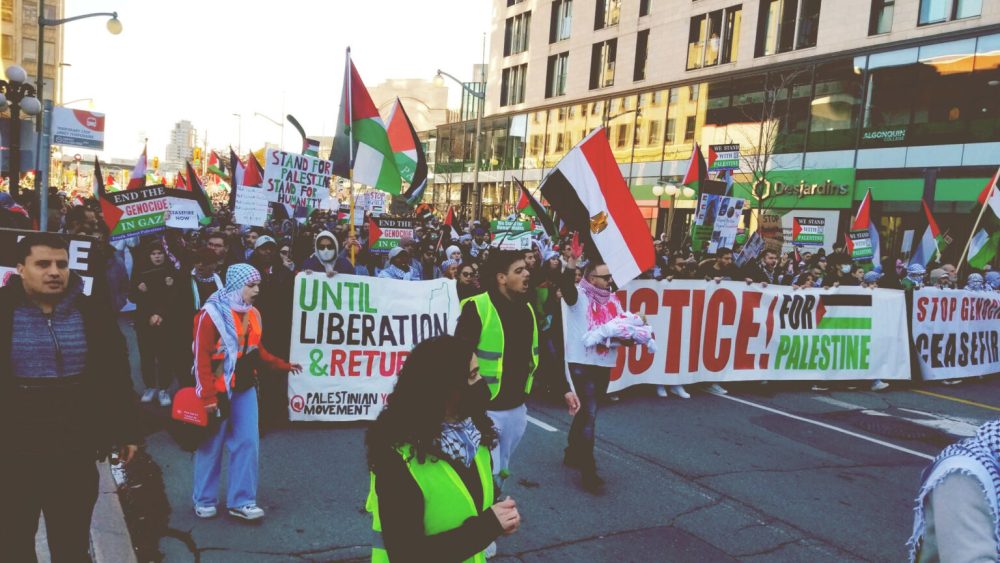
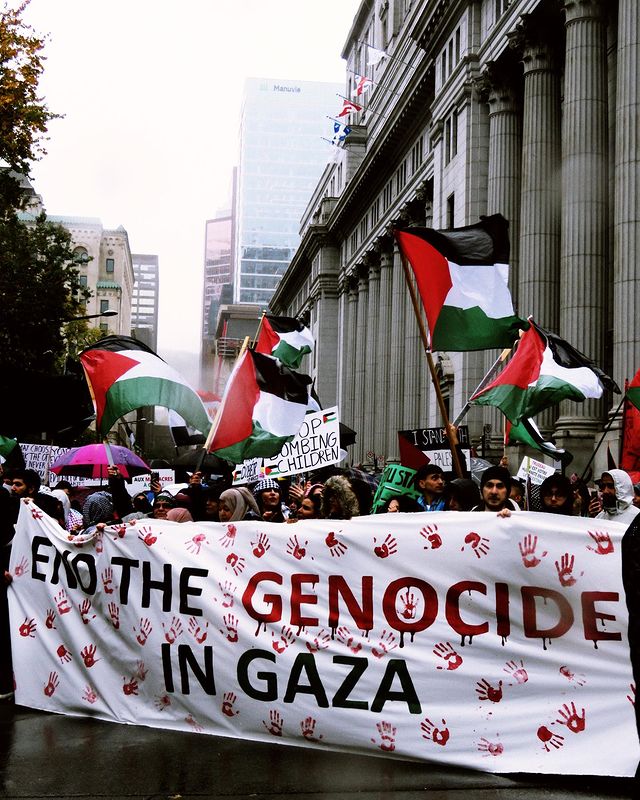
Since Hamas’s October 7th attack, killing around 1,400 people and taking around 240 hostages, Israel has been carrying out a massive campaign of death and destruction on the Palestinian people through a brutal siege and military offensive. Thousands of Gazans have died, over 10,500 at last estimate, with thousands more estimated buried under the rubble of countless buildings collapsed by the bombings. Fuel has run out at many hospitals, worsening an already deadly crisis caused not only by the air and ground assault but also by the blocking of food, water, and fuel from entering the open-air prison.
The colonial violence of the Israeli state has intensified in the West Bank as well, where Israeli settlers have been given increasing access and encouragement to arm themselves. Between IDF and settler civilian attacks, at least 133 Palestinians in the West Bank have been killed. Israel recently deported Palestinians working in Israel to Gaza, where they will be under constant threat of death, but only after imprisoning, beating, and interrogating many of them. In the face of all this, Western states like the US and Canada have been standing by Israel, publicly mourning the deaths of Israeli soldiers, shying away from providing any meaningful international pressure for a ceasefire, and creating an environment generally hostile to solidarity with the Palestinian struggle.
Across Canada, anarchists and others have been organizing to support Palestine from afar. So much has been happening there’s no way we can cover it all, but we’ve put together a summary of some of the efforts that have taken place over the last few weeks, as well as some reflections on proposals for anarchist interventions.
Occupations
On October 30, coordinated office occupations began of 17 Canadian MPs demanding that Canada call for a ceasefire.
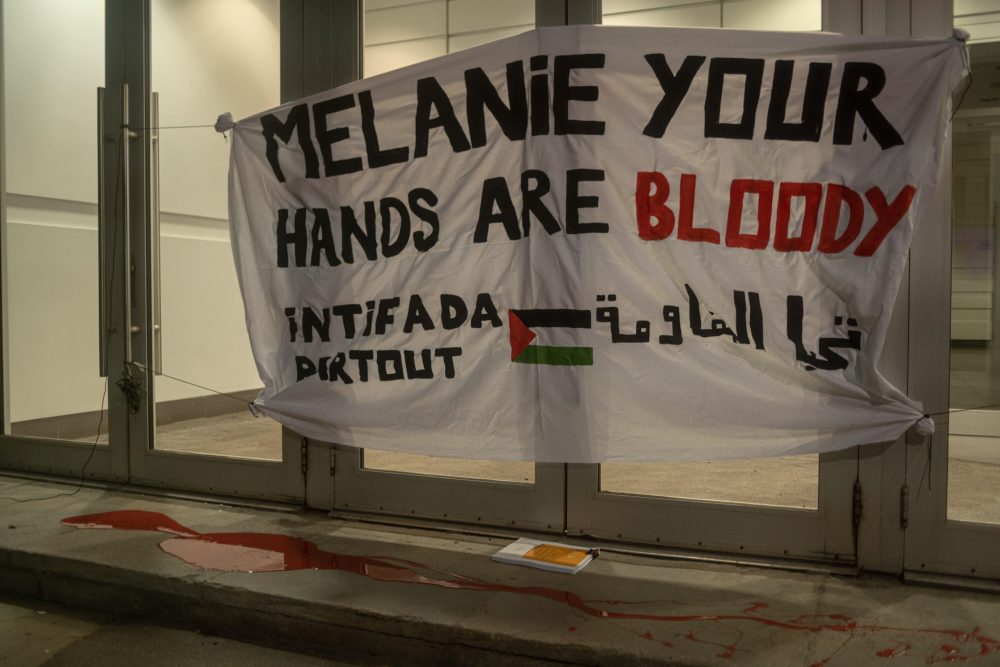
In addition to office occupations, MPs have been targeted in other ways. On November 1st, the entrance to Melanie Joly’s MP office was drenched in red paint and had a banner hung on it. As well, the list of the names of the Palestinians killed by Israel’s ongoing genocide in Gaza (produced by Palestine’s Health ministry) was left in front of the door of the building.
In Montreal, protests have been been happening downtown at least once a week as well, with emergency protests called a few times as well. These demonstrations have consistently brought out thousands of people.
Weekly marches have been occurring in Toronto, with the latest on November 4 including a 5 hour sit-in in Toronto’s financial district going late into the night.
Blockades
In Toronto, INKAS Armored, a defense contractor with tied to the IDF, was picketed:
Early on the morning of October 30th, a crowd descended on INKAS Armored, a Toronto-based defence contractor with ties to the Israeli Defence Forces. Responding to a call from Palestinian trade unions for workers around the world to shut down exports to the Israeli military, the protesters set up picket lines to block access to the facility.
In Vancouver on November 3rd, anti-Zionist Jews held an action where they blocked a major artery to the Port of Vancouver, calling for an end to business as usual in the face of the assault on Gaza.
Anarchist Analyses of Palestine Solidarity
A few proposals have emerged recently for how anarchists and radicals should engage in this moment of international solidarity with Palestine. Because we imagine our readers will come across them, we’d like to offer a few reflections.
An anonymous submission to North Shore Counter-info has called for anarchists to escalate their interventions in the current moment. The article speaks, in part, to a desire for a specifically anarchist response to the unfolding crisis, one in which it is easy to feel powerless, and where the way to respond from a specific politic is at times unclear.
Commentary published in Montreal Counter-Info offers a different suggestion: for anarchists and the radical left to “prioritize the voice(s) of the people concerned and acknowledging their complete leadership of the ongoing resistance movement…accept a secondary role: to sometimes stay silent, to listen, and to learn.” It also asserts: “it is in no way our role to emphasize “complexity” and bring “nuance” to the situation.”
We believe that an anarchist response to this situation requires careful reflection, and identification of both the specific analysis and skillsets that anarchists bring. A meaningful anarchist response requires political clarity, which in turn requires time spent understanding the issue and building political analysis together. It requires reflecting on our range of tactics and skills, and what these can offer to an international solidarity movement. It also requires an honest discussion of strategy, developed with our comrades or adapted from other contexts. We can use a lens of effectiveness, or of what tactics we wish to see generalized, what skills we may be able to help foster and spread, but the why matters. Whatever words we use to describe it, we should assess both the intentions and likely effects of our interventions. Are we aiming to spread a message of solidarity in a new but still symbolic way, have we identified a chokepoint that allows for a more material intervention in the flow of money, information, or equipment to Israel and those supporting it, or are we doing something else entirely?
We should remain critical of our desire to ‘escalate’ – does this stem from a belief that ‘escalated’ actions (one-off or sustained) are more effective than marches and rallies in this moment, do they feel more politically fulfilling (to us, or to a broader movement), does taking on more risk mean we care more? How does acting with urgency support or hinder our goals? There are myriad good reasons to escalate, and it is worth being clear about what those reasons are, and whether the tactics we choose align with those reasons.
While the submission to North Shore Counter-info may give some anarchists a much needed push to begin reflecting on how to engage more thoughtfully and consciously in this context, its lack of specificity makes its message ring hollow. While hope is a critical part of any struggle, the vision for anarchists to “share food, tell stories, dance and sing songs, bask in the warmth of the sun, and marvel at the deep night sky” feels out of touch while the Gaza sky, day and night, is filled with explosions. Living free in Canada is not a suitable anarchist intervention in the absence of a direct proposal to use that freedom to affect something outside of ourselves.
While the commentary in Montreal Counter-Info proposes a model of solidarity that misses the opportunity for deeper understanding, unity, and empowerment, its assertion that showing up is never the wrong thing remains true: “While solidarity in words means little at the moment, solidarity in the streets will never be too much.” In this moment, we must not look away – with our eyes on Palestine, and a critical gaze toward every violent nation state, including our own, we can turn to each other and find a way forward.
Comments Off on Invitation to the First International Gathering of Anarchist and Antiauthoritarian Practices in Tijuana, Mexico
Nov082023
Anonymous submission to MTL Counter-info
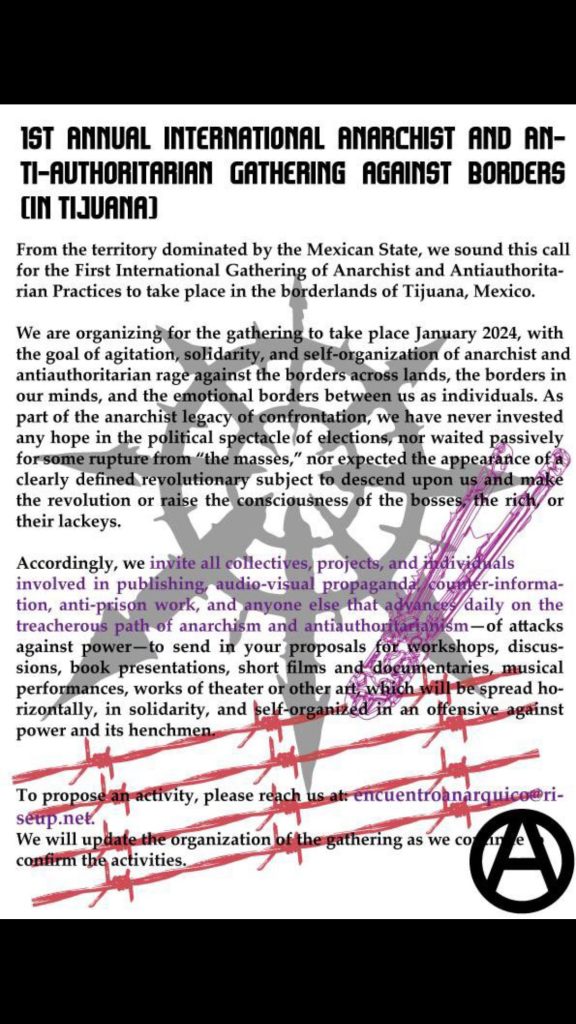
From the territory dominated by the Mexican State, we sound this call for the First International Gathering of Anarchist and Antiauthoritarian Practices to take place in the borderlands of Tijuana, Mexico.
We are organizing for the gathering to take place January 25, 26 and 27 2024, with the goal of agitation, solidarity, and self-organization of anarchist and antiauthoritarian rage against the borders across lands, the borders in our minds, and the emotional borders between us as individuals. As part of the anarchist legacy of confrontation, we have never invested any hope in the political spectacle of elections, nor waited passively for some rupture from “the masses,” nor expected the appearance of a clearly defined revolutionary subject to descend upon us and make the revolution or raise the consciousness of the bosses, the rich, or their lackeys.
Accordingly, we invite all collectives, projects, and individuals involved in publishing, audio-visual propaganda, counter-information, anti-prison work, and anyone else that advances daily on the treacherous path of anarchism and antiauthoritarianism—of attacks against power—to send in your proposals for workshops, discussions, book presentations, short films and documentaries, musical performances, works of theater or other art, which will be spread horizontally, in solidarity, and self-organized in an offensive against power and its henchmen.
To propose an activity, please reach us at: encuentroanarquico@riseup.net.
We will update the organization of the gathering as we continue to confirm the activities.
Today, November 1st 2023, when the veil is at its thinnest, the dead in Gaza speak to us.
We, the writers, are not Palestinian. We write this for fellow north american anarchists of a certain type. You’ll see yourself as you read. We also write this for the anarchy-adjacent, and for anyone who is interested.
The horror of Israel’s genocide of Palestinians is deep, inescapable, and intricate. We, anarchists and those close to anarchy, understand the history, the context of apartheid, the numbers, the hypocrisy, the exceptionalism, the cruelty, the torture. We sob. We lose sleep, and friends, and family.
We feel helpless, so we undertake the relatively and subjectively fearsome tasks available in the current repertoire of “resistance”. These tasks are fine, and understandable: marches, popular education, “movement-building”, “speaking out” at school or at work, petitions and declarations, non-violent direct action.
Are you truly satisfied with the fine and understandable? Is the moral righteousness of “taking a stand” all that you need to live in freedom with others?
We see each other on the streets, marching grimly. We see each other on the subway, or at our places of work or study, wearing keffiyehs or other talismans of who we are and where we stand. We see hundreds of thousands like us, in the glassy black mirrors of our lives, lit up with both spectacles of death, and spectacles of refusal.
It is unnecessary to repeat to each other, and possibly to anyone else, what we already understand. Anarchists, please don’t waste your time organizing webinars. Someone else will write the petitions, make the memes, write the tweets. Leave the begging of the state to the liberals. Hundreds of thousands will inevitably fill the perennial role of those who grovel for scraps, for concessions, for living death, instead of full and ecstatic life. They will film themselves dancing out these rituals.
What are these social movements that march and beg? Mass theatre. It’s fine and understandable, but don’t overestimate it.
We don’t beg. We take.
What of the students who are censored, the teachers who risk losing their jobs? Resist the seduction of individal drama raised onto the pedestal of collective action. That’s the work of radicals who have accepted they are living in non-radical times, professional revolutionaries making their personal trouble into a campaign.
It’s fine and understandable for some – but anarchists, please, don’t waste much of your breath arguing with enemies and trying to prove to the world you are right.
The speeches, the poems, the open letters, and declarations? Do these things quickly and don’t let yourself get exhausted by it, because words drift and flutter and dissolve, as will this text. Enjoy their transient effect while they last, but know that the expressions that last are of a more concrete kind.
Direct action? How direct is it? How long does it last? Is the effect just another colourful blip on the network of black mirrors, plus a fine or charge? We hear slogans chanted as you, the solidarity activist, gets dragged away. It’s good you’re doing the scary meaningful thing – whatever that may be for you, or you, or you. It is fine and understandable. But is that it? Is your end game just to shut down a small part of the infrastructure of genocide for a few hours, and inspire others and make people think?
Not all direct action gets the goods.
Whatever you do above ground, maybe it’s time to take it under. Whatever you do with the utmost care and secrecy, maybe now’s the time get even better at it.
It’s an old adage that few follow: Live as if you are already free.
We’re not going to be prescriptive except in this one regard: our entire existence should change. The horror compels us to do so. If you’ve been hesitant, the time is now to dramatically transform the self, the way we relate to it, and the way we relate to others. No matter how many stupid social rules you have already discarded, get ready to toss away even more. It’s not just a quantative effort, though: you’ll need to face the sacred cows of your subservience, your biggest fears, the most daunting obstacles.
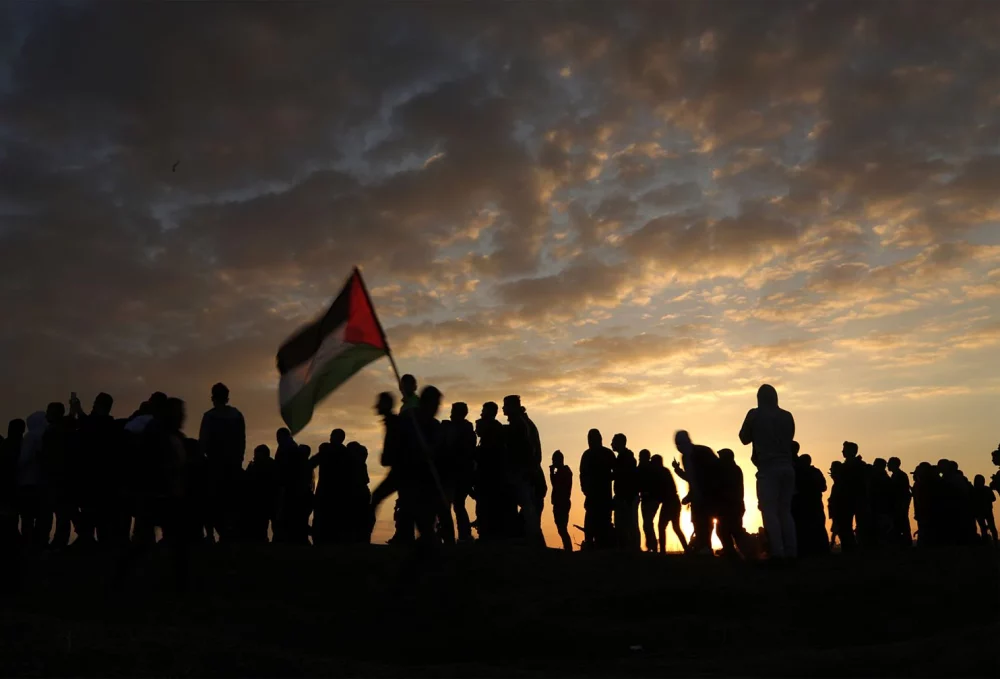
Only in the condition of living free can we ever be able to enact our desire to live with Gazans in freedom. Together, literally or symbolically, we want to share food, tell stories, dance and sing songs, bask in the warmth of the sun, and marvel at the deep night sky.
It’s time not just for reversals, though these are fine and understandable for some: replacing inertia with action, silence with speech.
It’s time for a decisive step outside of the circle of death, the boring theatrics of refusal, repression, further protest, then more death. That circle is drawn by the nation state and his loyal pal: existing society. Within that circle, genocide and land theft will certainly persist, almost as if – it absurdly seems – fueled by our grief, our funeral marches.
If we haven’t already, it’s time for us to leave that circle, entirely. When we leave, we do not march.
Comments Off on Palestine: Reminders of What Solidarity Means
Nov022023
Anonymous submission to MTL Counter-info
Recent years have seen intense and conflictual debates within the radical left on how to act in solidarity with marginalised and oppressed groups and on the role of allies (a word to which many, including myself, prefer the term accomplices). There is no doubt that Indigenous, Black, queer and transfeminist struggles have deeply reshaped both vocabularies and practices, greatly enriching and complexifying our thoughts and struggles. These questions have simultaneously created profound disagreements, enabled new alliances, transformed relations of force, and led to scissions. Despite certain divisions, the particular context of the past years has at least established certain relatively agreed-upon principals, and I am stunned that we need to recall these principals now, as Israel’s war against the Palestinian people demands that we once again adopt a position of solidarity.
Apparently, the need to listen to and believe the oppressed, particularly when we find ourselves on the side of the oppressor, is not self-evident in the Palestinian context, even as it is considered imperative in many other contexts. Similarly, it is somehow unclear that we must take the posture notably adopted during Indigenous decolonial struggles : prioritize the voice(s) of the people concerned and acknowledging their complete leadership of the ongoing resistance movement. In our solidarity with Palestine, we must once again accept a secondary role: to sometimes stay silent, to listen, and to learn.
Listening does not mean stopping our critical reflection on the information and positions that we receive. Listening means avoiding the temptation to homogenize Palestinians, attempting to hear the multiple voices of their liberation movement, taking the time to try to understand their internal conflicts, and thinking with the care necessary when considering situations with foreign codes of meaning. And listening certainly means “not speaking” recognizing our extreme exteriority to the reality lived by Palestinians—in Palestine or elsewhere—and acknowledging that we may not be in a position to develop and publicly share strategic considerations. If this seems obvious to me, there is something I am even more certain of: it is in no way our role to emphasize “complexity” and bring “nuance” to the situation. At a moment when the so-called “complexity of the conflict” is constantly deployed to avoid a strong condemnation of Israel in the public space, to present this type of reflexion is simply unacceptable.
We must couple a position of true listening, with the humility and uncertainty this implies, with a position of firm and engaged solidarity. In a context where Canadian government keeps reiterating its support to Israeli violence, this second dimension is essential and urgent. Above all, we must show up. Go to protests and actions, regardless of whether their tactics could differ from the rituals of the Montreal far left. Solidarity with Palestine is not a question of abstract and symbolic internationalism, but of concrete opposition to our own state, which is materially engaged in the oppression of the Palestinian people.
We also bear this responsibility towards those for whom our home is a land of exile, whether it be temporary or permanent. It is critical that the Palestinians with whom we share our city not only feel respected as humans whose fundamental rights we defend, but as actors with real agency, possessing thoughts, heritages, and political practices that are rich and singular. As citizens of a state directly implicated in making Palestine inaccessible and uninhabitable for its diaspora, we must do all we can to make our home liveable for those who find themselves here, a place where life is a synonym of dignity and not solely survival, and where exile may unfold as a political experience. This comment also applies to those peoples for whom the Palestinian struggle is a fundamental issue deeply rooted in their political culture.
To Palestinians and their long-standing accomplices from the Middle East and Arab world: know that certain silences arise from an immense respect for your struggle, and they do not exclude total solidarity, in words and in actions. I release this statement only because I see my friends from the Middle East dismayed by the weak stance taken by local radical left; this has pushed me to write, out of the wish that my political world be a place of sincere welcome and solidarity.
To those who share my form of silence: show up. While solidarity in words means little at the moment, solidarity in the streets will never be too much.
Comments Off on Intifada Everywhere: Direct Action at the Office of Melanie Joly
Nov012023
Anonymous submission to MTL Counter-info
A banner was hung in front of the building where Mélanie Joly’s office is (225 Chabanel O., Montreal). Red paint was poured, and the list of the names of the Palestinians killed by Israel’s ongoing genocide in Gaza (produced by Palestine’s Health ministry) was left in front of the door of the building.
Statement follows.
Canada, yet again guilty of genocide
It is said by some that Gaza is the biggest prison in the world. We fully agree with such a description, although it is obviously now a euphemism, since Gaza has become an extermination camp. Blocking water, food, medicine, electricity, fuel and internet to a population wholly dependent on imports and international aid, while carpet bombing them, can only produce one outcome. You can avoid the word as much as you please, but the reality is this : the Israeli government is committing a genocide, in full view and with your full support, Mélanie Joly, Justin Trudeau and the rest of the parasitic invertebrates that supposedly represent our will and our interests.
The international network of complicity
By the time this statement is released the latest phase of the genocide will have killed more than 10,000 Palestinians. This number includes entire families, teachers, doctors, journalists, students, drivers, nurses, street vendors, artists and so on. The colonial Israeli state tests the world’s threshold on crimes against humanity with every passing day. Canada might not be the one who is dropping a thousand bombs daily in Gaza, or handing out assault rifles to settlers bent on annexation and shooting families. However, Israel wouldn’t be able to do so without the unrelenting support of the imperialist states of the “global north”. Israel wouldn’t even exist today if it wasn’t continually armed, financed, and legitimized by the imperialist powers of Europe, some of their former colonies like Canada and Australia, and the hegemonic empire of the US.
Bound together militarily by NATO, and economically through trade agreements and forums like the G7, this imperial coalition fosters its alliance with the fascist state of Israel as a way to keep a military fortress in this historically strategic region. This alliance is crucial to the destabilization strategy put forward by the US, which seeks to prevent the peoples and the states of the region that are hostile to US hegemony from uniting themselves in an anti-imperialist struggle. Israel is vital to the US empire, which is essential to Canadian power. Mainstream medias, held by capitalist conglomerates or states, work hand in hand with this coalition to legitimize the ethnic cleansing of Palestinians by disseminating the dehumanizing fascist discourse of the Israeli government.
International solidarity : Act here and now!
We salute those who have marched through the streets, blocked governmental offices and weapons manufacturers, and expressed their solidarity on the walls and windows of this sad, sad, sad fucken city built on stolen lands. However, we are convinced that we are not the only ones who are disappointed and frustrated with the passivity and tardiness of our fellow comrades of the far left in taking transformative actions against the ongoing genocide. We also deplore the statements that were issued by leftist organizations like [redacted] that equalized the violence of the colonized with that of the colonizers like.
While we understand the threat of violence that activists face by the strong international Zionist forces, we draw our courage from our comrades in Palestine who are at the front line of this genocidal and colonial violence. They are calling for us to be in solidarity. Now is the time to respond to their calls for action without hesitation. Solidarity is not a slogan nor a hashtag. Solidarity materializes itself through action. To abstain from answering swiftly and with force to the calls to strike, to protest, to sabotage and to boycott coming from Palestine is to give a free pass to “our” governments in their unconditional support to Israel.
Colonial peace or liberation struggle?
Peace is not the absence of conflict; peace is the presence of justice. Justice in Palestine, just as in Canada, means decolonization. This material process implies that the colonized get their lands back, that they can enjoy the right to return and that they obtain reparations, all of which, sadly for our self-appointed liberal allies, mean that violence will inevitably be part of the process. Of course, gunning down Israeli “non-combatants” can be criticized from a humanistic and a strategic perspective. Nonetheless, we have to keep in mind that Israel is a settler colonial state in which every citizen has to go through military training and service. The “civilians” of Israel are literally born to serve an ethnic cleansing enterprise. A population subjected daily to humiliation, state and settler repression, manufactured poverty, apartheid and dispossession of land, cannot be held to a higher moral standard than that of the Israeli fascist state. A ceasefire, while immediately needed, is not in itself any kind of long-term solution for the people of Gaza or Palestine.
We stand with a liberated Palestine, from the river to the sea
As citizens of the settler colonial state of Canada, our immediate task is not to deliberate on the legitimacy of the Al-Aqsa Flood operation, but rather to help the Palestinian struggle for self-determination by striking Israel’s international network of complicity. It implies overturning our own imperialist states, attacking our governments and blocking the capitalist production and exportation of goods to Israel. Weapons manufacturers supplying Israel’s genocide of the Palestinian people must be blocked, trashed and shamed. You can find the ones closest to you on Worldbeyondwar.org (see their “Canada: Stop Arming Israel” campaign).
Calling for the enforcement of international or humanitarian law is an hopeless endeavor. As long as the US and it’s lackeys like “Canada” remain the dominant powers of an international order based on capitalism and imperialism, the ethnic cleansing of the Palestinians will go on, no matter how many millions decry it. This is not an opinion but simply a description of the actual situation. Only a popular and international uprising, employing militant means and defiant methods, has the potential to overturn the international network of complicity. That is our solidarity.
Most expect to be captured on video when walking through downtown streets, which are often littered with traditional types of security cameras, such as the dome cameras, bullet cameras, or the newer remote controlled PTZ (Point, Tilt, Zoom) cameras. Previously, this was less expected in residential neighborhoods, which now have an increasing amount of home surveillance systems like Amazon’s Ring or Google Nest cameras. Police departments have seized on the increasing popularity of these devices and struck deals with their parent companies to directly incorporate them into existing surveillance networks and access data without the knowledge or permission of the camera owner. Some doorbell style cameras offer forms of audio surveillance as well: Amazon’s Ring cameras, easily spotted by their ominous glowing circle, can reportedly capture conversation-level audio from up to 25 feet away. Ring has partnered with more than a thousand police departments across the United States . Some police departments even ran pilot programs that enabled them to constantly live-stream from residents’ doorbell cameras.
While the rapid expansion of home surveillance systems like doorbell cameras has been extensively noted and attacked by anarchists, there has been less focus on the equally rapid expansion of vehicle-based surveillance systems.
For a long time now, cars have been at the center of many high-profile arrests of anarchists. Most major cities have invested in roadside automated license plate readers (ALPR), and many police vehicles are equipped with dashboard ALPR, which read, record, and search every license plate across assorted databases. The No Trace Project has thoroughly documented the many types of trackers and listening devices that police across the world have installed in the vehicles of anarchists. Even without being bugged, almost every modern car contains technology that logs your trips (and much more) and can be easily accessed by law enforcement. In the US, most car manufacturers routinely provide vehicle information to law enforcement without a subpoena or warrant. The vast majority of cars sold in the US over the last few years feature telematic modules that transmit information, including location information, directly to the servers of the manufacturer for remote storage. Further information can be extracted with physical access to the target vehicle: a tool sold by the US company Berla can find the full location history of a vehicle, as well as contact lists, call logs, SMS messages and more of any phone that has been connected to the car’s infotainment system.
Cars, especially newer vehicles with built-in computer systems, know everything about their users and, consequentially, the people around them. Tesla is taking this a step further, turning cars into mobile, high-definition video surveillance systems.
Every Tesla vehicle has cameras that provide 360-degree video surveillance around the vehicle while it is in motion. There are nine cameras in total: eight exterior facing cameras (three front-facing cameras, two fender cameras, one rear-view camera, and two side cameras on the “b-pillar” between the windows) and one interior facing cabin camera. The footage that is collected by these cameras is stored locally on a USB drive or other storage device connected to the vehicle’s central computer system, but footage also makes its way to Tesla’s servers. For instance, Tesla offers a (minimum) 72-hour backup of all footage recorded in case the driver-installed USB drive is stolen. Some countries have banned Teslas from driving near sensitive government areas, such as China and Germany, which banned the cars from driving on certain Berlin police grounds.
All nine Tesla cameras are actively recording while the car is moving. However, even when the car is parked and turned off, the cameras are often still recording. Tesla offers a feature called “sentry mode” which transforms the parked car into a camera system that can capture video from all directions. This mode supposedly has to be manually switched on by the owner. It uses four of the nine cameras (one on each side of the vehicle), and the video feed can be accessed in real-time via a smartphone app. The cameras are activated and an “alert” notification is sent to the app every time someone touches the vehicle or the vehicle moves, but also activate when someone walks near the vehicle or other nearby movement is detected. Videos are uploaded to centralized Tesla servers as a backup. Even if the cameras did not activate or trigger a “sentry event,” video can still be recovered of anything that happened in camera range within (at least) an hour before it is overwritten. However, Tesla owners can use publicly available code to modify their computer system and store all footage indefinitely.
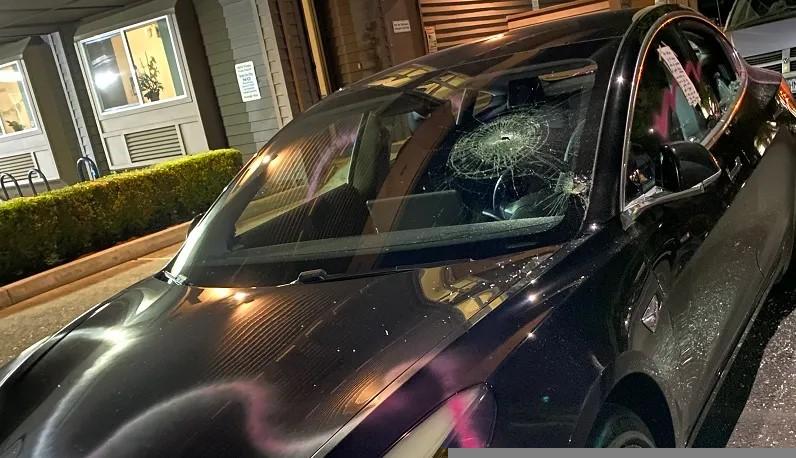
A Tesla damaged during a demo in Portland, Oregon in June 2022.
The cameras used in Teslas are made by the technology and weapons giant Samsung. So far, most have a resolution of 1.2 megapixels, but since 2023 some cars have 5 megapixel cameras which are significantly more detailed and color-accurate. The front cameras have a range of up to 250 meters. It is possible for older models of Teslas to be upgraded to the newer hardware and better cameras.
It is already possible to harness the video footage from Teslas and run it through artificial intelligence (AI) programs that automatically process faces and license plates. In 2019, a presenter at a security conference showed how he could use his Tesla, a relatively affordable minicomputer, and publicly available programs to create a system to track and store all passing faces and license plates. Combining high quality security cameras that capture footage with artificial intelligence powered programs that automatically analyze that footage is not a thing of the future, it is already here. Google’s home security system, Google Nest, comes equipped with a feature that automatically keeps track of “familiar faces,” and many other consumer-grade security systems have similar features. Soon, the rent-a-cop watching dozens of TV screens from a windowless room could be augmented, or even replaced, by AI-powered security systems that are taught to automatically flag certain faces and “suspicious” behaviors and alert security. The recent development of 5G networks enables the wireless connectivity and high-speed data transfer needed to transmit sufficiently detailed live video from security cameras to AI systems in data centers and law enforcement fusion centers.
Just as doorbell cameras have become a major resource to police, Tesla cameras have already proved to be an important and increasingly sought-after source of evidence in investigations. Footage from Teslas, including parked Teslas in sentry mode (which was only introduced by the company in 2019), has already appeared in a number of cases in the US and beyond:
2019 in Berkeley, CA: Video from a Tesla allows police to identify and arrest someone for breaking into a car. They were wearing a GPS-tracking ankle monitor at the time of the break-in.
2019 in San Fransisco, CA: A Tesla is broken into and its cameras capture the face and license plate of the suspect, resulting in arrest.
2020 in Springfield, MA: FBI investigation into a racist Church arson and other crimes involves footage from a parked Tesla, which clearly shows the face of the suspect as he steals one of the wheels from it.
2020 in Stamford, CT: Two were arrested for armed robbery after police take footage from a parked Tesla that shows the license plate of their getaway car.
2021 in Berlin, Germany: An explosive device is placed and activated near a construction site. Berlin police used video from a nearby parked Tesla to identify and arrest an allegedly “left-extremist” suspect.
2021 in Memphis, TN: A parked Tesla records people stealing the wheel of a nearby car, and the footage is publicized by police in an attempt to identify the suspects.
2021 in UK: Police use video from Tesla to find and arrest a person who keyed the parked car. Video showed the face and license plate of the suspect.
2021 in Riverside, CA: Tesla driving on highway had its window shot out by a BB gun, police used the footage to identify the suspect’s car and make an arrest.
2023 in San Jose, CA: PG&E transformer boxes were blown up in two separate attacks, knocking out power to thousands. A multi-agency investigation results in an arrest, a key piece of evidence is video from a parked Tesla that shows the suspect near the scene. Phone data (likely a geo-fence warrant) is also used to identify and arrest a suspect.
2023 in Bend, OR: Police investigating a murder case make a public plea for Tesla owners to check their footage from the day and look for a specific car.
In these cases and others, law enforcement made direct quotes about the importance of Tesla videos in the course of the investigation:
“Without people being willing to share their surveillance videos with us, we probably wouldn’t have been able to make progress on this case, so that was essential.”
Assistant Police Chief of San Jose, CA
“This is the one that did him in and this is the reason why he got arrested.”
Police officer pointing to a Tesla camera
“It’s rare but we’re seeing more and more of these [Tesla] surveillance cameras all over the place now and we’re happy to see that because it’s a really effective crime-fighting tool.”
San Fransisco PD PIO
“Today’s technology enables automobile manufacturers like Tesla to generate recordings, which of course have enormous added value for the police when solving crimes and traffic accident scenarios. It would be negligent not to use this opportunity.”
President of the Gewerkschaft der Polizei, a German police union
As more Teslas hit the road, the state’s surveillance network expands; the supposed line between “citizen” and “cop” vanishes. The same surveillance technology that Tesla has pioneered is being introduced by other car manufacturers and after-market manufacturers. A new feature by BMW allows users to generate a live 3D render of their car’s surroundings from a smartphone app. Other companies are not far behind, teasing features that are similar to Tesla’s sentry mode.
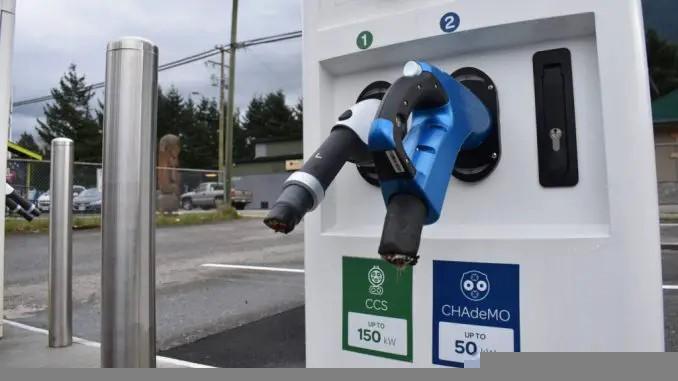
Electric vehicle charging station with severed cables.
What should anarchists take away from this? How can we continue to attack this panoptic hellscape and get away with it?
When concerned about potential video surveillance, we must now remember to check for Tesla vehicles in addition to doorbell cameras and more traditional visible security systems. It may be possible to avoid activating the cameras of parked Teslas by walking on the other side of the street. Unlike all other forms of surveillance cameras, parked cars will not always be in the same spot – a street free of any visible cameras one night might have a Tesla parked on it the next. This means car cameras present a particular challenge when planning paths to avoid surveillance. For now, no other major car manufacturer seems to regularly include surveillance cameras, so Tesla’s unique shape allows them to be identified at a distance and avoided (or targeted!) more easily.
Unfortunately, it is often impossible to avoid the eyes of cameras completely. General practices for avoiding identification through security camera footage include: using loose-fitting clothing to cover up completely. If circumstances prevent covering the eyes with sunglasses or otherwise, ensure that everything surrounding the eyes remains hidden. Eyebrows in particular have a tendency to reveal themselves in the eye gap of a mask and can be very identifying. The clothes used, including shoes, should only be worn once, and should be acquired in a way that cannot be traced (by store cameras, transaction history, etc.). Ideally, the clothes lack logos or unique patterns. Clothes should be discarded or destroyed immediately after, again through untraceable methods and in a location with no connection to you. Gait analysis, the forensic method of identifying your unique walking patterns, may become increasingly enabled by artificial intelligence; consider modifying how you walk when on camera. Video footage showing patterns of left-handedness has also been used by investigators to identify suspects.
It is best to keep as much distance from cameras as possible and avoid turning directly towards them. Simply turning your head away from the vehicle while you walk by can help conceal your face. Even when wearing a mask, higher definition footage can still reveal identifying features. Tesla cameras differ from most traditional security cameras in that they are below head height rather than overhead. Umbrellas and the brims of hats and hoods that might offer effective concealment from an overhead camera may be ineffective against the low angles of a car camera.
In most of the arrests involving Tesla footage, the person was identified by their car, and often a license plate. The existence of ALPR, other cameras, and centralized databases makes it very difficult, and often impossible, to travel by car without leaving a trail. In contrast, bicycles lack license plates, are much more easily checked for tracking devices, are simple to steal or buy for little cash and discard, and have proven to be significantly more difficult to trace in criminal investigations.
In attacks against Teslas or things nearby, be aware that you are on camera and prepare accordingly. With some practice, slingshots (or other projectiles) can be used effectively from a distance. An awl can easily deflate tires by stabbing into the upper sidewall, and is quieter than a knife, though the damage is easier to patch. It is not too hard to spot the Tesla cameras once you familiarize yourself with their locations, and they can be easily covered with spray paint.
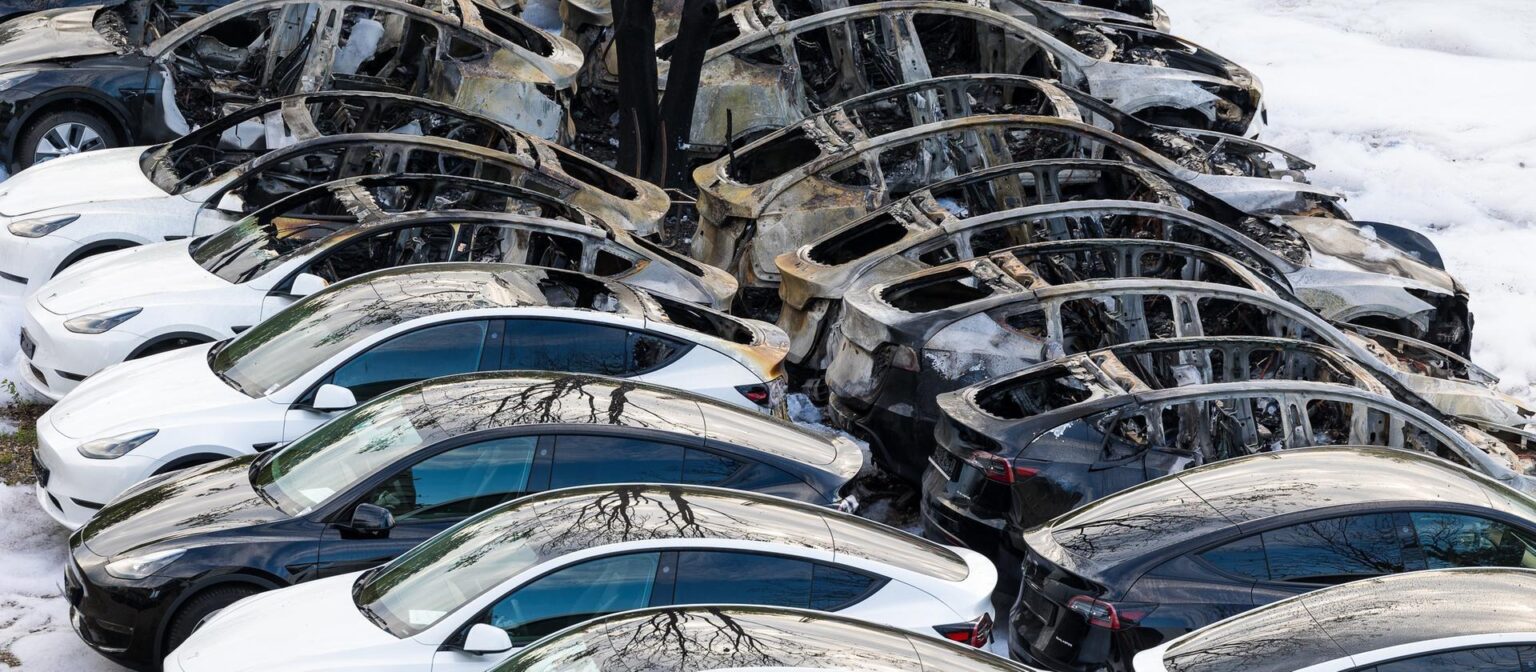
Some of the usual suggested methods for incendiary attacks against cars become obsolete or ill-suited when we begin to consider electric vehicles. Advice on placement of an incendiary device often assumes the existence of a gas tank and a flammable fuel engine. With electric vehicles, and Teslas in particular, the major flammable parts of the car are the tires and the lithium-ion battery, which is throughout most of the bottom of the car in the chassis. Tires catch fire more easily, and some chemical fire-starter cubes or road flares heating the tire directly can be sufficient. The flaming tire may then set fire to the batteries.To target the batteries, the underside of the car must be heated enough to create a thermal runaway effect in the battery cells. This can be very difficult to extinguish and almost guarantees the total destruction of the car. Gasoline or a similar accelerant concentrated in one spot under the car is the most effective way to quickly generate enough heat for a battery fire. It is inadvisable to break car windows to place an incendiary device inside, which increases risk of discovery (breaking glass is loud!) and DNA traces.
From a responsibility claim for an arson in Frankfurt, Germany in 2023: “We torched some new Teslas in Frankfurt tonight. As a salute to the protests in Munich. As one attack among many on the destructive auto industry…Tesla is one of our most prominent enemies. The company represents like no other the ideology of green capitalism and the ongoing global and colonial destruction.”.
The “electric car revolution” continues to pillage the earth through resource extraction, cars continue to kill and maim human and non-human animals in massive numbers, and systems of surveillance and control continue to be refined and expanded. Tesla, along with other electric vehicle manufacturers, can and should be attacked by anarchists. It can be attacked at many levels: the network of charging stations is vulnerable to sabotage, the vehicle lots and buildings can be attacked, and the cars themselves can be easily damaged or destroyed.
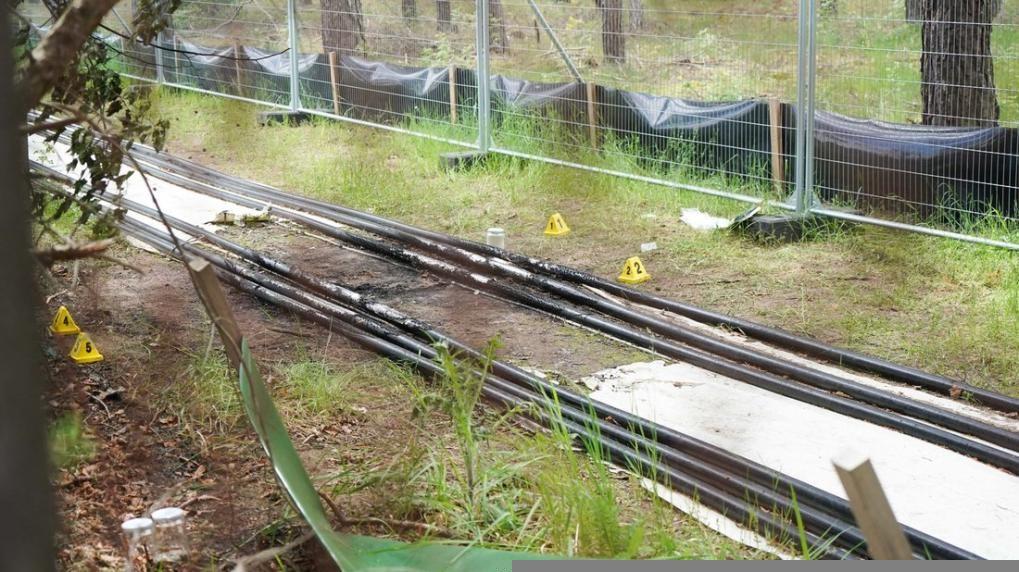
Six high-voltage cables supplying power to the site of a Tesla “gigafactory” were torched near Berlin, Germany in May 2021. Translated from the communique: “Our fire opposes the lie of the ecological car.”.
Fuck Tesla. Fuck all cars and all cameras. Death to the state. Nothing but love to all anarchist troublemakers, vandals, and creatures of the night. Strike wisely and don’t get caught!
Warrior Up (some guides on this website are not be up to date with modern investigatory tactics, or include unreliable methods)
Some of these links contain detailed guides for destructive actions. It is best to view these using Tails or Whonix. A setup guide and download link for Tails can be found here.
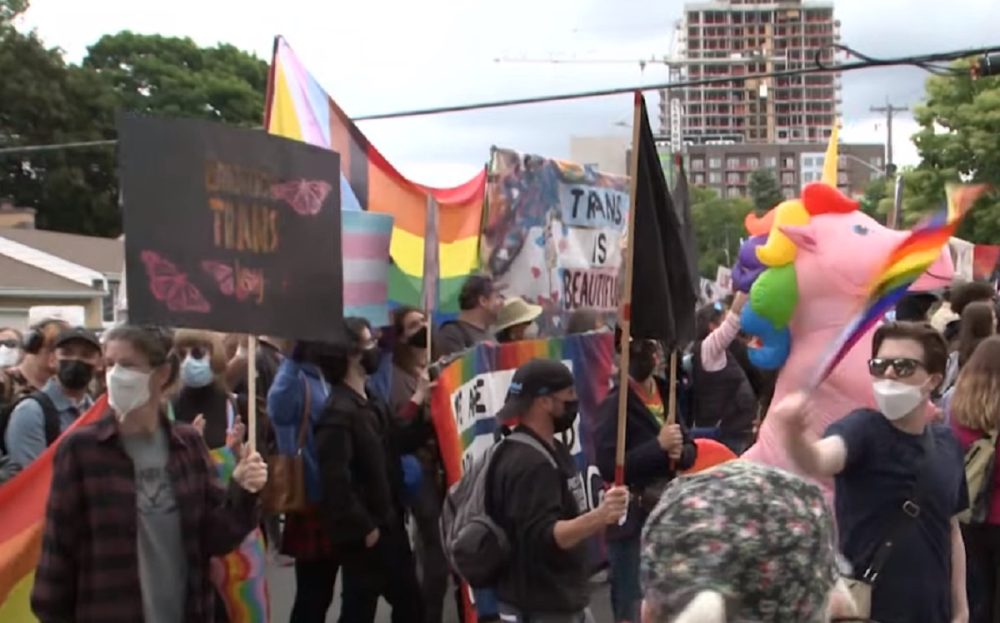
On a Friday morning in June, something like 200 fascists descended upon Broadview and Carling in suburban ottawa. By the time they’d formed up, a blockade of defenders had already taken the north side of the intersection. Over the next several hours, those two large contingents split into smaller blockades spanning several blocks, with a series of confrontations that ended in around 400 defenders completely corralling the fascists off. There we stayed until the end of the school day, leaving the fash with no one to harass or proselytise to and heading home victorious.
Through the last months of face-offs, our enemies have gotten bolder and more willing to be violent. This demo brought supporters in from all across the country, even one guy from all the way down in Florida. On top of all the regular pushing, shoving and punching, people were sexually assaulted and threatened with dogs. There was at least one credible knife sighting. Many of us were hurt, some injured in ways that lasted beyond that week.
But we’ve also witnessed some pretty goddamn beautiful collective skill-building through being in the streets together over and over after the convoy. The difference in discipline and open-ness to militance from the much-mythologised shitshow of Billings Bridge is drastic. Not that long ago, it was hard to imagine anyone just showing up in black bloc on ottawa streets – and if they did, they were immediately badjacketed by marshalls.
In contrast, on June 9, we had walls of banners multiple rows deep, at multiple heights, completely shutting out livestreamers’ cameras. As the day went on, they broke into four smaller, maneuvrable units to cover the terrain. Honourable mentions also go to black umbrellas and pole-mounted banners with text facing inwards at our own people – “WEAR A FUCKING MASK” and “STOP FILMING” – caught on camera by liberal streamers who characteristically ignored the messages. Bloc crews saw their fashion choices working just as intended. Fash tried and failed miserably at picking out individuals from the crowds, accusing anyone in black of anything and everything.
Set the tone and people will follow
The most inspiring part of that day has to be how readily people stepped up to wall off the fash – even if it meant chasing after them as they popped up out of side streets left and right. It wasn’t just the usual bloc crews and trans punks holding down those lines, it was everyone, government employees, grandparents and other Love-Not-Hate types. Even the most cynical among us hardly noticed if anyone was urging peace and non-confrontation.
It turns out civil servants will follow the lead of a vest and megaphone even if they’re calling to confront fascists head-on. It’s hard to tell how much of that is a growing familiarity and acceptance of antifascist tactics in ottawa and how much of that is just liberals’ deeply ingrained desire to follow authority – any authority, apparently.
Sometimes, liberals can also be handled by just keeping their hands busy. At the start, the crowd kept making way for clusters of cops, risking the police splitting our side down the middle and forcing us off the street. A massive horizontal pride banner, requiring about a dozen pairs of hands to hold taut, and other banners were distributed to the back. Redirection worked to prevent them from parting again though they’d never dare, or want, to knowingly stand in the cops’ way.
Trans liberation means youth liberation
There are three schools along those few blocks of Broadview: Notre Dame High School, Broadview Public School (K-8) and Nepean High School. Billboard Chris chose this specific street and these specific schools for a reason – because on October 18, 2021, students from that neighbourhood completely fucking humiliated him and ran him out of town.
As governments all around Canada go all-in on attacks on trans youth, we must understand that trans liberation requires youth liberation. It means liberation not only from right-wing legislators and parents who want to own their children but all the carceral power of the state. It means understanding schools as themselves a site of violence through police and policing by staff. It means empowering trans kids to exercise their own agency while showing them that they aren’t alone in this three-way fight. It means the end to adult supremacy and settler colonial power as a whole.
Tout le monde déteste la police
June 9th was probably the biggest police response a lot of new antifascists in ottawa have seen. Near the beginning, bike cops faced up against our frontlines and we braced ourselves, expecting them to try to bash their way through us. Instead, our numbers grew and we reinforced our lines. They seemed to give up on gaining full control of the terrain, though they got in more than their fair share of assaults against us in defence of the fash. But we held our positions even as the cops had to call for water and switch out their overheating forces.
The arrest count at the end of the day was 5 catch-and-releases, no charges. Of those 5, 4 were defenders and 1 was a brown teen on the other side. As always, the cops couldn’t be clearer about their allegiances. Though no one has to shell out for legal fees or mass-delete Signal chats this time around, that still means being identified to the state and unmasked in full view of the fash.
We also had the first uses of pepper spray against our side in a while. And some mainstream media journos – much as they’re not our friends, either – got shut out by the cops. A drone watched us throughout, now a regular feature of community defences in ottawa. All this reminds us of RCMP tactics, catch-and-releases and media exclusion zones at Fairy Creek. Is that a coincidence, or is our new chief pig bringing out the tricks he tested in his old job out west? We’re seeing shifts in police tactics now, away from their mostly hands-off approach to the left in the past couple years but different too from the police lines that would whale on our comrades pre-2020. Where that’s headed remains to be seen.
Ottawa is one of those cities where everyone leaves or burns out. It often seems like no one still around remembers that fascists rallied in ottawa long before January 2022. So as shit keeps heating up, we want to remind the folks who got into this through the pandemic or convoy about the recent history of pig violence and repression against antifascists in ottawa.
While we hope we won’t have to deal with them again so soon, we should all be reminding ourselves what to do when arrests happen. The crowd was slow to respond when people were grabbed and hauled away. Some belatedly rushed in with umbrellas to block streamers’ cameras, but far too late. When that one youth was arrested, those around him visibly turned away. (We know what the cops can do to brown kids and we know the fascists aren’t going to have his back. Opposing white supremacy means being against it even when a youth’s chosen the wrong side.) Possible witnesses for narrowly-avoided legal cases vanished with no way to get in touch. We should count ourselves lucky and make sure we’re prepared for the arduous task of supporting someone through charges if and when they stick in the future.
As always, we keep us safe
In the wake of that June demo and in the months after, we’ve seen more and more calls for government action, safe zones, pride funding for safety and security (cops-and-cops-and-more-cops). To that, we say: not in our fucking names.
When heads of corporate prides come together with their fancy press conferences to beg Daddy Trudeau for more money for their TD-sponsored festivals, we call it what it is: a fucking insult. We reject the co-optation by politicians and nonprofit who spit in our faces by making us into victims and not proud defenders.
We must remember that June 9th was an unequivocal victory. No amount of politicians wringing their hands and crying in the press can change that we fucking did that. Trans people and our comrades-in-arms corralled hundreds of violent fascists and held them in place for over two hours. We did it ourselves, despite the best efforts of the police to stop us. And we can and will do it again. In the face of resurgent fascism, neoliberal co-optation and state repression, we will win.
Montreal’s 17th Annual International Anarchist Theatre Festival May 2024, seeks plays
Application deadline: November 14, 2023
The Montreal International Anarchist Theatre Festival (MIATF), the only festival in the world dedicated to anarchist theatre, is currently seeking plays, monologues, dance-theatre, puppet shows, mime, etc., in English, French and other languages, on the theme of anarchism or any subject pertaining to anarchism, i.e. against all forms of oppression including the State, capitalism, war, patriarchy, etc.
We will also consider pieces exploring ecological, social and economic justice, racism, feminism, poverty, class and gender oppression from an anarchist perspective. We welcome work from anarchist and non-anarchist writers.
Comments Off on New ‘Anarchist Union Journal’ in USA and Canada
Sep162023
Anonymous submission to MTL Counter-info
Good news!
Some USA and Canada anarcho-syndicalists are working together on an online and paper journal project called :
Anarchist Union Journal.
In the USA, some of us are part of the propaganda group called Workers Solidarity Alliance, some are not. In Canada, some are part of the new Quebec ‘Friends of the IWA’ circle.
We are joining together in this project to facilitate the creation of an International Workers Association union federation in both Canada and USA.
Want to learn more about us? See the text just below!
Please subscribe to our social media accounts and visit our website.
About us Anarchist Union Journal is a free Canadian/USA anarcho-syndicalist online and paper aperiodical publication.
How we are organized? We have two types of online meetings : 1) larger meetings that happen twice a year; and 2) the coordinating committee meetings that happen every two weeks or so. Coordinating committee participants are there voluntarily and need to have a certain level of involvement.
Who can participate to the journal? There are no dues, nor fees to participate, there is no membership. Participation is open to whoever agrees with the journal’s goals or is interested in learning more about them with some help. We don’t favor voting, we prefer consensus, which means discussion until an agreement is reached.
Aim of the journal The journal’s goal is to build an anarchist union movement by spreading working-class news in USA and Canada. We work to facilitate, in both countries, the creation of free unions that would follow the principles of the International Workers Association (IWA) and affiliate to it.
What are the IWA principles? Following the IWA principles means creating a working-class federation of community and workplace unions that organises direct actions against capitalism and the State while building the autonomy and empowerment of the working-class and oppressed. IWA unions also fight against all political parties, electoralism and integration in the State’s industrial relation structures. They also have a clear goal of breaking away with established oppressions of the State and capitalism and therefore actively educate people in favor of communist anarchism as a solution for collective emancipation.
What can be published in the journal? We love short news about struggles. We also appreciate your individual or collective reflections and experiences. Having live debate is an essential part of a movement! Of course, theoretical texts are welcomed. We’ll however try not to publish too much at the same time. You’re in an IWA union somewhere else in the world? Please keep us updated about your activities and campaigns! Sure we accept a variety of content, but priority will be given to content that follows the IWA principles.
Production of the journal You can contribute with texts of around 500-1000 words. Please attach your article with at least one image (if copyrighted, please get the artist’s autorisation to use their creation!). Here are the accepted file formats for the text: .doc/.docx /.odt/.rtf/ or even pdf. Please send us your article and image in separated files by email at anarchistunionjournal@riseup.net
Next publication The first publication deadline is late September 2023. Shipping of paper copies will be as soon as possible after the online journal is published on the web site.
Can I subscribe to paper copies? You can ask for free paper copies of the journal. Just contact us at our email address: anarchistunionjournal@riseup.net. The shipping of paper copies will always be done as soon as possible after the online journal will be published on the website.
Can a local place become a dropping point? All new request for dropping points can be addressed to us by email. All dropping points will be cited on the website.
Already interested in participating in an anarchist union? Depending on where you’re located, please contact the nearest group below -Cercle des ami.e.s de l’AIT – Québec : IWA-AIT_quebec@riseup.net
How to stay updated? You can follow us on our social media accounts! You can also subscribe on our web site to an email news letter. There’s also an RSS if you have a feed aggregator. (but what is an RSS feed? https://en.wikipedia.org/wiki/RSS)
Upcoming online events! We’ll have an opened online meeting for our first publication! Contact us by email of with any of our social media in order to join the meeting!
Comments Off on Montreal 2023 Rent Strike, Why and How
Aug162023
Anonymous submission to MTL Counter-info
To pledge to join the strike, fill out this quick form. 5,000 pledges are needed. More information, including sample letters, graphics, pdfs, and events, will be posted here. To support the strike, hang a banner from your balcony. An upcoming event, a BBQ at Parc Lafontaine (corner of Panet/Sherbrooke), 12pm, this Saturday (Aug 19) will go over the following points in detail. For questions about the strike, email slam.matu@protonmail.com.
On August, 2nd the Montreal Autonomous Tenants’ Union released a call for a rent strike across the city. The strike is against the government’s new Bill 31, against rent hikes, and for housing for all. The call included a pledge form with a required 5,000 pledges from tenants across the city to join the strike before the strike could officially begin.
To some, a call for a rent strike of 5,000 tenants across Montreal may seem ambitious and risky. The purpose of this text is to respond to legal and political concerns. We hope that this text helps supporters and likely allies better understand the strike and find ways to help.
Hundreds of tenants are currently on rent strike across Ontario. In the past six years, rent strikes have exploded from Los Angeles, to Parkdale, to New York, and all across North America during COVID-19. The strikes have proven that withholding rent is our most effective weapon as tenants against the real estate industry. A general rent strike in Montreal would be no exception in its ability to help ignite a social movement and threaten the interests of government and landlords.
Consequently, we think there is broad agreement that if we can pull a strike of this scale off and win, that would be good. We think most disagreement comes from whether this is possible or safe for tenants.
This is a long text. It is meant to be as comprehensive as possible at this moment. It can be scrolled through depending on the questions that interest you. The text is probably missing answers to questions that we have overlooked, or lacks clarity in sections. Please send over thoughts and recommendations for our work moving forward. For a much shorter summary, we recommend our instagram primer on the strike.
Whether a strike is possible or safe boils down to questions about the integrity and seriousness of our plans for the strike, the historic precedents of this kind of rent strike, and the risk of eviction for tenants.
A Summary of the Plan to go on Rent Strike
This plan describes how 5,000+ people could go on rent strike in Montreal for and no one get evicted. A rent strike of this magnitude would be a serious escalation in tenant power, create the basis for future rent strikes in the city, and offer the best chance at beating Bill 31 (a social democratic analysis of the bill can be found here) and rapidly rising rents.
Key parts: This rent strike has four core components 1) an online pledge to go on rent strike 2) banners on balconies against Bill 31 and for a rent strike 3) regular strike meetings of people who have filled out the pledge and the election of strike captains for each neighbourhood in Montreal 4) regular popular education events, leaflets, and posters on how to rent strike safely and historic precedents, and 5) a strike fund to support tenants on strike.
The online pledge is a form (like a Google form but a cryptform), that people sign to pledge to go on rent strike if 5,000 other people sign the pledge. If less than 5,000 people sign, there will be no rent strike. The pledge collects contact information, including phone number and email, as well as neighbourhood. Once someone pledges the union contacts them to get them involved in activities in preparation for a strike.
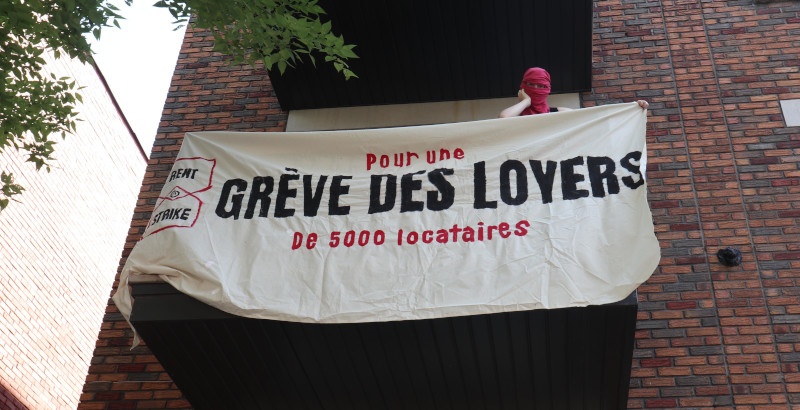
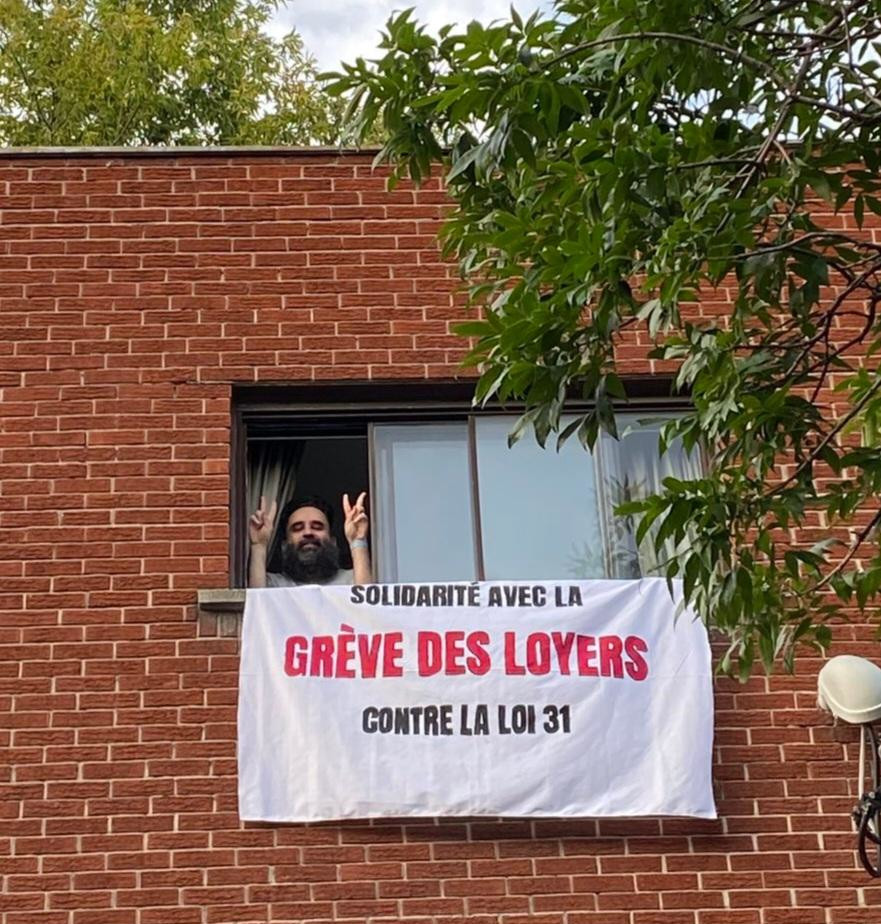
The banner on balconies (or signs on windows) would be a process of people putting banners on their balconies “Against Bill 31 / For a general rent strike” This is a good mobilizational tactic overall against Bill 31, and would encourage people to learn about the rent strike. Flyering outside metro stations, tabling, social media, and banner making events, are being used to encourage people to hang banners from their balcony or put signs in their windows.
Strike meetings would be meetings of people have filled out the pledge. We plan to announce our first strike meeting of people who have filled out the pledge soon. They will occur regularly come September, with a major strike assembly once 1,000 pledges are received, and another major assembly once 4,000 is reached. Strike meetings would be used to coordinate 1) flyering 2) tabling & banner dropping 3) social media sharing 4) workshops on rent striking 5) postering 6) neighbourhood, street, and building organizing to discuss Bill 31 and the increasing cost of rent 7) when the strike is closer, reconfirmation with people who’ve signed the pledge form that they are still interested in going on rent strike through a phone call campaign. Strike captains and committees for each Montreal neighbourhood will be organized at these assemblies. Once the strike starts the strike meetings would be responsible for coordinating mutual aid among strikers, raising strike funds to pay interest and court costs, and targeting landlords and tribunals trying to evict tenants.
Popular education forms will be help regularly to inform people about the strike in greater detail, answer popular questions, and share information about future events.
A Strike fund which we plan to release soon will be designed to support tenants who are on strike facing eviction proceedings. It will also be used to assist tenants facing harassment or antagonism from their landlord because they are strike supporters before and during the strike.
But what if I’m the only tenant under my landlord on rent strike? Even with 5,000 people on rent strike, there will be some tenants under landlords without neighbours on strike. The purpose of the strike meetings would be to coordinate building organizing and street organizing in the case of duplexes and triplexes so that people can draw in their neighbours. It is much easier to convince neighbours to withhold rent if they know it is a city-wide movement and if hundreds of people have banners on their balconies against Bill 31. Even if you are alone, rent strikes, including during COVID, have often had individual tenants joining thousands of others on strike without their neighbours necessarily being involved. The legal protections remain the same (as long as you pay rent before a judge can give a decision, it is much harder to evict you, especially for the first month). With 5,000 and more people on rent strike, it would also clog the tribunal system significantly. It might take a few months before a hearing. Landlords would also be afraid to file for eviction. If they did, the strike committee would hear about it and organize actions against any landlord who tries to evict during the rent strike. Actions could also be organized at the TAL to condemn the eviction process. If the worst does come, which we doubt it would, the strike committee would have funds to help pay for moving costs, legal fees, and possibly subsidize some rent.
What if people don’t actually go on rent strikebut have pledged to? This is subject to continued discussion but one important thing would be a calling campaign. If 5,000 pledges is reached, we will call a general assembly to prepare for the strike. Strikers will then coordinate a call campaign to confirm with people before if they’re still interested in a rent strike now that it is a real possibility. So long as 5,000 people are still ready and willing, the rent strike will move forward at an appropriate 1st of the following month (so long as there is ample time to prepare). It would be expected that many more people may join the rent strike if it goes on into a second month.
The History of Rent Strikes and Going Up Against Power “Alone”
The victory of Toronto’s 2017 rent strike of 300 tenants against MetCap Living has set an important example for how rent strikes can achieve much more than our court system will give. Rent strikes continue to unfold in Toronto, with another 300 tenants on rent strikes reported in May of this year. With other recent examples in cities like Los Angeles, it is inarguable that rent strikes are our best chance at collectively winning major concessions.
The concern here is that the rent strike we are proposing would cover a variety of different landlords. Using our model, even if we are encouraging and assisting building organizing, it is very possible that some tenants will be the only tenant on strike against their specific landlord. However, this is not uncommon in the history of successful rent strikes.
In fact, studying the history of notable rent strikes suggests that a mass of tenants striking against a single common landlord as in Parkdale is an exception. Rent strikes have often been generalized social movements against a variety of landlords. Crimethinc’s short history of rent strikes is available here.
COVID-19 is a perfect example of thousands of tenants in different cities going on spontaneous rent strike. Our union has several examples of Montreal tenants solo-ing rent strikes and succeeding during the pandemic (and, in fact, several tenants who have solo-ed rent strikes after the heat of the pandemic, without a broader context of organizing, and won). In the US, for instance, a landlord association estimated 31 percent of tenants went on rent strike for the month of March 2020. Parkdale Organize, which organized Toronto’s 2017 strike, also organized similar multi-landlord strikes. Keep Your Rent Toronto estimated 100,000 people used their forms to notify their landlord of their intention to withhold rent. These strikes succeeded in protecting tenants from having to pay during the heat of the pandemic, even in cities without eviction moratoriums. Strikers used systems of mutual aid, and mobbed court hearings of tenants from different buildings. These strikes had unity between strikers, despite not having the same landlord. This is to be expected when thousands of people are in the same rent-strike boat together.
Other examples come from strikes like Harlem’s 1963 rent strikes, the 1970s Italian auto-reduction movement, Barcelona’s rent strike in 1931, and Ireland’s land wars. In Harlem, for instance, tenants across over 50 buildings of dilapidated housing went on rent strike. One major victory came in the form of many tenants’ rent being temporarily set at $1/month. During Barcelona’s rent strike, tenants would blockade streets to prevent evictions, and break tenants back into their housing, making use of neighbourhood and worker committees.
In New York, eviction defence is currently a popular tool that has been used to stop the eviction of tenants. The most well-known examples are of tenants who have resisted through physical blockades outside of the tenants’ apartment. The blockades are defended by eviction defence networks, not usually other tenants of the same landlord. Although, much more illegal and less legally grey than rent strikes, this strategy of eviction defence has had huge success in New York and elsewhere.
In the worker and tenant sphere, wildcat strikes, boycotts, civil disobedience, refusals of unsafe work, and walkouts, and even strikes such as the Oakland 2011 general strike, have included people spontaneously and even lone-worker striking against specific or different employers or schools with the protection of a broader union or mass movement. In Montreal, you can visit the IWW if your employer is stealing your wages. The IWW can then mobilize their membership to call your employer. The union is leveraging the collective support of workers from a variety of workplaces to individual people who are otherwise alone in front of their boss. They have had a lot of success.
The benefit of our current moment is that, unlike during COVID-19, we have a few more months and weeks to plan the rent strike. We can organize neighbourhood committees to coordinate mutual aid and eviction defence. We can offer more escalation. We can also meet in person, and are more agile in our capacity to do street actions. Mass and neighbourhood meetings of everyone participating in the rent strike would actually be possible this time.
Legal Protections
It is not as though we are without legal protections while on rent strike. One protection that Quebec tenants have under Article 1883 of the Civil Code is exactly similar to the protection relied on by tenants who went on strike in Toronto in 2017. If a tenant had eviction proceedings opened against them, as long as they pay their rent back before a judge can render a decision they can avoid eviction. One tactic is to pay back all the outstanding rent on your court date. Other people get a non-profit or lawyer to hold the money in trust and to pay it on this date.
There are limitations to this legal strategy. We understand that frequent delay, if it causes serious damage to the owner, may constitute a legal reason which justifies the eviction of a tenant. For this reason it may be ideal to only do a rent strike for one month. This will be a decision of the strike assembly. We are making sure tenants and our members are familiar with this article.
Legal scholars, most notably Seema Shafei, have also argued for the right to rent strike as being incorporated within our constitutional right to strike or similar associational protections. Striking at work, for instance, is recognized as constitutionally protected.
Practical Protections
Above the legal protections, is the practical questions that will face a landlord if they try to evict a tenant on rent strike. If 5,000 people are on rent strike, able to coordinate and organize between one another, attempting to evict a tenant could be… well, difficult. If neighbourhood strike captains and the core strike committee is sufficiently organized, the public would become familiar with any landlord trying to evict a rent striking tenant. We would leverage the power of this mass to make it clear to each and every landlord that they should wait the strike out, instead of applying for eviction. A variety of street and collective actions have been used by SLAM to pressure landlords, and have had major success with much smaller groups.
Another practical protection is the flooding of the tribunals. Basically, it would be difficult, if not impossible, for the tribunals to quickly process 5,000 eviction requests. The hearings would take a lot longer to roll around than expected.
Just as during COVID-19, the landlord will also know that they can expect the rent back eventually. They know that their tenant otherwise makes their rent payments. Unlike the usual situation of eviction, the failure to pay rent is not financial but political. While there are many landlords who would love to evict their tenants for any reason, several landlords may keep a tenant knowing that they will pay their rent more regularly once the rent strike storm has rolled over.
Finally, while we have focused on the case of a tenant who is on rent strike without their neighbours, one of our principal efforts will be spreading rent strikes in buildings with willing tenants. Once one tenant in a building has pledged to go on rent strike, it is a lot easier to convince others. This is possible through the Montreal tenants’ union usual strategy of building and street organizing (organizing common meetings, door-knockings, one-on-ones), and because there will be more optimism around rent striking if you know 5,000 other people, and at least one neighbour are on rent strike. Banners on balconies, street demos, and news coverage, would also inspire increased confidence. If several tenants in a building are on rent strike, the logic of “But I can’t possibly evict all of them at once!” (to quote a landlord during the COVID-19 strikes) applies to a landlord.
Low Participation
There is the possibility of low participation in the rent strike. This is really only a concern for the organizers of the strike, rather than the sympathizers. If 5,000 tenants do not pledge to go on strike, then there simply would be no strike. We would conduct a phone and text message campaign if 5,000 is reached to also confirm that there is continued interest and the 5,000 pledges is not some phantom figure. However, even if 5,000 strikers is not reached, the popular education, flyering, information sharing, the threat of a potential strike to the government, will not disappear. In fact, if 5,000 strikers is not reached, we will still have done a job of spreading knowledge and comfort with tactics of resistance. While failing to get a strike vote can be demoralizing, they can also be excellent opportunities for spreading popular education and training new organizers. While we do not like elected officials, launching a campaign that is likely to not succeed entirely has been used with success by political parties to gradually build a base. But again, success or failure at hitting 5,000 pledges, this is a concern for the organizers, not other tenants.
Once 5,000 people have both pledged and confirmed their interest in a rent strike, if the strike lasts longer than a month (a decision up to neighbourhood committees and the strikers’ assembly), we can certainly expect more tenants’ to join. Every strike we are familiar with significantly increased their numbers in their second month of striking.
But Still, is a Rent Strike Risky?
There are certainly risks with going on rent strike. It is imaginable that the tactics above don’t work, that government repression is too strong against the strike, that the legal protections in place fall through, and several if not several dozen people are evicted. It is possible that relationships of tenants with their landlords take a turn for the worst, or that landlords act outside the bounds of legality or manipulate their legal privileges in response. These are possibilities. We have highlighted above many reasons why we think these possibilities can be mitigated. However, what is probable, going forward… actually, what is almost certain… is that without an organized tenant movement taking risks, using bold tactics, Montreal will be the next Toronto and Vancouver. Our rents will outpace our incomes, the elderly and poor will be harassed and evicted from their units. Homelessness will continue to increase. In ten years, our current rents will seem like a pipe dream. This is all to say, we are balancing competing risks: the risk of bold action versus the risk of inaction. Both could mean eviction, gentrification, poverty, and displacement. For the reasons we highlighted above, we believe taking our chance can lead to huge reward. We can seriously mitigate the risks. It is possible, in fact precedented, that 5,000 people go on rent strike and no one is evicted. The risks we are taking are for a better world and to avoid the risks of a worse one.
People involved in the strike are not professionals. That should be clear. The union has long-time organizers from different milieus. However, they don’t accept the responsibility of housing professionals. Their goal is to offer a tactic to the tenants’ movement: the rent strike. If it is accepted by tenants in the city, we will try our hardest using some of the tactics and goalposts above. But, whatever is done will be up to the tenants involved. The union will help organize the assemblies, popular education, and actions. As in every uprising, though, the union won’t be responsible for every success or mistake made along the way. During the 2012 student uprising in Quebec, over 3,000 people were arrested, people faced disciplinary measures from their university, serious injuries were suffered, and over 400 people faced criminal charges. We can’t say that the 2012 strike organizers were responsible for this repression. We can’t even say that it was “worth it.” All we can say is that sometimes people stand up, accept the risks or ignore them. These are decisions made by mature people. They are risks necessary to social progress that every social movement takes.
Conclusion
Thank you for reading through the proposal for a 2023 Montreal general rent strike. Here are ways the tenant union suggests in which you can support the work towards a strike:
You can join our tenants’ union in calling for your strike and add your name to the organizations encouraging a Montreal rent strike. To do so, email us at: slam.matu@protonmail.com
Easiest: You can share our Facebook events, especially the upcoming event on “Why & How” to go on rent strike against Bill 31 (Saturday, Aug 19th, 12pm to 2pm). At the moment, our Facebook game could use a boost.
You can join us at our upcoming event on “Why & How” to go on rent strike against Bill 31. It will be at Parc Lafontaine, Saturday, August 19th, from 12pm to 2pm at the corner of Sherbrooke/Panet. There will be a BBQ!
You can hang a banner from your balcony: We have extra banners, email slam.matu@protonmail.com to get your hands on one.
Share your events with us and we will share them among our members and strikers and invite them to join. We hope to show up as contingents to the upcoming mobilizations against Bill 31.
The above text is not an official SLAM publication. It is a re-editted letter received by many radical organizations explaining the strike.