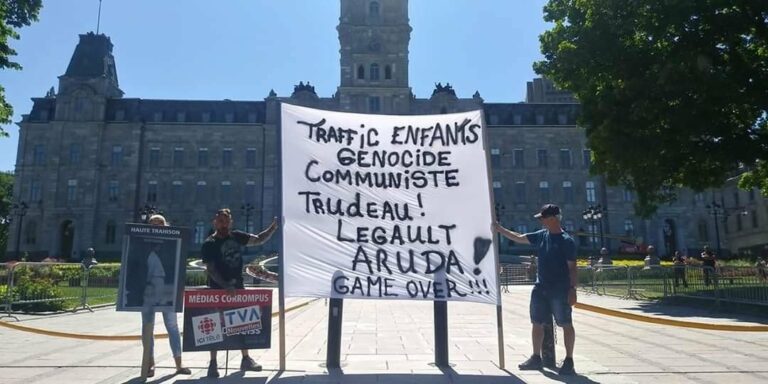
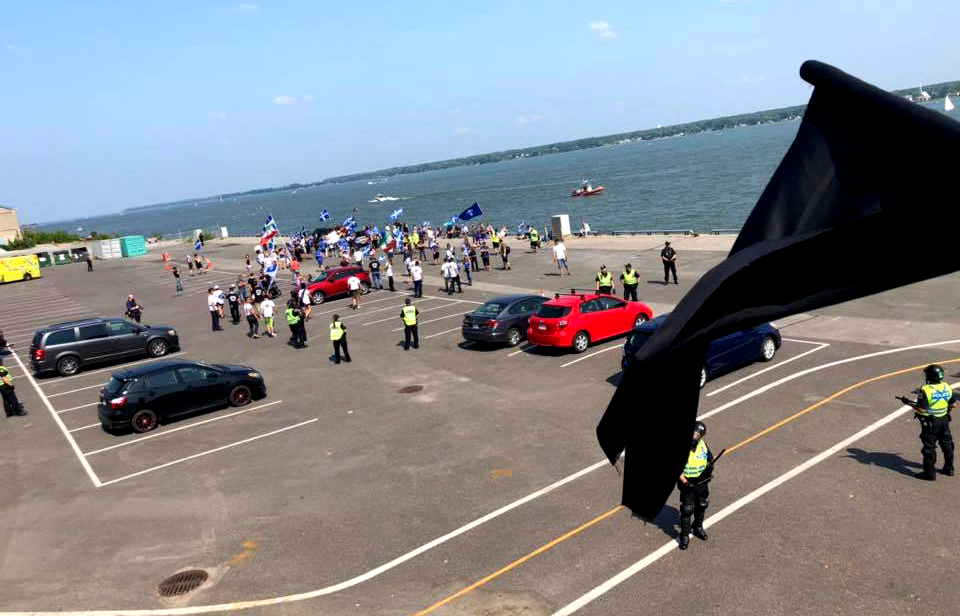
In 2019, the far right in Québec was a lot quieter than it had been in 2018 and 2017, the year that Montréal Antifasciste was formed. There are a number of reasons for this: the CAQ taking power in October 2018 demobilized a certain number of members in the organized groups, who found themselves with a government that was at least partially sympathetic to their identitarian demands (of course, this is not to in any way suggest that these far-right ideas and currents have magically disappeared); major internal conflicts that had been building for some time finally exploded in the past year, particularly within La Meute but also within various groupuscules, including the Gardiens du Québec (LGDQ) and Groupe Sécurité Patriote (GSP), destabilizing the most important and best structured groups; taking advantage of the weakening of the key groups, a certain number of marginal figures and “problematic leaders” (for example, Pierre Dion of the Quebec “Gilets jaunes” (Yellow Vests), Luc Desjardins and Michel Meunier of LGDQ, as well as other distasteful individuals like Diane Blain) have played a more important role, further discrediting and demobilizing the national-populist far right; the sustained work of antifascists in identifying ad denouncing the more radical elements, meaning, the full-on fascists and neo-Nazis in Québec’s far right, which doubtless took the wind out of the sails of part of the base supporting Atalante and the alt-right groupuscules; the antiracist and antifascist movement also continued its sustained mobilization against the national-populist current, particularly what was its key vehicle throughout 2019, the Vague bleue. The decline in activity on Québec’s far right doesn’t signal a victory for antifascist forces. To the contrary, with a majority populist government in the Assemblée Nationale, a government that moved rapidly in its first year in power to pass the racist Bill 21 on state secularism, as well as gagging debate to adopt a variety of anti-immigrant measures, it is reasonable to postulate that the right-wing forces are simply taking a breather, because they feel they’ve achieved some of their main goals. That said, the relative calm has been an opportunity for us to do the work necessary to deepen and refine our analysis, which has led us to define two broad tendencies on the far right. (For more, see Between National Populism and Neofascism: The State of the Far Right in Québec in 2019 .) ...