
Call of the East journal No. 1
The new Appel de l’Est journal! Read it, print it and spread it! English version if you would like copies for your group or city, write to the information committee: appeldelest-info@riseup.net
The new Appel de l’Est journal! Read it, print it and spread it! English version if you would like copies for your group or city, write to the information committee: appeldelest-info@riseup.net
To read: english | 8.5×11″ | PDF To print: english/français | 11×17″ | PDF
(…) Perhaps the words of Fallon, Amélie, and Carlos will inspire you to build friendships based on trust and affinity, to have each others’ backs, and to translate your own rage against the world of prisons and police and borders into actions. As Carlos “El Chivo” wrote, “I know that anarchist solidarity is strong like an oak tree, and that always goes farther than simple words.” And as anarchists everywhere never cease to remind us: it’s easy to attack. Somewhere between Mexico City and Montréal, March 2014. ...

...
Paper copies available at L’Insoumise , 1407 and La Belle Époque . English version to read online Printable version english-french 11"x17"
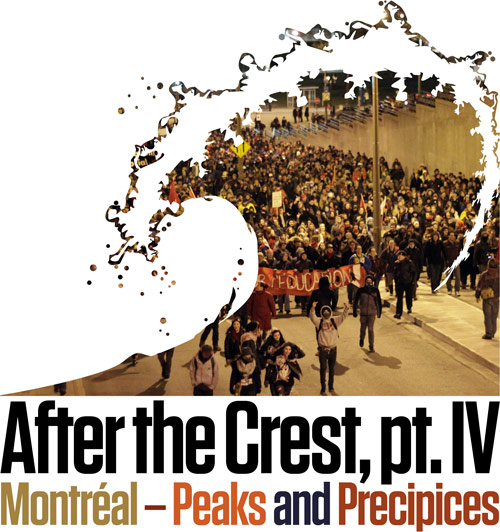
This is the final installment in our “After the Crest” series exploring how to navigate the waning phase of social movements. It is a personal reflection on anarchist participation in the 2012 student strike in Montréal and the disruptions that accompanied it. The product of much collective discussion, this article explores the opportunities anarchists missed during the high point of the conflict by limiting themselves to the framework of the strike, and the risks they incurred by attempting to maintain it once it had entered a reformist endgame. ...

Beginnings I. Anarchist ideas are not dead things, to be viewed as a logical conclusion of certain ideas of justice, equality or “humanity.” There is no logical series, no precise and irrefutable argument that must convince a rational person. It is a certain relation to power, a certain disgust at authority and its pretensions, a certain sensitivity to the coercions of daily life that inform and inspire these explorations. That to a degree one must want to be anarchist, look toward revolt, have a desire to act and a feel for the immediate, a will for domination to not merely be resented but actively opposed—toward an eradication of guilt and other emotional forms of social control. That without these inclinations no logic would suffice to convince anybody, and that even if it did, enough belief in certain abstract ideas remains nothing but abstract as long as one does not engage with those other ideas through all parts of her awareness, in every aspect of her life, in defiance of the fear that is the final wall protecting society from all our passions, all our charged will. ...

Read - Print (8.5"x11") What I refer to as the “CL(ASSE)” is the CLASSE (La Coalition large de l’Association pour une Solidarité Syndicale Étudiante) and the post-CLASSE ASSÉ (l’Association pour une Solidarité Syndicale Étudiante). Although distinct in a few ways (several mandates and associations) the one dissolved into the other, and can not be discussed separately. Following the strike, many ‘radicals’ have taken to elaborating how the CL(ASSE) accomplished an assumed what . Its form is praised, its content misunderstood and its function left at “victory.” I. Content ...

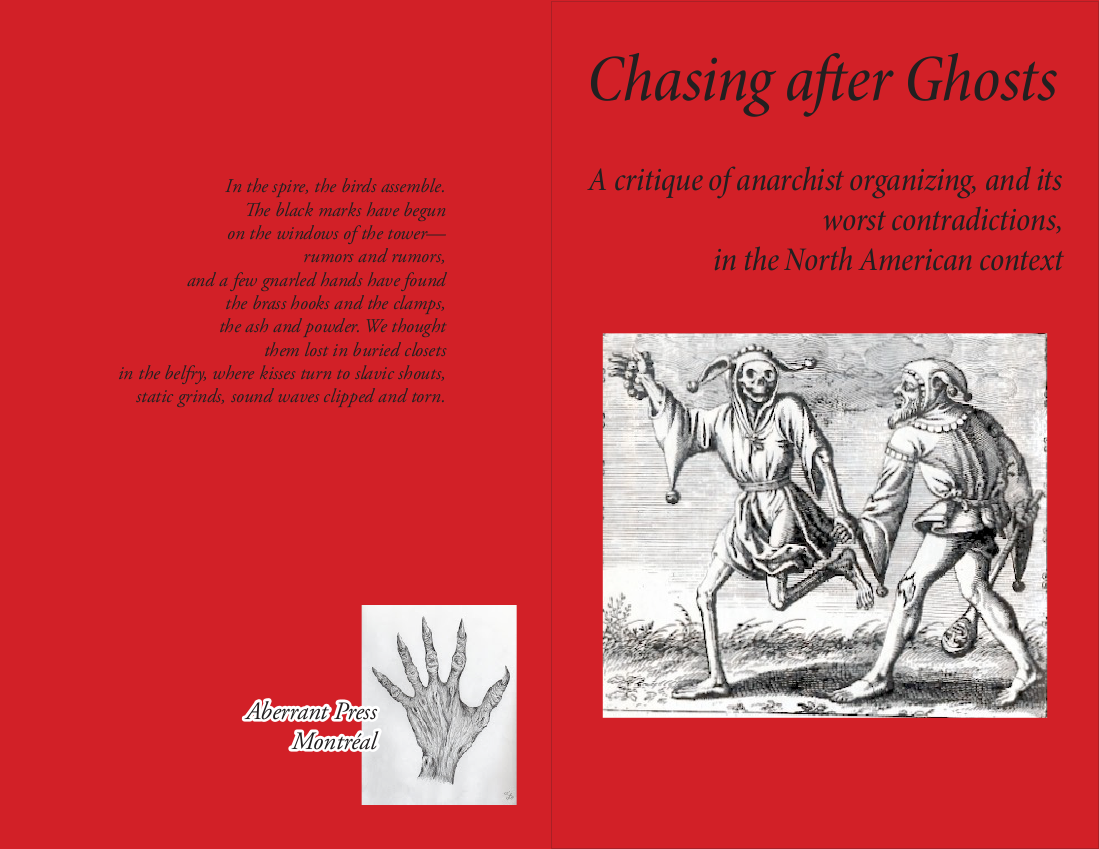
Print-format zine (8.5"x11") The thrust of this critique is not pointed towards individual convictions, ideas and desires. As always, the greater the scope of our generalizations, the more exceptions we leave outside. These are responses to general trends and tendencies observed in the North American anarchist milieu. (United States and Canada - because there is a context that exists that is more than the addition of these two countries, but that is, of course, quite different in Mexico.) It is quite likely that many of these trends do exist elsewhere in the world, as do many products of American culture. That being said, I believe that many of these tendencies are particularly North American, even if their resonance is felt beyond these borders. Many of these statements and points have been said elsewhere, at different times and by different voices. The point lies that critiques ill-heard bear repeating. Will some be offended, feel targeted? I hope that if this is the case, those offended will not take their indignation as an excuse to throw this piece in the garbage, to rail against it. We are already too few, and too isolated. Yet no numbers or figures could be justification for silence. Cooperation and camaraderie in struggle become meaningless if they are conditional on thin-lipped nodding and pats on the back, if they refuse reflection and debate. Forgive the assumption, but we did not become anarchists in an effort to seek support and acceptance on all sides, to paint glue over cracks and inconsistencies. To be cliché, radical means seeking out the roots of any problem, situation, social or political form. If we cannot see aspects of society that are reproduced in our own circles, then any attempt at radical change is hopeless, no matter how large or how militant. That, or the more radical consequences of the anarchist project will be taken up by others before they are taken up by anarchists themselves. Of course, this is already happening, as it has happened before. Lastly, if your response to this text is merely, ‘but we’re working hard!’ then accept the response that any good boss will give you. ‘Work harder.’ Openings I. ...

“The moment where we take back our lives, where we free ourselves from morality, fear, and the identities imposed on us. It cannot be stopped by a negotiation table, nor a ballot box. It isn’t the beginning of a movement nor will it die with a movement: It is to be alive, free, and wild!” ...