14401063651_d0e4b69166_b

In response to 'The Religion of Green Anarchy'

In ’ The religion of green anarchy’, the author continually refers to their ideas of what “green anarchism” is about without referring to where exactly these ideas are stated. There is not a single quote from a green anarchist journal or book in the essay, nor is there any reference to what texts the author has or has not read dealing with green anarchy. If the author’s idea of green anarchy is based on conversations with individuals at land defense camps, it would be good to say so – in this case the critique becomes more about “how some people interpret green anarchy” then about green anarchy in its totality. This essay takes a large and complex tangle of ideas that have been evolving since at least the 80’s[1.For example, the Earth First Journal characterizes EF as having had multiple stages, and characterizes their evolution as realizing the inter-relationship between social and ecological struggles. See 25th anniversary special issue.], and simplifies them into a caricature (‘the morality of pure wilderness’) that neglects most of the theory that makes green anarchist thought and its associated currents worth reading in the first place. I would also suspect that this may be why Green and Black review did not respond to the essay. ...

August 25, 2017 · mtlcounter-info
14401063651_d0e4b69166_b

The religion of green anarchy

This text was originally sent to Black and Green Review. They never responded. Disclaimer—in North America, which is my context, land defense struggles are often from indigenous perspectives, and they are struggles based on reclaiming or defending land from the state. I can only speak from a settler perspective, and my critique is specifically of land defense through a futurist lens and the deification of nature as it is practiced by settlers in North America. ...

May 6, 2017 · mtlcounter-info
miseenpratique

Putting into practice: adding to the conversation on anarchist activity in Montreal

Download and Print Here We’d like to respond with our thoughts to a text Mise en Commun (Putting in Common) that has been circulated critiquing insurrectionary projects and perspectives in Montreal. We appreciate that the authors of Mise en Common want to elaborate similarities and clarify differences, and move past bad faith. We’re taking this as an occasion to respond and to clarify ideas that we’ve been reflecting on for a few years now. We’ll try to use points of difference with Mise en Commun as an opportunity to delve further into ideas and how they inform practices, rather than limiting the scope of our text to simply addressing the critiques. We recognize that the length of this text might not facilitate a simple back-and-forth with the original authors, but our goal is to contribute to a larger discussion about these questions. We hope others will feel compelled to participate in this process of clarifying ideas and directions. ...

March 13, 2017 · Anonymous submission
6842780324_99f4a57bb2_b

In response to "Dear comrades in the streets"

Why do you insist on organizing within or in parallel of larger demos, or given symbolic dates? Moments when not only do you know the attacks from police will come because the whole repressive apparatus will be organized, coordinated, deployed and empowered by their laws and technology, but where you will also be reminded to watch your backs for the hostile masses in the street (have you not seen yet, the masses ready to trample you under their fear?), the whole amalgam of leftists who want to maintain and manage domination alternatively, the snitches, and the paciflics* as we call them in Montreal, already setting yourself up in a kettle between cops and citizens, more so than on a normal day. ...

May 12, 2014 · mtlcounter-info
Vivredecombat-read

Vivre de combat: a critique of CL(ASSE)

Read - Print (8.5"x11") What I refer to as the “CL(ASSE)” is the CLASSE (La Coalition large de l’Association pour une Solidarité Syndicale Étudiante) and the post-CLASSE ASSÉ (l’Association pour une Solidarité Syndicale Étudiante). Although distinct in a few ways (several mandates and associations) the one dissolved into the other, and can not be discussed separately. Following the strike, many ‘radicals’ have taken to elaborating how the CL(ASSE) accomplished an assumed what . Its form is praised, its content misunderstood and its function left at “victory.” I. Content ...

February 4, 2013 · mtlcounter-info
chasing

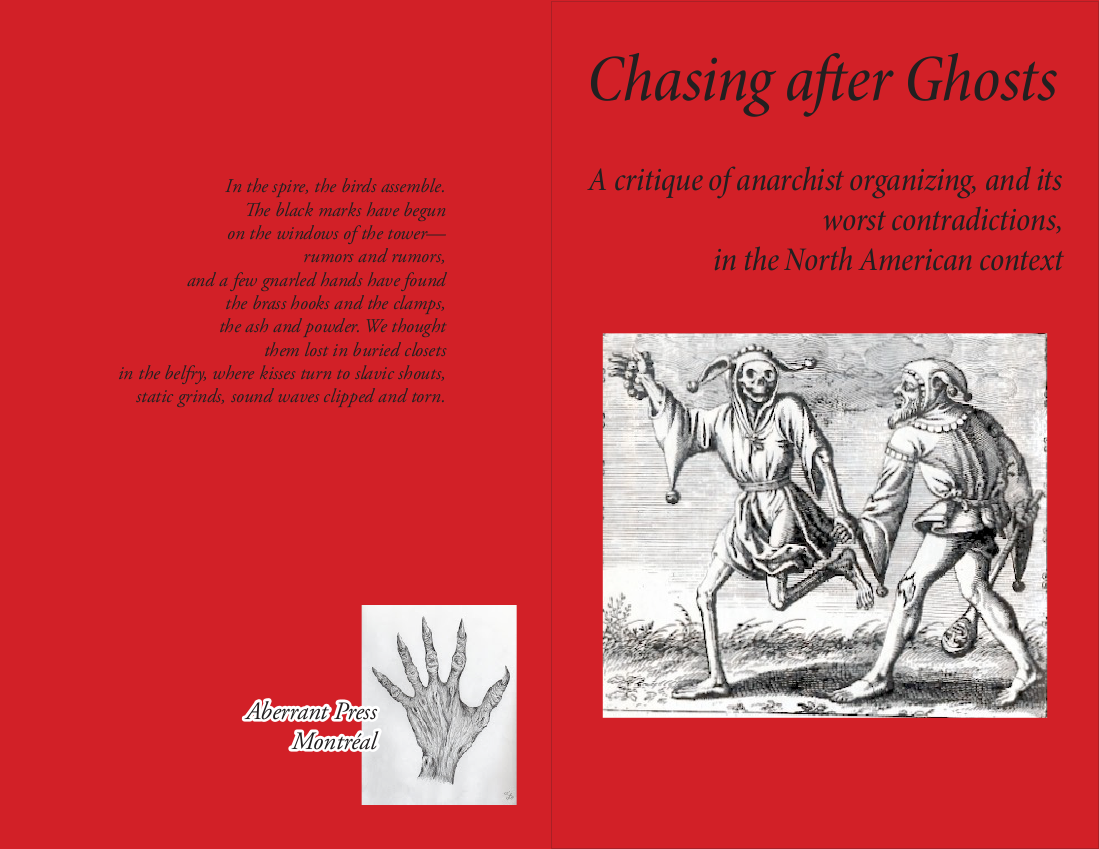
Chasing after Ghosts: a Critique of anarchist organizing, and its worst contradictions, in the American context

Print-format zine (8.5"x11") The thrust of this critique is not pointed towards individual convictions, ideas and desires. As always, the greater the scope of our generalizations, the more exceptions we leave outside. These are responses to general trends and tendencies observed in the North American anarchist milieu. (United States and Canada - because there is a context that exists that is more than the addition of these two countries, but that is, of course, quite different in Mexico.) It is quite likely that many of these trends do exist elsewhere in the world, as do many products of American culture. That being said, I believe that many of these tendencies are particularly North American, even if their resonance is felt beyond these borders. Many of these statements and points have been said elsewhere, at different times and by different voices. The point lies that critiques ill-heard bear repeating. Will some be offended, feel targeted? I hope that if this is the case, those offended will not take their indignation as an excuse to throw this piece in the garbage, to rail against it. We are already too few, and too isolated. Yet no numbers or figures could be justification for silence. Cooperation and camaraderie in struggle become meaningless if they are conditional on thin-lipped nodding and pats on the back, if they refuse reflection and debate. Forgive the assumption, but we did not become anarchists in an effort to seek support and acceptance on all sides, to paint glue over cracks and inconsistencies. To be cliché, radical means seeking out the roots of any problem, situation, social or political form. If we cannot see aspects of society that are reproduced in our own circles, then any attempt at radical change is hopeless, no matter how large or how militant. That, or the more radical consequences of the anarchist project will be taken up by others before they are taken up by anarchists themselves. Of course, this is already happening, as it has happened before. Lastly, if your response to this text is merely, ‘but we’re working hard!’ then accept the response that any good boss will give you. ‘Work harder.’ Openings I. ...

December 18, 2012 · mtlcounter-info